Paper I — Q1
(a) Obtain Norton equivalent circuit at terminals ab of the coupled circuit shown in the figure. Using it, find out the current…
Obtain Norton equivalent circuit at terminals ab of the coupled circuit shown in the figure. Using it, find out the current passing through 5 Ω resistor connected between the terminals ab. 10 marks
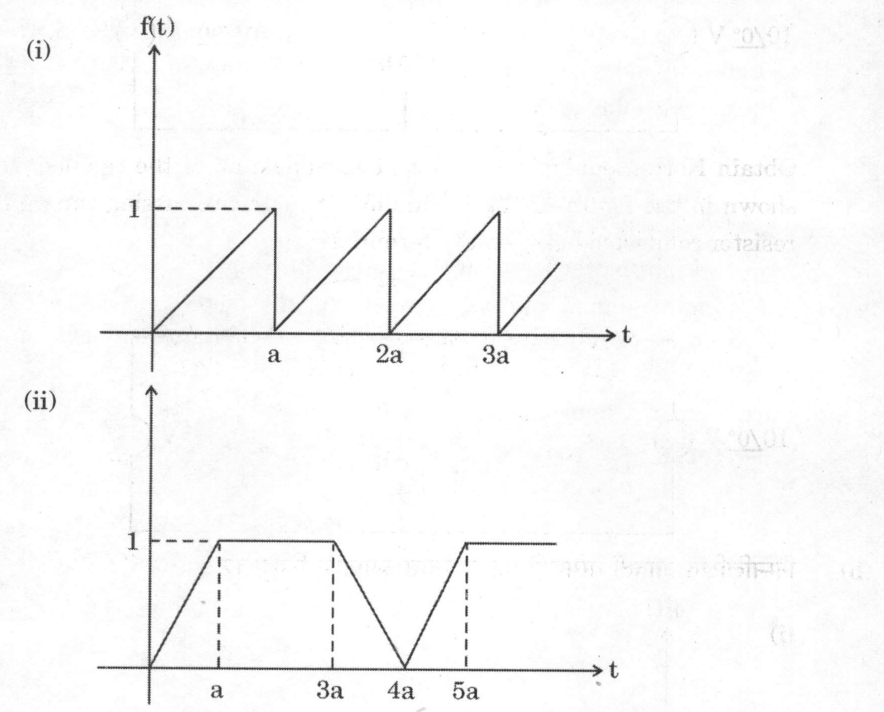
Obtain the Laplace transform of the following periodic waveforms : (10 marks) (i) (ii)
A 3-phase, 50 Hz, star-connected cage-type induction motor has standstill input impedance of (1·0 + j 3·0) Ω per phase. The motor is connected through a cable from 400 V, 3-phase balanced supply so that the blocked rotor voltage at its terminal is dropped by 20% from the supplied voltage. The motor is to be started through a DOL starter from the same supply and cable as above. Find : (i) the cable impedance per phase, (ii) the motor starting current, (iii) input power factor at the time of starting. (Assume negligible stator impedance of the motor and cable R/X ratio of 3 : 1 at 50 Hz supply. Also ignore magnetizing current and core losses.) 10 marks
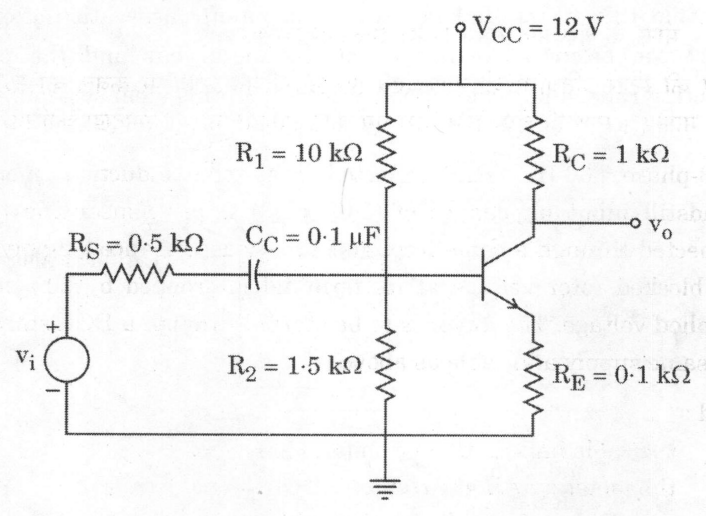
Calculate the lower corner frequency for the circuit shown below. Take transistor parameters as : β = 100, V_BE = 0·7 V and V_A = ∞. (10 marks) V_CC = 12 V, R_1 = 10 kΩ, R_S = 0·5 kΩ, C_C = 0·1 μF, R_2 = 1·5 kΩ, R_C = 1 kΩ, R_E = 0·1 kΩ
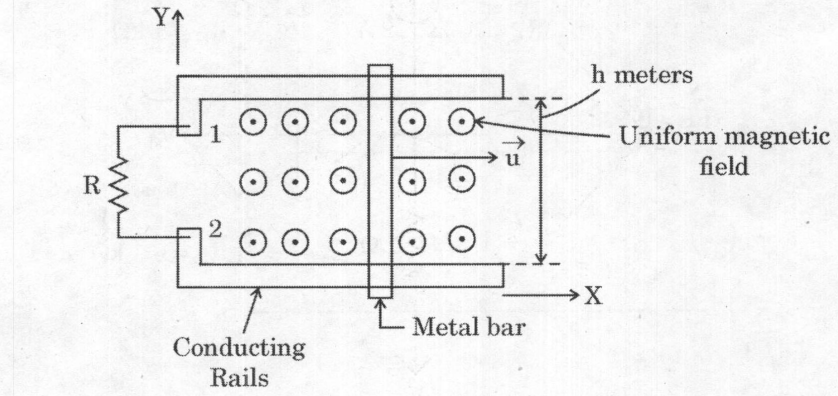
A metal bar slides over a pair of conducting rails in a uniform magnetic field B⃗ = a⃗_z B_0 Wb/m² with a constant velocity u⃗ m/s as shown below in the figure. A resistance 'R' Ω is connected between terminals 1 and 2. Prove that this system upholds the principle of conservation of energy. Neglect the electrical resistance of the metal bar and the pair of conducting rails, and the mechanical friction of this ideal system. 10 marks
हिंदी में प्रश्न पढ़ें
चित्र में दर्शाए गए युग्मित परिपथ का ab अन्तस्थों पर नॉर्टन समतुल्य परिपथ निकालिए । उसका उपयोग करते हुए, ab अन्तस्थों के मध्य जुड़े 5 Ω के प्रतिरोधक से प्रवाहित होने वाली धारा ज्ञात कीजिए । (10 अंक)
निम्नलिखित आवर्ती तरंगरूपों का लाप्लास रूपांतरण निकालिए : (10 अंक) (i) (ii)
एक त्रि-कला, 50 Hz तारा-संयोजित पंजर प्रेरण मोटर की विराम निवेश प्रतिबाधा (1·0 + j 3·0) Ω प्रति कला है । यह मोटर 400 V, त्रि-कला संतुलित विद्युत प्रदाय से केबल के माध्यम से जोड़ी गई है जिससे इसके सिरे पर अवरोधित घूर्णक बोल्टता संभरण बोल्टता से 20% कम हो । इस मोटर को उपयुक्त संभरण बोल्टता एवं केबल द्वारा एक DOL स्टार्टर के माध्यम से शुरु किया जाना है । ज्ञात कीजिए : (i) केबल की प्रतिबाधा प्रति कला, (ii) मोटर की आरंभिक धारा, (iii) मोटर के शुरू होते समय निवेश शक्ति गुणांक । (मोटर की स्टेटर प्रतिबाधा को नगण्य एवं 50 Hz विद्युत प्रदाय पर केबल का R/X अनुपात 3 : 1 मानिए । साथ ही चुंबकीय धारा एवं क्रोड हानियों को भी अनदेखा कीजिए ।) (10 अंक)
नीचे दर्शाए गए परिपथ के लिए निम्न कोणा आवृत्ति निकालिए । ट्रांजिस्टर के प्राचल निम्नानुसार हैं : β = 100, V_BE = 0·7 V एवं V_A = ∞ । (10 अंक)
चित्र में दर्शाए अनुसार एकसमान चुंबकीय क्षेत्र B⃗ = a⃗_z B_0 Wb/m² में एक धातु पट्टी एक सुचालक रेल के जोड़े के ऊपर अचर बेग u⃗ m/s से फिसलती है । अंतस्थ 1 और 2 के मध्य एक प्रतिरोध 'R' Ω जुड़ा है । सिद्ध कीजिए कि यह तंत्र ऊर्जा संरक्षण के सिद्धांत का अनुमोदन करता है । धातु पट्टी एवं सुचालक रेल के जोड़े के विद्युतीय प्रतिरोध तथा इस आदर्श तंत्र के यांत्रिक घर्षण को अनदेखा कीजिए । (10 अंक)

The figures printed on the question paper
Cut from the original 2023 Electrical Engineering paper, exactly as the candidates in the hall saw them.
The figure this question refers to, in words
The question paper is a scan and the diagram did not survive as text. This is the figure as read from the original page — every component, value and label — so the question can be worked from the text below.
(a) A circuit diagram featuring two voltage sources and coupled inductors. On the left, a voltage source of 10∠0° V is connected in series with a 4 Ω resistor. This connects to a node marked with a dot, which is the start of an inductor with impedance j8 Ω. On the right, a voltage source of 10∠90° V is connected in series with a 2 Ω resistor. This connects to a node marked with a dot, which is the start of an inductor with impedance j4 Ω. The two inductors are magnetically coupled with a mutual impedance of j5 Ω, indicated by an arc connecting the two dotted nodes. The other ends of the j8 Ω and j4 Ω inductors are connected together at a central node. Terminal 'a' is connected to this central node. Terminal 'b' is connected to the common bottom wire that links the negative terminals of both voltage sources.
(b) A circuit diagram showing four switches labeled SW1, SW2, SW3, and SW4. Each switch is connected in series with a 5 V voltage source (represented by a resistor symbol with a 5 V label). The other ends of the switches are connected to a common ground. The voltage sources are connected to the input of a block labeled 'Logic Circuit'. The output of the logic circuit is labeled X. Below the diagram, a caption reads: (SW1, SW2, SW3, SW4 : Switch 1, Switch 2, Switch 3, Switch 4).
(c) Circuit diagram showing a two-port network. On the left, a voltage source labeled V_S1 with positive terminal up is connected in series with the input port of a rectangular box labeled 'Network'. The current entering the top terminal of the network is labeled I_1. On the right, a voltage source labeled V_S2 with positive terminal up is connected in series with the output port of the network. The current entering the top terminal of the network from the right side is labeled I_2. The bottom terminals of both sources and the network are connected by a common wire.
Below the circuit is a table with 5 rows and 5 columns. Header row: (empty), V_S1 Volts, V_S2 Volts, I_1 Amp, I_2 Amp Row 1: Experiment 1, 100, 50, 5, -30 Row 2: Experiment 2, 50, 100, -20, -5 Row 3: Experiment 3, 25, 0, -, - Row 4: Experiment 4, -, -, 5, 0
(d) A BJT common-emitter amplifier circuit. A DC voltage source V_CC = 12 V is connected to the top rail. A voltage divider bias network consists of resistor R_1 = 10 kΩ connected between V_CC and the base, and resistor R_2 = 1.5 kΩ connected between the base and ground. The collector is connected to V_CC through a resistor R_C = 1 kΩ. The emitter is connected to ground through a resistor R_E = 0.1 kΩ. The output voltage v_o is taken at the collector. The input signal v_i is connected in series with a source resistance R_S = 0.5 kΩ and a coupling capacitor C_C = 0.1 μF, which connects to the base of the transistor. The transistor is an NPN type.
(e) A 2D diagram showing a metal bar sliding on a pair of horizontal conducting rails. The setup is in the X-Y plane. The rails are connected on the left side to a resistor labeled 'R'. The terminals of the resistor are labeled '1' (top) and '2' (bottom). A vertical metal bar bridges the two rails and is shown moving to the right with a velocity vector labeled 'u'. The distance between the rails is labeled 'h meters'. The region between the rails is filled with circles containing dots, representing a uniform magnetic field directed out of the page, labeled 'Uniform magnetic field'. The X-axis points to the right, and the Y-axis points up.
What "Solve" is asking you to do
Choose the method, then carry it through to a final answer. Identifying what kind of problem this is and why that method applies is the first thing marked; a correct figure arrived at invisibly earns almost nothing.
Structure that answers it
Given data and what is required → method chosen, with the reason it applies → set-up (equation, circuit, free body, trial balance) → working, step by step → answer with units and any condition of validity
Where marks are lost
Doing the middle steps mentally and writing only the result. In mathematics papers, a further loss comes from giving a decimal where the exact value in surds or fractions was wanted, or from skipping the justification a part explicitly asks for.
How this answer will be evaluated
Approach
(a) calculate: given > formula > substitution > result with units > interpretation | (b) calculate: given > formula > substitution > result with units > interpretation | (c) calculate: given > formula > substitution > result with units > interpretation | (d) calculate: given > formula > substitution > result with units > interpretation | (e) justify: claim > 3-4 reasons > evidence > conclusion Full marks: Complete circuit models, correct derivations, all sub-parts solved with proper units and phasor diagrams where applicable.
Key points expected
- Redraw circuit with mutual inductance j5 Ω marked
- Calculate Norton current (short-circuit current) at ab
- Calculate Norton impedance (Thevenin impedance) at ab
- Compute load current using Norton equivalent
- Identify period T for each waveform
- Integrate one period to find F1(s)
- Apply periodic function formula F(s) = F1(s)/(1-e^-sT)
- Correct limits and function definition for each segment
Evaluation rubric
Each sub-part is marked on its own, against the marks and word limit printed on the paper.
- (a) Norton equivalent at terminals ab and current through 5 Ω load. 10 marks
calculate— given → formula → substitution → result with units → interpretation
Must cover
- Redraw circuit with mutual inductance j5 Ω marked
- Calculate Norton current (short-circuit current) at ab
- Calculate Norton impedance (Thevenin impedance) at ab
- Compute load current using Norton equivalent
Loses marks
- Sign error in mutual inductance voltage
- Missing Norton equivalent circuit diagram
- Formula application without circuit model
Earns more
- Correct handling of dot convention for coupled coils
- Phasor diagram of currents/voltages
- Verification via Thevenin equivalent
Extra mark
- Explicit KVL/KCL equations for mesh analysis
- (b) Laplace transform of two periodic waveforms (i) and (ii). 10 marks
calculate— given → formula → substitution → result with units → interpretation
Must cover
- Identify period T for each waveform
- Integrate one period to find F1(s)
- Apply periodic function formula F(s) = F1(s)/(1-e^-sT)
- Correct limits and function definition for each segment
Loses marks
- Incorrect period identification
- Missing division by (1-e^-sT)
- Integration errors in F1(s)
Earns more
- Step-by-step integration for ramp and constant segments
- Clear labeling of time intervals (0 to a, a to 3a, etc.)
Extra mark
- Alternative method using unit step functions
- (c) Cable impedance, starting current, and input power factor for DOL start. 10 marks
calculate— given → formula → substitution → result with units → interpretation
Must cover
- Calculate cable impedance using 20% voltage drop condition
- Apply R/X ratio of 3:1 to find cable R and X
- Calculate total impedance (cable + motor) for DOL start
- Compute starting current and power factor from total impedance
Loses marks
- Ignoring cable impedance in starting current calculation
- Incorrect R/X ratio application
- Confusing line and phase voltage
Earns more
- Per-phase equivalent circuit diagram
- Correct use of line-to-line vs phase voltage (400V line)
- Explicit calculation of cable R and X components
Extra mark
- Phasor diagram showing voltage drop across cable
- (d) Lower corner frequency of the common-emitter amplifier circuit. 10 marks
calculate— given → formula → substitution → result with units → interpretation
Must cover
- DC bias analysis to find Q-point (Ic, Vce)
- Calculate small-signal parameters (gm, rπ, re)
- Identify coupling and bypass capacitor effects
- Calculate lower corner frequency using dominant pole or Bode plot
Loses marks
- Missing DC bias calculation
- Incorrect small-signal model
- Ignoring effect of source resistance Rs
Earns more
- AC equivalent circuit with capacitors as impedances
- Correct calculation of input and output time constants
- Use of β=100 and VBE=0.7V in bias calculation
Extra mark
- Bode plot sketch showing lower corner frequency
- (e) Proof that the sliding bar system conserves energy. 10 marks
justify— claim → 3-4 reasons → evidence → conclusion
Must cover
- Calculate induced EMF (Blv) and current (E/R)
- Determine magnetic force on bar (BIL) opposing motion
- Calculate mechanical power input (F*v)
- Calculate electrical power dissipated (I²R) and show equality
Loses marks
- Missing force calculation (BIL)
- Incorrect power balance (mechanical vs electrical)
- Ignoring direction of induced current
Earns more
- Free body diagram of forces on the bar
- Circuit diagram showing induced EMF and current direction
- Explicit statement of Lenz's law application
Extra mark
- Energy flow diagram (mechanical to electrical)
Model answer coming soon
Every evaluation on this site is marked against a verified model answer. This question's answer is still being written; evaluation opens the moment it lands.
More from Electrical Engineering 2023 Paper I
- Q1 (a) Obtain Norton equivalent circuit at terminals ab of the coupled circuit shown in the…
- Q2 (a) For the circuit shown in the figure, obtain the value of voltage across 0·5 Ω and 2·5…
- Q3 (a) (i) Consider the shift register shown in the figure below, which is implemented using…
- Q4 (a) For the circuit shown below, early voltage V_A = ∞ and β = 100. Find the reverse satu…