Paper I — Q5
(a) A 400 V, 50 Hz, 3-phase star-connected cylindrical rotor synchronous motor has synchronous impedance of (0·5 + j 2·5) Ω per…
A 400 V, 50 Hz, 3-phase star-connected cylindrical rotor synchronous motor has synchronous impedance of (0·5 + j 2·5) Ω per phase. It develops a maximum power of 50 kW at rated terminal voltage. Find the excitation voltage, motor current and input power factor under maximum power condition. 10 marks
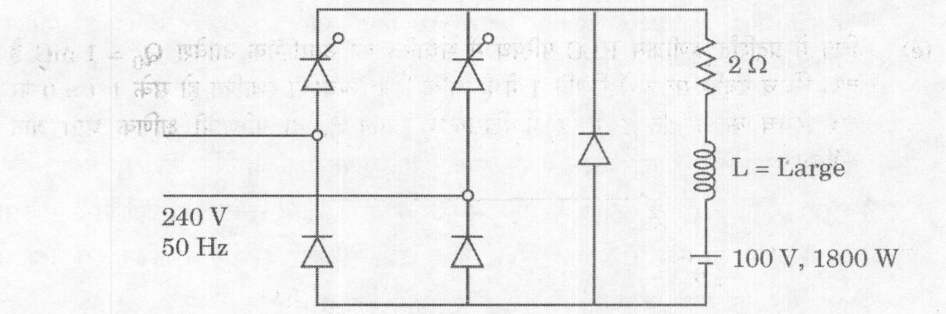
A half-controlled converter fed from 240 V, 50 Hz single-phase ac source is feeding 1800 W power to a 100 V battery as shown in the figure below. The battery is connected in series with a large inductance and a resistance of 2 Ω. The inductance is large enough to make the load current flat and continuous.
Find : the triggering angle of the thyristors,
rms value of fundamental component of converter input current, and
the input power factor in the ac side. (Assume the inductor has a resistance of 1 Ω) 10 marks
A signal x(t) is described as x(t) = (5/2) cos (160 × 10³ πt) + 7 cos (170 × 10³ πt) + (5/2) cos (180 × 10³ πt) Show that this is an Amplitude modulated signal. Find : the ratio Pₛ/Pc where Pₛ is power in side bands and Pc is power in carrier.
the power efficiency in this AM signal. 10 marks
When a transmission line of characteristic impedance 50 Ω is short-circuited at the termination, the voltage minima were found to be 25 cm apart. If the short circuit is replaced by unknown load impedance Z_L Ω, the minima shifted 8 cm towards the load and the standing wave ratio was found to be 4. Calculate the unknown load impedance Z_L. 10 marks
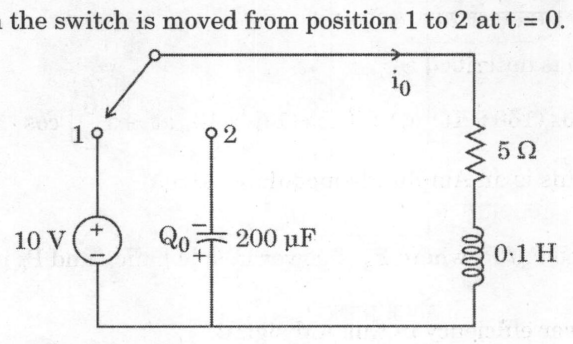
In the series RLC circuit shown in the figure, the capacitor has an initial charge Q_0 = 1 mC and the switch is in position 1 long enough to establish the steady state. Find the transient current which results when the switch is moved from position 1 to 2 at t = 0. 10 marks
हिंदी में प्रश्न पढ़ें
एक 400 V, 50 Hz, त्रि-कला तारा-संयोजित वृत्तीय घुर्णक तुल्यकालिक मोटर की तुल्यकालिक प्रतिबाधा (0·5 + j 2·5) Ω प्रति कला है । यह निर्धारित अन्तस्थ बोल्टता पर 50 kW की अधिकतम शक्ति उत्पन्न करती है । अधिकतम शक्ति की स्थिति में उत्तेजना बोल्टता, मोटर धारा तथा निवेश शक्ति गुणांक ज्ञात कीजिए । (10 अंक)
240 V, 50 Hz एकल-कला ए.सी. स्रोत द्वारा पोषित एक अर्ध-नियंत्रित परिवर्तक, एक 100 V की बैटरी को 1800 W शक्ति संभरित करता है, जैसा कि चित्र में प्रदर्शित है । बैटरी श्रेणीक्रम में एक विशाल प्रेरकत्व तथा एक 2 Ω के प्रतिरोध के साथ संयोजित है । प्रेरकत्व भार धारा को सपाट व सतत बनाने के लिए पर्याप्त बड़ा है ।
ज्ञात कीजिए : थायरिस्टर का उत्त्प्रेरण (ट्रिगर) कोण,
परिवर्तक की निवेश धारा के मूल घटक का rms मान, और
ac की तरफ निवेश शक्ति गुणांक । (मान लीजिए कि प्रेरक में 1 Ω प्रतिरोध है) (10 अंक)
एक संकेत x(t), x(t) = (5/2) cos (160 × 10³ πt) + 7 cos (170 × 10³ πt) + (5/2) cos (180 × 10³ πt) द्वारा वर्णित है । दर्शाइए कि यह एक आयाम मॉडुलित संकेत है । ज्ञात कीजिए : Pₛ/Pc का अनुपात, जहाँ Pₛ पार्श्व पट्टिका में शक्ति तथा Pc संवाहक में शक्ति है ।
इस AM संकेत में शक्ति दक्षता । (10 अंक)
जब 50 Ω लाक्षणिक प्रतिबाधा वाली एक पारेषण लाइन को अन्तस्थ पर लघु-परिपथित किया जाता है, तो बोल्टता के अल्पतमों की आपस में दूरी 25 cm पाई जाती है । यदि लघु परिपथ को एक अज्ञात भार प्रतिबाधा Z_L Ω से प्रतिस्थापित कर दिया जाता है, तो अल्पतम, भार की ओर 8 cm विस्थापित हो जाता है तथा अप्रगामी (स्थिर) तरंग अनुपात 4 पाया जाता है । अज्ञात भार प्रतिबाधा Z_L की गणना कीजिए । (10 अंक)
चित्र में प्रदर्शित श्रेणीक्रम RLC परिपथ में संधारित्र का आरम्भिक आवेश Q_0 = 1 mC है तथा स्विच पर्याप्त समय से स्थिति 1 में है ताकि स्थिर अवस्था स्थापित हो सके । t = 0 पर जब स्विच को स्थिति 1 से 2 में खिसकाया जाता है, तो परिणामी क्षणिक धारा ज्ञात कीजिए । (10 अंक)
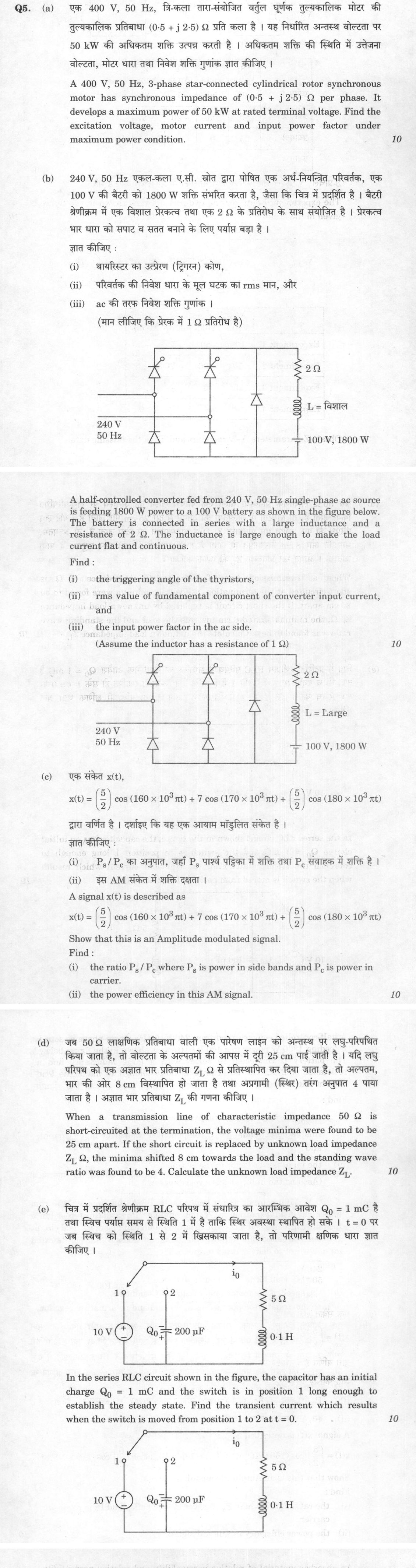
The figures printed on the question paper
Cut from the original 2023 Electrical Engineering paper, exactly as the candidates in the hall saw them.
The figure this question refers to, in words
The question paper is a scan and the diagram did not survive as text. This is the figure as read from the original page — every component, value and label — so the question can be worked from the text below.
(b) Circuit diagram of a single-phase half-controlled rectifier. The AC source is labeled '240 V, 50 Hz'. The rectifier bridge consists of two thyristors (labeled with gate symbols) on the top and bottom left, and two diodes on the top and bottom right. The DC output side is connected to a series load consisting of a resistor labeled '2 Ω', an inductor labeled 'L = Large', and a DC voltage source (battery) labeled '100 V, 1800 W'. The battery polarity is positive at the top.
(c) Circuit diagram: A two-port network represented by a central rectangular box labeled 'Network'. The left port is connected to a voltage source labeled V_S1 with positive polarity at the top. The current entering the top terminal of the network is labeled I_1 with an arrow pointing right. The right port is connected to a voltage source labeled V_S2 with positive polarity at the top. The current entering the top terminal of the network from the right is labeled I_2 with an arrow pointing left. The bottom terminals of both sources and the network are connected by a common wire.
Table: A table with 5 rows and 5 columns. Header Row: [Empty], V_S1 Volts, V_S2 Volts, I_1 Amp, I_2 Amp Row 1: Experiment 1, 100, 50, 5, -30 Row 2: Experiment 2, 50, 100, -20, -5 Row 3: Experiment 3, 25, 0, -, - Row 4: Experiment 4, -, -, 5, 0
(e) A circuit diagram showing a single-pole double-throw switch. The common terminal of the switch is connected to the top of a series branch containing a 5 Ohm resistor and a 0.1 H inductor. The bottom of the inductor is connected to a common ground line. The switch has two positions, labeled 1 and 2. Position 1 connects the common terminal to the positive terminal of a 10 V DC voltage source, whose negative terminal is connected to the ground line. Position 2 connects the common terminal to the top plate of a 200 uF capacitor, whose bottom plate is connected to the ground line. The capacitor is labeled with an initial charge Q0, with the top plate marked positive and the bottom plate marked negative. The current flowing from the switch towards the resistor is labeled i0.
What "Solve" is asking you to do
Choose the method, then carry it through to a final answer. Identifying what kind of problem this is and why that method applies is the first thing marked; a correct figure arrived at invisibly earns almost nothing.
Structure that answers it
Given data and what is required → method chosen, with the reason it applies → set-up (equation, circuit, free body, trial balance) → working, step by step → answer with units and any condition of validity
Where marks are lost
Doing the middle steps mentally and writing only the result. In mathematics papers, a further loss comes from giving a decimal where the exact value in surds or fractions was wanted, or from skipping the justification a part explicitly asks for.
How this answer will be evaluated
Approach
(a) calculate: given > formula > substitution > result with units > interpretation | (b) calculate: given > formula > substitution > result with units > interpretation | (c) calculate: given > formula > substitution > result with units > interpretation | (d) calculate: given > formula > substitution > result with units > interpretation | (e) calculate: given > formula > substitution > result with units > interpretation Full marks: Complete phasor/circuit analysis with correct units and verification steps
Key points expected
- Convert line voltage to phase voltage (400/√3 V)
- Apply maximum power condition (δ = 90°)
- Calculate current using phasor equation (Ea - Vt)/Zs
- Determine power factor from current phase angle
- Calculate load current from power and voltage (1800W/100V)
- Determine average output voltage from load circuit equation
- Solve for firing angle α using Vavg = 2Vmax cosα / π
- Calculate fundamental current and power factor
Evaluation rubric
Each sub-part is marked on its own, against the marks and word limit printed on the paper.
- (a) Determine excitation voltage, motor current, and input power factor at maximum power. 10 marks
calculate— given → formula → substitution → result with units → interpretation
Must cover
- Convert line voltage to phase voltage (400/√3 V)
- Apply maximum power condition (δ = 90°)
- Calculate current using phasor equation (Ea - Vt)/Zs
- Determine power factor from current phase angle
Loses marks
- Uses line voltage instead of phase voltage
- Ignores resistance component of impedance
Earns more
- Draws phasor diagram showing Vt, Ea, and Ia
- Calculates power angle δ explicitly
Extra mark
- Verifies result using power formula P = 3VtEa sinδ / Zs
- (b) Find thyristor triggering angle, fundamental current RMS, and input power factor. 10 marks
calculate— given → formula → substitution → result with units → interpretation
Must cover
- Calculate load current from power and voltage (1800W/100V)
- Determine average output voltage from load circuit equation
- Solve for firing angle α using Vavg = 2Vmax cosα / π
- Calculate fundamental current and power factor
Loses marks
- Ignores inductor resistance in load calculation
- Uses peak voltage instead of RMS in power equation
Earns more
- Draws converter circuit with current waveforms
- Calculates total RMS current for comparison
Extra mark
- Calculates displacement factor separately
- (c) Show signal is AM and find sideband-to-carrier power ratio and efficiency. 10 marks
calculate— given → formula → substitution → result with units → interpretation
Must cover
- Identify carrier and sideband frequencies from x(t)
- Calculate power in carrier and sidebands
- Determine modulation index m from amplitudes
- Calculate power efficiency using standard AM formula
Loses marks
- Confuses amplitude with power in calculations
- Incorrectly identifies carrier frequency
Earns more
- Sketches AM waveform showing modulation
- Shows frequency spectrum diagram
Extra mark
- Calculates total transmitted power
- (d) Calculate unknown load impedance from standing wave measurements. 10 marks
calculate— given → formula → substitution → result with units → interpretation
Must cover
- Calculate wavelength from minima spacing (2 × 25 cm)
- Determine reflection coefficient magnitude from SWR
- Calculate phase shift from 8 cm displacement
- Compute load impedance using Smith chart or formula
Loses marks
- Confuses voltage minima with maxima positions
- Incorrect sign in phase angle calculation
Earns more
- Uses Smith chart for impedance transformation
- Shows reflection coefficient in polar form
Extra mark
- Verifies result by calculating new SWR
- (e) Find transient current in series RLC circuit after switching. 10 marks
calculate— given → formula → substitution → result with units → interpretation
Must cover
- Determine initial conditions (Vc0, iL0) at t=0
- Calculate circuit parameters (α, ω0, ωd)
- Identify damping type (underdamped, critical, overdamped)
- Write complete transient current expression
Loses marks
- Incorrect initial conditions at switching instant
- Wrong characteristic equation for RLC circuit
Earns more
- Draws circuit for t > 0 with initial conditions
- Calculates damping ratio ζ
Extra mark
- Plots current waveform showing transient behavior
Model answer coming soon
Every evaluation on this site is marked against a verified model answer. This question's answer is still being written; evaluation opens the moment it lands.
More from Electrical Engineering 2023 Paper I
- Q2 (a) For the circuit shown in the figure, obtain the value of voltage across 0·5 Ω and 2·5…
- Q3 (a) (i) Consider the shift register shown in the figure below, which is implemented using…
- Q4 (a) For the circuit shown below, early voltage V_A = ∞ and β = 100. Find the reverse satu…
- Q5 (a) A 400 V, 50 Hz, 3-phase star-connected cylindrical rotor synchronous motor has synchr…
- Q6 (a) A 200 V, 1100 rpm, dc shunt motor takes 1·5 A and runs at 1150 rpm under no load cond…
- Q7 (a) A 400 V, 3-phase, 50 Hz, star-connected synchronous motor has per phase synchronous i…
- Q8 (a) A 415 V, 4-pole, 3-phase, 50 Hz, star-connected squirrel cage induction motor has per…