Paper I — Q2
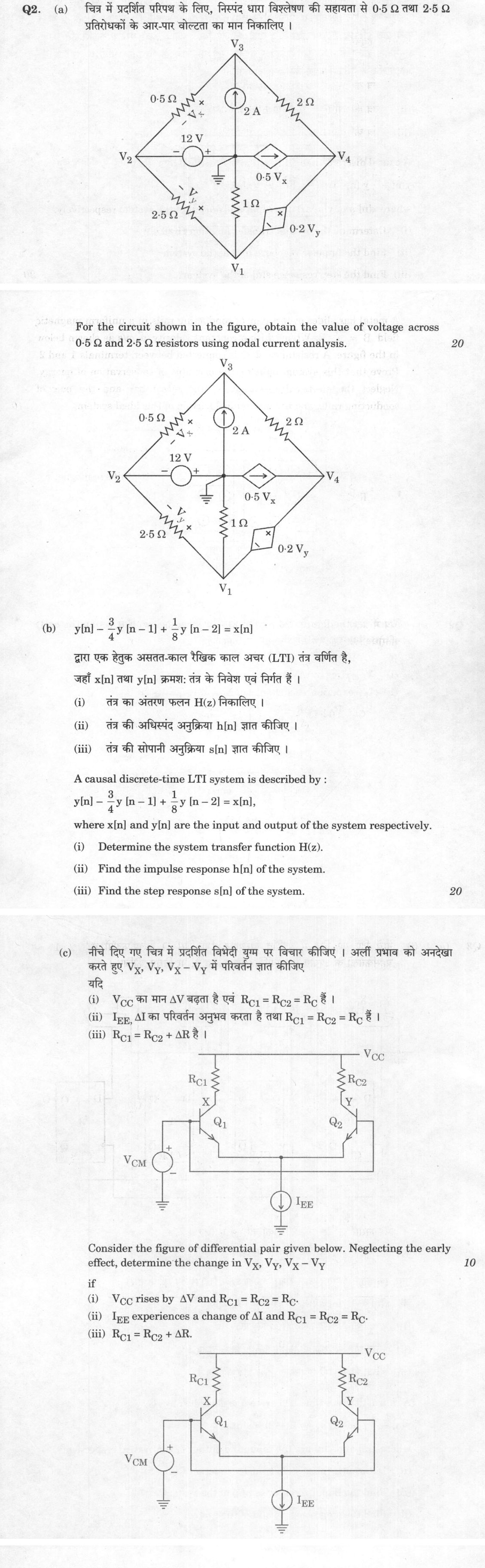
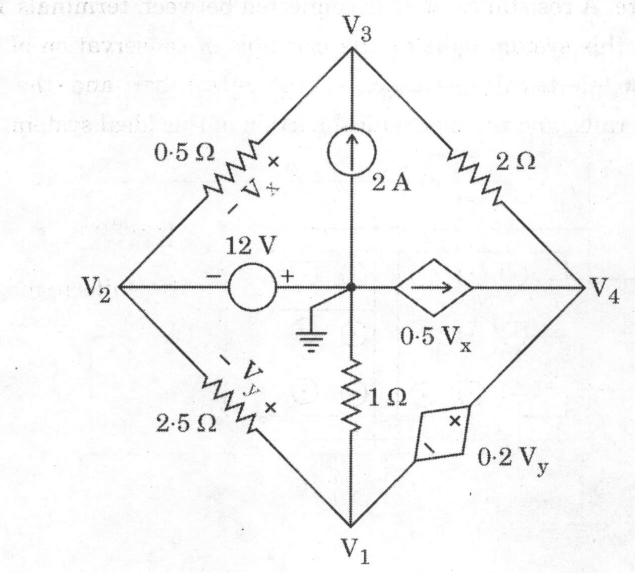
(a) For the circuit shown in the figure, obtain the value of voltage across 0·5 Ω and 2·5 Ω resistors using nodal current…
For the circuit shown in the figure, obtain the value of voltage across 0·5 Ω and 2·5 Ω resistors using nodal current analysis. 20 marks
A causal discrete-time LTI system is described by : y[n] − (3/4)y[n−1] + (1/8)y[n−2] = x[n], where x[n] and y[n] are the input and output of the system respectively. (i) Determine the system transfer function H(z). (ii) Find the impulse response h[n] of the system. (iii) Find the step response s[n] of the system. 20 marks
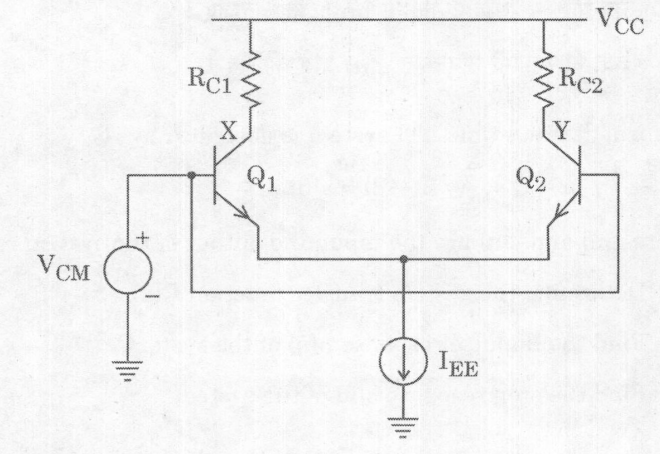
Consider the figure of differential pair given below. Neglecting the early effect, determine the change in V_X, V_Y, V_X - V_Y if (i) V_CC rises by ΔV and R_C1 = R_C2 = R_C. (ii) I_EE experiences a change of ΔI and R_C1 = R_C2 = R_C. (iii) R_C1 = R_C2 + ΔR. 10 marks
हिंदी में प्रश्न पढ़ें
चित्र में प्रदर्शित परिपथ के लिए, निस्पंद धारा विस्लेषण की सहायता से 0.5 Ω तथा 2.5 Ω प्रतिरोधकों के आर-पार वोल्टता का मान निकालिए । (20 अंक)
y[n] − (3/4)y[n−1] + (1/8)y[n−2] = x[n] द्वारा एक हेतुक असतत-काल रैखिक काल अचर (LTI) तंत्र वर्णित है, जहाँ x[n] तथा y[n] क्रमशः तंत्र के निवेश एवं निर्गत हैं । (i) तंत्र का अंतरण फलन H(z) निकालिए । (ii) तंत्र की अधिस्पंद अनुक्रिया h[n] ज्ञात कीजिए । (iii) तंत्र की सोपानी अनुक्रिया s[n] ज्ञात कीजिए । (20 अंक)
नीचे दिए गए चित्र में प्रदर्शित विभेदी युग्म पर विचार कीजिए । अर्ली प्रभाव को अनदेखा करते हुए V_X, V_Y, V_X - V_Y में परिवर्तन ज्ञात कीजिए यदि (i) V_CC का मान ΔV बढ़ता है एवं R_C1 = R_C2 = R_C है । (ii) I_EE, ΔI का परिवर्तन अनुभव करता है तथा R_C1 = R_C2 = R_C है । (iii) R_C1 = R_C2 + ΔR है । (10 अंक)
The figures printed on the question paper
Cut from the original 2023 Electrical Engineering paper, exactly as the candidates in the hall saw them.
The figure this question refers to, in words
The question paper is a scan and the diagram did not survive as text. This is the figure as read from the original page — every component, value and label — so the question can be worked from the text below.
(a) A bridge circuit with nodes V1 (bottom), V2 (left), V3 (top), V4 (right). Branch V2-V3: 0.5 ohm resistor with current Ix (arrow down-right). Branch V3-V4: 2 ohm resistor. Branch V2-V1: 2.5 ohm resistor with current Iy (arrow down-right). Branch V1-V4: 1 ohm resistor in series with a dependent voltage source 0.2 Vy (polarity: + at V1 side). A 12 V source (polarity: - at V2, + at center) between V2 and the center node. A 2 A current source (arrow up) between center and V3. A dependent voltage source 0.5 Vx (polarity: + at center, - at V4) between center and V4. The center node is grounded.
Model answer
Written by UPSC Answer Check against this question's marking rubric, to the expected length. UPSC does not publish answers for Mains — this is one way to score well, not an official key.
(a) Let the center node be the reference at 0 V. The 12 V source has its negative terminal at V2 and positive at the center, so V2 = −12 V.
The 0.5 Ω resistor is between V3 and V4, with its current arrow down-right from V3 to V4. Let Vx = V3 − V4. The dependent source 0.5 Vx has + at the center and − at V4, so 0 − V4 = 0.5 Vx = 0.5(V3 − V4). Hence V4 = −V3.
The 2.5 Ω resistor is between V2 and V1, with current arrow down-right from V2 to V1, so let Vy = V2 − V1.
Nodal analysis at V3: currents leaving towards V2 and V4, and towards the center. The 2 A source arrow up from center to V3 means 2 A enters V3, so −2 A leaves V3. (V3 − V2)/2 + (V3 − V4)/0.5 − 2 = 0. Substitute V2 = −12 V and V4 = −V3: (V3 + 12)/2 + (V3 + V3)/0.5 − 2 = 0 0.5V3 + 6 + 4V3 − 2 = 0 4.5V3 + 4 = 0 ⇒ V3 = −8/9 V. Thus V4 = −V3 = 8/9 V. Vx = V3 − V4 = −8/9 − 8/9 = −16/9 V. So the voltage across the 0.5 Ω resistor is |Vx| = 16/9 V ≈ 1.78 V, with V4 positive with respect to V3 by 16/9 V.
Nodal analysis at V1: branches to V2 and to V4 through 1 Ω in series with dependent source 0.2 Vy, whose + terminal is at V1. (V1 − V2)/2.5 + (V1 − V4 − 0.2 Vy)/1 = 0. With Vy = V2 − V1 = −12 − V1: (V1 + 12)/2.5 + V1 − V4 − 0.2(−12 − V1) = 0 0.4V1 + 4.8 + V1 − V4 + 2.4 + 0.2V1 = 0 1.6V1 + 7.2 − V4 = 0 ⇒ V4 = 1.6V1 + 7.2. Set V4 = 8/9: 1.6V1 = 8/9 − 7.2 = 8/9 − 36/5 = (40 − 324)/45 = −284/45 V1 = (−284/45)/(8/5) = −71/18 V. Then Vy = −12 − (−71/18) = −145/18 V. Voltage across the 2.5 Ω resistor is |Vy| = 145/18 V ≈ 8.06 V, with V1 positive with respect to V2 by 145/18 V.
Final answers for (a): Voltage across 0.5 Ω resistor = 16/9 V ≈ 1.78 V Voltage across 2.5 Ω resistor = 145/18 V ≈ 8.06 V
(b) (i) Taking the Z-transform with zero initial conditions: Y(z) − (3/4)z⁻¹Y(z) + (1/8)z⁻²Y(z) = X(z). Thus H(z) = Y(z)/X(z) = 1/[1 − (3/4)z⁻¹ + (1/8)z⁻²] = z²/[(z − 1/2)(z − 1/4)]. H(z) = z²/[(z − 1/2)(z − 1/4)], ROC |z| > 1/2.
(ii) For the impulse response, write H(z)/z = z/[(z − 1/2)(z − 1/4)] = 2/(z − 1/2) − 1/(z − 1/4). Inverse Z-transform with ROC |z| > 1/2: h[n] = [2(1/2)ⁿ − (1/4)ⁿ]u[n]. h[n] = [2(1/2)ⁿ − (1/4)ⁿ]u[n].
(iii) For the step response, X(z) = z/(z − 1). Therefore S(z) = H(z)X(z) = z³/[(z − 1/2)(z − 1/4)(z − 1)]. S(z)/z = z²/[(z − 1/2)(z − 1/4)(z − 1)] = −2/(z − 1/2) + (1/3)/(z − 1/4) + (8/3)/(z − 1). Inverse Z-transform: s[n] = [−2(1/2)ⁿ + (1/3)(1/4)ⁿ + 8/3]u[n]. s[n] = [8/3 − 2(1/2)ⁿ + (1/3)(1/4)ⁿ]u[n].
(c) (i) V_CC rises by ΔV, with R_C1 = R_C2 = R_C: ΔV_X = ΔV, ΔV_Y = ΔV, Δ(V_X − V_Y) = 0. ΔV_X = ΔV, ΔV_Y = ΔV, Δ(V_X − V_Y) = 0.
(ii) I_EE changes by ΔI, with R_C1 = R_C2 = R_C: Each collector current changes by ΔI/2. ΔV_X = −(ΔI/2)R_C, ΔV_Y = −(ΔI/2)R_C, Δ(V_X − V_Y) = 0. ΔV_X = −(ΔI/2)R_C, ΔV_Y = −(ΔI/2)R_C, Δ(V_X − V_Y) = 0.
(iii) R_C1 = R_C2 + ΔR, with I_C1 = I_C2 = I_EE/2: ΔV_X = −(I_EE/2)ΔR, ΔV_Y = 0, Δ(V_X − V_Y) = −(I_EE/2)ΔR. ΔV_X = −(I_EE/2)ΔR, ΔV_Y = 0, Δ(V_X − V_Y) = −(I_EE/2)ΔR.
What "Solve" is asking you to do
Choose the method, then carry it through to a final answer. Identifying what kind of problem this is and why that method applies is the first thing marked; a correct figure arrived at invisibly earns almost nothing.
Structure that answers it
Given data and what is required → method chosen, with the reason it applies → set-up (equation, circuit, free body, trial balance) → working, step by step → answer with units and any condition of validity
Where marks are lost
Doing the middle steps mentally and writing only the result. In mathematics papers, a further loss comes from giving a decimal where the exact value in surds or fractions was wanted, or from skipping the justification a part explicitly asks for.
How this answer will be evaluated
Approach
(a) calculate: given > formula > substitution > result with units > interpretation | (b(i)) calculate: given > formula > substitution > result with units > interpretation | (b(ii)) calculate: given > formula > substitution > result with units > interpretation | (b(iii)) calculate: given > formula > substitution > result with units > interpretation | (c) calculate: given > formula > substitution > result with units > interpretation Full marks: Complete nodal analysis with supernode; correct H(z), h[n], s[n] with ROC; all three differential pair cases with proper small-signal reasoning.
Key points expected
- Identify supernode formed by 12V source
- Formulate nodal equations for V1, V2, V3, V4
- Express dependent sources in terms of node voltages
- Solve system for node voltages
- Apply Z-transform to difference equation
- Express H(z) = Y(z)/X(z)
- Factor denominator polynomial
- Inverse Z-transform of H(z)
Evaluation rubric
Each sub-part is marked on its own, against the marks and word limit printed on the paper.
- (a) Voltage across 0.5 Ω and 2.5 Ω resistors via nodal analysis. 20 marks
calculate— given → formula → substitution → result with units → interpretation
Must cover
- Identify supernode formed by 12V source
- Formulate nodal equations for V1, V2, V3, V4
- Express dependent sources in terms of node voltages
- Solve system for node voltages
Loses marks
- Missing supernode constraint
- Sign errors in KCL equations
- Ignoring dependent source control variables
Earns more
- Correctly define Vx and Vy
- Show KCL at each node
- Verify power balance
Extra mark
- Redrawn circuit with labeled nodes
- (b(i)) System transfer function H(z).
calculate— given → formula → substitution → result with units → interpretation
Must cover
- Apply Z-transform to difference equation
- Express H(z) = Y(z)/X(z)
- Factor denominator polynomial
Loses marks
- Incorrect Z-transform of delayed terms
- Algebraic error in H(z) expression
Earns more
- State ROC for causality
- Show partial fraction setup
Extra mark
- Block diagram of system
- (b(ii)) Impulse response h[n] of the system.
calculate— given → formula → substitution → result with units → interpretation
Must cover
- Inverse Z-transform of H(z)
- Use partial fraction expansion
- Express h[n] in closed form
Loses marks
- Incorrect inverse transform
- Missing unit step u[n] in h[n]
Earns more
- Identify poles and residues
- Verify h[0] and h[1] values
Extra mark
- Plot of h[n] for first few n
- (b(iii)) Step response s[n] of the system.
calculate— given → formula → substitution → result with units → interpretation
Must cover
- Multiply H(z) by Z-transform of step
- Inverse Z-transform to find s[n]
- Express s[n] in closed form
Loses marks
- Incorrect multiplication in z-domain
- Algebraic error in inverse transform
Earns more
- Show s[n] = sum of h[k] for k<=n
- Verify steady-state value
Extra mark
- Plot of s[n] for first few n
- (c) Change in VX, VY, VX-VY for three perturbation cases. 10 marks
calculate— given → formula → substitution → result with units → interpretation
Must cover
- Analyze case (i): VCC change with matched RC
- Analyze case (ii): IEE change with matched RC
- Analyze case (iii): RC mismatch effect
- Neglect Early effect as instructed
Loses marks
- Ignoring Early effect
- Incorrect assumption of current splitting
- Missing differential output calculation
Earns more
- Use small-signal model
- Show symmetry arguments
- Express results in terms of ΔV, ΔI, ΔR
Extra mark
- Small-signal equivalent circuit
Practice this exact question
Write your answer and it is marked point by point against the model answer above — what you covered, what you missed, what you got wrong.
Evaluate my answer →More from Electrical Engineering 2023 Paper I
- Q1 (a) Obtain Norton equivalent circuit at terminals ab of the coupled circuit shown in the…
- Q2 (a) For the circuit shown in the figure, obtain the value of voltage across 0·5 Ω and 2·5…
- Q3 (a) (i) Consider the shift register shown in the figure below, which is implemented using…
- Q4 (a) For the circuit shown below, early voltage V_A = ∞ and β = 100. Find the reverse satu…
- Q5 (a) A 400 V, 50 Hz, 3-phase star-connected cylindrical rotor synchronous motor has synchr…