Paper I — Q6
(a) A 200 V, 1100 rpm, dc shunt motor takes 1·5 A and runs at 1150 rpm under no load condition at rated voltage. Its armature…
A 200 V, 1100 rpm, dc shunt motor takes 1·5 A and runs at 1150 rpm under no load condition at rated voltage. Its armature resistance including brushes is 0·5 Ω. While running under full load, its field circuit gets open circuited due to fault and the motor takes 5 times of its rated input current to deliver rated torque. Find : the full load torque of the machine, and
the speed of the motor under field fault condition. Assume no armature copper losses at no load and no armature reaction. 20 marks
An absorber material of relative permeability and relative permittivity of εᵣ = μᵣ = 6 – j6 is coated on a perfectly conducting sheet and this combination is placed in free space as shown in the figure given below. A 500 MHz wave is incident on it normally from free space. Calculate the thickness of the absorber required to attenuate the reflected wave by 30 dB. 20 marks
A 120 V, 1000 rpm, 350 W separately excited dc motor is supplied via half-controlled single-phase bridge rectifier for speed control purpose. The supply voltage to the rectifier is 200 V, 50 Hz ac and to obtain the desired speed, the triggering angle is set at 105° at one instant. The armature current is discontinuous with an average value of 2 A and it continues up to 30° beyond voltage zero. The motor armature resistance is 1·5 Ω. Determine the operating speed of the motor. (Assume constant flux operation and no armature reaction) 10 marks
हिंदी में प्रश्न पढ़ें
एक 200 V, 1100 rpm, dc समानांतर क्रम मोटर निर्धारित वोल्टता पर भार रहित अवस्था में 1150 rpm पर चलती है और 1·5 A लेती है। इसका ब्रश सहित आर्मेचर प्रतिरोध 0·5 Ω है। जब यह पूर्ण भार पर चल रही होती है, तो दोष के कारण इसकी क्षेत्र कुंडली खुले परिपथ में हो जाती है और मोटर निर्धारित बलाघूर्ण प्रदान करने के लिए, निर्धारित निवेश धारा से 5 गुना धारा लेती है। ज्ञात कीजिए : यंत्र का पूर्ण भार बलाघूर्ण, और
क्षेत्र दोष की अवस्था में मोटर की गति। मान लीजिए कि भार रहित अवस्था में आर्मेचर कॉपर हास नहीं हैं और आर्मेचर रिएक्शन भी नहीं है। (20 अंक)
एक शोषक पदार्थ जिसके सापेक्ष पारगम्यता और सापेक्ष परावैद्युतांक के मान εr = μr = 6 – j6 हैं, को एक आदर्श सुचालक पतर के ऊपर लेपित किया गया है और यह संयोजन, मुक्त अंतराल में रखा गया है जैसा कि चित्र में प्रदर्शित है। मुक्त अंतराल से एक 500 MHz की तरंग इस पर लम्बवत आपतित है। परावर्तित तरंग के 30 dB क्षीणन के लिए शोषक की वांछित मोटाई की गणना कीजिए। (20 अंक)
एक 120 V, 1000 rpm, 350 W अलग से उत्तेजित dc मोटर, गति नियंत्रण के उद्देश्य से अर्ध-नियंत्रित एकल-कला ब्रिज दिष्टकारी द्वारा संभारित है। दिष्टकारी के लिए संभारण वोल्टता 200 V, 50 Hz ac है और वांछित गति प्राप्त करने के लिए एक समय उत्त्प्रेरण (ट्रिगर) कोण 105° समायोजित किया गया है। आर्मेचर धारा औसत मान 2 A के साथ असतत है और यह वोल्टता शून्य के 30° परे तक निरंतर रहती है। मोटर आर्मेचर का प्रतिरोध 1·5 Ω है। मोटर की परिचालन गति ज्ञात कीजिए। (मान लीजिए कि स्थिर अभिवाह परिचालन है और आर्मेचर प्रतिक्रिया नहीं है) (10 अंक)
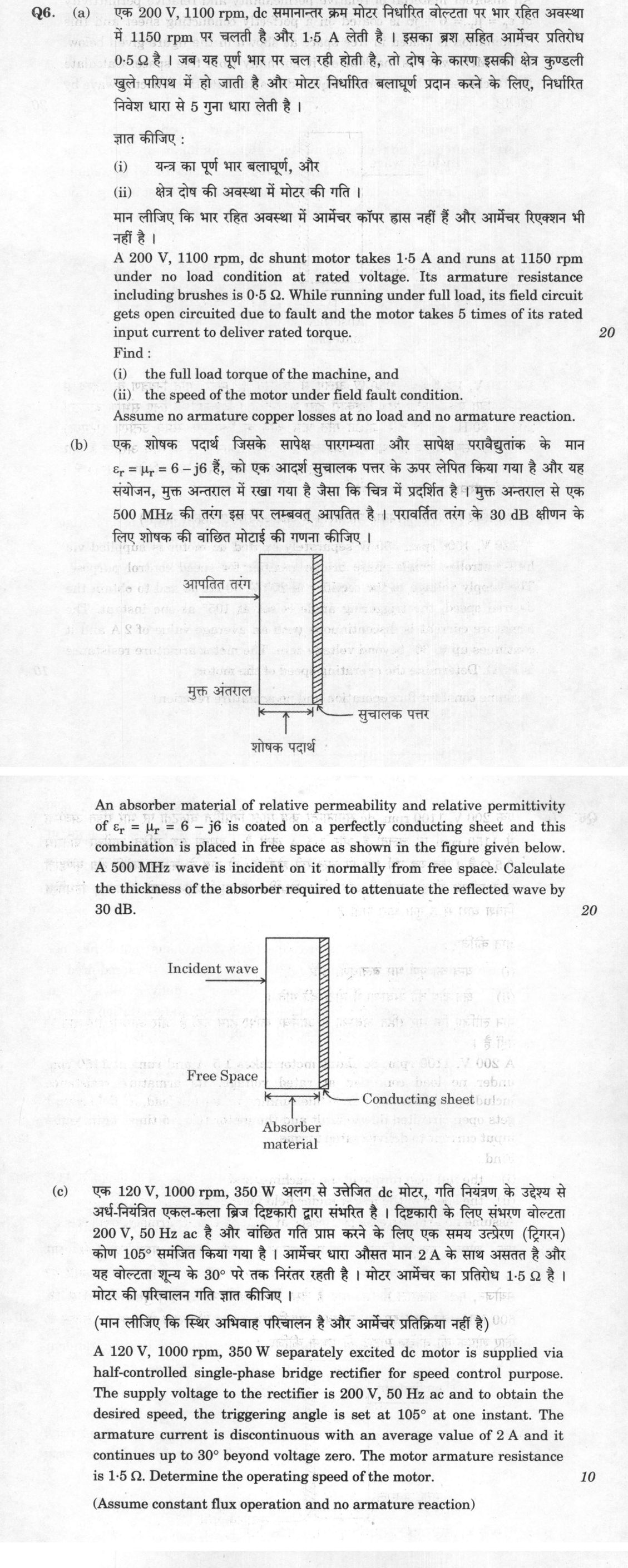
The figure printed on the question paper
Cut from the original 2023 Electrical Engineering paper, exactly as the candidates in the hall saw it.
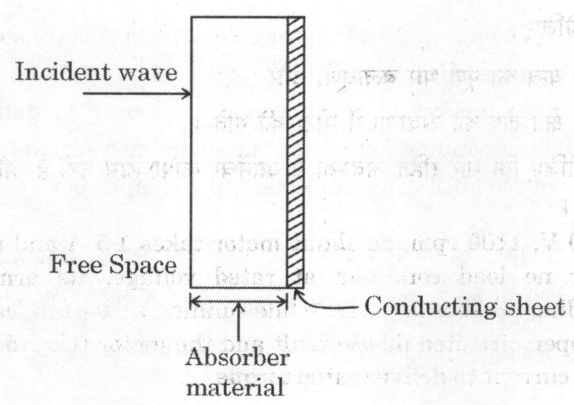
The figure this question refers to, in words
The question paper is a scan and the diagram did not survive as text. This is the figure as read from the original page — every component, value and label — so the question can be worked from the text below.
(b) A schematic diagram showing a rectangular block labeled 'Absorber material' positioned between a region labeled 'Free Space' on the left and a vertical hatched line on the right labeled 'Conducting sheet'. A horizontal arrow labeled 'Incident wave' points from the left towards the absorber material. A double-headed arrow below the block indicates the thickness of the absorber material.
(c) Circuit diagram: A two-port network (labeled 'Network' or 'तंत्र') is connected between two voltage sources. On the left, a voltage source V_S1 is connected to the input port. The positive terminal is at the top. Current I_1 flows into the top terminal of the network. On the right, a voltage source V_S2 is connected to the output port. The positive terminal is at the top. Current I_2 flows into the top terminal of the network (indicated by an arrow pointing left). The bottom terminals of both sources and the network are connected together. Below the circuit is a table with 5 rows and 5 columns. The header row contains: (blank), V_S1 Volts, V_S2 Volts, I_1 Amp, I_2 Amp. Row 1 (Experiment 1 / प्रयोग 1): 100, 50, 5, -30. Row 2 (Experiment 2 / प्रयोग 2): 50, 100, -20, -5. Row 3 (Experiment 3 / प्रयोग 3): 25, 0, -, -. Row 4 (Experiment 4 / प्रयोग 4): -, -, 5, 0.
What "Solve" is asking you to do
Choose the method, then carry it through to a final answer. Identifying what kind of problem this is and why that method applies is the first thing marked; a correct figure arrived at invisibly earns almost nothing.
Structure that answers it
Given data and what is required → method chosen, with the reason it applies → set-up (equation, circuit, free body, trial balance) → working, step by step → answer with units and any condition of validity
Where marks are lost
Doing the middle steps mentally and writing only the result. In mathematics papers, a further loss comes from giving a decimal where the exact value in surds or fractions was wanted, or from skipping the justification a part explicitly asks for.
How this answer will be evaluated
Approach
Framework: Electrical Engineering, Paper 1. (a) calculate: given > formula > substitution > result with units > interpretation | (b) calculate: given > formula > substitution > result with units > interpretation | (c) calculate: given > formula > substitution > result with units > interpretation Full marks: Correct method with all steps shown, proper units, and clear interpretation of results.
Key points expected
- Calculate no-load back EMF (E0) from V and Ia
- Determine rated field current (If) from no-load data
- Apply torque equation T ∝ φIa for rated torque
- Calculate speed using E ∝ φN relationship
- Calculate intrinsic impedance of absorber material
- Determine propagation constant (α and β) from εr, μr
- Apply transmission line model for reflection coefficient
- Solve for thickness d using attenuation formula
Evaluation rubric
Each sub-part is marked on its own, against the marks and word limit printed on the paper.
- (a) Determine full load torque and speed under field fault condition. 20 marks
calculate— given → formula → substitution → result with units → interpretation
Must cover
- Calculate no-load back EMF (E0) from V and Ia
- Determine rated field current (If) from no-load data
- Apply torque equation T ∝ φIa for rated torque
- Calculate speed using E ∝ φN relationship
Loses marks
- Ignoring field current in total current calculation
- Using wrong proportionality for torque or speed
- Sign errors in voltage drop calculations
Earns more
- Explicitly state assumption of no armature reaction
- Show calculation of armature current at full load
- Verify units for torque (N-m) and speed (rpm)
Extra mark
- Draw equivalent circuit of DC shunt motor
- Comment on stability of speed under field fault
- (b) Calculate absorber thickness for 30 dB attenuation of reflected wave. 20 marks
calculate— given → formula → substitution → result with units → interpretation
Must cover
- Calculate intrinsic impedance of absorber material
- Determine propagation constant (α and β) from εr, μr
- Apply transmission line model for reflection coefficient
- Solve for thickness d using attenuation formula
Loses marks
- Using real part of εr, μr only (ignoring loss)
- Incorrect formula for reflection coefficient
- Unit errors in frequency or thickness
Earns more
- Show calculation of complex refractive index
- State boundary conditions at conducting sheet
- Convert dB attenuation to linear ratio correctly
Extra mark
- Draw equivalent transmission line model
- Comment on skin depth in the material
- (c) Determine operating speed of DC motor with discontinuous current. 10 marks
calculate— given → formula → substitution → result with units → interpretation
Must cover
- Calculate average voltage from rectifier output
- Apply KVL to armature circuit for back EMF
- Use speed-torque relationship for separately excited motor
- Account for discontinuous current interval (105° to 210°)
Loses marks
- Using continuous current formula for average voltage
- Ignoring armature resistance in KVL
- Wrong trigonometric limits for integration
Earns more
- Show integration for average voltage calculation
- State assumption of constant flux operation
- Verify armature resistance drop calculation
Extra mark
- Draw rectifier circuit with motor load
- Sketch current waveform showing discontinuity
Model answer coming soon
Every evaluation on this site is marked against a verified model answer. This question's answer is still being written; evaluation opens the moment it lands.
More from Electrical Engineering 2023 Paper I
- Q3 (a) (i) Consider the shift register shown in the figure below, which is implemented using…
- Q4 (a) For the circuit shown below, early voltage V_A = ∞ and β = 100. Find the reverse satu…
- Q5 (a) A 400 V, 50 Hz, 3-phase star-connected cylindrical rotor synchronous motor has synchr…
- Q6 (a) A 200 V, 1100 rpm, dc shunt motor takes 1·5 A and runs at 1150 rpm under no load cond…
- Q7 (a) A 400 V, 3-phase, 50 Hz, star-connected synchronous motor has per phase synchronous i…
- Q8 (a) A 415 V, 4-pole, 3-phase, 50 Hz, star-connected squirrel cage induction motor has per…