Paper I — Q7
(a) A 400 V, 3-phase, 50 Hz, star-connected synchronous motor has per phase synchronous impedance Zₛ = (0·5 + j 3·5) Ω. It is…
A 400 V, 3-phase, 50 Hz, star-connected synchronous motor has per phase synchronous impedance Zₛ = (0·5 + j 3·5) Ω. It is required to operate the motor as synchronous condenser to deliver 100 kVAr at rated voltage and no load. Find the motor current and excitation voltage under this condition. (Assume zero motor input power at no load) 20 marks
Two statistically independent Poisson random variables X₁ and X₂ with respective parameters λ₁ and λ₂ are added to form Y = X₁ + X₂. Show that the random variable Y is Poisson distributed with parameter (λ₁ + λ₂). 10 marks
Derive the relationship between Binomial and Poisson random variables when Binomial distribution becomes equal to the Poisson distribution. 10 marks
The circuit given in the figure below is in steady state initially before the thyristor is triggered. The thyristor is triggered at t = 0. Calculate (10 marks) the maximum current the thyristor will carry.
the instant of carrying maximum current by the thyristor.
the conduction time of the thyristor. (Assume zero latching and holding current for the thyristor)
हिंदी में प्रश्न पढ़ें
एक 400 V, त्रि-कला, 50 Hz, तारा-संयोजित, तुल्यकालिक मोटर की प्रति कला तुल्यकालिक प्रतिबाधा Zₛ = (0·5 + j 3·5) Ω है । निर्धारित वोल्टता और शून्य भार पर मोटर को 100 kVAr देने के लिए तुल्यकालिक संधारित्र की तरह प्रचालित करना वांछनीय है । इस परिस्थिति में मोटर धारा और उत्तेजन वोल्टता ज्ञात कीजिए । (शून्य भार पर मोटर की निवेश शक्ति शून्य मान लीजिए)
दो सांख्यिक रूप से स्वतंत्र प्वासों यादृच्छिक चर X₁ तथा X₂ जिनके प्राचल क्रमशः λ₁ तथा λ₂ हैं, को Y = X₁ + X₂ निरूपित करने के लिए जोड़ा गया है । प्रदर्शित कीजिए कि यादृच्छिक चर Y प्राचल (λ₁ + λ₂) के साथ प्वासों वितरित है ।
द्विपद और प्वासों यादृच्छिक चर के मध्य संबंध व्युत्पन्न कीजिए जबकि द्विपद वितरण, प्वासों वितरण के बराबर हो जाता है ।
चित्र में दिखाया गया परिपथ आरंभ में, थायरिस्टर के उत्त्प्रेरित (ट्रिगरित) होने के पूर्व स्थायी अवस्था में है । थायरिस्टर t = 0 पर उत्त्प्रेरित (ट्रिगरित) होता है, तो निम्न की गणना कीजिए : थायरिस्टर द्वारा वहन की जाने वाली अधिकतम धारा ।
थायरिस्टर द्वारा अधिकतम धारा वहन का क्षण ।
थायरिस्टर का चालन समय । (थायरिस्टर के लिए लैचिंग और धारण धारा शून्य मान लीजिए)
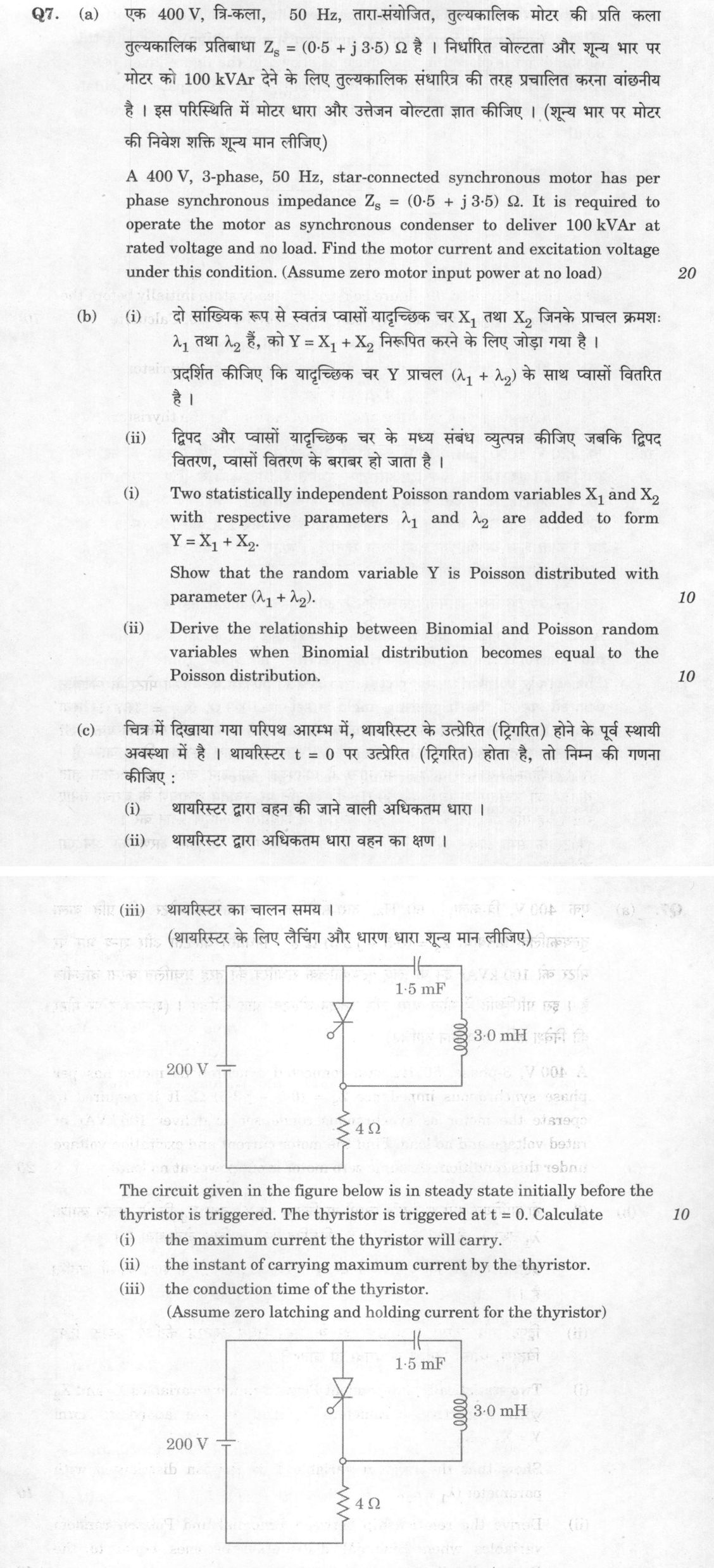
The figure printed on the question paper
Cut from the original 2023 Electrical Engineering paper, exactly as the candidates in the hall saw it.
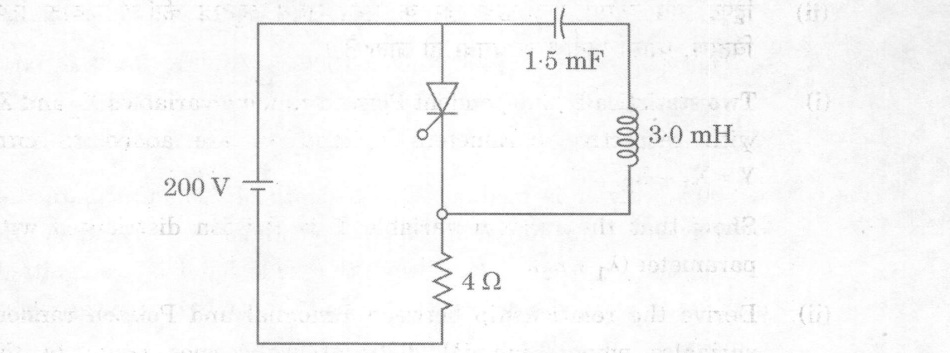
The figure this question refers to, in words
The question paper is a scan and the diagram did not survive as text. This is the figure as read from the original page — every component, value and label — so the question can be worked from the text below.
(c) A DC circuit consists of a 200 V DC voltage source connected between a top positive rail and a bottom negative rail. Across the rails is a branch containing a thyristor (SCR) in series with a 4-ohm resistor: the anode of the thyristor connects to the top rail, its cathode connects to an intermediate node, and the 4-ohm resistor connects between this intermediate node and the bottom rail. Connected across the thyristor (between the top rail and the intermediate node) is a series branch composed of a 1.5 mF capacitor and a 3.0 mH inductor, with the capacitor connected to the top rail and the inductor connected to the intermediate node.
Model answer
Written by UPSC Answer Check against this question's marking rubric, to the expected length. UPSC does not publish answers for Mains — this is one way to score well, not an official key.
(a) Take the terminal phase voltage as reference. Vph = 400/√3 = 230.94 V ∠0°.
The motor absorbs P = 0 and delivers Q = 100 kVAr, so the 3-phase absorbed complex power is S = −j100,000 VA.
For a star-connected motor, S = 3 Vph I*. Hence I* = (−j100,000)/(3 × 230.94) = −j144.34 A so I = j144.34 A, i.e. 144.34 A leading Vph by 90°.
Use the synchronous-motor voltage equation: E = Vph − I Zs, with Zs = (0.5 + j3.5) Ω.
I Zs = j144.34(0.5 + j3.5) = −505.18 + j72.17 V.
Eph = 230.94 − (−505.18 + j72.17) = 736.12 − j72.17 V.
|Eph| = √(736.12² + 72.17²) = 739.65 V.
Line excitation emf = √3 × 739.65 = 1281.1 V.
Thus, Motor current = 144.34 A leading; excitation emf = 739.65 V/phase = 1281.1 V line.
(b)(i) For a Poisson variable X with parameter λ, the probability generating function is G_X(z) = E[z^X] = e^λ(z−1).
Since X₁ and X₂ are independent, G_Y(z) = G_X₁(z) G_X₂(z) = e^λ₁(z−1) e^λ₂(z−1) = e^(λ₁+λ₂)(z−1).
But e^Λ(z−1) is exactly the PGF of a Poisson variable with parameter Λ = λ₁+λ₂. Expanding, G_Y(z) = e^−Λ Σ [Λ^k z^k/k!] for k = 0, 1, 2, …
Therefore, P(Y = k) = e^−(λ₁+λ₂) (λ₁+λ₂)^k/k!.
Hence Y = X₁ + X₂ is Poisson distributed with parameter λ₁ + λ₂.
(b)(ii) Let X ~ Bin(n, p). Then P(X = k) = nCk p^k (1−p)^n−k.
Put λ = np, so p = λ/n. Then P(X = k) = [n(n−1)…(n−k+1)/k!] (λ/n)^k (1−λ/n)^n−k = λ^k/k! [n(n−1)…(n−k+1)/n^k] (1−λ/n)^n (1−λ/n)^−k.
Now take the limit n → ∞, p → 0, with np = λ fixed. Then [n(n−1)…(n−k+1)/n^k] → 1, (1−λ/n)^n → e^−λ, (1−λ/n)^−k → 1.
Thus P(X = k) → e^−λ λ^k/k!.
So the Binomial distribution tends to the Poisson distribution when n is very large, p is very small, and np = λ remains finite. This is the law of rare events.
(c)(i) Before triggering, SCR is off. In DC steady state, inductor is short and capacitor is open. Hence no current flows through the 4 Ω resistor, so the intermediate node voltage is 0 V. Therefore capacitor voltage is v_C(0) = 200 V, and inductor current i_L(0) = 0.
After triggering, SCR is ideal ON, so the intermediate node is at 200 V. The resistor current is i_R = 200/4 = 50 A.
Let i_LC be positive from top rail to intermediate node through the LC branch. KCL at the intermediate node gives i_T + i_LC = 50, so i_T = 50 − i_LC.
For the LC branch, L d²i_LC/dt² + i_LC/C = 0.
Natural frequency: ω₀ = 1/√(LC) = 1/√(3×10⁻³ × 1.5×10⁻³) = 471.405 rad/s.
Surge impedance: Z₀ = √(L/C) = √(3×10⁻³ / 1.5×10⁻³) = √2 Ω.
Thus i_LC(t) = −(200/√2) sin(471.405 t) = −141.421 sin(471.405 t) A.
Therefore, i_T(t) = 50 + 141.421 sin(471.405 t) A.
Maximum i_T occurs when sin(471.405 t) = 1: i_T(max) = 50 + 141.421 = 191.42 A.
(c)(ii) Maximum occurs when 471.405 t = π/2. So t = π/(2 × 471.405) = 3.332 × 10⁻³ s = 3.332 ms.
(c)(iii) Thyristor turns off when i_T = 0: 50 + 141.421 sin(471.405 t) = 0 sin(471.405 t) = −50/141.421 = −0.353553.
The first positive solution after t = 0 is 471.405 t = π + arcsin(0.353553) = 3.50296 rad.
Hence t = 3.50296 / 471.405 = 7.431 × 10⁻³ s = 7.431 ms.
So the conduction time of the thyristor is 7.431 ms.
What "Calculate" is asking you to do
Apply the standard formula or schedule to data the question has already supplied — a table of readings, cost records, a balance sheet — and produce the number. The method is rarely in doubt; the marks sit in the named intermediate quantities, each of which has to appear as a labelled line.
Structure that answers it
Data as given → formula or standard treatment, named → substitution → each intermediate, labelled → result with units
Where marks are lost
Omitting an intermediate the marking scheme pays for separately, or rounding at an intermediate line so the final figure drifts. In commerce and accountancy, any figure in a statement that no numbered working note supports is treated as unearned.
How this answer will be evaluated
Approach
(a) calculate: given > formula > substitution > result with units > interpretation | (b(i)) derive: given > assumptions > stepwise derivation > result > check | (b(ii)) derive: given > assumptions > stepwise derivation > result > check | (c) calculate: given > formula > substitution > result with units > interpretation Full marks: Complete derivations with correct phasor/circuit models and all sub-parts solved accurately.
Key points expected
- Per-phase equivalent circuit with Zs and Vph
- Calculation of phase voltage (400/√3)
- Determination of current magnitude and angle
- Calculation of excitation voltage E using KVL
- Definition of Poisson PMF for X1 and X2
- Use of convolution sum for Y = X1 + X2
- Application of multinomial theorem
- Final result matching Poisson(λ1+λ2) form
Evaluation rubric
Each sub-part is marked on its own, against the marks and word limit printed on the paper.
- (a) Motor current and excitation voltage for 100 kVAr delivery at no load. 20 marks
calculate— given → formula → substitution → result with units → interpretation
Must cover
- Per-phase equivalent circuit with Zs and Vph
- Calculation of phase voltage (400/√3)
- Determination of current magnitude and angle
- Calculation of excitation voltage E using KVL
Loses marks
- Using line voltage instead of phase voltage
- Ignoring the resistance component of Zs
- Sign error in phasor addition for E
Earns more
- Phasor diagram showing V, E, and I
- Explicit statement of leading power factor
- Verification of zero real power input
Extra mark
- Calculation of power factor angle explicitly
- (b(i)) Proof that sum of independent Poisson variables is Poisson. 10 marks
derive— given → assumptions → stepwise derivation → result → check
Must cover
- Definition of Poisson PMF for X1 and X2
- Use of convolution sum for Y = X1 + X2
- Application of multinomial theorem
- Final result matching Poisson(λ1+λ2) form
Loses marks
- Skipping the convolution step
- Incorrect application of multinomial theorem
Earns more
- Clear step-by-step algebraic manipulation
- Explicit statement of independence assumption
Extra mark
- Mention of moment generating function method
- (b(ii)) Derivation of Poisson limit from Binomial distribution. 10 marks
derive— given → assumptions → stepwise derivation → result → check
Must cover
- Binomial PMF expression with n and p
- Limit conditions: n→∞, p→0, np=λ
- Evaluation of limit terms (n-k)/n and (1-p)^n
- Final result matching Poisson(λ) form
Loses marks
- Failing to show the limit of (1-p)^n
- Incorrect substitution of p = λ/n
Earns more
- Explicit handling of the (1-λ/n)^n term
- Clear definition of the limit process
Extra mark
- Numerical example illustrating the convergence
- (c) Max current, time of max current, and conduction time of thyristor. 10 marks
calculate— given → formula → substitution → result with units → interpretation
Must cover
- Circuit analysis for t > 0 (RLC series)
- Determination of damping factor and resonant frequency
- Expression for current i(t) with initial conditions
- Calculation of t_max and conduction interval
Loses marks
- Ignoring the 4Ω resistance in the circuit
- Incorrect initial voltage on the capacitor
- Using wrong formula for damped frequency
Earns more
- Identification of underdamped response
- Correct initial conditions for L and C
- Graph of current waveform
Extra mark
- Calculation of peak inverse voltage
Practice this exact question
Write your answer and it is marked point by point against the model answer above — what you covered, what you missed, what you got wrong.
Evaluate my answer →More from Electrical Engineering 2023 Paper I
- Q4 (a) For the circuit shown below, early voltage V_A = ∞ and β = 100. Find the reverse satu…
- Q5 (a) A 400 V, 50 Hz, 3-phase star-connected cylindrical rotor synchronous motor has synchr…
- Q6 (a) A 200 V, 1100 rpm, dc shunt motor takes 1·5 A and runs at 1150 rpm under no load cond…
- Q7 (a) A 400 V, 3-phase, 50 Hz, star-connected synchronous motor has per phase synchronous i…
- Q8 (a) A 415 V, 4-pole, 3-phase, 50 Hz, star-connected squirrel cage induction motor has per…