Paper I — Q8
(a) A 415 V, 4-pole, 3-phase, 50 Hz, star-connected squirrel cage induction motor has per phase parameters of r_s = 1·1 Ω, r_r =…
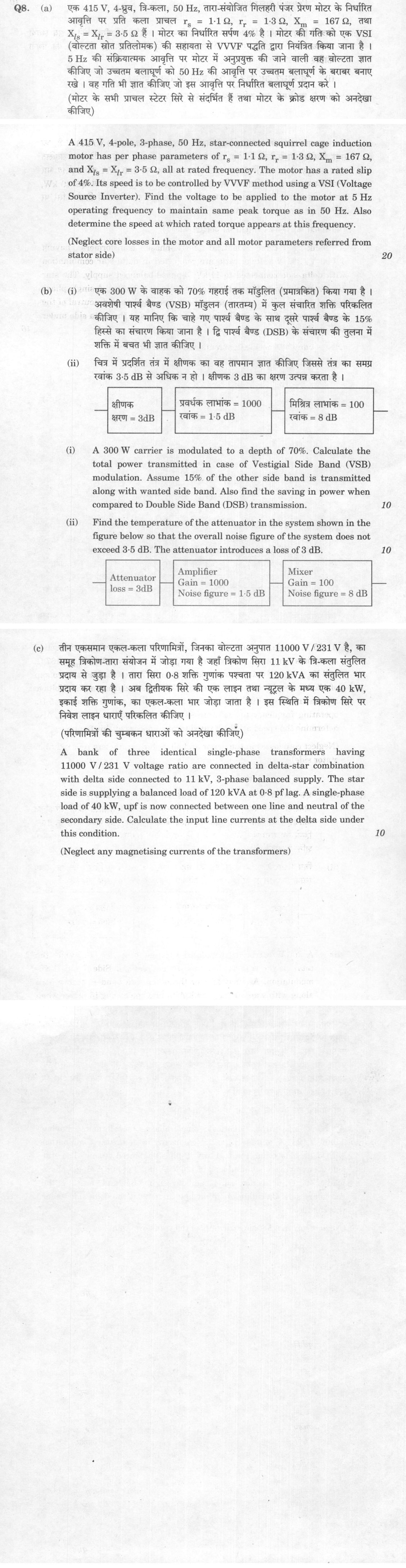
A 415 V, 4-pole, 3-phase, 50 Hz, star-connected squirrel cage induction motor has per phase parameters of r_s = 1·1 Ω, r_r = 1·3 Ω, X_m = 167 Ω, and X_ls = X_lr = 3·5 Ω, all at rated frequency. The motor has a rated slip of 4%. Its speed is to be controlled by VVVF method using a VSI (Voltage Source Inverter). Find the voltage to be applied to the motor at 5 Hz operating frequency to maintain same peak torque as in 50 Hz. Also determine the speed at which rated torque appears at this frequency. (Neglect core losses in the motor and all motor parameters referred from stator side) 20 marks
A 300 W carrier is modulated to a depth of 70%. Calculate the total power transmitted in case of Vestigial Side Band (VSB) modulation. Assume 15% of the other side band is transmitted along with wanted side band. Also find the saving in power when compared to Double Side Band (DSB) transmission. 10 marks
Find the temperature of the attenuator in the system shown in the figure below so that the overall noise figure of the system does not exceed 3·5 dB. The attenuator introduces a loss of 3 dB. 10 marks
A bank of three identical single-phase transformers having 11000 V/231 V voltage ratio are connected in delta-star combination with delta side connected to 11 kV, 3-phase balanced supply. The star side is supplying a balanced load of 120 kVA at 0·8 pf lag. A single-phase load of 40 kW, upf is now connected between one line and neutral of the secondary side. Calculate the input line currents at the delta side under this condition. (Neglect any magnetising currents of the transformers) 10 marks
हिंदी में प्रश्न पढ़ें
एक 415 V, 4-ध्रुव, त्रि-कला, 50 Hz, तारा-संयोजित गिलहरी पंजर प्रेरण मोटर के निर्धारित आवृत्ति पर प्रति कला प्राचल r_s = 1.1 Ω, r_r = 1.3 Ω, X_m = 167 Ω, तथा X_ls = X_lr = 3.5 Ω हैं । मोटर का निर्धारित सर्पण 4% है । मोटर की गति को एक VSI (वोल्टता स्रोत प्रतिलोमक) की सहायता से VVVF पद्धति द्वारा नियंत्रित किया जाना है । 5 Hz की संक्रियात्मक आवृत्ति पर मोटर में अनुप्रयुक्त की जाने वाली वह वोल्टता ज्ञात कीजिए जो उच्चतम बलाघूर्ण को 50 Hz की आवृत्ति पर उच्चतम बलाघूर्ण के बराबर बनाए रखे । वह गति भी ज्ञात कीजिए जो इस आवृत्ति पर निर्धारित बलाघूर्ण प्रदान करे । (मोटर के सभी प्राचल स्टेटर सिरे से संदर्भित हैं तथा मोटर के कोर क्षरण को अनदेखा कीजिए)
एक 300 W के वाहक को 70% गहराई तक मॉडुलित (प्रमाणित) किया गया है । अवशेषी पार्श्व बैंड (VSB) मॉडुलन (तारतम्य) में कुल संचारित शक्ति परिकलित कीजिए । यह मानिए कि चाहे गए पार्श्व बैंड के साथ दूसरे पार्श्व बैंड के 15% हिस्से का संचारण किया जाना है । द्वि पार्श्व बैंड (DSB) के संचारण की तुलना में शक्ति में बचत भी ज्ञात कीजिए ।
चित्र में प्रदर्शित तंत्र में शीणक का वह तापमान ज्ञात कीजिए जिससे तंत्र का समग्र रवांक 3·5 dB से अधिक न हो । शीणक 3 dB का क्षरण उत्पन्न करता है ।
तीन एकसमान एकल-कला परिणामित्रों, जिनका बोल्टता अनुपात 11000 V/231 V है, का समूह त्रिकोण-तारा संयोजन में जोड़ा गया है जहाँ त्रिकोण सिरा 11 kV के त्रि-कला संतुलित प्रदाय से जुड़ा है । तारा सिरा 0·8 शक्ति गुणांक पश्चता पर 120 kVA का संतुलित भार प्रदाय कर रहा है । अब द्वितीयक सिरे की एक लाइन तथा न्यूट्रल के मध्य एक 40 kW, इकाई शक्ति गुणांक, का एकल-कला भार जोड़ा जाता है । इस स्थिति में त्रिकोण सिरे पर निवेश लाइन धाराएँ परिकलित कीजिए । (परिणामित्रों की चुंबकन धाराओं को अनदेखा कीजिए)
The figure printed on the question paper
Cut from the original 2023 Electrical Engineering paper, exactly as the candidates in the hall saw it.

The figure this question refers to, in words
The question paper is a scan and the diagram did not survive as text. This is the figure as read from the original page — every component, value and label — so the question can be worked from the text below.
(b) A block diagram of a cascaded system consisting of three blocks connected in series from left to right. The input is on the far left and the output is on the far right. The first block is labeled 'Attenuator' with 'loss = 3dB'. The second block is labeled 'Amplifier' with 'Gain = 1000' and 'Noise figure = 1.5 dB'. The third block is labeled 'Mixer' with 'Gain = 100' and 'Noise figure = 8 dB'.
What "Calculate" is asking you to do
Apply the standard formula or schedule to data the question has already supplied — a table of readings, cost records, a balance sheet — and produce the number. The method is rarely in doubt; the marks sit in the named intermediate quantities, each of which has to appear as a labelled line.
Structure that answers it
Data as given → formula or standard treatment, named → substitution → each intermediate, labelled → result with units
Where marks are lost
Omitting an intermediate the marking scheme pays for separately, or rounding at an intermediate line so the final figure drifts. In commerce and accountancy, any figure in a statement that no numbered working note supports is treated as unearned.
How this answer will be evaluated
Approach
Framework: Electrical Engineering, Paper 1. (a) calculate: given > formula > substitution > result with units > interpretation | (b(i)) calculate: given > formula > substitution > result with units > interpretation | (b(ii)) calculate: given > formula > substitution > result with units > interpretation | (c) calculate: given > formula > substitution > result with units > interpretation Full marks: Correct method, clear diagrams, accurate calculations, and proper interpretation of results.
Key points expected
- Equivalent circuit with parameters scaled to 5 Hz
- Slip calculation for peak torque at 50 Hz
- Voltage calculation maintaining constant V/f or flux
- Speed calculation for rated torque at 5 Hz
- Sideband power calculation for 70% modulation
- VSB power calculation including 15% vestigial
- DSB power calculation for comparison
- Power saving calculation in Watts or dB
Evaluation rubric
Each sub-part is marked on its own, against the marks and word limit printed on the paper.
- (a) Determine VSI voltage at 5 Hz for constant peak torque and the speed for rated torque. 20 marks
calculate— given → formula → substitution → result with units → interpretation
Must cover
- Equivalent circuit with parameters scaled to 5 Hz
- Slip calculation for peak torque at 50 Hz
- Voltage calculation maintaining constant V/f or flux
- Speed calculation for rated torque at 5 Hz
Loses marks
- Using 50 Hz parameters directly at 5 Hz
- Ignoring the change in slip for peak torque
- Sign errors in the equivalent circuit equations
Earns more
- Explicit statement of neglecting core losses
- Phasor diagram of the equivalent circuit
- Verification of torque values at both frequencies
Extra mark
- Graphical representation of torque-speed curve
- Discussion of VSI switching effects
- (b(i)) Calculate total VSB power and power saving compared to DSB. 10 marks
calculate— given → formula → substitution → result with units → interpretation
Must cover
- Sideband power calculation for 70% modulation
- VSB power calculation including 15% vestigial
- DSB power calculation for comparison
- Power saving calculation in Watts or dB
Loses marks
- Forgetting to include the 15% vestigial power
- Incorrect modulation index usage
- Confusing carrier power with total power
Earns more
- Spectrum diagram showing VSB and DSB
- Explicit formula for sideband power
Extra mark
- Comparison with SSB power
- Discussion of bandwidth efficiency
- (b(ii)) Find attenuator temperature for system noise figure limit. 10 marks
calculate— given → formula → substitution → result with units → interpretation
Must cover
- Cascade noise figure calculation (Friis formula)
- Attenuator noise temperature relation to loss
- Solving for temperature given 3.5 dB limit
- Conversion between dB and linear values
Loses marks
- Using dB values directly in linear formulas
- Ignoring the gain of the attenuator (1/L)
- Incorrect ordering of stages in cascade
Earns more
- Block diagram with noise temperatures
- Step-by-step substitution in Friis formula
Extra mark
- Discussion of physical temperature vs noise temperature
- Sensitivity analysis of the result
- (c) Calculate input line currents at the delta side. 10 marks
calculate— given → formula → substitution → result with units → interpretation
Must cover
- Secondary phase currents for balanced load
- Secondary phase currents for single-phase load
- Transformation to primary (delta) side
- Vector sum for line currents
Loses marks
- Ignoring the phase shift in delta-star
- Incorrect vector addition of currents
- Forgetting the single-phase load contribution
Earns more
- Phasor diagram of primary currents
- Explicit calculation of turns ratio
Extra mark
- Calculation of power factor at input
- Discussion of unbalanced loading effects
Model answer coming soon
Every evaluation on this site is marked against a verified model answer. This question's answer is still being written; evaluation opens the moment it lands.
More from Electrical Engineering 2023 Paper I
- Q5 (a) A 400 V, 50 Hz, 3-phase star-connected cylindrical rotor synchronous motor has synchr…
- Q6 (a) A 200 V, 1100 rpm, dc shunt motor takes 1·5 A and runs at 1150 rpm under no load cond…
- Q7 (a) A 400 V, 3-phase, 50 Hz, star-connected synchronous motor has per phase synchronous i…
- Q8 (a) A 415 V, 4-pole, 3-phase, 50 Hz, star-connected squirrel cage induction motor has per…