Paper II — Q1
(a) The figure shows a unity feedback system. The steady-state value of the unit step response c(t) is 0·8. Determine the maximum…
The figure shows a unity feedback system. The steady-state value of the unit step response c(t) is 0·8. Determine the maximum overshoot in the response c(t) : 10 marks
A circuit breaker is rated as 2500 A, 1500 MVA, 33 kV, 3 sec, 3-phase, oil circuit breaker. Determine its rated normal current, breaking current, making current and short-time rating (current). 10 marks
An audio signal, whose bandwidth is 15 kHz, is to be digitized using PCM. Uniform quantization with 1024 levels and binary encoding are assumed. Determine the minimum sampling rate. If the actual sampling rate is 20% excess of the minimum rate, determine the minimum permissible bit rate. 10 marks
Briefly explain the following logical instructions of 8085 microprocessor : (i) ANA M (ii) XRA M (iii) CMC (iv) STC (v) RRC 10 marks
In a three-phase 400 km long transmission line, the conductors are spaced at the corners of an equilateral triangle of side 5 m. The diameter of each conductor is 3 cm. Calculate the capacitance per phase of the 400 km long conductor. 10 marks
हिंदी में प्रश्न पढ़ें
चित्र में एक इकाई पुनर्निवेश तंत्र दिखाया गया है। इकाई पद अनुक्रिया (रेस्पोंस) c(t) का स्थायी-दशा मान 0·8 है। अनुक्रिया c(t) में अधिकतम ओवरशूट ज्ञात कीजिए : (10 अंक)
एक परिपथ विचोजक को 2500 A, 1500 MVA, 33 kV, 3 sec, 3-कला, ऑयल परिपथ विचोजक की तरह निर्धारित किया गया है। उसकी निर्धारित सामान्य धारा, विचोजन धारा, संयोजन धारा एवं लघु-समय रेटिंग (धारा) ज्ञात कीजिए। (10 अंक)
एक श्रव्य संकेत, जिसकी बैंड-चौड़ाई 15 kHz है, को पी० सी० एम० का उपयोग करते हुए अंकिक बनाना है। 1024 स्तरों (levels) के साथ एकसमान कांटन एवं द्वि-आधारी कोडन मान लीजिए। न्यूनतम प्रतिचयन दर (मिनिमम सैम्पलिंग रेट) निर्धारित कीजिए। यदि वास्तविक प्रतिचयन दर, न्यूनतम दर से 20% ज्यादा है, तो न्यूनतम अनुमत्य बिट दर ज्ञात कीजिए। (10 अंक)
8085 सूक्ष्म-संसाधित्र (माइक्रोप्रोसेसर) के निम्नलिखित तार्किक निर्देशों की संक्षिप्त व्याख्या कीजिए : (i) ANA M (ii) XRA M (iii) CMC (iv) STC (v) RRC (10 अंक)
एक त्रि-कला (श्री-फेज़) 400 km लम्बी संचरण लाइन में, चालकों (कण्डक्टरों) को 5 m भुजा वाले एक समबाहु त्रिभुज के कोनों के अन्तराल पर रखा गया है। प्रत्येक चालक का व्यास 3 cm है। इस 400 km लम्बे चालक की प्रति कला धारिता की गणना कीजिए। (10 अंक)
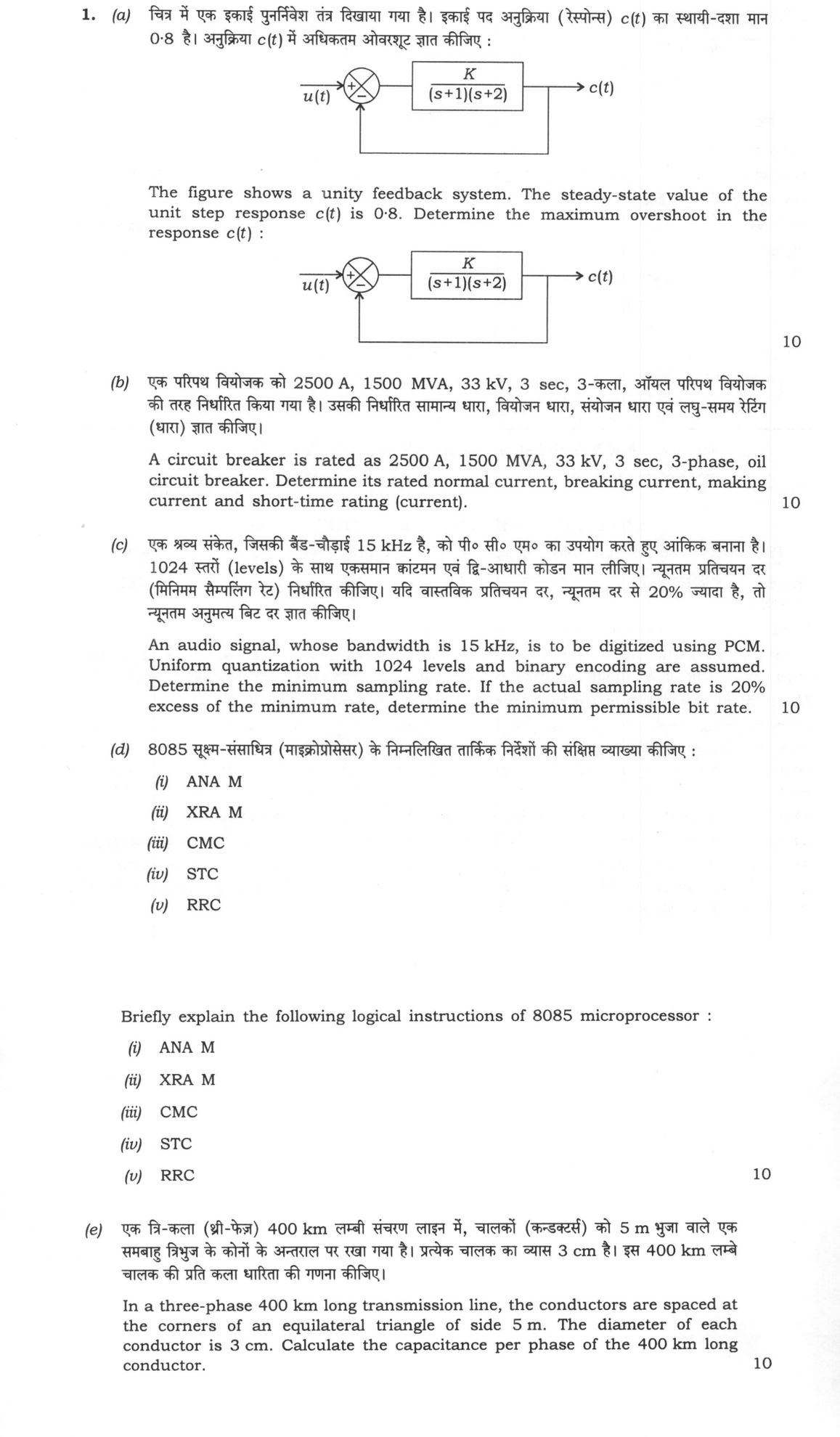
The figure this question refers to, in words
The question paper is a scan and the diagram did not survive as text. This is the figure as read from the original page — every component, value and label — so the question can be worked from the text below.
(a) A block diagram of a unity negative feedback control system: An input signal u(t) goes into a summing junction with a positive (+) sign. The error output from the summing junction enters a forward-path transfer function block with transfer function K / ((s + 1)(s + 2)). The output of this block is c(t). A unity feedback path is taken from c(t) and fed back into the summing junction with a negative (-) sign.
Model answer
Written by UPSC Answer Check against this question's marking rubric, to the expected length. UPSC does not publish answers for Mains — this is one way to score well, not an official key.
(a) For a unity negative feedback system, the closed-loop transfer function is
C(s)/R(s) = G(s)/(1 + G(s)) = [K/((s + 1)(s + 2))] / [1 + K/((s + 1)(s + 2))]
= K/(s^2 + 3s + 2 + K).
For a unit step input, R(s) = 1/s. By the final value theorem,
c(∞) = lim s→0 s C(s) = lim s→0 K/(s^2 + 3s + 2 + K) = K/(2 + K).
Given c(∞) = 0·8,
K/(2 + K) = 0·8
K = 0·8(2 + K) = 1·6 + 0·8K
0·2K = 1·6
K = 8.
Hence the closed-loop denominator is
s^2 + 3s + 2 + 8 = s^2 + 3s + 10.
Compare with the standard second-order denominator s^2 + 2ζω_n s + ω_n^2:
ω_n^2 = 10, so ω_n = √10 rad/s.
2ζω_n = 3, so ζ = 3/(2√10).
The system is underdamped because ζ < 1. Maximum overshoot is
M_p = e^(-πζ/√(1 − ζ^2)) × 100%.
Now 1 − ζ^2 = 1 − 9/40 = 31/40. Therefore
ζ/√(1 − ζ^2) = [3/(2√10)] / [√(31/40)] = 3/√31.
So
M_p = e^(-3π/√31) × 100% ≈ 18·40%.
Maximum overshoot ≈ 18·40%.
(b) For a three-phase circuit breaker, the rated normal current is the given continuous current rating.
Rated normal current = 2500 A.
The rated breaking current is obtained from the three-phase power formula
S = √3 V I.
Here S = 1500 MVA, V = 33 kV.
I_b = 1500 × 10^6 / (√3 × 33 × 10^3) A
I_b = 1500/(√3 × 33) kA = 500√3/33 kA ≈ 26·24 kA rms.
The making current is taken as 2·55 times the rated symmetrical breaking current for a 50 Hz system:
I_m = 2·55 I_b = 2·55 × 500√3/33 kA
I_m = 425√3/11 kA ≈ 66·92 kA peak.
The short-time rating current is the rms short-circuit current the breaker can carry for the specified short time, here 3 sec. It is equal to the rated breaking current.
Rated normal current = 2500 A.
Breaking current = 500√3/33 kA ≈ 26·24 kA rms.
Making current = 425√3/11 kA ≈ 66·92 kA peak.
Short-time rating current = 500√3/33 kA ≈ 26·24 kA rms for 3 sec.
(c) The bandwidth of the audio signal is W = 15 kHz.
By the Nyquist sampling theorem, the minimum sampling rate is
f_s,min = 2W = 2 × 15 kHz = 30 kHz.
Number of quantization levels L = 1024.
1024 = 2^10, so the number of bits per sample is
n = log2 1024 = 10 bits/sample.
The actual sampling rate is 20% in excess of the minimum rate:
f_s = 1·2 × 30 kHz = 36 kHz.
Therefore the minimum permissible bit rate for binary PCM is
R_b = n f_s = 10 × 36,000 = 360,000 bits/s.
Minimum sampling rate = 30 kHz.
Minimum permissible bit rate = 360 kbit/s.
(d) In the following, M denotes the memory location whose address is held in the HL register pair.
(i) ANA M
ANA M performs a bitwise logical AND between the accumulator and the contents of memory location M. The result is stored in the accumulator; the memory content remains unchanged.
Operation: A ← A ∧ (M)
Flags affected: S, Z, and P are updated according to the result. CY and AC are reset. It is commonly used for masking bits.
(ii) XRA M
XRA M performs a bitwise logical exclusive-OR between the accumulator and the contents of memory location M. The result is stored in the accumulator; the memory content remains unchanged.
Operation: A ← A ⊕ (M)
Flags affected: S, Z, and P are updated. CY and AC are reset. It is used to complement selected bits or to clear the accumulator by XORing it with itself.
(iii) CMC
CMC complements the carry flag. If CY = 0, it becomes 1; if CY = 1, it becomes 0.
Operation: CY ← complement of CY
No other flags are affected.
(iv) STC
STC sets the carry flag unconditionally.
Operation: CY ← 1
No other flags are affected.
(v) RRC
RRC rotates the accumulator right by one bit. The least significant bit D0 moves to D7 and also to the carry flag. The other bits shift right by one position.
Operation: D7 ← D0, D6 ← D7, ..., D0 ← D1, and CY ← old D0.
Only the CY flag is affected. Other flags are not changed.
(e) For a symmetrically spaced three-phase transmission line, the capacitance per phase to neutral per unit length is
C_0 = 2π ε0 / ln(D/r) F/m,
where D is the equilateral spacing and r is the conductor radius.
Given:
D = 5 m
Diameter of conductor = 3 cm = 0·03 m
r = 0·03/2 = 0·015 m
ε0 = 8·854 × 10^-12 F/m
Now
D/r = 5/0·015 = 1000/3 ≈ 333·333.
ln(D/r) = ln(1000/3) ≈ 5·80914.
Therefore
C_0 = (2π × 8·854 × 10^-12)/5·80914 F/m
C_0 ≈ 9·5767 × 10^-12 F/m.
For a line length of 400 km = 400 × 10^3 m, the total capacitance per phase is
C = C_0 × 400 × 10^3
C ≈ 9·5767 × 10^-12 × 400 × 10^3 F
C ≈ 3·8307 × 10^-6 F.
Capacitance per phase of the 400 km line ≈ 3·83 μF.
This result assumes symmetric equilateral spacing, negligible ground effect, and negligible corona.
What "Solve" is asking you to do
Choose the method, then carry it through to a final answer. Identifying what kind of problem this is and why that method applies is the first thing marked; a correct figure arrived at invisibly earns almost nothing.
Structure that answers it
Given data and what is required → method chosen, with the reason it applies → set-up (equation, circuit, free body, trial balance) → working, step by step → answer with units and any condition of validity
Where marks are lost
Doing the middle steps mentally and writing only the result. In mathematics papers, a further loss comes from giving a decimal where the exact value in surds or fractions was wanted, or from skipping the justification a part explicitly asks for.
How this answer will be evaluated
Approach
Framework: Electrical Engineering, Paper 2. (a) calculate: given > formula > substitution > result with units > interpretation | (b) calculate: given > formula > substitution > result with units > interpretation | (c) calculate: given > formula > substitution > result with units > interpretation | (d) explain: definition/context > points in order > small example > short close | (e) calculate: given > formula > substitution > result with units > interpretation Full marks: All parts with complete working, correct formulas, units, and interpretation
Key points expected
- Closed-loop transfer function derived
- K determined from steady-state value 0.8
- Damping ratio ζ calculated from characteristic equation
- Overshoot formula applied with correct ζ
- Rated normal current from MVA and kV
- Breaking current from MVA and kV
- Making current as 2.55 times breaking current
- Short-time rating calculation shown
Evaluation rubric
Each sub-part is marked on its own, against the marks and word limit printed on the paper.
- (a) Maximum overshoot in the response c(t) 10 marks
calculate— given → formula → substitution → result with units → interpretation
Must cover
- Closed-loop transfer function derived
- K determined from steady-state value 0.8
- Damping ratio ζ calculated from characteristic equation
- Overshoot formula applied with correct ζ
Loses marks
- Missing closed-loop transfer function
- Incorrect steady-state gain calculation
- Wrong damping ratio formula
Earns more
- Block diagram reduction shown
- Characteristic equation explicitly written
- Final overshoot value with percentage
Extra mark
- Stability comment on system response
- (b) Rated normal current, breaking current, making current, short-time rating 10 marks
calculate— given → formula → substitution → result with units → interpretation
Must cover
- Rated normal current from MVA and kV
- Breaking current from MVA and kV
- Making current as 2.55 times breaking current
- Short-time rating calculation shown
Loses marks
- Missing three-phase factor √3
- Wrong making current multiplier
- No units on final answers
Earns more
- Three-phase power formula used
- All values with correct units (A, kA)
- Step-by-step substitution shown
Extra mark
- Circuit breaker rating interpretation
- (c) Minimum sampling rate and minimum permissible bit rate 10 marks
calculate— given → formula → substitution → result with units → interpretation
Must cover
- Nyquist sampling rate from 15 kHz bandwidth
- Bits per sample from 1024 levels
- Actual sampling rate with 20% excess
- Bit rate calculation with correct units
Loses marks
- Wrong Nyquist rate (not 2× bandwidth)
- Incorrect bits per sample
- Missing 20% excess calculation
Earns more
- Nyquist theorem explicitly stated
- Log₂(1024) = 10 bits shown
- Final bit rate in kbps or Mbps
Extra mark
- PCM system diagram
- (d) Explanation of five 8085 logical instructions 10 marks
explain— definition/context → points in order → small example → short close
Must cover
- ANA M: AND accumulator with memory
- XRA M: XOR accumulator with memory
- CMC: Complement carry flag
- STC: Set carry flag to 1
Loses marks
- Missing any of the five instructions
- Confusing CMC with STC
- No mention of flag effects
Earns more
- RRC: Rotate right with carry explained
- Flag effects mentioned for each
- One-line example per instruction
Extra mark
- 8085 flag register diagram
- (e) Capacitance per phase of 400 km conductor 10 marks
calculate— given → formula → substitution → result with units → interpretation
Must cover
- Geometric mean distance (GMD) for equilateral triangle
- Geometric mean radius (GMR) from 3 cm diameter
- Capacitance formula for three-phase line
- Final capacitance in μF or nF
Loses marks
- Wrong GMD for equilateral triangle
- Missing GMR correction factor
- No units on capacitance
Earns more
- GMD = 5 m for equilateral spacing
- GMR = 0.7788 × r shown
- Per-unit-length then total capacitance
Extra mark
- Transmission line diagram
Practice this exact question
Write your answer and it is marked point by point against the model answer above — what you covered, what you missed, what you got wrong.
Evaluate my answer →More from Electrical Engineering 2023 Paper II
- Q1 (a) The figure shows a unity feedback system. The steady-state value of the unit step res…
- Q2 (a) The block diagram of a feedback system is shown in the figure. (i) Sketch the complet…
- Q3 (a) Write the state and output equations for the system shown in the figure. Choose state…
- Q4 (a) Consider a systematic linear block code with binary elements whose parity check equat…