Paper II — Q5
(a) The figure shows a compensator network, where R₁ = 3 MΩ, R₂ = 1 MΩ, C = 1 μF. Vᵢ(t) and Vₒ(t) are the input voltage and…
The figure shows a compensator network, where R₁ = 3 MΩ, R₂ = 1 MΩ, C = 1 μF. Vᵢ(t) and Vₒ(t) are the input voltage and output voltage respectively. Determine the attenuation in dB provided by this network at very high frequencies : 10 marks
A resistive strain gauge, with a gauge factor 2·2, is cemented on a rectangular steel bar with the elastic modulus, E = 205×10⁶ kN/m². The width and thickness of the steel bar is 3·5 cm and 0·55 cm respectively. An axial force of 12 kN is applied. If the nominal resistance of the strain gauge is 100 Ω, determine the change in resistance of the strain gauge. 10 marks
A three-phase, 50 Hz, 415 V supply delivers 250 kW power at power factor of 0·8 lagging. The line power factor is desired to be improved to 0·9 lagging by installing shunt capacitors. Calculate the capacitance if they are connected in delta. 10 marks
Binary data is transmitted over additive white Gaussian noise (AWGN) channel at a bit rate of 5 kilobits/sec. The single-sided power spectral density for the channel is 10⁻⁷ W/Hz. Non-coherent orthogonal binary FSK with higher frequency signalling tone of 1 MHz is used. The bit energy, E_b = 2×10⁻⁶ J. Determine the minimum required bandwidth and average bit error probability. 10 marks
Consider a three-phase, Δ-Y connected, 30 MVA, 33/11 kV transformer with differential relay protection. If the CT ratios are 500 : 5A on the primary side and 2000 : 5A on the secondary side, compute the relay current setting for faults drawing up to 200% of rated transformer current. 10 marks
हिंदी में प्रश्न पढ़ें
नीचे चित्र में एक प्रतिकारी संजाल प्रदर्शित है, जिसमें R₁ = 3 MΩ, R₂ = 1 MΩ, C = 1 μF है। Vᵢ(t) एवं Vₒ(t) क्रमशः निवेश बोल्टता और निर्गत बोल्टता है। बहुत उच्च आवृत्तियों पर इस संजाल द्वारा दी जाने वाली शीणता को dB में ज्ञात कीजिए : 10 अंक
एक प्रतिरोधक विकृति मापी (स्ट्रेन गेज), जिसका गेज गुणक 2·2 है, को एक आयताकार स्टील सलाख (बार), जिसका प्रत्यास्था मॉडुलस, E = 205×10⁶ kN/m² है, पर सीमेंटिकृत किया गया है। स्टील सलाख की चौड़ाई एवं मोटाई क्रमशः 3·5 cm और 0·55 cm है। 12 kN का एक अक्षीय बल लगाया जाता है। यदि विकृति मापी का अभीष्ट (नॉमिनल) प्रतिरोध 100 Ω है, तो विकृति मापी के प्रतिरोध में परिवर्तन निकालिए। 10 अंक
एक त्रि-कला, 50 Hz, 415 V सप्लाई 250 kW शक्ति, 0·8 पश्चता शक्ति गुणक पर प्रदान करती है। पार्श्वपथ धारिताओं के संस्थापन द्वारा लाइन शक्ति गुणक को 0·9 पश्चता तक सुधार किया जाना वांछित है। यदि उन पार्श्वपथ धारिताओं को डेल्टा में जोड़ा गया हो, तो धारिता ज्ञात कीजिए। 10 अंक
द्वि-आधारी डाटा को यौगिक सफेद गॉसियन रव (ए० डब्ल्यू० जी० एन०) चैनल पर 5 किलोबिट्स प्रति सेकंड की बिट दर से संचारित किया जाता है। चैनल के लिए एकल-पार्श्व शक्ति स्पेक्ट्रम घनत्व 10⁻⁷ W/Hz है। असंसक्त (नॉन-कोहरेंट) लंबिक द्वि-आधारी एफ० एस० के०, जिसकी अधिक आवृत्ति संकेतन टोन 1 MHz है, को उपयोग में लिया गया है। बिट ऊर्जा, E_b = 2×10⁻⁶ J है। न्यूनतम आवश्यक बैंड-चौड़ाई एवं औसतन बिट त्रुटि प्रायिकता ज्ञात कीजिए। 10 अंक
एक त्रि-कला, Δ-Y जुड़े हुए, 30 MVA, 33/11 kV, विभेदक रिले रक्षण सहित परिणामित्र लीजिए। यदि प्राइमरी की तरफ CT अनुपात 500 : 5A एवं सेकंडरी की तरफ CT अनुपात 2000 : 5A है, तो ऐसे दोष (फॉल्ट), जो परिणामित्र की नियत धारा की 200% तक धारा ले रहे हैं, उनके लिए रिले धारा अवस्थापन (सेटिंग) ज्ञात कीजिए। 10 अंक
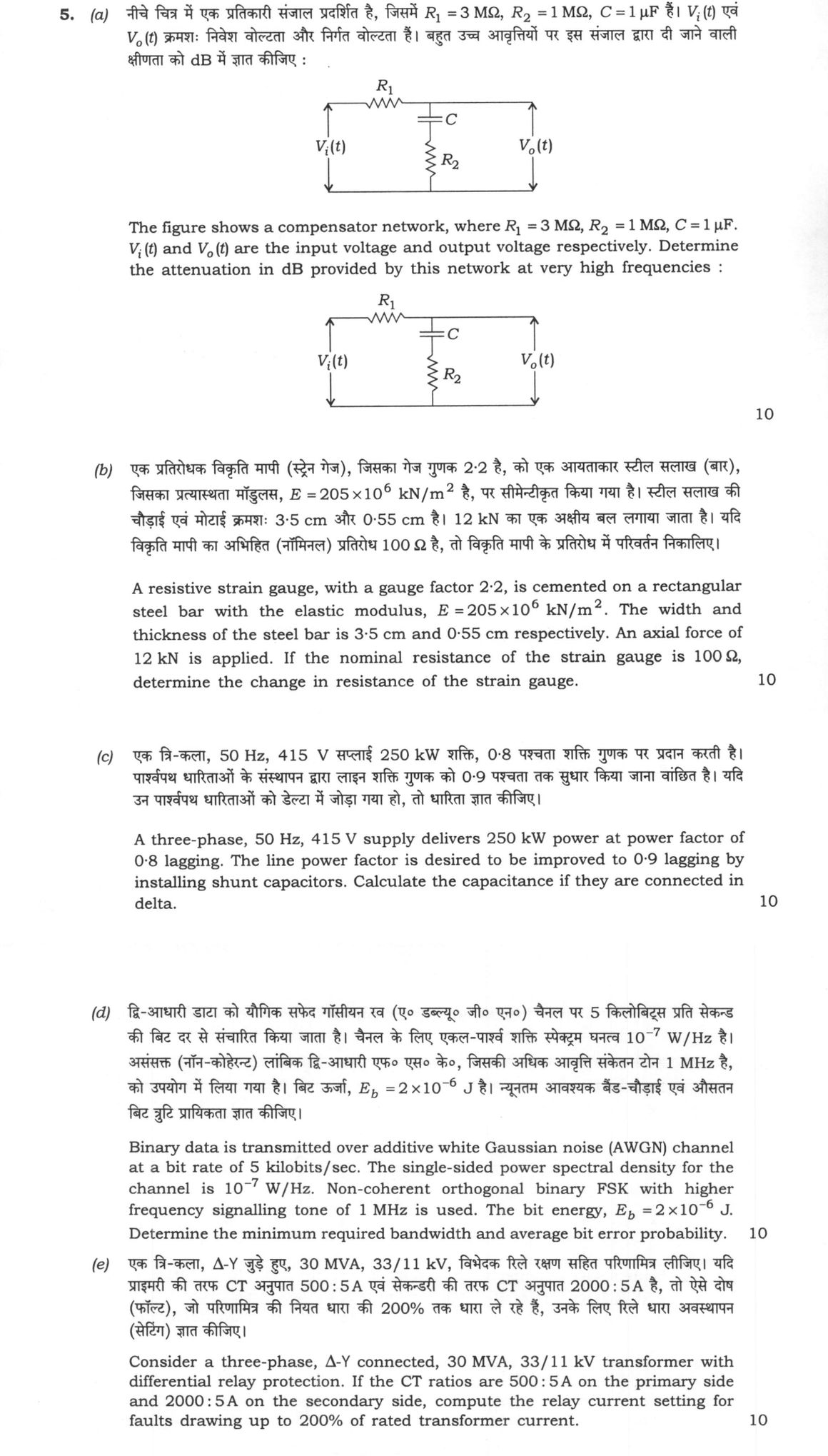
The figure this question refers to, in words
The question paper is a scan and the diagram did not survive as text. This is the figure as read from the original page — every component, value and label — so the question can be worked from the text below.
(a) A compensator network with an input port on the left and an output port on the right. A continuous reference wire runs along the bottom between the bottom input terminal and bottom output terminal. The input voltage across the input terminals is labeled V_i(t) with a vertical double-headed arrow. From the top input terminal, a horizontal series branch contains a resistor R_1 = 3 MΩ. After R_1, the line connects to a node that continues horizontally to the top output terminal, where the output voltage is labeled V_o(t) with a vertical double-headed arrow. From the node between R_1 and the output terminal, a vertical shunt branch connects to the bottom reference wire, consisting of a capacitor C = 1 μF in series above a resistor R_2 = 1 MΩ.
Model answer
Written by UPSC Answer Check against this question's marking rubric, to the expected length. UPSC does not publish answers for Mains — this is one way to score well, not an official key.
(a) The circuit is a voltage-divider network. Let the shunt branch impedance be Z₂ = R₂ + 1/(jωC). By the voltage-divider theorem, Vₒ/Vᵢ = Z₂/(R₁ + Z₂) = (R₂ + 1/(jωC))/(R₁ + R₂ + 1/(jωC)). At very high frequencies, ω → ∞, so 1/(jωC) → 0. Hence Vₒ/Vᵢ → R₂/(R₁ + R₂). Therefore the attenuation in dB is A_dB = 20 log₁₀ |Vᵢ/Vₒ| = 20 log₁₀((R₁ + R₂)/R₂). Substitute R₁ = 3 MΩ and R₂ = 1 MΩ: A_dB = 20 log₁₀((3 + 1)/1) = 20 log₁₀ 4 = 40 log₁₀ 2. Since log₁₀ 2 = 0.30103, A_dB = 40 × 0.30103 = 12.0412 dB. Final: attenuation = 12.04 dB. As a voltage gain, this is −12.04 dB.
(b) The elastic modulus is E = 205 × 10⁶ kN/m² = 205 × 10⁹ N/m². The bar dimensions are b = 3.5 cm = 0.035 m, t = 0.55 cm = 0.0055 m. Cross-sectional area A = b t = 0.035 × 0.0055 = 1.925 × 10⁻⁴ m². Axial force F = 12 kN = 12 × 10³ N. Axial stress σ = F/A = (12 × 10³)/(1.925 × 10⁻⁴) = 6.2338 × 10⁷ N/m². By Hooke’s law, axial strain ε = σ/E = (6.2338 × 10⁷)/(2.05 × 10¹¹) = 3.0409 × 10⁻⁴. For a strain gauge, gauge factor GF = (ΔR/R)/ε. Thus ΔR = GF ε R. Given GF = 2.2 and R = 100 Ω, ΔR = 2.2 × 3.0409 × 10⁻⁴ × 100 = 0.0669 Ω. Final: change in resistance = 0.0669 Ω, or about 66.9 mΩ increase.
(c) The real power is P = 250 kW = 250 × 10³ W. Initial power factor cos φ₁ = 0.8 lagging. Therefore tan φ₁ = √(1 − 0.8²)/0.8 = 0.6/0.8 = 0.75. Initial reactive power Q₁ = P tan φ₁ = 250 × 0.75 = 187.5 kVAr. Desired power factor cos φ₂ = 0.9 lagging. Thus tan φ₂ = √(1 − 0.9²)/0.9 = √0.19/0.9 = 0.484322. Desired reactive power Q₂ = P tan φ₂ = 250 × 0.484322 = 121.0805 kVAr. Capacitor reactive power required Q_C = Q₁ − Q₂ = 187.5 − 121.0805 = 66.4195 kVAr. For capacitors connected in delta, each capacitor sees the line voltage V_L = 415 V. Total reactive power supplied by three delta-connected capacitors is Q_C = 3ωC V_L², where ω = 2πf = 2π × 50 = 314.159 rad/s. Hence C = Q_C/(3ω V_L²). Substitute Q_C = 66.4195 × 10³ VAr, V_L² = 415² = 172225 V²: C = (66.4195 × 10³)/(3 × 314.159 × 172225). Denominator = 3 × 314.159 × 172225 = 1.62318 × 10⁸. C = 4.0919 × 10⁻⁴ F. Final: capacitance per delta branch = 409.2 μF.
(d) Bit rate R_b = 5 kbit/s = 5000 bit/s. For non-coherent orthogonal binary FSK, the minimum tone separation is Δf = 1/T_b = R_b = 5000 Hz = 5 kHz. Given the higher frequency tone f_H = 1 MHz = 1000 kHz, the lower tone is f_L = f_H − Δf = 1000 − 5 = 995 kHz. Using the null-to-null bandwidth of each rectangular FSK tone as 2R_b, the minimum channel bandwidth to accommodate both tones is B_min = (f_H + R_b) − (f_L − R_b) = (f_H − f_L) + 2R_b = 5 kHz + 2 × 5 kHz = 15 kHz. Thus the required band extends from approximately 990 kHz to 1005 kHz.
For non-coherent orthogonal BFSK over AWGN, the average bit error probability is P_e = 1/2 exp(−E_b/(2N₀)). Given E_b = 2 × 10⁻⁶ J, N₀ = 10⁻⁷ W/Hz, E_b/N₀ = (2 × 10⁻⁶)/(10⁻⁷) = 20. Therefore P_e = 1/2 exp(−20/2) = 1/2 exp(−10). Since exp(−10) = 4.53999 × 10⁻⁵, P_e = 2.26999 × 10⁻⁵. Final: minimum required bandwidth = 15 kHz; average bit error probability = 2.27 × 10⁻⁵.
(e) Transformer rating S = 30 MVA = 30 × 10⁶ VA. Primary side voltage V_p = 33 kV = 33 × 10³ V. Secondary side voltage V_s = 11 kV = 11 × 10³ V. Rated primary line current I_p = S/(√3 V_p) = (30 × 10⁶)/(√3 × 33 × 10³) = 524.86 A. Rated secondary line current I_s = S/(√3 V_s) = (30 × 10⁶)/(√3 × 11 × 10³) = 1574.59 A. Primary CT ratio = 500:5 = 100:1. Secondary CT ratio = 2000:5 = 400:1.
For a Δ-Y transformer, the usual differential protection connection compensates the 30° phase shift by connecting the CTs on the Y side in delta and the CTs on the Δ side in star. Thus the primary relay current at rated load is I_p,relay = I_p × (5/500) = 524.86/100 = 5.2486 A. The secondary CT secondary current before delta connection is I_s,CT = I_s × (5/2000) = 1574.59/400 = 3.9365 A. Because the secondary CTs are connected in delta, the relay current is I_s,relay = √3 × 3.9365 = 6.8179 A.
For a through fault drawing 200% of rated transformer current, multiply both relay currents by 2: I_p,relay(200%) = 2 × 5.2486 = 10.497 A, I_s,relay(200%) = 2 × 6.8179 = 13.636 A. The differential spill current that the relay must override is I_diff = |13.636 − 10.497| = 3.139 A. Therefore the relay pickup setting must be greater than this value to remain stable for external faults up to 200% of rated current. Final: relay current setting ≈ 3.14 A; in practice, select the next higher available tap, say 3.2 A.
What "Calculate" is asking you to do
Apply the standard formula or schedule to data the question has already supplied — a table of readings, cost records, a balance sheet — and produce the number. The method is rarely in doubt; the marks sit in the named intermediate quantities, each of which has to appear as a labelled line.
Structure that answers it
Data as given → formula or standard treatment, named → substitution → each intermediate, labelled → result with units
Where marks are lost
Omitting an intermediate the marking scheme pays for separately, or rounding at an intermediate line so the final figure drifts. In commerce and accountancy, any figure in a statement that no numbered working note supports is treated as unearned.
How this answer will be evaluated
Approach
(a) calculate: given > formula > substitution > result with units > interpretation | (b) calculate: given > formula > substitution > result with units > interpretation | (c) calculate: given > formula > substitution > result with units > interpretation | (d) calculate: given > formula > substitution > result with units > interpretation | (e) calculate: given > formula > substitution > result with units > interpretation Full marks: All parts show complete circuit/model setup, correct derivations, and final answers with units.
Key points expected
- Draw equivalent circuit with impedances
- Derive transfer function V_o/V_i
- Evaluate limit as frequency approaches infinity
- Convert voltage ratio to dB
- Calculate cross-sectional area of bar
- Determine strain using stress and E
- Apply gauge factor definition
- Compute delta R from nominal R
Evaluation rubric
Each sub-part is marked on its own, against the marks and word limit printed on the paper.
- (a) Attenuation in dB at very high frequencies for the given RC network. 10 marks
calculate— given → formula → substitution → result with units → interpretation
Must cover
- Draw equivalent circuit with impedances
- Derive transfer function V_o/V_i
- Evaluate limit as frequency approaches infinity
- Convert voltage ratio to dB
Loses marks
- Using DC resistance values for AC analysis
- Incorrect dB conversion formula
Earns more
- Explicitly state high-frequency impedance of C
- Show voltage divider calculation steps
Extra mark
- Sketch Bode plot magnitude response
- (b) Change in resistance of the strain gauge under axial load. 10 marks
calculate— given → formula → substitution → result with units → interpretation
Must cover
- Calculate cross-sectional area of bar
- Determine strain using stress and E
- Apply gauge factor definition
- Compute delta R from nominal R
Loses marks
- Confusing stress with strain
- Incorrect area calculation
Earns more
- Show unit conversions for dimensions
- State stress formula explicitly
Extra mark
- Mention Poisson's ratio effect
- (c) Capacitance value for delta-connected shunt capacitors to improve power factor. 10 marks
calculate— given → formula → substitution → result with units → interpretation
Must cover
- Calculate initial reactive power Q1
- Calculate final reactive power Q2
- Determine required reactive power Qc
- Convert Qc to capacitance for delta
Loses marks
- Using line voltage instead of phase voltage for delta
- Ignoring power factor angle change
Earns more
- Draw phasor diagram of power triangle
- Show formula for Qc = sqrt(S^2 - P^2)
Extra mark
- Calculate line current before and after
- (d) Minimum bandwidth and average bit error probability for FSK system. 10 marks
calculate— given → formula → substitution → result with units → interpretation
Must cover
- Determine bandwidth from frequency separation
- Calculate Eb/N0 ratio
- Apply non-coherent FSK error formula
- State final probability value
Loses marks
- Using coherent FSK formula
- Incorrect bandwidth definition
Earns more
- Show Eb/N0 calculation steps
- Reference standard FSK error function
Extra mark
- Sketch FSK signal spectrum
- (e) Relay current setting for differential protection at 200% fault current. 10 marks
calculate— given → formula → substitution → result with units → interpretation
Must cover
- Calculate rated primary current
- Calculate rated secondary current
- Determine CT secondary currents at 200%
- Compute relay current setting
Loses marks
- Ignoring CT ratio differences
- Using primary current directly
Earns more
- Show CT ratio calculations
- State differential current formula
Extra mark
- Draw differential relay circuit diagram
Practice this exact question
Write your answer and it is marked point by point against the model answer above — what you covered, what you missed, what you got wrong.
Evaluate my answer →More from Electrical Engineering 2023 Paper II
- Q2 (a) The block diagram of a feedback system is shown in the figure. (i) Sketch the complet…
- Q3 (a) Write the state and output equations for the system shown in the figure. Choose state…
- Q4 (a) Consider a systematic linear block code with binary elements whose parity check equat…
- Q5 (a) The figure shows a compensator network, where R₁ = 3 MΩ, R₂ = 1 MΩ, C = 1 μF. Vᵢ(t) a…
- Q6 (a) (i) A power system has two generators with the following cost curves : Generator 1 :…
- Q7 (a) A discrete memoryless source generates three independent message symbols m_1, m_2 and…
- Q8 (a) The figure shows a unity feedback system with G(s) = 2/s(s+1)(s+2)(s+3). (i) Sketch t…