Paper II — Q2
(a) The block diagram of a feedback system is shown in the figure. (i) Sketch the complete root locus of the system. (ii) What is…
The block diagram of a feedback system is shown in the figure. (i) Sketch the complete root locus of the system. (ii) What is the value of K at s = 0? (iii) Find the range of K for closed-loop stability. 20 marks
Draw the connection diagram of a Schering bridge to measure the capacitance and dissipation factor. Write the balance equations and derive the formulae for finding the capacitance and dissipation factor. 20 marks
A linear delta modulator is designed to transmit speech signal bandlimited to 4 kHz. The specifications are— sampling rate = 10 times Nyquist rate; step size = 100 mV. The system is tested with 1 kHz sinusoidal signal. Determine the maximum amplitude of the test signal so that slope overload does not occur. Calculate the maximum power that can be transmitted without slope overload. 10 marks
हिंदी में प्रश्न पढ़ें
एक पुनर्निवेश तंत्र का खंड आरेख चित्र में दर्शाया गया है। (i) तंत्र के पूर्ण मूल बिन्दुपथ (रूट लोकस) का रेखाचित्र बनाइए। (ii) s = 0 पर K का मान क्या है? (iii) बंद-लूप स्थायित्व के लिए K का परास बताइए। (20 अंक)
संधारिता एवं क्षय गुणक मापने के लिए एक शेरिंग सेतु का संयोजन आरेख बनाइए। संतुलन समीकरण लिखिए तथा संधारिता और क्षय गुणक ज्ञात करने के लिए सूत्र निकालिए। (20 अंक)
4 kHz बैंड-बंधित स्पीच संकेत को संचारित करने के लिए एक रैखिक डेल्टा मॉडुलक डिजाइन किया गया है। इसके विनिर्देश इस प्रकार हैं— प्रतिचयन दर = नाइक्विस्ट दर से 10 गुनी; पद आमाप = 100 mV। तंत्र को 1 kHz के ज्यावक्रीय संकेत के साथ जाँचा गया। जाँच संकेत का अधिकतम आयाम निर्धारित कीजिए ताकि प्रवणता अधिभार न हो। अधिकतम शक्ति ज्ञात कीजिए, जो कि बिना प्रवणता अधिभार के संचारित की जा सके। (10 अंक)
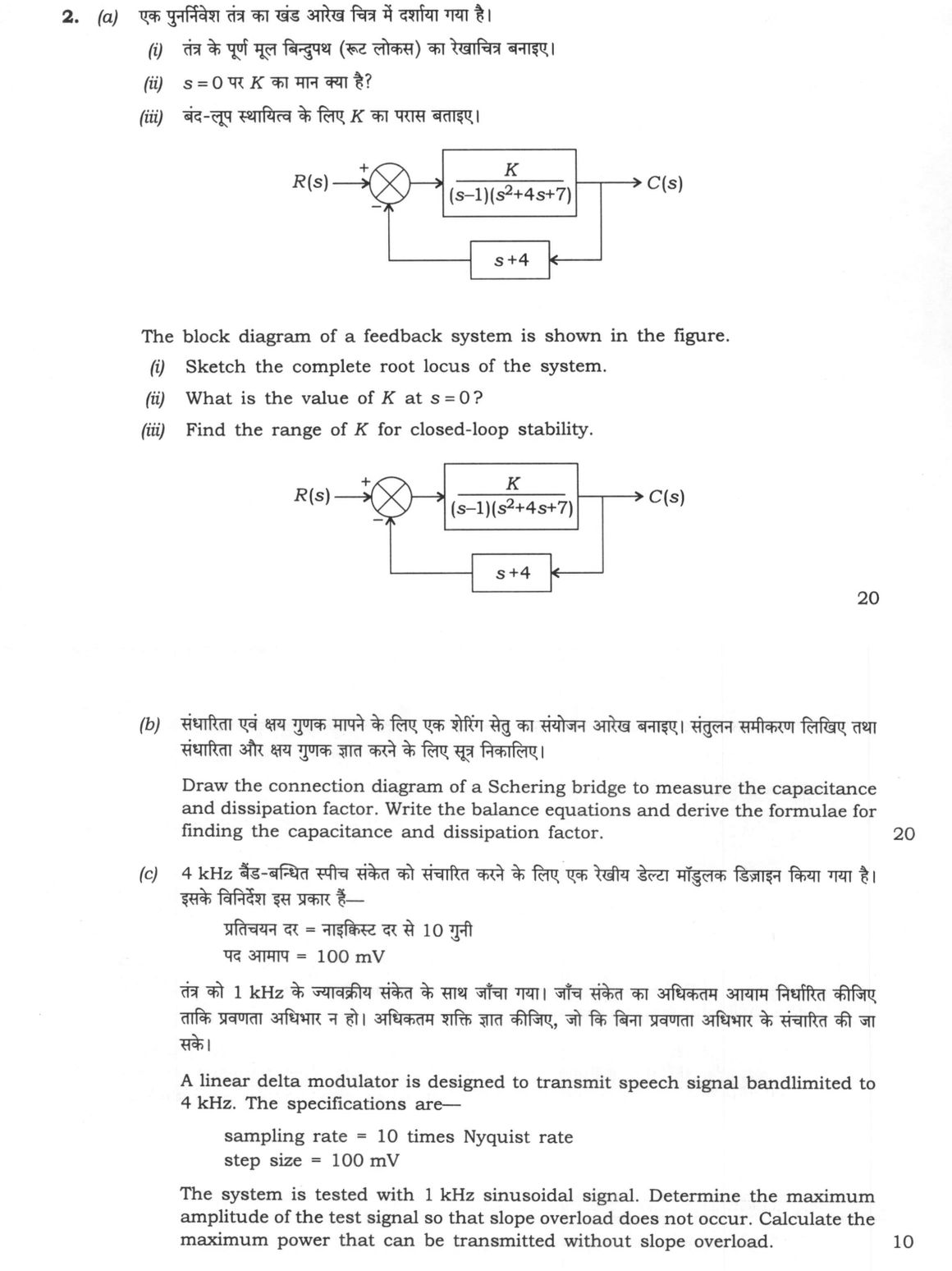
The figure this question refers to, in words
The question paper is a scan and the diagram did not survive as text. This is the figure as read from the original page — every component, value and label — so the question can be worked from the text below.
(a) A block diagram of a feedback control system. The input signal R(s) enters a summing junction where it is added to a negative feedback signal. The output of the summing junction is the input to a forward path block with the transfer function K / [(s-1)(s^2 + 4s + 7)]. The output of this block is the system output C(s). The output C(s) is fed back through a feedback path block with the transfer function s + 4, which returns to the negative input of the summing junction.
(c) An RLC circuit where the input voltage Vi(t) is applied across the input terminals. The top line contains a resistor R in series with an inductor L (L = 90 mu H). Following the inductor, a shunt capacitor C (C = 120 nF) is connected between the top line and the common bottom reference wire. The output voltage Vo(t) is measured across the capacitor C.
What "Solve" is asking you to do
Choose the method, then carry it through to a final answer. Identifying what kind of problem this is and why that method applies is the first thing marked; a correct figure arrived at invisibly earns almost nothing.
Structure that answers it
Given data and what is required → method chosen, with the reason it applies → set-up (equation, circuit, free body, trial balance) → working, step by step → answer with units and any condition of validity
Where marks are lost
Doing the middle steps mentally and writing only the result. In mathematics papers, a further loss comes from giving a decimal where the exact value in surds or fractions was wanted, or from skipping the justification a part explicitly asks for.
How this answer will be evaluated
Approach
(a) calculate: given > formula > substitution > result with units > interpretation | (b) derive: given > assumptions > stepwise derivation > result > check | (c) calculate: given > formula > substitution > result with units > interpretation Full marks: All parts fully solved with correct derivations, clear diagrams, and no errors.
Key points expected
- Characteristic equation: 1 + K(s+4)/[(s-1)(s^2+4s+7)] = 0
- Poles at s=1, -2±j3; zero at s=-4
- Asymptote centroid and angles calculated
- Routh-Hurwitz table for stability range
- Circuit diagram with four arms labeled
- Balance condition: Z1Z4 = Z2Z3
- Derivation of Cx = C3(C1/C2)
- Derivation of D = ωC1R1
Evaluation rubric
Each sub-part is marked on its own, against the marks and word limit printed on the paper.
- (a) Root locus sketch, K at s=0, and stability range for K. 20 marks
calculate— given → formula → substitution → result with units → interpretation
Must cover
- Characteristic equation: 1 + K(s+4)/[(s-1)(s^2+4s+7)] = 0
- Poles at s=1, -2±j3; zero at s=-4
- Asymptote centroid and angles calculated
- Routh-Hurwitz table for stability range
Loses marks
- Incorrect characteristic equation
- Missing asymptote calculation
- Routh table sign errors
Earns more
- Breakaway/break-in points calculated
- Angle of departure/arrival shown
- Imaginary axis crossing frequency found
Extra mark
- Sketch clearly labeled with all features
- (b) Schering bridge diagram, balance equations, and formulas for C and D. 20 marks
derive— given → assumptions → stepwise derivation → result → check
Must cover
- Circuit diagram with four arms labeled
- Balance condition: Z1Z4 = Z2Z3
- Derivation of Cx = C3(C1/C2)
- Derivation of D = ωC1R1
Loses marks
- Missing balance equation
- Incorrect impedance expressions
- No derivation steps shown
Earns more
- Impedance expressions for each arm
- Real and imaginary parts separated
- Advantages of Schering bridge mentioned
Extra mark
- Error analysis or practical considerations
- (c) Maximum amplitude and power for 1 kHz signal without slope overload. 10 marks
calculate— given → formula → substitution → result with units → interpretation
Must cover
- Nyquist rate: 2 × 4 kHz = 8 kHz
- Sampling rate: 10 × 8 kHz = 80 kHz
- Slope overload condition: Δf/Δt ≤ ΔV/Δt
- Max amplitude: A_max = Δf/(2πf)
Loses marks
- Incorrect Nyquist or sampling rate
- Missing slope overload condition
- Unit errors in final answer
Earns more
- Step size ΔV = 100 mV used correctly
- Power calculation: P = A^2/2
- Units consistent throughout
Extra mark
- Graphical representation of slope overload
Model answer coming soon
Every evaluation on this site is marked against a verified model answer. This question's answer is still being written; evaluation opens the moment it lands.
More from Electrical Engineering 2023 Paper II
- Q1 (a) The figure shows a unity feedback system. The steady-state value of the unit step res…
- Q2 (a) The block diagram of a feedback system is shown in the figure. (i) Sketch the complet…
- Q3 (a) Write the state and output equations for the system shown in the figure. Choose state…
- Q4 (a) Consider a systematic linear block code with binary elements whose parity check equat…
- Q5 (a) The figure shows a compensator network, where R₁ = 3 MΩ, R₂ = 1 MΩ, C = 1 μF. Vᵢ(t) a…