Paper II — Q8
(a) The figure shows a unity feedback system with G(s) = 2/s(s+1)(s+2)(s+3). (i) Sketch the approximate polar plot of…
The figure shows a unity feedback system with G(s) = 2/s(s+1)(s+2)(s+3).
Sketch the approximate polar plot of G(s).
Determine the closed-loop stability of the system using the polar plot of G(s).
Determine the gain margin of the system. 20 marks
Two ammeters having resistances of 1 Ω and 2 Ω respectively give full-scale deflections with 200 mA and 250 mA respectively. Find the shunt to be connected with these ammeters to extend their range to 20 A. The range extended ammeters are connected in parallel and then placed in a circuit in which a total current of 15 A is flowing. Find the readings of the ammeters. 20 marks
Two generating stations having short-circuit capacities of 1500 MVA and 1000 MVA respectively, and operating at 11 kV, are linked by an interconnected cable having a reactance of 0·7 Ω per phase. Determine the short-circuit capacity of each station after interconnection. 10 marks
हिंदी में प्रश्न पढ़ें
चित्र में G(s) = 2/s(s+1)(s+2)(s+3) के साथ एक इकाई पुनर्निवेश तंत्र प्रदर्शित की गई है।
G(s) का सरलिकृत ध्रुवी आरेख बनाइए।
G(s) के ध्रुवी आरेख को उपयोग में लेते हुए तंत्र का बंद-लूप स्थायित्व ज्ञात कीजिए।
तंत्र का लब्धि उपांत (गेन मार्जिन) ज्ञात कीजिए। 20
दो ऐमीटर, जिनके प्रतिरोध क्रमशः: 1 Ω एवं 2 Ω हैं, के पूर्ण-पैमाना विचेष क्रमशः: 200 mA एवं 250 mA हैं। इन ऐमीटरों के पारस को 20 A तक बढ़ाने के लिए संयोजित किया जाने वाला शंट ज्ञात कीजिए। पारस वर्धित ऐमीटरों (रेंज एक्सटेंडेड ऐमीटरों) को समांतर क्रम में जोड़ा गया है और फिर उनको एक ऐसे परिपथ में रखा गया है जिसमें कुल धारा 15 A बह रही है। दोनों ऐमीटरों के पाठ्यांकों (रीडिंग्स) को ज्ञात कीजिए। 20
दो विद्युत-उत्पादन केन्द्र, जिनकी लघुपथ क्षमताएँ क्रमशः: 1500 MVA एवं 1000 MVA हैं और 11 kV पर प्रचालित हैं, 0·7 Ω प्रतिघात प्रति कला वाली एक केबल द्वारा अन्तःसंयोजित (इन्टरकनेक्टेड) हैं। अन्तःसंयोजन के उपरांत प्रत्येक विद्युत-उत्पादन केन्द्र की लघुपथ क्षमता ज्ञात कीजिए। 10
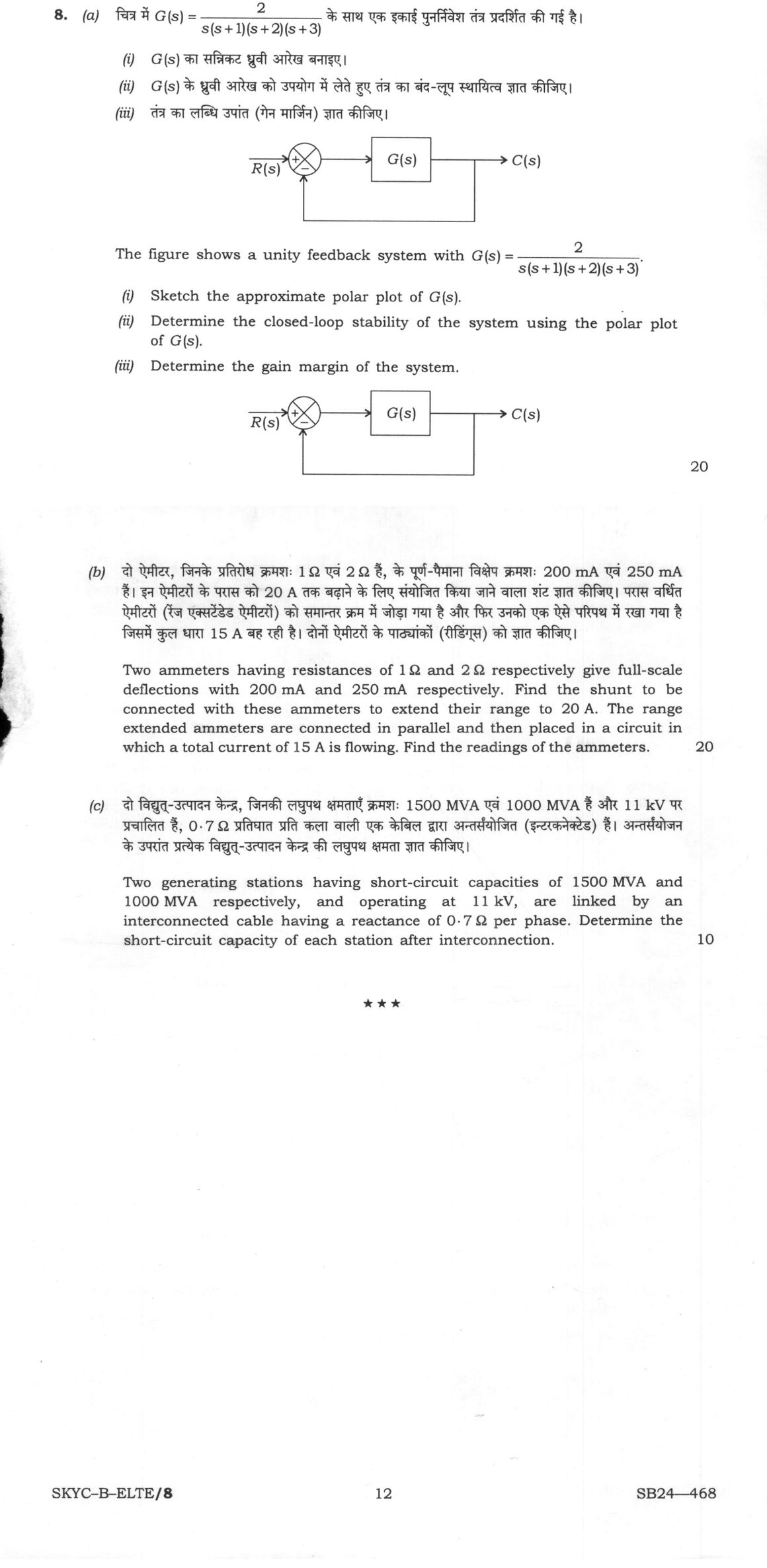
The figure this question refers to, in words
The question paper is a scan and the diagram did not survive as text. This is the figure as read from the original page — every component, value and label — so the question can be worked from the text below.
(a) A block diagram of a unity negative feedback control system. An input R(s) enters a summing junction with a plus sign (+). The output of the summing junction goes into a forward path transfer function block labelled G(s). The output of the block G(s) is labelled C(s). A feedback line branches from output C(s) and feeds back to the summing junction with a minus sign (-).
Model answer
Written by UPSC Answer Check against this question's marking rubric, to the expected length. UPSC does not publish answers for Mains — this is one way to score well, not an official key.
(a)(i) For G(s)=2/[s(s+1)(s+2)(s+3)], put s=jω:
G(jω)=2/[jω(1+jω)(2+jω)(3+jω)].
Let D=jω(1+jω)(2+jω)(3+jω). Expanding,
D=ω²(ω²−11)+j6ω(1−ω²).
So G=2/D. The polar plot points are:
- ω→0+: |G|→∞, phase→−90°, so curve comes from −j∞.
- 0<ω<1: real<0, imag<0, so curve lies in the third quadrant.
- ω=1: D=−10, hence G=−0.2+j0; it crosses the negative real axis at −0.2.
- 1<ω<√11: real<0, imag>0, so curve lies in the second quadrant.
- ω=√11: real=0 and G=j/(30√11)≈j0.0101; it crosses the positive imaginary axis.
- ω→∞: |G|→0, phase→−360°, so curve returns to the origin along the positive real axis.
Sketch: a large curve starting below the negative imaginary axis, crossing the negative real axis at −0.2, then crossing the positive imaginary axis near +j0.0101, and terminating at the origin from the right.
(a)(ii) Use the Nyquist stability criterion. For unity feedback, the critical point is −1+j0. The open-loop poles are s=0, −1, −2, −3. The pole at the origin is indented into the right half-plane; the number of open-loop poles in the right half-plane is P=0. The polar plot crosses the negative real axis only at −0.2, which lies to the right of −1. Hence the Nyquist plot does not encircle −1, so N=0. Then Z=N+P=0. Therefore there are no closed-loop poles in the right half-plane. The closed-loop system is stable.
(a)(iii) The phase crossover occurs at ω=1 rad/s, where G(j1)=−0.2+j0. Hence |G(j1)|=0.2. Gain margin is
GM=1/|G(jωpc)|=1/0.2=5.
In dB, GMdB=20 log10(5)≈13.98 dB.
Gain margin =5 (=13.98 dB). Since GM>1, the system is stable and can tolerate a fivefold increase in gain before marginal stability.
(b) For ammeter 1: Rm1=1 Ω, Ifs1=0.2 A, new range I=20 A. Multiplying factor m1=20/0.2=100. Shunt:
S1=Rm1/(m1−1)=1/(100−1)=1/99 Ω≈0.0101 Ω.
For ammeter 2: Rm2=2 Ω, Ifs2=0.25 A. Multiplying factor m2=20/0.25=80. Shunt:
S2=Rm2/(m2−1)=2/(80−1)=2/79 Ω≈0.0253 Ω.
Equivalent resistances of the extended ammeters:
Re1=Rm1∥S1=(1×1/99)/(1+1/99)=1/100 Ω.
Re2=Rm2∥S2=(2×2/79)/(2+2/79)=1/40 Ω.
When connected in parallel, equivalent resistance is
Req=(1/100×1/40)/(1/100+1/40)=1/140 Ω.
Total current is 15 A, so common voltage is
V=15×1/140=3/28 V.
Reading of first extended ammeter equals its branch current:
I1=V/Re1=(3/28)/(1/100)=75/7 A≈10.71 A.
Reading of second extended ammeter:
I2=V/Re2=(3/28)/(1/40)=30/7 A≈4.29 A.
Check: I1+I2=75/7+30/7=105/7=15 A.
Readings are 75/7 A ≈10.71 A and 30/7 A ≈4.29 A.
(c) Use equivalent reactance method. For a three-phase fault at VLL=11 kV, Ssc=VLL²/X, with V in kV and X in Ω, giving MVA. Thus V²=11²=121 kV².
Source reactances:
X1=121/1500=0.080667 Ω.
X2=121/1000=0.121 Ω.
Line reactance Xt=0.7 Ω.
At station 1 after interconnection, the local source is in parallel with the remote path X2+Xt:
S1′=S1+V²/(X2+Xt)=1500+121/(0.121+0.7)
=1500+121/0.821=1647.38 MVA.
At station 2:
S2′=S2+V²/(X1+Xt)=1000+121/(0.080667+0.7)
=1000+121/0.780667=1154.996 MVA.
Short-circuit capacities after interconnection: station 1 =1647.38 MVA; station 2 =1155.00 MVA. This assumes a balanced three-phase fault, negligible resistance, and 11 kV source voltage.
What "Solve" is asking you to do
Choose the method, then carry it through to a final answer. Identifying what kind of problem this is and why that method applies is the first thing marked; a correct figure arrived at invisibly earns almost nothing.
Structure that answers it
Given data and what is required → method chosen, with the reason it applies → set-up (equation, circuit, free body, trial balance) → working, step by step → answer with units and any condition of validity
Where marks are lost
Doing the middle steps mentally and writing only the result. In mathematics papers, a further loss comes from giving a decimal where the exact value in surds or fractions was wanted, or from skipping the justification a part explicitly asks for.
How this answer will be evaluated
Approach
(a) calculate: given > formula > substitution > result with units > interpretation | (b) calculate: given > formula > substitution > result with units > interpretation | (c) calculate: given > formula > substitution > result with units > interpretation Full marks: Complete working with correct values, clear diagrams, and proper units throughout.
Key points expected
- Evaluate G(jω) magnitude and phase at key frequencies
- Sketch polar plot showing asymptotes and origin
- Apply Nyquist criterion for closed-loop stability
- Calculate gain margin from phase crossover frequency
- Calculate shunt resistance for each ammeter
- Determine equivalent resistance of parallel combination
- Apply current division for 15A total current
- Calculate individual ammeter readings
Evaluation rubric
Each sub-part is marked on its own, against the marks and word limit printed on the paper.
- (a) Polar plot sketch, stability check, and gain margin calculation for G(s). 20 marks
calculate— given → formula → substitution → result with units → interpretation
Must cover
- Evaluate G(jω) magnitude and phase at key frequencies
- Sketch polar plot showing asymptotes and origin
- Apply Nyquist criterion for closed-loop stability
- Calculate gain margin from phase crossover frequency
Loses marks
- Missing phase crossover frequency calculation
- Incorrect stability conclusion without Nyquist analysis
- Polar plot not showing correct asymptotic behavior
Earns more
- Identify phase crossover frequency ω = √6 rad/s
- State gain margin as 1/2 or -6 dB
- Show asymptotic behavior at low and high frequencies
- Confirm system is stable with no encirclements
Extra mark
- Provide Bode plot for cross-verification
- Calculate phase margin for completeness
- (b) Shunt resistances for 20A range and parallel circuit current readings. 20 marks
calculate— given → formula → substitution → result with units → interpretation
Must cover
- Calculate shunt resistance for each ammeter
- Determine equivalent resistance of parallel combination
- Apply current division for 15A total current
- Calculate individual ammeter readings
Loses marks
- Incorrect shunt resistance calculation
- Missing parallel circuit analysis
- Readings not summing to total current
Earns more
- Show shunt formula R_s = I_g R_g / (I - I_g)
- Calculate shunt values: 0.01005Ω and 0.0201Ω
- Find parallel equivalent resistance correctly
- Show current division calculation steps
Extra mark
- Verify readings sum to 15A
- Calculate power dissipation in shunts
- (c) Short-circuit capacity of each station after interconnection. 10 marks
calculate— given → formula → substitution → result with units → interpretation
Must cover
- Convert MVA ratings to per-unit reactances
- Draw equivalent circuit with cable reactance
- Calculate fault current at each bus
- Convert back to MVA short-circuit capacity
Loses marks
- Missing per-unit conversion
- Incorrect equivalent circuit configuration
- Final answer not in MVA
Earns more
- Use 11kV as base voltage
- Calculate per-unit cable reactance correctly
- Show parallel combination of source impedances
- Present final MVA values for both stations
Extra mark
- Calculate fault current in kA
- Compare pre and post interconnection values
Practice this exact question
Write your answer and it is marked point by point against the model answer above — what you covered, what you missed, what you got wrong.
Evaluate my answer →More from Electrical Engineering 2023 Paper II
- Q5 (a) The figure shows a compensator network, where R₁ = 3 MΩ, R₂ = 1 MΩ, C = 1 μF. Vᵢ(t) a…
- Q6 (a) (i) A power system has two generators with the following cost curves : Generator 1 :…
- Q7 (a) A discrete memoryless source generates three independent message symbols m_1, m_2 and…
- Q8 (a) The figure shows a unity feedback system with G(s) = 2/s(s+1)(s+2)(s+3). (i) Sketch t…