Paper II — Q7
(a) A discrete memoryless source generates three independent message symbols m_1, m_2 and m_3 with probabilities 0·9, 0·08 and…
A discrete memoryless source generates three independent message symbols m_1, m_2 and m_3 with probabilities 0·9, 0·08 and 0·02 respectively.
Design a binary variable length Huffman code. (Assign '0' to the message with highest probability). Determine the average code length, compression ratio and coding efficiency.
Design a binary first-order extension code for this source and find the average code length for the designed code. Determine the compression ratio and efficiency for the extended code. 20 marks
What is the universal relay torque equation? Using this equation, derive the impedance relay, reactance relay and mho relay characteristics. Also draw the operating characteristic and indicate clearly the zones of operation and no operation. 20 marks
A single-phase distributor ABC fed at A is shown in the figure below. The impedances of the sections AB and BC are same and equal to (0·15 + j0·25) Ω. The power factors are lagging with respect to the voltage at the far end. If the voltage at the far end is 240 V, then determine the supply voltage and its phase angle with respect to the far end : 10 marks
हिंदी में प्रश्न पढ़ें
एक असतत स्मृतिहीन स्रोत, तीन स्वतंत्र संदेश प्रतीक-चिह्नों m_1, m_2 एवं m_3 का क्रमशः: 0·9, 0·08 एवं 0·02 प्रायिकताओं के साथ जनन करता है।
एक द्वि-आधारी परिवर्ती लम्बाई का हफमैन कूट डिजाइन कीजिए। ('0' उस संदेश को निर्दिष्ट कीजिए, जिसकी प्रायिकता अधिकतम हो।) औसत कूट लम्बाई, संपीड़न अनुपात एवं कोडन दक्षता ज्ञात कीजिए।
इस स्रोत के लिए एक द्वि-आधारी प्रथम-श्रेणी विस्तार कूट अभिकल्पित कीजिए और इस अभिकल्पित कूट के लिए औसत कूट लम्बाई ज्ञात कीजिए। विस्तारित कूट के लिए संपीड़न अनुपात एवं दक्षता निकालिए। 20
यूनिवर्सल रिले बल-आघूर्ण समीकरण क्या होता है? इस समीकरण का उपयोग करते हुए प्रतिबाधा रिले, प्रतिघात रिले एवं म्हो रिले के अभिलक्षणों को व्युत्पन्न कीजिए। इनके प्रचालन अभिलक्षणों को भी आरेखित कीजिए और प्रचालन व अप्रचालन क्षेत्रों (जोनस) को स्पष्टतापूर्वक दिखाइए। 20
एक एकल-कला वितरक ABC, जिसका भरण A सिरे पर है, नीचे चित्र में प्रदर्शित किया गया है। AB एवं BC खंडों (सेक्शन्स) की प्रतिबाधाएँ एकसमान हैं और उसका मान (0·15 + j0·25) Ω के बराबर है। शक्ति गुणक अंतिम सिरे की वोल्टता से पश्चता में हैं। यदि अंतिम सिरे की वोल्टता 240 V है, तो सप्लाई वोल्टता एवं उसका कला कोण, अंतिम सिरे के संदर्भ में, ज्ञात कीजिए : 10 marks
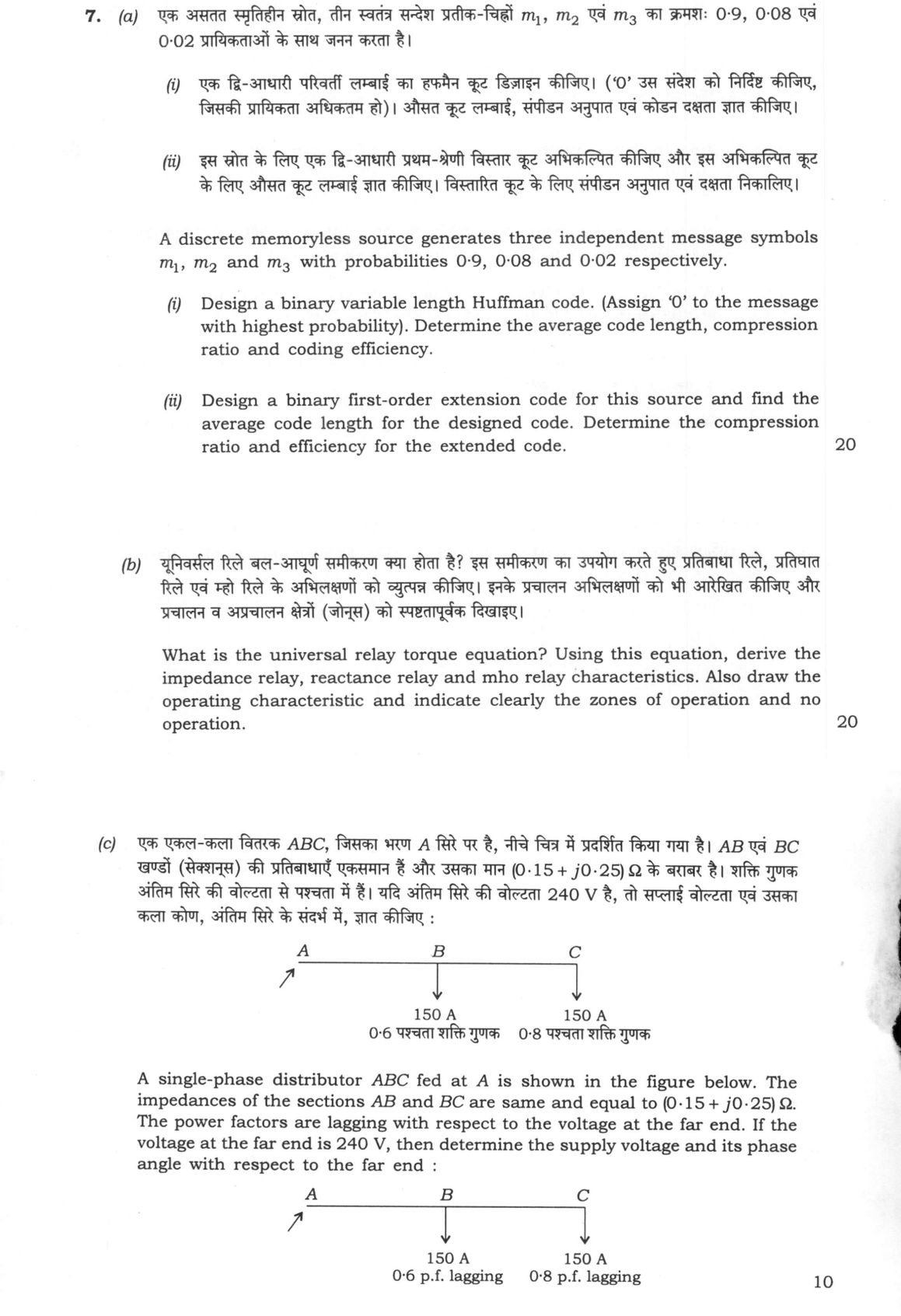
The figure this question refers to, in words
The question paper is a scan and the diagram did not survive as text. This is the figure as read from the original page — every component, value and label — so the question can be worked from the text below.
(c) A single-phase electrical distributor line diagram. A horizontal line represents the conductor with three points labeled A, B, and C from left to right. An arrow points to point A indicating the supply source. At point B, a vertical arrow points downward labeled '150 A' with the text '0.6 p.f. lagging' below it. At point C, a vertical arrow points downward labeled '150 A' with the text '0.8 p.f. lagging' below it. The text above the diagram states that the impedances of sections AB and BC are equal to (0.15 + j0.25) Ohm.
Model answer
Written by UPSC Answer Check against this question's marking rubric, to the expected length. UPSC does not publish answers for Mains — this is one way to score well, not an official key.
(a) (i) Use the Huffman method for a discrete memoryless source. The probabilities are 9/10, 2/25 and 1/50. The two least probable symbols are m₃ and m₂, so combine 0.02+0.08=0.10. The remaining probabilities are 0.90 and 0.10; combine them to 1.00. The tree gives depths 1, 2, 2. Assign 0 to m₁ as required:
- m₁=0, m₂=10, m₃=11. It satisfies Kraft equality: 1/2+1/4+1/4=1. The code is prefix-free, hence uniquely decodable. Average code length L=0.9(1)+0.08(2)+0.02(2)=0.90+0.16+0.04=11/10=1.10 bits/symbol. Entropy H=−Σp log₂p. For this source, H=0.9 log₂(10/9)+0.08 log₂(12.5)+0.02 log₂(50)=0.1368+0.2915+0.1129=0.5412 bits/symbol. Taking the uncompressed representation as the 2-bit fixed-length code for three symbols, compression ratio CR=2/(11/10)=20/11=1.818. Coding efficiency η=H/L=0.5412/1.10=0.492=49.2%. The efficiency is below 100% because L is still above H. Average length = 1.10 bits/symbol, CR = 1.818, efficiency = 49.2%.
(ii) For a first-order extension, group two independent symbols. The pair probabilities are products: 11=0.81, 12=0.072, 21=0.072, 13=0.018, 31=0.018, 22=0.0064, 23=0.0016, 32=0.0016, 33=0.0004. Their sum is 1.0000. Apply Huffman merging to these nine probabilities: 33+23=0.0020; 32+0.0020=0.0036; 22+0.0036=0.0100; 13+0.0100=0.0280; 31+0.0280=0.0460; 12+0.0460=0.1180; 21+0.1180=0.1900; 11+0.1900=1.0000. The resulting depths are 11=1, 21=2, 12=3, 31=4, 13=5, 22=6, 32=7, 33=8, 23=8. One valid prefix code is:
- 11=0, 21=10, 12=110, 31=1110, 13=11110, 22=111111, 32=1111100, 33=11111010, 23=11111011. No codeword is a prefix of another, so the extended code is uniquely decodable. Average length per extended symbol, i.e. per pair, is L₂=0.81(1)+0.072(2)+0.072(3)+0.018(4)+0.018(5)+0.0064(6)+0.0016(7)+0.0004(8)+0.0016(8) =0.81+0.144+0.216+0.072+0.090+0.0384+0.0112+0.0032+0.0128=1747/1250=1.3976 bits/pair. The value is below 2 bits/pair because the dominant pair 11 has length 1. Per original source symbol this is L₂/2=1747/2500=0.6988 bits/symbol. This is well below the original 1.10 bits/symbol. The entropy of the first-order extension is H₂=2H=1.0824 bits/pair. A fixed-length binary code for nine pair symbols needs 4 bits/pair. Hence CR=4/(1747/1250)=5000/1747=2.862, equivalently 2/0.6988=2.862. Efficiency η=H₂/L₂=1.0824/1.3976=0.774=77.4%. The extension improves efficiency because the pair distribution is more peaked than the single-symbol distribution. Average length = 1.3976 bits/pair, i.e. 0.6988 bits/symbol, CR = 2.862, efficiency = 77.4%.
(b) For sinusoidal steady state, constant impedances, and an ideal relay whose trip threshold is absorbed into the constants, the universal relay torque equation is T=K₁VI cos(θ−φ)+K₂V²+K₃I². Here T is torque in N·m for consistent units, V and I are rms phasors, θ is the angle of V with respect to I, φ is the relay phase angle, and K₁, K₂, K₃ are relay constants. The three terms are cross torque, voltage torque, and current torque. Let the fault impedance seen by the relay be Zf=V/I=R+jX. Then V=I(R+jX), so VI cos(θ−φ)=I²(R cosφ+X sinφ), V²=I²(R²+X²). The operating boundary is obtained by setting T=0: K₁(R cosφ+X sinφ)+K₂(R²+X²)+K₃=0. For K₂≠0, divide by K₂ and put A=K₁/K₂, B=K₃/K₂: R²+X²+A(R cosφ+X sinφ)+B=0. Completing the square gives (R+A/2 cosφ)²+(X+A/2 sinφ)²=A²/4−B. This is the general circle form in the R–X plane; the radius is real only when A²/4−B≥0. The side that operates is selected by the signs of the constants; the usual settings are stated below.
- Impedance relay: choose K₁=0 and B=−Zset². The linear terms vanish, giving R²+X²=Zset². It is a circle centred at the origin with radius Zset. The operating zone is the interior of the circle; the no-operation zone is the exterior.
- Reactance relay: choose K₂=0, φ=90°, and K₃=−K₁Xset. Then cosφ=0 and sinφ=1, so the boundary is X=Xset. It is a straight horizontal line parallel to the R axis. With the usual forward setting, the operating zone is the side containing the origin, X<Xset; the no-operation zone is X>Xset.
- Mho relay: choose K₃=0, A=−Zset, and φ=φset. The characteristic is R²+X²−Zset(R cosφset+X sinφset)=0. This is a circle through the origin with diameter Zset∠φset. Its centre is (Zset/2 cosφset, Zset/2 sinφset) and its radius is Zset/2. The operating zone is the interior; the no-operation zone is the exterior. Drawing: draw the R axis horizontal to the right and the X axis vertical upward. For the impedance relay, draw a circle centred at the origin with radius Zset. For the reactance relay, draw a horizontal line at X=Xset and shade the side containing the origin. For the mho relay, plot the point (Zset cosφset, Zset sinφset), draw the circle having the line from the origin to that point as its diameter, and shade the interior. Mark the unshaded exterior or upper region as no operation.
(c) Assume sinusoidal steady state and constant section impedances. Take the far-end voltage at C as reference: V_C=240∠0 V. The load power factors are lagging with respect to V_C, so the current angles are θ_C=−cos⁻¹0.8=−36.87°, θ_B=−cos⁻¹0.6=−53.13°. Thus I_C=150∠−36.87°=150(0.8−j0.6)=120−j90 A, I_B=150∠−53.13°=150(0.6−j0.8)=90−j120 A. Section BC carries only the C load, so I_BC=I_C. Section AB carries the B load plus the current feeding C, so I_AB=I_B+I_C=210−j210 A. Each section impedance is Z=0.15+j0.25 Ω. Voltage drop in BC: I_CZ=(120−j90)(0.15+j0.25)=(120×0.15+90×0.25)+j(120×0.25−90×0.15)=40.5+j16.5 V. Therefore V_B=V_C+I_CZ=240+40.5+j16.5=280.5+j16.5 V. Voltage drop in AB: I_ABZ=(210−j210)(0.15+j0.25)=(210×0.15+210×0.25)+j(210×0.25−210×0.15)=84+j21 V. Therefore V_A=V_B+I_ABZ=280.5+j16.5+84+j21=364.5+j37.5 V. As a check, V_A=V_C+I_BZ+2I_CZ; I_BZ=43.5+j4.5 V and 2I_CZ=81+j33 V, giving the same 364.5+j37.5 V. The supply voltage magnitude is |V_A|=√(364.5²+37.5²)=√134266.5=366.4 V. The phase angle of V_A with respect to V_C is tan⁻¹(37.5/364.5)=tan⁻¹(25/243)=5.87°. All voltages are rms values, and the positive angle means the supply voltage leads the far-end voltage. Supply voltage = 366.4 V, leading the far-end voltage by 5.87°.
What "Design" is asking you to do
Produce a specification that meets the given brief and demonstrate that it does. In civil and electrical papers the design is incomplete until it is expressed in buildable numbers — diameter, spacing, section, component value — and checked back against every limit stated.
Structure that answers it
Requirements and permissible values listed → code clause or design basis adopted → proportioning calculations → the specification in final dimensions → check against each requirement → sketch
Where marks are lost
Stopping at a required area or a required value without converting it into the bar size, spacing or component actually provided. The provided-against-required comparison and the serviceability or stability check are separately marked and routinely left out.
How this answer will be evaluated
Approach
(a(i)) calculate: given > formula > substitution > result with units > interpretation | (a(ii)) calculate: given > formula > substitution > result with units > interpretation | (b) derive: given > assumptions > stepwise derivation > result > check | (c) calculate: given > formula > substitution > result with units > interpretation Full marks: Complete derivations, correct phasor diagrams, and accurate numerical results with units.
Key points expected
- Construct Huffman tree with '0' for highest probability
- Calculate average code length (L)
- Calculate source entropy (H)
- Determine compression ratio and efficiency
- List 9 message pairs with joint probabilities
- Construct Huffman tree for the extended source
- Calculate average code length per symbol
- State universal relay torque equation
Evaluation rubric
Each sub-part is marked on its own, against the marks and word limit printed on the paper.
- (a(i)) Huffman code design and performance metrics for the given source.
calculate— given → formula → substitution → result with units → interpretation
Must cover
- Construct Huffman tree with '0' for highest probability
- Calculate average code length (L)
- Calculate source entropy (H)
- Determine compression ratio and efficiency
Loses marks
- Assigning '0' to lowest probability symbol
- Omitting entropy calculation
Earns more
- Correct binary code assignment for m1, m2, m3
- Explicit calculation of H = -Σ p log p
Extra mark
- Comparison of L with H
- (a(ii)) First-order extension code design and performance metrics.
calculate— given → formula → substitution → result with units → interpretation
Must cover
- List 9 message pairs with joint probabilities
- Construct Huffman tree for the extended source
- Calculate average code length per symbol
- Determine compression ratio and efficiency
Loses marks
- Using single-symbol probabilities for extension
- Failing to divide total length by 2
Earns more
- Correct calculation of joint probabilities (e.g., 0.81, 0.072)
- Comparison of extended code efficiency with part (i)
Extra mark
- Note on convergence of efficiency to 100%
- (b) Derivation of relay characteristics from universal torque equation. 20 marks
derive— given → assumptions → stepwise derivation → result → check
Must cover
- State universal relay torque equation
- Derive impedance relay characteristic (circle through origin)
- Derive reactance relay characteristic (horizontal line)
- Derive mho relay characteristic (circle through origin)
Loses marks
- Missing the universal torque equation
- Incorrect geometric representation of characteristics
Earns more
- Draw operating characteristic diagrams for each relay
- Indicate zones of operation and no-operation clearly
Extra mark
- Comparison of sensitivity of the three relays
- (c) Supply voltage and phase angle for the single-phase distributor. 10 marks
calculate— given → formula → substitution → result with units → interpretation
Must cover
- Draw circuit diagram with loads at B and C
- Calculate current phasors for loads at B and C
- Calculate voltage drop in sections AB and BC
- Determine supply voltage magnitude and phase angle
Loses marks
- Ignoring reactive component of voltage drop
- Incorrect current direction or load placement
Earns more
- Use of phasor diagram for voltage drop calculation
- Correct handling of lagging power factor angles
Extra mark
- Calculation of voltage regulation
Practice this exact question
Write your answer and it is marked point by point against the model answer above — what you covered, what you missed, what you got wrong.
Evaluate my answer →More from Electrical Engineering 2023 Paper II
- Q4 (a) Consider a systematic linear block code with binary elements whose parity check equat…
- Q5 (a) The figure shows a compensator network, where R₁ = 3 MΩ, R₂ = 1 MΩ, C = 1 μF. Vᵢ(t) a…
- Q6 (a) (i) A power system has two generators with the following cost curves : Generator 1 :…
- Q7 (a) A discrete memoryless source generates three independent message symbols m_1, m_2 and…
- Q8 (a) The figure shows a unity feedback system with G(s) = 2/s(s+1)(s+2)(s+3). (i) Sketch t…