Paper I — Q2
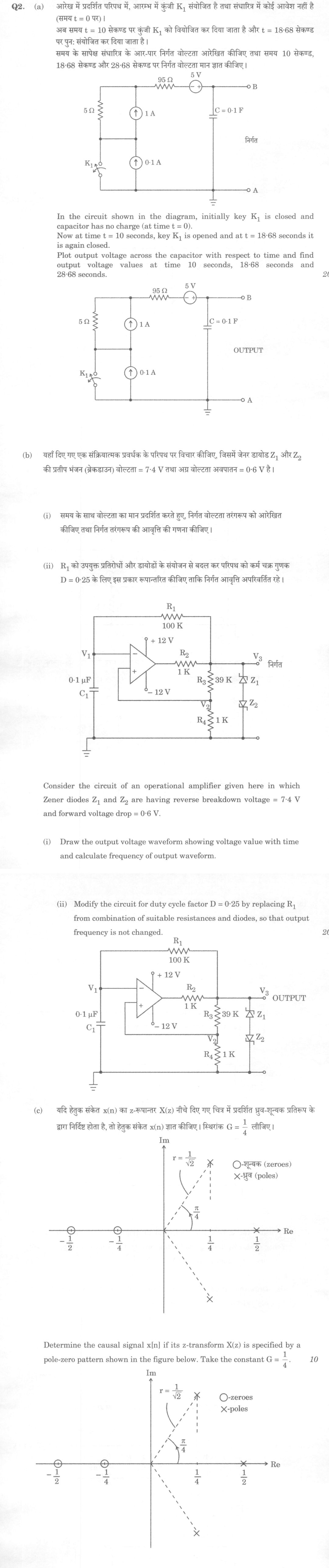
(a) In the circuit shown in the diagram, initially key K₁ is closed and capacitor has no charge (at time t = 0). Now at time t =…
In the circuit shown in the diagram, initially key K₁ is closed and capacitor has no charge (at time t = 0). Now at time t = 10 seconds, key K₁ is opened and at t = 18·68 seconds it is again closed. Plot output voltage across the capacitor with respect to time and find output voltage values at time 10 seconds, 18·68 seconds and 28·68 seconds. 20 marks
Consider the circuit of an operational amplifier given here in which Zener diodes Z₁ and Z₂ are having reverse breakdown voltage = 7·4 V and forward voltage drop = 0·6 V. (i) Draw the output voltage waveform showing voltage value with time and calculate frequency of output waveform. (ii) Modify the circuit for duty cycle factor D = 0·25 by replacing R₁ from combination of suitable resistances and diodes, so that output frequency is not changed. 20 marks
Determine the causal signal x[n] if its z-transform X(z) is specified by a pole-zero pattern shown in the figure below. Take the constant G = 1/4. 10 marks
हिंदी में प्रश्न पढ़ें
आरेख में प्रदर्शित परिपथ में, आरंभ में कुंजी K₁ संयोजित है तथा संधारित्र में कोई आवेश नहीं है (समय t = 0 पर)। अब समय t = 10 सेकंड पर कुंजी K₁ को विचोजित कर दिया जाता है और t = 18·68 सेकंड पर पुनः संयोजित कर दिया जाता है। समय के सापेक्ष संधारित्र के आर-पार निर्गत वोल्टता आरेखित कीजिए तथा समय 10 सेकंड, 18·68 सेकंड और 28·68 सेकंड पर निर्गत वोल्टता मान ज्ञात कीजिए। 20
यहाँ दिए गए एक संक्रियात्मक प्रवर्धक के परिपथ पर विचार कीजिए, जिसमें जेनर डायोड Z₁ और Z₂ की प्रतिप भंजन (ब्रेकडाउन) वोल्टता = 7·4 V तथा अग्र वोल्टता अवपातन = 0·6 V है। (i) समय के साथ वोल्टता का मान प्रदर्शित करते हुए, निर्गत वोल्टता तरंगरूप को आरेखित कीजिए तथा निर्गत तरंगरूप की आवृत्ति की गणना कीजिए। (ii) R₁ को उपयुक्त प्रतिरोधों और डायोडों के संयोजन से बदल कर परिपथ को कर्म चक्र गुणांक D = 0·25 के लिए इस प्रकार रूपांतरित कीजिए ताकि निर्गत आवृत्ति अपरिवर्तित रहे। 20
यदि हेतुक संकेत x(n) का z-रूपान्तर X(z) नीचे दिए गए चित्र में प्रदर्शित ध्रुव-शून्यक प्रतिरूप के द्वारा निर्दिष्ट होता है, तो हेतुक संकेत x(n) ज्ञात कीजिए। स्थिरांक G = 1/4 लीजिए। 10
The figure this question refers to, in words
The question paper is a scan and the diagram did not survive as text. This is the figure as read from the original page — every component, value and label — so the question can be worked from the text below.
(a) Circuit diagram for a transient analysis problem. The circuit consists of a DC voltage source of 5 V in series with a 95 Ohm resistor. This series combination is connected to a node labeled 'B'. From node B, a capacitor with capacitance C = 0.1 F is connected to a bottom reference node labeled 'A', which is grounded. The output voltage is measured across the capacitor between terminals B and A. The 5 V source is connected to the other end of the 95 Ohm resistor, which connects to a node on the left. This left node is connected to a parallel combination of a 5 Ohm resistor and a current source of 1 A (pointing upwards). The bottom of this parallel combination connects to a switch K1. The other terminal of switch K1 connects to the bottom reference node A. Additionally, a current source of 0.1 A (pointing upwards) is connected in parallel with the switch K1, bridging the node between the 5 Ohm resistor/1 A source and the bottom reference node A. The switch K1 is shown in the open position in the diagram.
(b) A two-stage transistor amplifier circuit. The power supply is V_CC = 12 V. The input signal is labeled 'Input' (Hindi: निवेश) and is coupled to the base of transistor T1 via a 10 uF capacitor C1. Transistor T1 is an NPN transistor. Its collector is connected to V_CC via a 9.1 K resistor R1. Its emitter is connected to a node shared with the base of transistor T2. This node is connected to ground via a 36 K resistor R3. The base of T1 is also connected to a feedback network consisting of a 100 K resistor R4 and a 200 Ohm resistor R5 in series, which connects the emitter of T2 to the base of T1. The 200 Ohm resistor R5 is bypassed to ground by a 3.3 uF capacitor C4. The emitter of T2 is connected to ground via a 1.3 K resistor R6. Transistor T2 is an NPN transistor. Its collector is connected to V_CC via a 2 K resistor R2. The collector of T2 is also connected to the base of T1 via a 10 uF capacitor C2. The output is labeled 'Output' (Hindi: निर्गत) and is taken from the collector of T2, coupled through a 100 uF capacitor C3 to a 10 K load resistor R_L. The emitter of T2 is also connected to ground via a 1 K resistor R7 and a 100 uF capacitor C5 in parallel. The text states that for transistors T1 and T2, V_BE = 0.6 V and beta = 499.
(c) A pole-zero plot on the complex z-plane. The horizontal axis is labeled 'Re' and the vertical axis is labeled 'Im'. The origin is at the intersection. Zeros are marked with circles and poles with crosses. There are two zeros located on the negative real axis at coordinates -1/2 and -1/4. There are three poles: one is located on the positive real axis at coordinate 1/2. The other two are complex conjugate poles located in the first and fourth quadrants. The pole in the first quadrant is connected to the origin by a dashed line, with the magnitude labeled 'r = 1/sqrt(2)' and the angle labeled 'pi/4'. A legend in the top right corner indicates that a circle represents a zero and a cross represents a pole.
What "Solve" is asking you to do
Choose the method, then carry it through to a final answer. Identifying what kind of problem this is and why that method applies is the first thing marked; a correct figure arrived at invisibly earns almost nothing.
Structure that answers it
Given data and what is required → method chosen, with the reason it applies → set-up (equation, circuit, free body, trial balance) → working, step by step → answer with units and any condition of validity
Where marks are lost
Doing the middle steps mentally and writing only the result. In mathematics papers, a further loss comes from giving a decimal where the exact value in surds or fractions was wanted, or from skipping the justification a part explicitly asks for.
How this answer will be evaluated
Approach
Framework: Circuit Analysis & Signal Processing. (a) calculate: given > formula > substitution > result with units > interpretation | (b) calculate: given > formula > substitution > result with units > interpretation | (c) calculate: given > formula > substitution > result with units > interpretation Full marks: Complete circuit analysis with all steps, correct values, and clear diagrams
Key points expected
- Thevenin equivalent circuits for part (a)
- Zener diode voltage clamping in part (b)
- Partial fraction expansion in part (c)
- Correct time constant calculations
- Proper waveform sketches
Evaluation rubric
Each sub-part is marked on its own, against the marks and word limit printed on the paper.
- (a) Capacitor voltage at t=10s, 18.68s, 28.68s and plot
calculate— given → formula → substitution → result with units → interpretation
Must cover
- Thevenin equivalent for K1 closed/open states
- Time constant calculation for each state
- Voltage values at specified time points
- Sketch of v_c(t) waveform
Loses marks
- Missing Thevenin equivalent circuit
- Incorrect time constant calculation
Earns more
- Correct sign convention for capacitor voltage
- Explicit statement of initial conditions
Extra mark
- Labeled time constants on the plot
- (b) Output waveform, frequency, and modified circuit for D=0.25
calculate— given → formula → substitution → result with units → interpretation
Must cover
- Output voltage levels using Zener parameters
- Frequency calculation using R1 and C1
- Waveform sketch with voltage values
- Modified R1 circuit for D=0.25
Loses marks
- Ignoring Zener forward voltage drop
- Incorrect frequency formula application
Earns more
- Correct Zener voltage drop application
- Clear labeling of high/low states
Extra mark
- Duty cycle calculation shown explicitly
- (c) Causal signal x[n] from pole-zero plot 10 marks
calculate— given → formula → substitution → result with units → interpretation
Must cover
- X(z) expression from pole-zero locations
- Partial fraction expansion
- Inverse Z-transform for each term
- Final x[n] expression
Loses marks
- Incorrect pole-zero identification
- Missing inverse Z-transform steps
Earns more
- Correct handling of complex conjugate poles
- Explicit ROC statement for causality
Extra mark
- Verification of initial value theorem
Model answer coming soon
Every evaluation on this site is marked against a verified model answer. This question's answer is still being written; evaluation opens the moment it lands.
More from Electrical Engineering 2025 Paper I
- Q1 (a) In the circuit given below, find the voltages at point A and point B. 10 marks (b) De…
- Q2 (a) In the circuit shown in the diagram, initially key K₁ is closed and capacitor has no…
- Q3 (a) Consider the Boolean function: F(A, B, C, D) = Σ m (1, 3, 4, 11, 12, 13, 14, 15). Imp…
- Q4 (a) For the Schottky transistor circuit shown below, determine I_B, I_D, I_C and V_CE. Ne…
- Q5 (a) As shown in the figure, just inside the surface of a dielectric slab, the electric fi…