Paper I — Q5
(a) As shown in the figure, just inside the surface of a dielectric slab, the electric field (E₁) is 15 V/m and it makes an angle…
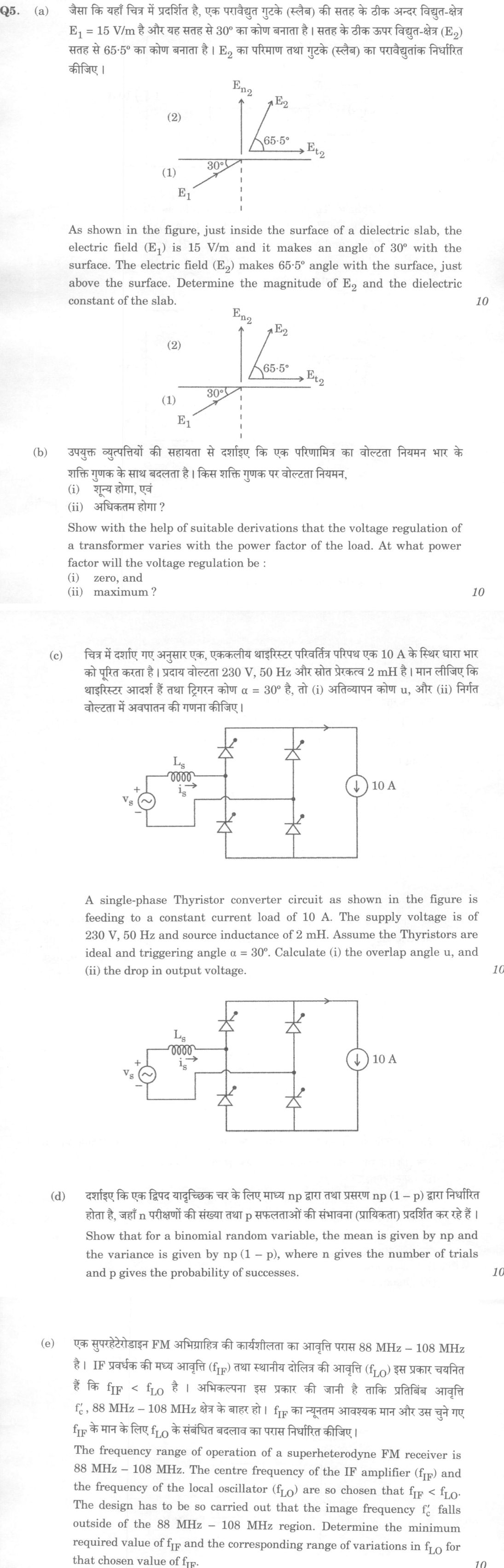
As shown in the figure, just inside the surface of a dielectric slab, the electric field (E₁) is 15 V/m and it makes an angle of 30° with the surface. The electric field (E₂) makes 65.5° angle with the surface, just above the surface. Determine the magnitude of E₂ and the dielectric constant of the slab. 10 marks
Show with the help of suitable derivations that the voltage regulation of a transformer varies with the power factor of the load. At what power factor will the voltage regulation be : (i) zero, and (ii) maximum ? 10 marks
A single-phase Thyristor converter circuit as shown in the figure is feeding to a constant current load of 10 A. The supply voltage is of 230 V, 50 Hz and source inductance of 2 mH. Assume the Thyristors are ideal and triggering angle α = 30°. Calculate (i) the overlap angle u, and (ii) the drop in output voltage. 10 marks
Show that for a binomial random variable, the mean is given by np and the variance is given by np (1 – p), where n gives the number of trials and p gives the probability of successes. 10 marks
The frequency range of operation of a superheterodyne FM receiver is 88 MHz – 108 MHz. The centre frequency of the IF amplifier (f_IF) and the frequency of the local oscillator (f_LO) are so chosen that f_IF < f_LO. The design has to be so carried out that the image frequency f'_c falls outside of the 88 MHz – 108 MHz region. Determine the minimum required value of f_IF and the corresponding range of variations in f_LO for that chosen value of f_IF. 10 marks
हिंदी में प्रश्न पढ़ें
जैसा कि यहाँ चित्र में प्रदर्शित है, एक परावैद्युत गुटके (स्लैब) की सतह के ठीक अंदर विद्युत-क्षेत्र E₁ = 15 V/m है और यह सतह से 30° का कोण बनाता है। सतह के ठीक ऊपर विद्युत-क्षेत्र (E₂) सतह से 65.5° का कोण बनाता है। E₂ का परिमाण तथा गुटके (स्लैब) का परावैद्युतांक निर्धारित कीजिए। (10 अंक)
उपयुक्त न्युतियों की सहायता से दर्शाइए कि एक परिणामित्र का वोल्टता नियमन भार के शक्ति गुणक के साथ बदलता है। किस शक्ति गुणक पर वोल्टता नियमन, (i) शून्य होगा, एवं (ii) अधिकतम होगा? (10 अंक)
चित्र में दर्शाए गए अनुसार एक, एककलीय थाइरिस्टर परिवर्तित्र परिपथ एक 10 A के स्थिर धारा भार को पूरित करता है। प्रदाय वोल्टता 230 V, 50 Hz और स्रोत प्रेरकत्व 2 mH है। मान लीजिए कि थाइरिस्टर आदर्श हैं तथा ट्रिगर कोण α = 30° है, तो (i) अतिव्यापन कोण u, और (ii) निर्गत वोल्टता में अवपातन की गणना कीजिए। (10 अंक)
दर्शाइए कि एक द्विपद यादृच्छिक चर के लिए माध्य np द्वारा तथा प्रसरण np (1 – p) द्वारा निर्धारित होता है, जहाँ n परीक्षणों की संख्या तथा p सफलताओं की संभावना (प्रायिकता) प्रदर्शित कर रहे हैं। (10 अंक)
एक सुपरहेटेरोडाइन FM अभिग्राहित की कार्यशीलता का आवृत्ति परास 88 MHz – 108 MHz है। IF प्रवर्धक की मध्य आवृत्ति (f_IF) तथा स्थानीय दोलित्र की आवृत्ति (f_LO) इस प्रकार चयनित हैं कि f_IF < f_LO है। अभिकल्पना इस प्रकार की जानी है ताकि प्रतिबिंब आवृत्ति f'_c, 88 MHz – 108 MHz क्षेत्र के बाहर हो। f_IF का न्यूनतम आवश्यक मान और उस चुने गए f_IF के मान के लिए f_LO के संबंधित बदलाव का परास निर्धारित कीजिए। (10 अंक)
The figure this question refers to, in words
The question paper is a scan and the diagram did not survive as text. This is the figure as read from the original page — every component, value and label — so the question can be worked from the text below.
(a) A diagram illustrating the boundary conditions of an electric field at the interface of a dielectric slab. A horizontal solid line represents the surface separating two regions: region (1) below (inside the slab) and region (2) above. A vertical dashed line indicates the normal to the surface. In region (1), a vector labeled E1 points upwards and to the right, making an angle of 30 degrees with the horizontal surface. In region (2), a vector labeled E2 points upwards and to the right, making an angle of 65.5 degrees with the horizontal surface. The components of E2 are explicitly shown: a vertical component labeled En2 and a horizontal component labeled Et2.
(c) A single-phase full-bridge thyristor converter circuit. On the left, an AC voltage source labeled Vs is connected in series with an inductor labeled Ls. The current flowing through the inductor is labeled is with an arrow pointing to the right. The inductor connects to the top and bottom AC input terminals of a bridge rectifier. The bridge consists of four thyristors arranged in a standard full-bridge configuration: two thyristors in the upper arms and two in the lower arms. The DC output terminals of the bridge are connected to a load on the right. The load is represented by a current source symbol (a circle with a downward-pointing arrow) labeled 10 A. An arrow at the top of the load indicates the direction of current flow.
Model answer
Written by UPSC Answer Check against this question's marking rubric, to the expected length. UPSC does not publish answers for Mains — this is one way to score well, not an official key.
(a) Take region 1 as the dielectric slab and region 2 as air. With no free surface charge at the boundary, the boundary conditions are: tangential electric field continuous, and normal electric flux density continuous. The given angles are with the surface, so for a field E making angle θ with the surface, the tangential component is E cosθ and the normal component is E sinθ.
- Tangential E: E₁ cos30° = E₂ cos65.5°.
- Normal D: ε₁ E₁ sin30° = ε₂ E₂ sin65.5°.
Here ε₂ = ε₀ and ε₁ = εr ε₀, where εr is the relative permittivity, or dielectric constant, of the slab.
From the tangential condition, E₂ = 15 cos30° / cos65.5° = 15(√3/2)/cos65.5°. Using cos30° = 0.866025 and cos65.5° ≈ 0.414694, E₂ ≈ 15(0.866025)/0.414694 ≈ 31.3 V/m.
Divide the normal condition by the tangential condition: (ε₁/ε₂)(E₁ sin30°)/(E₁ cos30°) = (E₂ sin65.5°)/(E₂ cos65.5°), so (ε₁/ε₂) tan30° = tan65.5°. Since ε₁/ε₂ = εr, εr = tan65.5°/tan30°. With tan65.5° ≈ 2.194 and tan30° = 1/√3 ≈ 0.577350, εr ≈ 2.194/0.577350 ≈ 3.80.
Final: E₂ ≈ 31.3 V/m and εr ≈ 3.80, dimensionless.
(b) Let E₂ be the no-load secondary induced emf in volts, V₂ the full-load terminal voltage in volts, I₂ the full-load current in amperes, and R and X the equivalent resistance and reactance in ohms referred to the secondary. Voltage regulation is VR = (E₂ - V₂)/V₂, often expressed as 100 × (E₂ - V₂)/V₂ percent. Take V₂ as the reference phasor.
For a lagging power factor cosφ, the current phasor is I₂∠-φ. The series drop is I₂(R + jX)∠-φ. Hence E₂ = [V₂ + I₂(R cosφ + X sinφ)] + j[I₂(X cosφ - R sinφ)]. The exact magnitude is E₂ = √((V₂ + I₂(R cosφ + X sinφ))² + (I₂(X cosφ - R sinφ))²). For the usual small transformer voltage drop, the quadrature term is neglected in the magnitude approximation, giving E₂ ≈ V₂ + I₂(R cosφ + X sinφ). Therefore VR_lag ≈ I₂(R cosφ + X sinφ)/V₂.
For a leading power factor, the current phasor is I₂∠+φ. Repeating the resolution gives the in-phase drop as I₂(R cosφ - X sinφ), so VR_lead ≈ I₂(R cosφ - X sinφ)/V₂. These expressions show that regulation depends on both cosφ and sinφ, and the sign of the reactive drop changes with the power-factor angle.
(i) Zero regulation requires the approximate in-phase drop to be zero: R cosφ - X sinφ = 0. Thus tanφ = R/X. This is a leading power factor because the reactive drop opposes the resistive drop. The corresponding power factor is cosφ = 1/√(1 + (R/X)²) = X/√(R² + X²), leading.
(ii) Maximum regulation occurs for a lagging power factor, where the resistive and reactive drops add. Maximize f(φ) = R cosφ + X sinφ. Differentiate: df/dφ = -R sinφ + X cosφ. Set df/dφ = 0: X cosφ = R sinφ, so tanφ = X/R. The second derivative is -R cosφ - X sinφ, which is negative for positive R and X, so this gives a maximum. The power factor is cosφ = R/√(R² + X²), lagging. The maximum approximate regulation is I₂√(R² + X²)/V₂. Validity: small drops, I₂√(R² + X²) << V₂.
(c) Given: Vs = 230 V rms, f = 50 Hz, Ls = 2 mH = 0.002 H, Id = 10 A, α = 30°. The thyristors are ideal, so their voltage drops are neglected; only source inductance causes overlap and output voltage drop.
The peak supply voltage is Vm = 230√2 V ≈ 325.27 V. The angular frequency is ω = 2πf = 100π rad/s ≈ 314.16 rad/s.
For a single-phase full-bridge thyristor converter with source inductance, the commutation relation from volt-second balance is cosα - cos(α + u) = 2ωLsId/Vm. Substitute the data: 2ωLsId/Vm = 2(100π)(0.002)(10)/(230√2) = 4π/(230√2) ≈ 0.03863. Therefore cos(30° + u) = cos30° - 0.03863 = √3/2 - 0.03863 ≈ 0.866025 - 0.038634 = 0.827391. Hence 30° + u = cos⁻¹(0.827391) ≈ 34.17°, and u ≈ 34.17° - 30° = 4.17°.
The average output voltage drop is the average of the voltage lost during the overlap interval. The lost volt-seconds per half cycle are ∫ from α to α+u of Vm sin(ωt) d(ωt) = Vm[cosα - cos(α + u)]. Using the commutation relation, this equals 2ωLsId. Averaging over a half cycle of π radians gives ΔV = 2ωLsId/π. Substitute: ΔV = 2(100π)(0.002)(10)/π = 4 V.
Final: u ≈ 4.17° and ΔV = 4.00 V.
(d) Let X be a binomial random variable with n trials and success probability p. Put q = 1 - p. The probability mass function is P(X = k) = C(n,k)pᵏqⁿ⁻ᵏ, for k = 0,1,...,n, where C(n,k) is the binomial coefficient.
The mean is E[X] = Σ over k = 0 to n of k C(n,k)pᵏqⁿ⁻ᵏ. The k = 0 term is zero. Use the identity k C(n,k) = n C(n-1,k-1). Then E[X] = n p Σ over k = 1 to n of C(n-1,k-1)pᵏ⁻¹qⁿ⁻ᵏ. Let j = k - 1. Then j runs from 0 to n-1, and E[X] = n p Σ over j = 0 to n-1 of C(n-1,j)pʲqⁿ⁻¹⁻ʲ. By the binomial theorem, the sum is (p + q)ⁿ⁻¹ = 1. Therefore E[X] = np.
For the variance, compute E[X(X-1)] first: E[X(X-1)] = Σ over k = 0 to n of k(k-1) C(n,k)pᵏqⁿ⁻ᵏ. Terms k = 0 and k = 1 are zero. Use k(k-1) C(n,k) = n(n-1) C(n-2,k-2). Then E[X(X-1)] = n(n-1)p² Σ over k = 2 to n of C(n-2,k-2)pᵏ⁻²qⁿ⁻ᵏ. Let j = k - 2. Then E[X(X-1)] = n(n-1)p² Σ over j = 0 to n-2 of C(n-2,j)pʲqⁿ⁻²⁻ʲ = n(n-1)p²(p + q)ⁿ⁻² = n(n-1)p².
Now E[X²] = E[X(X-1) + X] = E[X(X-1)] + E[X] = n(n-1)p² + np. Hence Var(X) = E[X²] - (E[X])² = n(n-1)p² + np - (np)² = n(n-1)p² + np - n²p² = np - np² = np(1-p). This holds for n a non-negative integer and 0 ≤ p ≤ 1.
Final: mean = np and variance = np(1-p).
(e) For the standard high-side injection FM superheterodyne arrangement, the local oscillator is above the carrier: fLO = fc + fIF. The mixer produces the difference fLO - fc = fIF. The image frequency f′c is the unwanted RF that also gives the same IF: |f′c - fLO| = fIF. With high-side injection, the image lies above the LO, so f′c = fLO + fIF = fc + 2fIF.
The receiver tuning range is fc = 88 MHz to 108 MHz. The image must fall outside this band. Since f′c = fc + 2fIF increases with fc, the lowest image frequency occurs at fc = 88 MHz. To keep even this lowest image outside the band, it must be at least the upper end of the band: 88 MHz + 2fIF ≥ 108 MHz. Therefore 2fIF ≥ 20 MHz, fIF ≥ 10 MHz. The minimum required IF is fIF(min) = 10 MHz.
For this chosen IF, the local oscillator frequency is fLO = fc + 10 MHz. When fc = 88 MHz, fLO = 98 MHz. When fc = 108 MHz, fLO = 118 MHz. Thus the LO must vary from 98 MHz to 118 MHz. This also satisfies fIF < fLO because 10 MHz is less than every LO frequency in the range.
Final: minimum fIF = 10 MHz; corresponding fLO range = 98 MHz to 118 MHz.
What "Solve" is asking you to do
Choose the method, then carry it through to a final answer. Identifying what kind of problem this is and why that method applies is the first thing marked; a correct figure arrived at invisibly earns almost nothing.
Structure that answers it
Given data and what is required → method chosen, with the reason it applies → set-up (equation, circuit, free body, trial balance) → working, step by step → answer with units and any condition of validity
Where marks are lost
Doing the middle steps mentally and writing only the result. In mathematics papers, a further loss comes from giving a decimal where the exact value in surds or fractions was wanted, or from skipping the justification a part explicitly asks for.
How this answer will be evaluated
Approach
(a) calculate: given > formula > substitution > result with units > interpretation | (b) derive: given > assumptions > stepwise derivation > result > check | (c) calculate: given > formula > substitution > result with units > interpretation | (d) derive: given > assumptions > stepwise derivation > result > check | (e) calculate: given > formula > substitution > result with units > interpretation Full marks: Complete derivations/calculations with correct formulas, clear steps, and proper units.
Key points expected
- Apply boundary conditions for E and D
- Resolve E1 and E2 into normal and tangential components
- Use continuity of tangential E field
- Use continuity of normal D field
- Draw equivalent circuit of transformer
- Derive voltage regulation formula with pf
- Identify condition for zero regulation
- Identify condition for maximum regulation
Evaluation rubric
Each sub-part is marked on its own, against the marks and word limit printed on the paper.
- (a) Magnitude of E2 and dielectric constant of the slab. 10 marks
calculate— given → formula → substitution → result with units → interpretation
Must cover
- Apply boundary conditions for E and D
- Resolve E1 and E2 into normal and tangential components
- Use continuity of tangential E field
- Use continuity of normal D field
Loses marks
- Confusing angle with surface vs normal
- Ignoring dielectric constant in D calculation
Earns more
- Correctly identify angles with the normal
- State relative permittivity relation
Extra mark
- Draw vector diagram of fields
- (b) Derivation of voltage regulation vs power factor and conditions for zero/max. 10 marks
derive— given → assumptions → stepwise derivation → result → check
Must cover
- Draw equivalent circuit of transformer
- Derive voltage regulation formula with pf
- Identify condition for zero regulation
- Identify condition for maximum regulation
Loses marks
- Missing derivation steps
- Incorrect sign convention in phasor diagram
Earns more
- Phasor diagram showing voltage drop
- Mention leading/lagging power factor effects
Extra mark
- Graphical representation of regulation curve
- (c) Overlap angle u and drop in output voltage. 10 marks
calculate— given → formula → substitution → result with units → interpretation
Must cover
- Use overlap angle formula for single-phase converter
- Substitute given values (I, Ls, V, f)
- Calculate voltage drop due to source inductance
- State assumptions (ideal thyristors)
Loses marks
- Incorrect formula for overlap angle
- Ignoring source inductance effect
Earns more
- Show intermediate calculation steps
- Mention effect of overlap on output
Extra mark
- Sketch of voltage/current waveforms
- (d) Proof that mean is np and variance is np(1-p). 10 marks
derive— given → assumptions → stepwise derivation → result → check
Must cover
- Define binomial distribution PMF
- Derive mean using expectation definition
- Derive variance using E[X^2] - (E[X])^2
- Show algebraic simplification steps
Loses marks
- Skipping algebraic steps
- Incorrect use of summation limits
Earns more
- Use factorial properties correctly
- State conditions for binomial distribution
Extra mark
- Mention connection to Poisson distribution
- (e) Minimum f_IF and range of f_LO variations. 10 marks
calculate— given → formula → substitution → result with units → interpretation
Must cover
- Use image frequency formula f'_c = f_LO + f_IF
- Set condition for f'_c outside 88-108 MHz
- Calculate minimum f_IF
- Determine corresponding f_LO range
Loses marks
- Incorrect image frequency formula
- Ignoring the f_IF < f_LO condition
Earns more
- Explain superheterodyne principle briefly
- Show frequency relationship diagram
Extra mark
- Mention practical considerations for f_IF
Practice this exact question
Write your answer and it is marked point by point against the model answer above — what you covered, what you missed, what you got wrong.
Evaluate my answer →More from Electrical Engineering 2025 Paper I
- Q2 (a) In the circuit shown in the diagram, initially key K₁ is closed and capacitor has no…
- Q3 (a) Consider the Boolean function: F(A, B, C, D) = Σ m (1, 3, 4, 11, 12, 13, 14, 15). Imp…
- Q4 (a) For the Schottky transistor circuit shown below, determine I_B, I_D, I_C and V_CE. Ne…
- Q5 (a) As shown in the figure, just inside the surface of a dielectric slab, the electric fi…
- Q6 (a) (i) What is meant by armature reaction in DC machines ? Show with the help of develop…
- Q7 (a) It is given that E⃗ = Eₘ sin (ω t - α z) â_y in free space α > 0. (i) Determine D⃗,…
- Q8 (a) (i) Show that the Smith chart constructed for a lossless transmission line gives a fa…