Paper I — Q4
(a) For the Schottky transistor circuit shown below, determine I_B, I_D, I_C and V_CE. Next, remove the Schottky diode and…
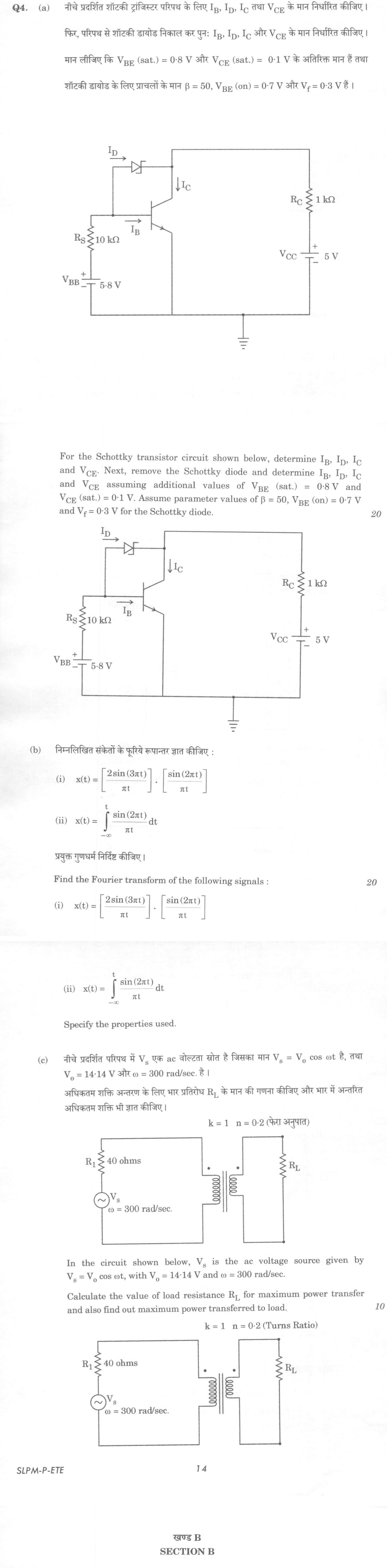
For the Schottky transistor circuit shown below, determine I_B, I_D, I_C and V_CE. Next, remove the Schottky diode and determine I_B, I_D, I_C and V_CE assuming additional values of V_BE (sat.) = 0.8 V and V_CE (sat.) = 0.1 V. Assume parameter values of β = 50, V_BE (on) = 0.7 V and V_f = 0.3 V for the Schottky diode. 20 marks
Find the Fourier transform of the following signals: x(t) = [2sin(3πt)/πt] · [sin(2πt)/πt]
x(t) = ∫₋∞^t [sin(2πt)/πt] dt Specify the properties used. 20 marks
In the circuit shown below, Vₛ is the ac voltage source given by Vₛ = V₀ cos ωt, with V₀ = 14.14 V and ω = 300 rad/sec. Calculate the value of load resistance R_L for maximum power transfer and also find out maximum power transferred to load. k = 1, n = 0.2 (Turns Ratio) 10 marks
हिंदी में प्रश्न पढ़ें
नीचे प्रदर्शित शॉटकी ट्रांजिस्टर परिपथ के लिए I_B, I_D, I_C तथा V_CE के मान निर्धारित कीजिए। फिर, परिपथ से शॉटकी डायोड निकाल कर पुनः I_B, I_D, I_C और V_CE के मान निर्धारित कीजिए। मान लीजिए कि V_BE (sat.) = 0.8 V और V_CE (sat.) = 0.1 V के अतिरिक्त मान हैं तथा शॉटकी डायोड के लिए प्राचलों के मान β = 50, V_BE (on) = 0.7 V और V_f = 0.3 V हैं। (20 अंक)
निम्नलिखित संकेतों के फुरिये रूपांतर ज्ञात कीजिए: x(t) = [2sin(3πt)/πt] · [sin(2πt)/πt]
x(t) = ∫₋∞^t [sin(2πt)/πt] dt प्रयुक्त गुणधर्म निर्दिष्ट कीजिए। (20 अंक)
नीचे प्रदर्शित परिपथ में Vₛ एक ac वोल्टता स्रोत है जिसका मान Vₛ = V₀ cos ωt है, तथा V₀ = 14.14 V और ω = 300 rad/sec. है। अधिकतम शक्ति अंतरण के लिए भार प्रतिरोध R_L के मान की गणना कीजिए और भार में अंतरित अधिकतम शक्ति भी ज्ञात कीजिए। k = 1, n = 0.2 (फेरा अनुपात) (10 अंक)
The figure this question refers to, in words
The question paper is a scan and the diagram did not survive as text. This is the figure as read from the original page — every component, value and label — so the question can be worked from the text below.
(a) An NPN bipolar junction transistor (BJT) circuit with a Schottky diode. The circuit has three main nodes: a base node, a collector node, and an emitter node. The emitter is connected directly to ground. The base node is connected to one end of a resistor RS (10 kOhm). The other end of RS is connected to the positive terminal of a DC voltage source VBB (5.8 V). The negative terminal of VBB is connected to ground. The base node is also connected to the anode of a Schottky diode. The cathode of the Schottky diode is connected to the collector node. The collector node is connected to one end of a resistor RC (1 kOhm). The other end of RC is connected to the positive terminal of a DC voltage source VCC (5 V). The negative terminal of VCC is connected to ground. The current through the Schottky diode is labeled ID and flows from the base to the collector. The base current is labeled IB and flows into the base. The collector current is labeled IC and flows into the collector. The collector-emitter voltage is labeled VCE.
(c) An AC circuit with a primary side and a secondary side coupled by an ideal transformer. Primary side: an AC voltage source Vs (marked with a sine wave symbol and omega = 300 rad/sec) is connected in series with a resistor R1 = 40 ohms. The primary winding of the transformer is connected across the series combination of Vs and R1. Secondary side: the secondary winding of the transformer is connected across a load resistor RL. The transformer has a dot on the top terminal of the primary winding and a dot on the top terminal of the secondary winding. The turns ratio is given as n = 0.2 and k = 1. The quantity to be determined is the value of RL for maximum power transfer and the maximum power transferred to the load.
Model answer
Written by UPSC Answer Check against this question's marking rubric, to the expected length. UPSC does not publish answers for Mains — this is one way to score well, not an official key.
(a) Let VBE = 0.7 V. Assume the Schottky diode is ON. Then VB − VC = Vf = 0.3 V, so VC = VCE = 0.7 − 0.3 = 0.4 V.
Base-resistor current: I_RS = (5.8 − 0.7)/(10 kΩ) = 0.51 mA = 510 µA.
Collector-resistor current: I_RC = (5 − 0.4)/(1 kΩ) = 4.6 mA.
At the base node: I_RS = IB + ID, so ID = 510 µA − IB.
At the collector node: IC = I_RC + ID.
The Schottky clamp prevents deep saturation, so the transistor remains active: IC = βIB = 50 IB.
Substitute: 50 IB = 4.6 mA + 510 µA − IB 50 IB = 5.11 mA − IB 51 IB = 5.11 mA IB = 0.100196 mA ≈ 100.2 µA.
Then: IC = 50 × 100.2 µA = 5.01 mA ID = 510 − 100.2 = 409.8 µA.
IB = 100.2 µA, ID = 409.8 µA, IC = 5.01 mA, VCE = 0.4 V.
Now remove the Schottky diode. Then ID = 0. Use VBE(sat) = 0.8 V and VCE(sat) = 0.1 V. IB = (5.8 − 0.8)/(10 kΩ) = 5.0/10 kΩ = 0.5 mA = 500 µA. IC = (5 − 0.1)/(1 kΩ) = 4.9 mA. Check saturation: βIB = 50 × 0.5 mA = 25 mA > IC, so saturation is valid.
IB = 500 µA, ID = 0, IC = 4.9 mA, VCE = 0.1 V.
(b)(i) Use X(ω) = ∫₋∞^∞ x(t) e^(−jωt) dt. Let A(ω) = FT{sin(3πt)/(πt)} = 1 for |ω| < 3π, else 0. B(ω) = FT{sin(2πt)/(πt)} = 1 for |ω| < 2π, else 0.
By the multiplication-in-time property, multiplication corresponds to convolution in frequency: X(ω) = 2/(2π) [A(ω) * B(ω)] = (1/π) C(ω).
Here C(ω) is the overlap of the intervals [−3π, 3π] and [ω−2π, ω+2π]. Therefore: C(ω) = 4π for |ω| ≤ π, C(ω) = 5π − |ω| for π ≤ |ω| ≤ 5π, C(ω) = 0 for |ω| ≥ 5π.
Hence X(ω) = 4 for |ω| ≤ π, X(ω) = 5 − |ω|/π for π ≤ |ω| ≤ 5π, X(ω) = 0 for |ω| ≥ 5π.
Properties used: known Fourier transform of sin(Wt)/(πt), linearity, and time-domain multiplication → frequency-domain convolution.
(b)(ii) Let g(t) = sin(2πt)/(πt). Then G(ω) = 1 for |ω| < 2π, else 0.
Here x(t) = ∫₋∞^t g(τ) dτ. Using the time-integration property: X(ω) = G(ω)/(jω) + πG(0)δ(ω).
Since G(0) = 1, X(ω) = πδ(ω) + 1/(jω) for 0 < |ω| < 2π, X(ω) = 0 for |ω| > 2π. The δ(ω) term represents the dc value. Property used: integration in time domain.
(c) Taking the given turns ratio as n = N₂/N₁ = 0.2. Reflect the load to the primary side: R_ref = RL/n² = RL/0.04 = 25 RL.
For maximum power transfer, the reflected load resistance must equal the source resistance: R_ref = R1 = 40 Ω. So 25 RL = 40 Ω, giving RL = 1.6 Ω.
Now V₀ = 14.14 V peak, so V_rms = 14.14/√2 = 10 V.
Maximum power transferred: P_max = V_rms²/(4R1) = 10²/(4 × 40) = 100/160 = 0.625 W.
Thus, RL = 1.6 Ω and P_max = 0.625 W. Condition: ideal transformer with k = 1, lossless coupling, and purely resistive conjugate matching.
What "Solve" is asking you to do
Choose the method, then carry it through to a final answer. Identifying what kind of problem this is and why that method applies is the first thing marked; a correct figure arrived at invisibly earns almost nothing.
Structure that answers it
Given data and what is required → method chosen, with the reason it applies → set-up (equation, circuit, free body, trial balance) → working, step by step → answer with units and any condition of validity
Where marks are lost
Doing the middle steps mentally and writing only the result. In mathematics papers, a further loss comes from giving a decimal where the exact value in surds or fractions was wanted, or from skipping the justification a part explicitly asks for.
How this answer will be evaluated
Approach
(a) calculate: given > formula > substitution > result with units > interpretation | (b) calculate: given > formula > substitution > result with units > interpretation | (c) calculate: given > formula > substitution > result with units > interpretation Full marks: Complete circuit analysis with correct diode logic; rigorous application of Fourier properties with clear naming; correct impedance reflection and power calculation.
Key points expected
- Redraw circuit with diode and mark reference directions
- Apply KVL to base-emitter loop to find I_B
- Determine diode state (on/off) using V_f = 0.3 V
- Calculate I_C and V_CE for both configurations
- Identify the rectangular pulse transform for the sin(πt)/t terms
- Apply the multiplication property (convolution in frequency)
- Apply the integration property for the second signal
- Explicitly name the properties used in the solution
Evaluation rubric
Each sub-part is marked on its own, against the marks and word limit printed on the paper.
- (a) Determine I_B, I_D, I_C, V_CE for the Schottky circuit and the modified circuit without the diode. 20 marks
calculate— given → formula → substitution → result with units → interpretation
Must cover
- Redraw circuit with diode and mark reference directions
- Apply KVL to base-emitter loop to find I_B
- Determine diode state (on/off) using V_f = 0.3 V
- Calculate I_C and V_CE for both configurations
Loses marks
- Ignoring the Schottky diode in the first part
- Using V_BE(on) instead of V_f for the diode drop
- Sign errors in KVL equations
Earns more
- Explicitly state assumption of active vs saturation region
- Show calculation for I_D using KCL at collector node
- Verify saturation condition for the diode-less case
Extra mark
- Sketch the I-V characteristic showing operating point
- (b) Find the Fourier transform of the two given signals and specify the properties used. 20 marks
calculate— given → formula → substitution → result with units → interpretation
Must cover
- Identify the rectangular pulse transform for the sin(πt)/t terms
- Apply the multiplication property (convolution in frequency)
- Apply the integration property for the second signal
- Explicitly name the properties used in the solution
Loses marks
- Confusing time-domain multiplication with frequency-domain convolution
- Failing to specify the properties used as requested
- Incorrect limits of integration or frequency
Earns more
- Correctly determine the frequency limits of the rectangular pulses
- Show the convolution integral or result for part (i)
- Handle the DC term (delta function) correctly in part (ii)
Extra mark
- Sketch the resulting frequency domain spectrum
- (c) Calculate the load resistance R_L for maximum power transfer and the maximum power transferred. 10 marks
calculate— given → formula → substitution → result with units → interpretation
Must cover
- Reflect the load resistance R_L to the primary side
- Apply the maximum power transfer theorem (R_L' = R_1)
- Calculate the value of R_L using the turns ratio n
- Compute the maximum power using the source voltage and resistance
Loses marks
- Using the wrong turns ratio formula (n vs 1/n)
- Using peak voltage directly in the power formula P = V^2/R
- Ignoring the source resistance R_1 in the matching condition
Earns more
- Correctly use the turns ratio n = 0.2 in the impedance transformation
- Convert peak voltage V_0 to RMS for power calculation
- Show the equivalent circuit with the reflected impedance
Extra mark
- Draw the equivalent circuit with the ideal transformer
Practice this exact question
Write your answer and it is marked point by point against the model answer above — what you covered, what you missed, what you got wrong.
Evaluate my answer →More from Electrical Engineering 2025 Paper I
- Q1 (a) In the circuit given below, find the voltages at point A and point B. 10 marks (b) De…
- Q2 (a) In the circuit shown in the diagram, initially key K₁ is closed and capacitor has no…
- Q3 (a) Consider the Boolean function: F(A, B, C, D) = Σ m (1, 3, 4, 11, 12, 13, 14, 15). Imp…
- Q4 (a) For the Schottky transistor circuit shown below, determine I_B, I_D, I_C and V_CE. Ne…
- Q5 (a) As shown in the figure, just inside the surface of a dielectric slab, the electric fi…
- Q6 (a) (i) What is meant by armature reaction in DC machines ? Show with the help of develop…
- Q7 (a) It is given that E⃗ = Eₘ sin (ω t - α z) â_y in free space α > 0. (i) Determine D⃗,…