Paper I — Q7
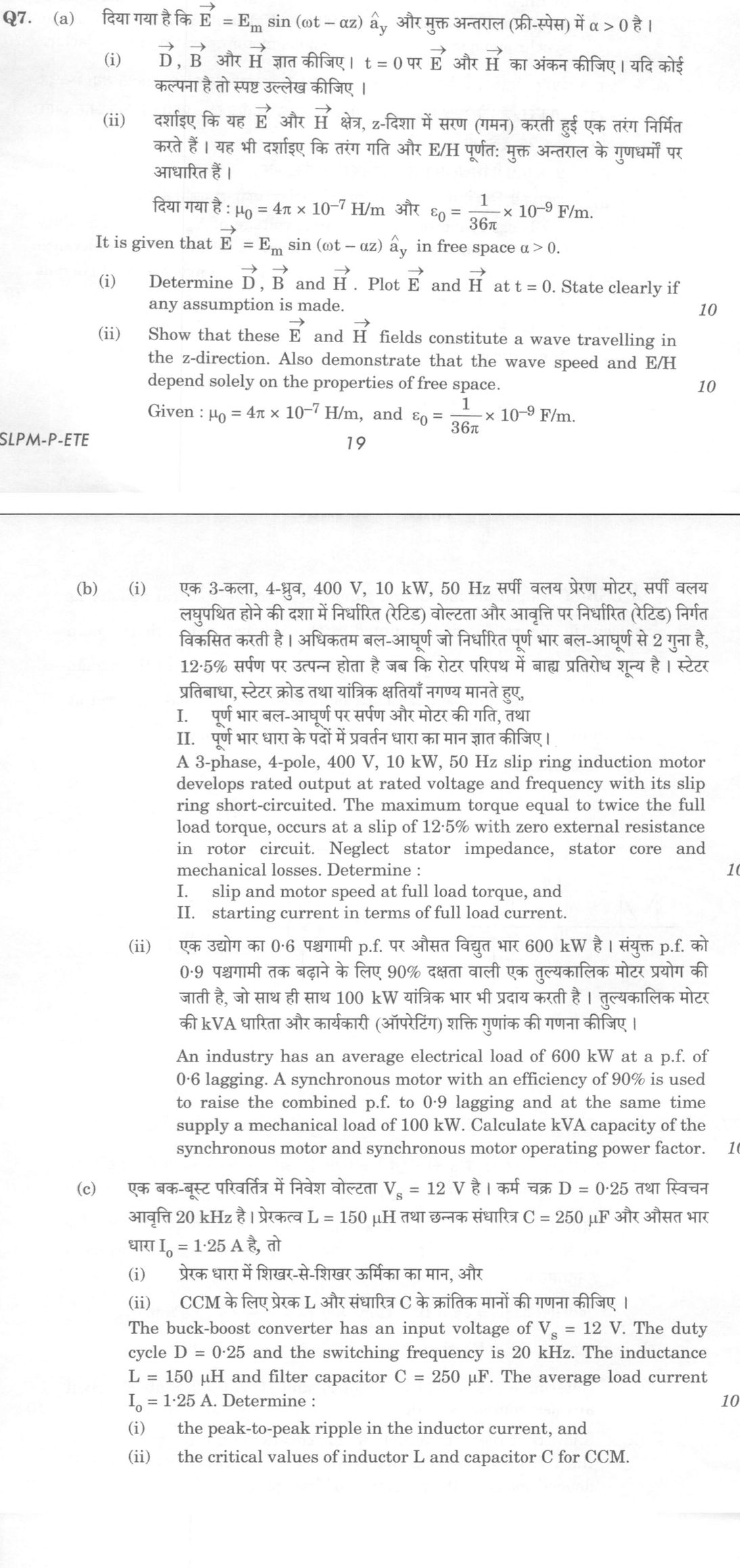
(a) It is given that E⃗ = Eₘ sin (ω t - α z) â_y in free space α > 0. (i) Determine D⃗, B⃗ and H⃗. Plot E⃗ and H⃗ at t = 0…
It is given that E⃗ = Eₘ sin (ω t - α z) â_y in free space α > 0.
Determine D⃗, B⃗ and H⃗. Plot E⃗ and H⃗ at t = 0. State clearly if any assumption is made.
Show that these E⃗ and H⃗ fields constitute a wave travelling in the z-direction. Also demonstrate that the wave speed and E/H depend solely on the properties of free space.
Given : μ₀ = 4π × 10⁻⁷ H/m, and ε₀ = 1/(36π) × 10⁻⁹ F/m.
A 3-phase, 4-pole, 400 V, 10 kW, 50 Hz slip ring induction motor develops rated output at rated voltage and frequency with its slip ring short-circuited. The maximum torque equal to twice the full load torque, occurs at a slip of 12·5% with zero external resistance in rotor circuit. Neglect stator impedance, stator core and mechanical losses. Determine :
I. slip and motor speed at full load torque, and II. starting current in terms of full load current. 10 marks
An industry has an average electrical load of 600 kW at a p.f. of 0·6 lagging. A synchronous motor with an efficiency of 90% is used to raise the combined p.f. to 0·9 lagging and at the same time supply a mechanical load of 100 kW. Calculate kVA capacity of the synchronous motor and synchronous motor operating power factor. 10 marks
The buck-boost converter has an input voltage of Vₛ = 12 V. The duty cycle D = 0·25 and the switching frequency is 20 kHz. The inductance L = 150 μH and filter capacitor C = 250 μF. The average load current I₀ = 1·25 A. Determine :
the peak-to-peak ripple in the inductor current, and
the critical values of inductor L and capacitor C for CCM. 10 marks
हिंदी में प्रश्न पढ़ें
दिया गया है कि E⃗ = Eₘ sin (ω t - α z) â_y और मुक्त अंतराल (फ्री-स्पेस) में α > 0 है।
D⃗, B⃗ और H⃗ ज्ञात कीजिए। t = 0 पर E⃗ और H⃗ का अंकन कीजिए। यदि कोई कल्पना है तो स्पष्ट उल्लेख कीजिए।
दर्शाइए कि यह E⃗ और H⃗ क्षेत्र, z-दिशा में सरण (गमन) करती हुई एक तरंग निर्मित करते हैं। यह भी दर्शाइए कि तरंग गति और E/H पूर्णतः मुक्त अंतराल के गुणधर्मों पर आधारित है।
दिया गया है : μ₀ = 4π × 10⁻⁷ H/m और ε₀ = 1/(36π) × 10⁻⁹ F/m.
एक 3-कला, 4-ध्रुव, 400 V, 10 kW, 50 Hz सर्पी बलय प्रेरण मोटर, सर्पी बलय लघुपथित होने की दशा में निर्धारित (रेटेड) वोल्टता और आवृत्ति पर निर्धारित (रेटेड) निर्गत विकसित करती है। अधिकतम बल-आघूर्ण जो निर्धारित पूर्ण भार बल-आघूर्ण से 2 गुना है, 12·5% सर्पण पर उत्पन्न होता है जब कि रोटर परिपथ में बाह्य प्रतिरोध शून्य है। स्टेटर प्रतिबाधा, स्टेटर कोर तथा यांत्रिक क्षतियाँ नगण्य मानते हुए,
I. पूर्ण भार बल-आघूर्ण पर सर्पण और मोटर की गति, तथा II. पूर्ण भार धारा के पदों में प्रवर्तन धारा का मान ज्ञात कीजिए। (10 अंक)
एक उद्योग का 0·6 पश्चगामी p.f. पर औसत विद्युत भार 600 kW है। संयुक्त p.f. को 0·9 पश्चगामी तक बढ़ाने के लिए 90% दक्षता वाली एक तुल्यकालिक मोटर प्रयोग की जाती है, जो साथ ही साथ 100 kW यांत्रिक भार भी प्रदाय करती है। तुल्यकालिक मोटर की kVA धारिता और कार्यकारी (ऑपरेटिंग) शक्ति गुणांक की गणना कीजिए। (10 अंक)
एक बक-बूस्ट परिवर्तित्र में निवेश वोल्टता Vₛ = 12 V है। कर्म चक्र D = 0·25 तथा स्विचन आवृत्ति 20 kHz है। प्रेरक L = 150 μH तथा छनक संधारित्र C = 250 μF और औसत भार धारा I₀ = 1·25 A है, तो
प्रेरक धारा में शिखर-से-शिखर झ्रिमिका का मान, और
CCM के लिए प्रेरक L और संधारित्र C के क्रांतिक मानों की गणना कीजिए। (10 अंक)
The figure this question refers to, in words
The question paper is a scan and the diagram did not survive as text. This is the figure as read from the original page — every component, value and label — so the question can be worked from the text below.
(b) Circuit diagram of a two-stage transistor amplifier. The circuit is powered by a DC supply V_CC = 12 V at the top rail and ground at the bottom rail. The input signal is applied to the base of transistor T1 via a coupling capacitor C1 (10 uF). The base of T1 is biased by a voltage divider network consisting of resistor R1 (9.1 K) connected to V_CC and a series combination of resistors R3 (36 K), R5 (200 E), and R6 (1.3 K) connected to ground. The emitter of T1 is connected to the junction between R3 and R5. A bypass capacitor C4 (3.3 uF) is connected in parallel with R6. The collector of T1 is connected to the base of transistor T2 via a coupling capacitor C2 (10 uF). The base of T2 is also connected to the junction between R3 and R5 via a resistor R4 (100 K). The collector of T2 is connected to V_CC via a resistor R2 (2 K). The output is taken from the collector of T2 via a coupling capacitor C3 (100 uF) and is connected to a load resistor R_L (10 K) which is connected to ground. The emitter of T2 is connected to ground via a resistor R7 (1 K). A bypass capacitor C5 (100 uF) is connected in parallel with R7. The text above the diagram asks to find the DC voltages on the collectors of transistors T1 and T2 respectively.
(c) Circuit diagram of a transformer circuit. On the left, an AC voltage source Vs is connected in series with a resistor R1 (40 ohms). The source is labeled 'Vs' and 'w = 300 rad/sec'. This primary circuit is connected to the primary coil of a transformer. The transformer is labeled with 'k = 1' and 'n = 0.2 (Turns Ratio)'. The secondary coil is connected to a load resistor labeled 'RL'. Dots indicate the polarity of the transformer windings.
What "Solve" is asking you to do
Choose the method, then carry it through to a final answer. Identifying what kind of problem this is and why that method applies is the first thing marked; a correct figure arrived at invisibly earns almost nothing.
Structure that answers it
Given data and what is required → method chosen, with the reason it applies → set-up (equation, circuit, free body, trial balance) → working, step by step → answer with units and any condition of validity
Where marks are lost
Doing the middle steps mentally and writing only the result. In mathematics papers, a further loss comes from giving a decimal where the exact value in surds or fractions was wanted, or from skipping the justification a part explicitly asks for.
How this answer will be evaluated
Approach
(a(i)) calculate: given > formula > substitution > result with units > interpretation | (a(ii)) justify: claim > 3-4 reasons > evidence > conclusion | (b(i)) calculate: given > formula > substitution > result with units > interpretation | (b(ii)) calculate: given > formula > substitution > result with units > interpretation | (c) calculate: given > formula > substitution > result with units > interpretation Full marks: Complete derivations with correct units, clear diagrams, and proper justification of all steps.
Key points expected
- Apply Maxwell's equations to find D, B, H
- State assumption of lossless free space
- Plot E and H at t=0
- Show correct phase relationship
- Demonstrate wave propagation in z-direction
- Show wave speed depends on μ₀, ε₀
- Show E/H ratio depends on free space
- Use given values of μ₀ and ε₀
Evaluation rubric
Each sub-part is marked on its own, against the marks and word limit printed on the paper.
- (a(i)) Determine D, B, H fields and plot E, H at t=0. 10 marks
calculate— given → formula → substitution → result with units → interpretation
Must cover
- Apply Maxwell's equations to find D, B, H
- State assumption of lossless free space
- Plot E and H at t=0
- Show correct phase relationship
Loses marks
- Missing phase relationship between E and H
- Incorrect field directions
Earns more
- Correct use of constitutive relations
- Clear labeling of field directions
Extra mark
- Sketch of wave propagation direction
- (a(ii)) Show wave travels in z-direction and depends on free space properties. 10 marks
justify— claim → 3-4 reasons → evidence → conclusion
Must cover
- Demonstrate wave propagation in z-direction
- Show wave speed depends on μ₀, ε₀
- Show E/H ratio depends on free space
- Use given values of μ₀ and ε₀
Loses marks
- No demonstration of z-direction propagation
- Incorrect dependence on medium properties
Earns more
- Clear derivation of wave speed formula
- Correct calculation of E/H ratio
Extra mark
- Comparison with standard wave equation
- (b(i)) Determine slip, motor speed, and starting current ratio. 10 marks
calculate— given → formula → substitution → result with units → interpretation
Must cover
- Calculate slip at full load torque
- Determine motor speed at full load
- Calculate starting current in terms of full load
- Use given motor parameters correctly
Loses marks
- Incorrect slip calculation
- Missing starting current ratio
Earns more
- Correct application of torque-slip relationship
- Clear step-by-step calculation
Extra mark
- Sketch of torque-slip curve
- (b(ii)) Calculate kVA capacity and operating power factor of synchronous motor. 10 marks
calculate— given → formula → substitution → result with units → interpretation
Must cover
- Calculate required kVA capacity
- Determine operating power factor
- Account for 90% efficiency
- Use given load and power factor values
Loses marks
- Ignoring efficiency in calculation
- Incorrect power factor determination
Earns more
- Correct power triangle construction
- Clear separation of real and reactive power
Extra mark
- Phasor diagram of power components
- (c) Determine inductor ripple and critical L, C values for CCM. 10 marks
calculate— given → formula → substitution → result with units → interpretation
Must cover
- Calculate peak-to-peak inductor ripple
- Determine critical inductance for CCM
- Determine critical capacitance for CCM
- Use given converter parameters
Loses marks
- Incorrect ripple calculation
- Missing critical component values
Earns more
- Correct application of buck-boost equations
- Clear distinction between CCM and DCM
Extra mark
- Waveform sketch of inductor current
Model answer coming soon
Every evaluation on this site is marked against a verified model answer. This question's answer is still being written; evaluation opens the moment it lands.
More from Electrical Engineering 2025 Paper I
- Q4 (a) For the Schottky transistor circuit shown below, determine I_B, I_D, I_C and V_CE. Ne…
- Q5 (a) As shown in the figure, just inside the surface of a dielectric slab, the electric fi…
- Q6 (a) (i) What is meant by armature reaction in DC machines ? Show with the help of develop…
- Q7 (a) It is given that E⃗ = Eₘ sin (ω t - α z) â_y in free space α > 0. (i) Determine D⃗,…
- Q8 (a) (i) Show that the Smith chart constructed for a lossless transmission line gives a fa…