Paper I — Q6
(a) (i) What is meant by armature reaction in DC machines ? Show with the help of developed view of armature conductors and poles…
What is meant by armature reaction in DC machines ? Show with the help of developed view of armature conductors and poles that the effect of armature m.m.f. on the main field is entirely cross-magnetizing. 10 marks
A 10 kW, 220 V DC shunt motor draws a line current of 5 A while running at no-load speed of 1200 rpm. It has an armature resistance of 0·2 Ω and field resistance of 200 Ω. Determine the efficiency of the motor when it delivers rated load. 10 marks
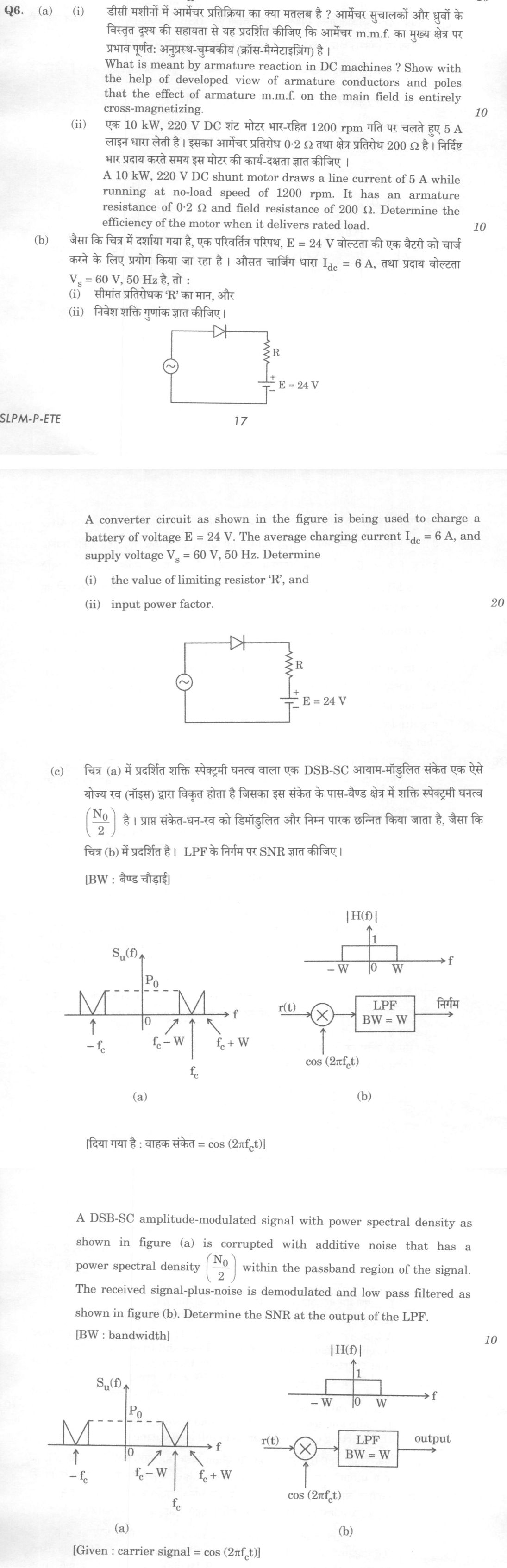
A converter circuit as shown in the figure is being used to charge a battery of voltage E = 24 V. The average charging current I_dc = 6 A, and supply voltage V_s = 60 V, 50 Hz. Determine (i) the value of limiting resistor 'R', and (ii) input power factor. 20 marks
A DSB-SC amplitude-modulated signal with power spectral density as shown in figure (a) is corrupted with additive noise that has a power spectral density (N_0/2) within the passband region of the signal. The received signal-plus-noise is demodulated and low pass filtered as shown in figure (b). Determine the SNR at the output of the LPF. [BW : bandwidth] [Given : carrier signal = cos (2πf_c t)] 20 marks
हिंदी में प्रश्न पढ़ें
डीसी मशीनों में आर्मेचर प्रतिक्रिया का क्या मतलब है ? आर्मेचर सुचालकों और ध्रुवों के विस्तृत दृश्य की सहायता से यह प्रदर्शित कीजिए कि आर्मेचर m.m.f. का मुख्य क्षेत्र पर प्रभाव पूर्णतः अनुप्रस्थ-चुंबकीय (क्रॉस-मैग्नेटाइजिंग) है। (10 अंक)
एक 10 kW, 220 V DC शंट मोटर भार-रहित 1200 rpm गति पर चलते हुए 5 A लाइन धारा लेती है। इसका आर्मेचर प्रतिरोध 0·2 Ω तथा क्षेत्र प्रतिरोध 200 Ω है। निर्धिष्ट भार प्रदाय करते समय इस मोटर की कार्य-दक्षता ज्ञात कीजिए। (10 अंक)
जैसा कि चित्र में दर्शाया गया है, एक परिवर्तित परिपथ, E = 24 V वोल्टता की एक बैटरी को चार्ज करने के लिए प्रयोग किया जा रहा है। औसत चार्जिंग धारा I_dc = 6 A, तथा प्रदाय वोल्टता V_s = 60 V, 50 Hz है, तो : (i) सीमांत प्रतिरोध 'R' का मान, और (ii) निवेश शक्ति गुणांक ज्ञात कीजिए। (20 अंक)
चित्र (a) में प्रदर्शित शक्ति स्पेक्ट्रमी घनत्व वाला एक DSB-SC आयाम-मॉडुलित संकेत एक ऐसे योज्य रव (नॉइस) द्वारा विकृत होता है जिसका इस संकेत के पास-बैंड क्षेत्र में शक्ति स्पेक्ट्रमी घनत्व (N_0/2) है। प्राप्त संकेत-धन-रव को डिमॉडुलित और निम्न पारक छानित किया जाता है, जैसा कि चित्र (b) में प्रदर्शित है। LPF के निर्गम पर SNR ज्ञात कीजिए। [BW : बैंड चौड़ाई] [दिया गया है : वाहक संकेत = cos (2πf_c t)] (20 अंक)
The figure this question refers to, in words
The question paper is a scan and the diagram did not survive as text. This is the figure as read from the original page — every component, value and label — so the question can be worked from the text below.
(b) A single-loop battery charging circuit diagram consisting of: an AC voltage source (circle with a sine wave symbol) on the left branch; the top terminal of the AC source connects to the anode of a diode oriented to conduct to the right; the cathode of the diode connects to the top terminal of a resistor labeled 'R'; the bottom terminal of resistor 'R' connects to the positive terminal (marked with a plus sign '+') of a DC voltage source/battery labeled 'E = 24 V'; the negative terminal of the DC source connects to the bottom terminal of the AC source, completing the loop. The question specifies supply voltage V_s = 60 V, 50 Hz and average charging current I_dc = 6 A, asking for the value of current-limiting resistor 'R' and the input power factor.
The problem includes two figures, labelled (a) and (b):
Figure (a): Graph of the power spectral density Su(f) versus frequency f for a DSB-SC amplitude-modulated signal.
- Horizontal axis represents frequency f with marked points: -fc, 0, fc - W, fc, and fc + W.
- Vertical axis represents Su(f) with a dashed horizontal line at peak value P0.
- The spectrum consists of two symmetric bands centered at -fc and +fc. The positive frequency band extends from fc - W to fc + W and has an M-shaped double-triangle profile: it rises linearly from 0 at fc - W to a peak of P0, falls linearly to 0 at fc, rises linearly to a peak of P0, and falls linearly to 0 at fc + W. An identical symmetric profile is centered at -fc.
Figure (b): Demodulation system and filter characteristic.
- Top: Plot of the low-pass filter frequency response magnitude |H(f)| versus f. It is an ideal rectangular low-pass filter with an amplitude of 1 from f = -W to f = W, and 0 elsewhere.
- Bottom: Block diagram of the receiver. The received input signal r(t) is fed into a multiplier (mixer) along with a local carrier cos(2*pi*fc*t). The output of the multiplier feeds into a block labelled 'LPF' with 'BW = W', which produces the final 'output'.
Model answer
Written by UPSC Answer Check against this question's marking rubric, to the expected length. UPSC does not publish answers for Mains — this is one way to score well, not an official key.
(a)(i) Armature reaction is the effect of the magnetic field set up by the armature current on the main field flux of a DC machine. In a developed view, place the N and S main poles on the stator and the armature conductors below them. With brushes on the geometrical neutral axis (GNA), the current in all armature conductors under one pole flows in one direction, and under the adjacent pole it reverses. Applying the right-hand rule, the armature m.m.f. wave is directed along the brush axis, i.e. the interpolar or q-axis. The main field m.m.f. is along the pole axis, i.e. the d-axis. Since these two axes are perpendicular, the armature m.m.f. has no component along the main field axis. Its effect is to strengthen one pole tip and weaken the other, distorting the main field and shifting the neutral axis. Hence, for brushes on the GNA, the armature reaction is entirely cross-magnetizing. Only if the brushes are shifted from the GNA does a demagnetizing or magnetizing component appear.
(a)(ii) Field current, I_f = V/R_f = 220/200 = 1.1 A. No-load armature current, I_a0 = I_L0 − I_f = 5 − 1.1 = 3.9 A. Field Cu loss = V I_f = 220 × 1.1 = 242 W. No-load armature Cu loss = I_a0² R_a = 3.9² × 0.2 = 3.042 W. No-load input = 220 × 5 = 1100 W. Constant losses, P_c = 1100 − 242 − 3.042 = 854.958 W.
At rated load, P_out = 10 kW = 10000 W. Let I_a be the rated armature current. Power balance gives: 10000 = 220 I_a − 0.2 I_a² − 854.958 So, 0.2 I_a² − 220 I_a + 10854.958 = 0. Solving, I_a = [220 ± √(220² − 4 × 0.2 × 10854.958)]/(2 × 0.2) = [220 ± √39716.034]/0.4. Taking the lower root, I_a = 51.778 A.
Rated armature Cu loss = 0.2 × 51.778² = 536.19 W. Total losses = 854.958 + 242 + 536.19 = 1633.15 W. Input at rated load = 10000 + 1633.15 = 11633.15 W. Efficiency, η = (10000/11633.15) × 100 = 85.96%.
η ≈ 85.96%.
(b)(i) The circuit is a single-phase half-wave diode battery charger. Taking the AC supply voltage as rms, V_m = √2 × 60 = 84.853 V. Conduction starts when V_m sinθ = E: α = sin⁻¹(E/V_m) = sin⁻¹(24/84.853) = sin⁻¹(√2/5) = 0.286756 rad. Conduction interval is α to π − α. Average current: I_dc = (1/2πR) ∫_α^(π−α) (V_m sinθ − E) dθ = [2V_m cosα − E(π − 2α)]/(2πR).
Here, V_m cosα = 60√2 × √23/5 = 12√46 = 81.388 V. π − 2α = 2.56808 rad. Numerator = 2 × 81.388 − 24 × 2.56808 = 101.142 V·rad. Given I_dc = 6 A: R = 101.142/(2π × 6) = 2.683 Ω.
R ≈ 2.683 Ω.
(b)(ii) The rms current is found from I_rms² = (1/2πR²) ∫_α^(π−α) (V_m sinθ − E)² dθ. Let J = ∫_α^(π−α) (V_m sinθ − E)² dθ = (V_m²/2 + E²)(π − 2α) + (V_m²/2) sin2α − 4 V_m E cosα.
With V_m² = 7200, E² = 576, sin2α = 2√46/25 = 0.542586: J = (3600 + 576)(2.56808) + 3600 × 0.542586 − 4 × 84.853 × 24 × 0.959166 = 4864.37 V²·rad.
Thus, I_rms² = 4864.37/(2π × 2.6829²) = 107.56 A². I_rms = 10.371 A.
Average input power, P_in = E I_dc + R I_rms² = 24 × 6 + 2.6829 × 107.56 = 432.57 W.
Input power factor = P_in/(V_s I_rms) = 432.57/(60 × 10.371) = 0.695.
Input power factor ≈ 0.695.
(c) For the DSB-SC signal, Su(f) = (1/4)[S_m(f − f_c) + S_m(f + f_c)]. The positive-frequency lobe extends from f_c − W to f_c + W and consists of two triangles. Its area is 2 × (1/2 × W × P₀) = P₀W. Hence the message power is P_m = 4P₀W.
After coherent demodulation by cos(2πf_c t) and ideal LPF with BW = W, the output signal is 0.5 m(t). Output signal power, P_s,out = (1/4)P_m = P₀W.
The input noise PSD is N₀/2 in both passbands. Multiplication by cos(2πf_c t) gives, for |f| ≤ W, S_n,out(f) = (1/4)[N₀/2 + N₀/2] = N₀/4. Thus output noise power, P_n,out = ∫_(−W)^(W) (N₀/4) df = N₀W/2.
Therefore, SNR_out = P_s,out/P_n,out = P₀W/(N₀W/2) = 2P₀/N₀.
SNR_out = 2P₀/N₀.
What "Solve" is asking you to do
Choose the method, then carry it through to a final answer. Identifying what kind of problem this is and why that method applies is the first thing marked; a correct figure arrived at invisibly earns almost nothing.
Structure that answers it
Given data and what is required → method chosen, with the reason it applies → set-up (equation, circuit, free body, trial balance) → working, step by step → answer with units and any condition of validity
Where marks are lost
Doing the middle steps mentally and writing only the result. In mathematics papers, a further loss comes from giving a decimal where the exact value in surds or fractions was wanted, or from skipping the justification a part explicitly asks for.
How this answer will be evaluated
Approach
(a(i)) explain: definition/context > points in order > small example > short close | (a(ii)) calculate: given > formula > substitution > result with units > interpretation | (b) calculate: given > formula > substitution > result with units > interpretation | (c) calculate: given > formula > substitution > result with units > interpretation Full marks: Complete method with correct diagrams, all steps shown, units included, final answers accurate
Key points expected
- Define armature reaction as distortion of main field flux
- Draw developed view of armature conductors and poles
- Show armature MMF is perpendicular to main field MMF
- Conclude effect is entirely cross-magnetizing
- Calculate field current from V and Rf
- Determine no-load armature current and losses
- Calculate rated load armature current
- Compute total losses and efficiency
Evaluation rubric
Each sub-part is marked on its own, against the marks and word limit printed on the paper.
- (a(i)) Define armature reaction and demonstrate cross-magnetizing effect via developed view. 10 marks
explain— definition/context → points in order → small example → short close
Must cover
- Define armature reaction as distortion of main field flux
- Draw developed view of armature conductors and poles
- Show armature MMF is perpendicular to main field MMF
- Conclude effect is entirely cross-magnetizing
Loses marks
- Missing developed view diagram
- Confusing cross-magnetizing with demagnetizing
Earns more
- Indicate direction of armature MMF
- Show flux density distribution
Extra mark
- Mention effect on neutral plane shift
- (a(ii)) Determine efficiency of DC shunt motor at rated load. 10 marks
calculate— given → formula → substitution → result with units → interpretation
Must cover
- Calculate field current from V and Rf
- Determine no-load armature current and losses
- Calculate rated load armature current
- Compute total losses and efficiency
Loses marks
- Ignoring field current in line current
- Using no-load current for rated load
Earns more
- Separate constant and variable losses
- Show input and output power calculation
Extra mark
- Mention mechanical losses assumption
- (b) Find limiting resistor R and input power factor for battery charger. 20 marks
calculate— given → formula → substitution → result with units → interpretation
Must cover
- Draw equivalent circuit with diode and resistor
- Calculate average voltage across R
- Determine R value using Ohm's law
- Calculate input power factor
Loses marks
- Ignoring diode conduction period
- Using DC values for AC power factor
Earns more
- Show diode conduction angle
- Calculate RMS current for power factor
Extra mark
- Mention diode voltage drop assumption
- (c) Determine SNR at LPF output for DSB-SC demodulation. 20 marks
calculate— given → formula → substitution → result with units → interpretation
Must cover
- Identify signal and noise PSD in passband
- Calculate signal power after demodulation
- Calculate noise power after LPF
- Compute SNR ratio
Loses marks
- Ignoring noise bandwidth effect
- Incorrect frequency shift calculation
Earns more
- Show frequency shifting due to multiplication
- Integrate PSD over bandwidth
Extra mark
- Mention coherent demodulation requirement
Practice this exact question
Write your answer and it is marked point by point against the model answer above — what you covered, what you missed, what you got wrong.
Evaluate my answer →More from Electrical Engineering 2025 Paper I
- Q3 (a) Consider the Boolean function: F(A, B, C, D) = Σ m (1, 3, 4, 11, 12, 13, 14, 15). Imp…
- Q4 (a) For the Schottky transistor circuit shown below, determine I_B, I_D, I_C and V_CE. Ne…
- Q5 (a) As shown in the figure, just inside the surface of a dielectric slab, the electric fi…
- Q6 (a) (i) What is meant by armature reaction in DC machines ? Show with the help of develop…
- Q7 (a) It is given that E⃗ = Eₘ sin (ω t - α z) â_y in free space α > 0. (i) Determine D⃗,…
- Q8 (a) (i) Show that the Smith chart constructed for a lossless transmission line gives a fa…