Paper II — Q1
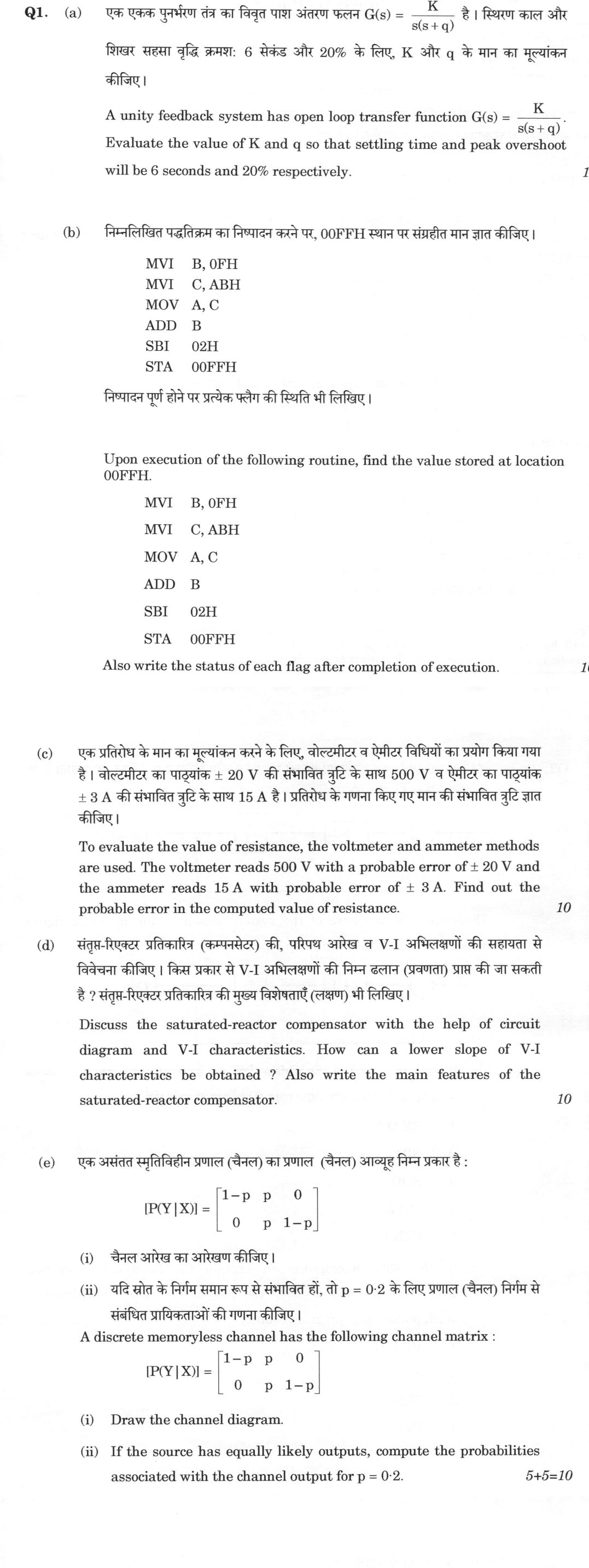
(a) A unity feedback system has open loop transfer function G(s) = K/(s(s+q)). Evaluate the value of K and q so that settling…
A unity feedback system has open loop transfer function G(s) = K/(s(s+q)). Evaluate the value of K and q so that settling time and peak overshoot will be 6 seconds and 20% respectively. 10 marks
Upon execution of the following routine, find the value stored at location 00FFH.
MVI B, 0FH MVI C, ABH MOV A, C ADD B SBI 02H STA 00FFH
Also write the status of each flag after completion of execution. 10 marks
To evaluate the value of resistance, the voltmeter and ammeter methods are used. The voltmeter reads 500 V with a probable error of ± 20 V and the ammeter reads 15 A with probable error of ± 3 A. Find out the probable error in the computed value of resistance. 10 marks
Discuss the saturated-reactor compensator with the help of circuit diagram and V-I characteristics. How can a lower slope of V-I characteristics be obtained ? Also write the main features of the saturated-reactor compensator. 10 marks
A discrete memoryless channel has the following channel matrix : [P(Y | X)] = 1-p & p & 0 0 & p & 1-p Draw the channel diagram.
If the source has equally likely outputs, compute the probabilities associated with the channel output for p = 0·2. 10 marks
हिंदी में प्रश्न पढ़ें
एक एकक पुनर्भरण तंत्र का विवृत पाश अंतरण फलन G(s) = K/(s(s+q)) है। स्थिरण काल और शिखर सहसा वृद्धि क्रमश: 6 सेकंड और 20% के लिए, K और q के मान का मूल्यांकन कीजिए। (10 अंक)
निम्नलिखित पद्धतिक्रम का निष्पादन करने पर, 00FFH स्थान पर संग्रहीत मान ज्ञात कीजिए।
MVI B, 0FH MVI C, ABH MOV A, C ADD B SBI 02H STA 00FFH
निष्पादन पूर्ण होने पर प्रत्येक फ्लैग की स्थिति भी लिखिए। (10 अंक)
एक प्रतिरोध के मान का मूल्यांकन करने के लिए, वोल्टमीटर व एमीटर विधियों का प्रयोग किया गया है । वोल्टमीटर का पाठ्यांक ± 20 V की संभावित त्रुटि के साथ 500 V व एमीटर का पाठ्यांक ± 3 A की संभावित त्रुटि के साथ 15 A है । प्रतिरोध के गणना किए गए मान की संभावित त्रुटि ज्ञात कीजिए । (10 अंक)
संतृप्त-रिएक्टर प्रतिकारित्र (कम्पनसेटर) की, परिपथ आरेख व V-I अभिलक्षणों की सहायता से विवेचना कीजिए । किस प्रकार से V-I अभिलक्षणों की निम्न ढलान (प्रवणता) प्राप्त की जा सकती है ? संतृप्त-रिएक्टर प्रतिकारित्र की मुख्य विशेषताएँ (लक्षण) भी लिखिए । (10 अंक)
एक असंतत स्मृतिहीन प्रणाल (चैनल) का प्रणाल (चैनल) आव्यूह निम्न प्रकार है : [P(Y | X)] = 1-p & p & 0 0 & p & 1-p चैनल आरेख का आरेखण कीजिए ।
यदि स्रोत के निर्गम समान रूप से संभावित हों, तो p = 0·2 के लिए प्रणाल (चैनल) निर्गम से संबंधित प्रायिकताओं की गणना कीजिए । (10 अंक)
Model answer
Drafted with AI by UPSC Answer Check against this question's marking rubric, to the expected length. UPSC does not publish answers for Mains — this is one way to score well, not an official key. How we build rubrics and answers.
(a) Design of K and q for given settling time and overshoot (10 marks)
The closed loop of the unity-feedback system is T(s) = K/(s² + qs + K), which compares with the standard form ω_n²/(s² + 2ζω_n s + ω_n²), so
ω_n² = K and 2ζω_n = q.
Damping ratio from the peak overshoot. M_p = e^(−πζ/√(1 − ζ²)) = 0.20, so πζ/√(1 − ζ²) = ln 5 = 1.609, that is ζ² = 1.609²/(π² + 1.609²) = 2.590/12.460 = 0.2079 and ζ = 0.456.
Natural frequency from the settling time. For the 2% band, t_s = 4/(ζω_n) = 6 s, so ζω_n = 0.667 and ω_n = 0.667/0.456 = 1.46 rad/s.
Gain and pole. K = ω_n² = 1.462² = 2.14 and q = 2ζω_n = 2 × 0.667 = 1.33.
So G(s) = 2.14/[s(s + 1.33)]. (With the 5% band, t_s = 3/(ζω_n), the values would be ω_n = 1.10 rad/s, K = 1.20 and q = 1.0.)
(b) 8085 routine (10 marks)
- MVI B, 0FH: B = 0FH.
- MVI C, ABH: C = ABH.
- MOV A, C: A = ABH.
- ADD B: A = ABH + 0FH = BAH (no carry, so CY = 0).
- SBI 02H: subtract immediate with borrow, A = A − 02H − CY = BAH − 02H − 0 = B8H.
- STA 00FFH: stores the accumulator in memory location 00FFH.
The value stored at 00FFH is B8H.
Flags after the last arithmetic instruction (SBI; STA does not change the flags). The result is B8H = 1011 1000:
- S = 1 (bit 7 of the result is 1);
- Z = 0 (the result is not zero);
- P = 1 (the result has four 1 bits, even parity);
- CY = 0 (no borrow, since BAH is larger than 02H);
- AC = 1 (in the 8085 subtraction is done by adding the 2's complement, and the low nibble A + D + 1 = 18H produces a carry out of bit 3, meaning no borrow from the low nibble).
(c) Probable error in a resistance from voltmeter and ammeter readings (10 marks)
R = V/I = 500/15 = 33.3 Ω. For a quotient the probable errors combine by the root-sum-square law, since probable errors are independent and do not all reach their limits at once:
ΔR/R = √[(ΔV/V)² + (ΔI/I)²].
The relative errors are ΔV/V = 20/500 = 0.04 (4%) and ΔI/I = 3/15 = 0.20 (20%). Therefore
ΔR/R = √(0.04² + 0.20²) = √0.0416 = 0.204, that is ±20.4%,
and ΔR = 0.204 × 33.3 = ±6.8 Ω. The resistance is R = 33.3 ± 6.8 Ω. (The worst-case, or limiting, error would be the arithmetic sum 4% + 20% = 24%, or 8 Ω, but a probable error uses the root-sum-square.) The ammeter error dominates.
(d) Saturated-reactor compensator (10 marks)
Principle. A saturated reactor is a reactor whose iron core is deliberately worked in the saturation region of its magnetising characteristic. Below the knee the flux is nearly proportional to the voltage and the current is small. Above the knee a small rise in voltage produces a large rise in current, since the incremental reactance falls to that of the air-core winding. So the voltage across the reactor is held almost constant while the current changes widely: it draws more inductive current, and absorbs more reactive power, as the bus voltage rises, and less as it falls, without any control system.
Circuit. The reactor is connected to the bus through a transformer, in parallel with a fixed shunt capacitor bank, and with a series slope-correcting capacitor. The capacitor supplies reactive power when the system voltage is low, when the reactor draws almost no current, and the reactor absorbs the excess as the voltage rises. The net effect is a compensator that regulates the bus voltage over a wide range of reactive demand.

V–I characteristic and its slope. The characteristic is linear up to the knee at about 1.0 pu and then rises with a small slope (the saturated reactance, typically 8–15% of the base without correction). The slope means the voltage changes slightly with the compensator current, so regulation is not perfect.
Obtaining a lower slope. The slope is reduced by a series slope-correcting capacitor, whose voltage drop opposes the reactor's inductive rise in the saturated region. Tuning this compensation can bring the slope down to about 2–5% or even to zero, and over-compensation gives a negative slope. The slope is the ratio of the voltage change to the current change, ΔV/ΔI.
Main features.
- It is passive and self-regulating: there are no thyristors, no firing circuits and no closed-loop control, so the response is almost instantaneous (within a cycle).
- The construction is robust, with no moving parts, high overload capacity and low maintenance.
- The saturating iron produces harmonics, which are reduced by a multi-core arrangement such as the twin-tripler or treble-tripler reactor with delta-connected windings.
- It needs a large mass of iron, is heavy and noisy, and has higher losses than a thyristor-controlled reactor.
- The voltage set point is fixed by the design (the knee of the characteristic), so it is inflexible compared with thyristor-based static var compensators.
(e) Discrete memoryless channel (10 marks)
(i) Channel diagram (5 marks). In the matrix, row i belongs to the input x_i and column j to the output y_j. From x₁ the output is y₁ with probability 1 − p and y₂ with probability p; from x₂ it is y₂ with probability p and y₃ with probability 1 − p. The other two entries are zero, so there are no transitions x₁ → y₃ and x₂ → y₁. This is a binary erasure channel with y₂ as the erasure symbol.

(ii) Output probabilities (5 marks). With equally likely inputs, P(x₁) = P(x₂) = 0.5, and p = 0.2, the output probabilities are P(y_j) = Σ_i P(x_i) P(y_j|x_i):
- P(y₁) = 0.5 × (1 − p) = 0.5 × 0.8 = 0.4;
- P(y₂) = 0.5 × p + 0.5 × p = 0.5 × 0.2 + 0.5 × 0.2 = 0.2;
- P(y₃) = 0.5 × (1 − p) = 0.4.
They add up to 1. The joint probabilities are P(x₁, y₁) = 0.4, P(x₁, y₂) = 0.1, P(x₂, y₂) = 0.1 and P(x₂, y₃) = 0.4. As a check, H(Y) = 1.522 bits and H(Y|X) = H(p) = 0.722 bits, so I(X; Y) = 0.80 bits = (1 − p) H(X).
How this answer will be evaluated
Evaluation rubric
Each sub-part is marked on its own, against the marks and word limit printed on the paper.
- (a) Evaluate K and q for the unity-feedback system G(s) = K/[s(s + q)] so that the settling time is 6 s and the peak overshoot is 20%. 10 marks
Must cover
- M_p = exp(−πζ/√(1 − ζ²)) = 0.2 gives ζ = 0.456
- t_s = 4/(ζω_n) (2% band) gives ω_n = 1.46 rad/s
- Matching s² + qs + K with s² + 2ζω_n s + ω_n²: K = ω_n², q = 2ζω_n
- K = 2.14 and q = 1.33
Loses marks
- Using t_s = 3/(ζω_n) without stating the tolerance band.
- Taking ζ from the peak overshoot as 0.2.
- Confusing K and q (q = ω_n² or K = 2ζω_n).
Earns more
- Stating the settling-time criterion used (2% band), and the 5% alternative.
- Closed-loop transfer function derived from the open loop.
Extra mark
- Verification of the resulting overshoot and settling time
- (b) Find the value stored at 00FFH by the given 8085 routine and the status of each flag after execution. 10 marks
Must cover
- ABH + 0FH = BAH (in A after ADD B)
- SBI 02H: BAH − 02H − CY = B8H, and CY = 0 after the ADD
- STA stores B8H at 00FFH
- Flags after SBI: S = 1, Z = 0, P = 1, CY = 0, AC = 1
Loses marks
- Treating SBI as a subtraction without borrow but ignoring CY.
- Wrong parity flag (odd parity).
- Storing BAH in the memory location.
Earns more
- Meaning of SBI (subtract immediate with borrow) and STA (store accumulator direct).
- Reasoning for the parity and auxiliary-carry flags.
Extra mark
- Note that STA does not affect flags
- (c) Find the probable error of the resistance computed from a voltmeter reading of 500 ± 20 V and an ammeter reading of 15 ± 3 A. 10 marks
Must cover
- R = V/I = 33.3 Ω
- Root-sum-square law for a quotient: ΔR/R = √((ΔV/V)² + (ΔI/I)²)
- Relative errors 4% and 20%
- ΔR/R ≈ ±20.4%, ΔR ≈ ±6.8 Ω
Loses marks
- Adding the relative errors arithmetically (24%, 8 Ω).
- Adding absolute errors of V and I directly.
- Reporting only the percentage or only ohms.
Earns more
- Distinction between probable error (RSS) and limiting error (arithmetic sum, 24%).
Extra mark
- Observation that the ammeter error dominates
- (d) Discuss the saturated-reactor compensator with a circuit diagram and V-I characteristic, how a lower slope is obtained, and its main features. 10 marks
Must cover
- Working principle: iron core operated in saturation, nearly constant voltage with widely varying current, passive self-regulation
- Circuit diagram: transformer, saturated reactor with slope-correcting series capacitor, fixed capacitor bank
- V-I characteristic: linear to the knee at about 1 pu, then a small slope; lower slope obtained by the series slope-correcting capacitor
- Features: fast, passive, no control loop, robust; drawbacks of harmonics (twin-tripler compensation), heavy iron, losses, noise
Loses marks
- Describing a thyristor-controlled reactor instead.
- Omitting the V-I characteristic or the slope-correction method.
- Claiming the characteristic is perfectly flat with no slope.
Earns more
- V-I sketch showing the knee and both slopes.
- Typical slope figures (uncorrected about 8–15%, corrected about 2–5%).
Extra mark
- Comparison with thyristor-controlled reactors and static var compensators
- (e) (i) Draw the channel diagram for the channel matrix [1 − p, p, 0; 0, p, 1 − p]; (ii) for equally likely inputs and p = 0.2, compute the output probabilities. 10 marks
Must cover
- Diagram: x₁ → y₁ (1 − p) and y₂ (p); x₂ → y₂ (p) and y₃ (1 − p); a binary erasure channel
- P(y_j) = Σ P(x_i)P(y_j|x_i) with P(x₁) = P(x₂) = 0.5
- P(y₁) = 0.4 and P(y₃) = 0.4
- P(y₂) = 0.2 and the sum is 1
Loses marks
- Drawing transitions x₁ → y₃ or x₂ → y₁.
- Reading the matrix by columns as inputs.
- Output probabilities that do not sum to 1.
Earns more
- Identification of y₂ as the erasure symbol.
- Joint probabilities P(x_i, y_j) computed.
Extra mark
- Mutual information 0.8 bit = (1 − p)H(X)
What "Evaluate" is asking you to do
Judge how well something has performed against the standard it set for itself — its stated aim, mandate or promise — and commit to a verdict. Name the yardstick before you judge; an unanchored judgement reads as opinion.
Structure that answers it
Name the yardstick — stated aim, mandate or benchmark → performance against it → shortfall against it → why the gap exists → verdict
Where marks are lost
Presenting both sides and then declining to decide, or delivering a verdict against a standard you never stated, which makes it look arbitrary.
Practice this exact question
Write your answer and it is marked point by point against the model answer above — what you covered, what you missed, what you got wrong.
Evaluate my answer →More from Electrical Engineering 2026 Paper II
- Q1 (a) A unity feedback system has open loop transfer function G(s) = \frac{K}{s(s+q)}. Eval…
- Q2 (a) Determine the response of the system shown in the following figure when it is excited…
- Q3 (a) (i) A system has a unit response as c(t) = 1 − e^(−0·5t). Evaluate its unit impulse a…
- Q4 (a) Design a PI controller so that a unity feedback system having open loop transfer func…