Paper II — Q4
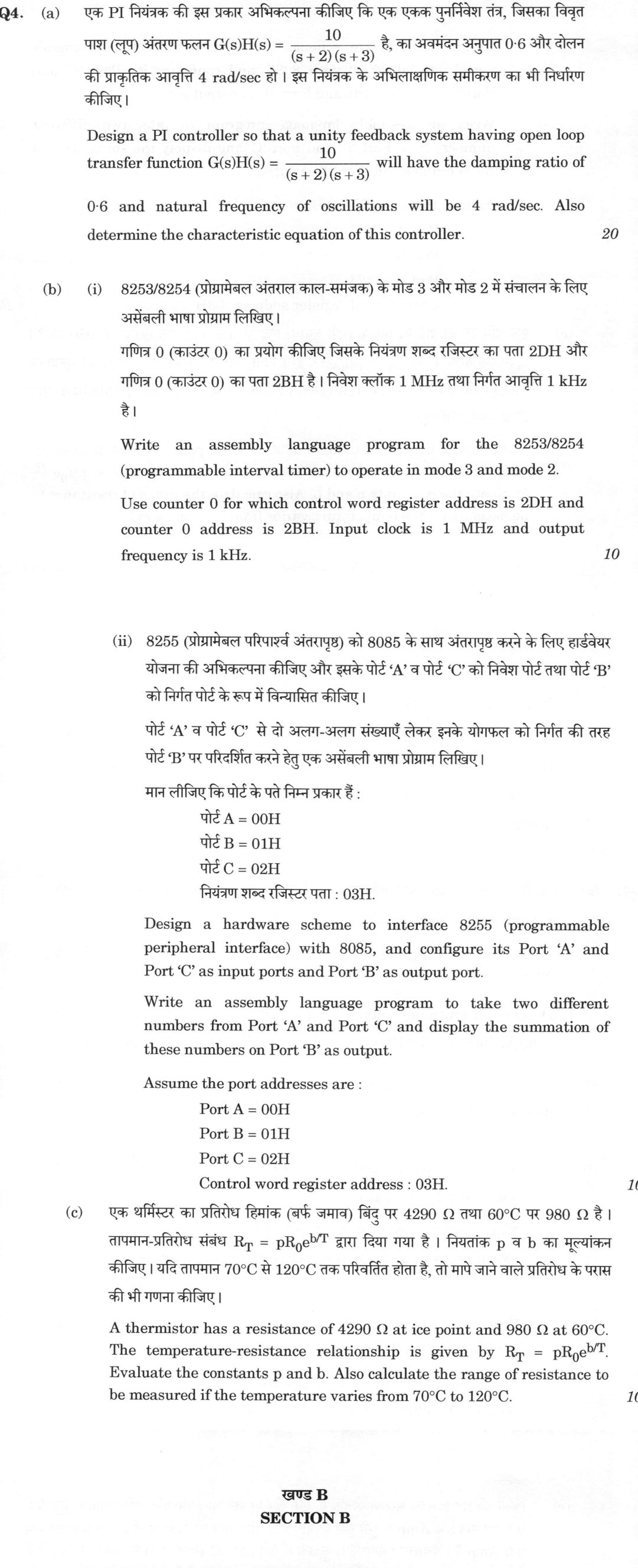
(a) Design a PI controller so that a unity feedback system having open loop transfer function G(s)H(s) = 10 / ((s + 2) (s + 3))…
Design a PI controller so that a unity feedback system having open loop transfer function G(s)H(s) = 10 / ((s + 2) (s + 3)) will have the damping ratio of 0·6 and natural frequency of oscillations will be 4 rad/sec. Also determine the characteristic equation of this controller. 20 marks
Write an assembly language program for the 8253/8254 (programmable interval timer) to operate in mode 3 and mode 2. Use counter 0 for which control word register address is 2DH and counter 0 address is 2BH. Input clock is 1 MHz and output frequency is 1 kHz. 10 marks
Design a hardware scheme to interface 8255 (programmable peripheral interface) with 8085, and configure its Port 'A' and Port 'C' as input ports and Port 'B' as output port.
Write an assembly language program to take two different numbers from Port 'A' and Port 'C' and display the summation of these numbers on Port 'B' as output.
Assume the port addresses are : Port A = 00H Port B = 01H Port C = 02H Control word register address : 03H. 10 marks
A thermistor has a resistance of 4290 Ω at ice point and 980 Ω at 60°C. The temperature-resistance relationship is given by R_T = pR_0e^b/T. Evaluate the constants p and b. Also calculate the range of resistance to be measured if the temperature varies from 70°C to 120°C. 10 marks
हिंदी में प्रश्न पढ़ें
एक PI नियंत्रक की इस प्रकार अभिकल्पना कीजिए कि एक एकक पुनर्निवेश तंत्र, जिसका विवृत पाश (लूप) अंतरण फलन G(s)H(s) = 10 / ((s + 2) (s + 3)) है, का अवमंदन अनुपात 0·6 और दोलन की प्राकृतिक आवृत्ति 4 rad/sec हो । इस नियंत्रक के अभिलाक्षणिक समीकरण का भी निर्धारण कीजिए । (20 अंक)
8253/8254 (प्रोग्रामेबल अंतराल काल-समंजक) के मोड 3 और मोड 2 में संचालन के लिए अर्सेंबली भाषा प्रोग्राम लिखिए । गणित्र 0 (काउंटर 0) का प्रयोग कीजिए जिसके नियंत्रण शब्द रजिस्टर का पता 2DH और गणित्र 0 (काउंटर 0) का पता 2BH है । निवेश क्लॉक 1 MHz तथा निर्गत आवृत्ति 1 kHz है । (10 अंक)
8255 (प्रोग्रामेबल परिपार्श्व अंतरापृष्ठ) को 8085 के साथ अंतरापृष्ठ करने के लिए हार्डवेयर योजना की अभिकल्पना कीजिए और इसके पोर्ट 'A' व पोर्ट 'C' को निवेश पोर्ट तथा पोर्ट 'B' को निर्गत पोर्ट के रूप में विन्यासित कीजिए।
पोर्ट 'A' व पोर्ट 'C' से दो अलग-अलग संख्याएँ लेकर इनके योगफल को निर्गत की तरह पोर्ट 'B' पर परिदर्शित करने हेतु एक असेम्बली भाषा प्रोग्राम लिखिए।
मान लीजिए कि पोर्ट के पते निम्न प्रकार हैं : पोर्ट A = 00H पोर्ट B = 01H पोर्ट C = 02H नियंत्रण शब्द रजिस्टर पता : 03H. (10 अंक)
एक थर्मिस्टर का प्रतिरोध हिमांक (बर्फ जमाव) बिंदु पर 4290 Ω तथा 60°C पर 980 Ω है। तापमान-प्रतिरोध संबंध R_T = pR_0e^b/T द्वारा दिया गया है। नियतांक p व b का मूल्यांकन कीजिए। यदि तापमान 70°C से 120°C तक परिवर्तित होता है, तो मापे जाने वाले प्रतिरोध के परास की भी गणना कीजिए। (10 अंक)
Model answer
Drafted with AI by UPSC Answer Check against this question's marking rubric, to the expected length. UPSC does not publish answers for Mains — this is one way to score well, not an official key. How we build rubrics and answers.
(a) PI controller for ζ = 0.6 and ω_n = 4 rad/s (20 marks)
Set-up. Take the PI controller as G_c(s) = K_p + K_i/s = (K_p s + K_i)/s, with unity feedback. The open-loop transfer function is
G_c(s)G(s)H(s) = 10(K_p s + K_i)/[s(s + 2)(s + 3)].
Characteristic equation. Setting 1 + G_cGH = 0 gives
s(s + 2)(s + 3) + 10(K_p s + K_i) = 0, that is, s³ + 5s² + (6 + 10K_p)s + 10K_i = 0.
Desired dominant pair. For ζ = 0.6 and ω_n = 4 rad/s, the pair of poles satisfies s² + 2ζω_n s + ω_n² = s² + 4.8s + 16 = 0, so s = −2.4 ± j3.2. The system is third order, so the third pole is placed at s = −p and the characteristic polynomial must equal
(s² + 4.8s + 16)(s + p) = s³ + (4.8 + p)s² + (16 + 4.8p)s + 16p.
Matching coefficients.
- s²: 4.8 + p = 5, so p = 0.2.
- s: 6 + 10K_p = 16 + 4.8 × 0.2 = 16.96, so K_p = 1.096.
- s⁰: 10K_i = 16 × 0.2 = 3.2, so K_i = 0.32.
The controller is G_c(s) = 1.096 + 0.32/s = 1.096(s + 0.292)/s. Its zero at s = −0.292 lies close to the third closed-loop pole at s = −0.2, so the two nearly cancel and the complex pair s = −2.4 ± j3.2 governs the response, as required. The integral action also makes the loop type 1 with zero steady-state error for a step input.
Characteristic equation of the compensated system.
s³ + 5s² + 16.96s + 3.2 = 0, which factorises as (s² + 4.8s + 16)(s + 0.2) = 0.
(b)(i) 8253/8254 counter 0 in Mode 3 and Mode 2 (10 marks)
Count. The clock is 1 MHz and the output must be 1 kHz, so N = 1 MHz/1 kHz = 1000 = 03E8H. The low byte is E8H and the high byte is 03H.
Control word. The format is D7 D6 = SC1 SC0 (counter select), D5 D4 = RW1 RW0 (read/write mode), D3 D2 D1 = M2 M1 M0 (mode) and D0 = BCD. For counter 0 (SC = 00), low byte then high byte (RW = 11) and binary counting (BCD = 0):
- Mode 3: 0 0 1 1 0 1 1 0 = 36H
- Mode 2: 0 0 1 1 0 1 0 0 = 34H
Program for Mode 3 (square wave).
- MVI A, 36H
- OUT 2DH (write the control word)
- MVI A, E8H
- OUT 2BH (low byte of the count into counter 0)
- MVI A, 03H
- OUT 2BH (high byte of the count)
- HLT
Program for Mode 2 (rate generator). It is the same except that the control word is 34H:
- MVI A, 34H
- OUT 2DH
- MVI A, E8H
- OUT 2BH
- MVI A, 03H
- OUT 2BH
- HLT
Output. In Mode 3, the count is even, so the output is a symmetrical square wave of period 1000 μs, high for 500 clock periods and low for 500. In Mode 2, the output stays high and goes low for one clock period (1 μs) once every 1000 clocks, giving a 1 kHz pulse train of narrow negative pulses, and the counter reloads automatically each time.
(b)(ii) Interfacing an 8255 with the 8085, mode-0 control word and program (10 marks)
Hardware scheme. The 8255 is I/O-mapped. The address/data lines AD0–AD7 of the 8085 are connected to D0–D7 of the 8255, and the 74LS373 latch, enabled by ALE, separates the low-order address A0–A7. Address lines A0 and A1 go directly to the A0 and A1 pins of the 8255 to select the register, and A2–A7 are decoded with IO/M to produce the chip select. RD, WR and RESET OUT of the 8085 go to the corresponding pins of the 8255.

With A7–A2 = 000000 and IO/M = 1 the chip select is active (low), and A1A0 chooses the register: 00 = Port A (00H), 01 = Port B (01H), 10 = Port C (02H) and 11 = control word register (03H), as the question states.
Control word. For the mode-set word (D7 = 1), Group A in Mode 0 (D6 D5 = 00), Port A input (D4 = 1), Port C upper input (D3 = 1), Group B in Mode 0 (D2 = 0), Port B output (D1 = 0) and Port C lower input (D0 = 1):
1 0 0 1 1 0 0 1 = 99H
Program.
- MVI A, 99H
- OUT 03H (configure the ports)
- IN 00H (first number from Port A)
- MOV B, A (keep it in register B)
- IN 02H (second number from Port C)
- ADD B (A = sum of the two numbers)
- OUT 01H (display the sum on Port B)
- HLT
The sum is an 8-bit result; a carry beyond bit 7 appears in the carry flag and is not shown on Port B.
(c) Thermistor constants and resistance range (10 marks)
Constants. Temperatures must be in kelvin, so T₀ = 273 K (ice point) and T₁ = 60 + 273 = 333 K. Only the product pR₀ can be found from the data, so R₀ is taken as the resistance at the ice point, R₀ = 4290 Ω, which makes the relation R_T = pR₀e^(b/T) fit the ice-point reading. At 273 K, 4290 = p × 4290 × e^(b/273), so p = e^(−b/273). At 333 K,
980 = p × 4290 × e^(b/333), so 980/4290 = e^(b(1/333 − 1/273)).
Taking logarithms, ln(0.2284) = −1.4767 = b × (−6.60 × 10⁻⁴), so
b = 2237 K, and p = e^(−2237/273) = e^(−8.195) = 2.76 × 10⁻⁴.
Resistance at 70 °C and 120 °C. R_T = 4290 × e^(2237(1/T − 1/273)).
- At 70 °C (T = 343 K): 1/343 − 1/273 = −7.475 × 10⁻⁴, the exponent is −1.672, so R = 4290 × 0.1878 = 806 Ω.
- At 120 °C (T = 393 K): 1/393 − 1/273 = −1.1185 × 10⁻³, the exponent is −2.502, so R = 4290 × 0.0819 = 351 Ω.
Range. The resistance to be measured lies between about 351 Ω and 806 Ω, a change of about 455 Ω. The resistance falls as the temperature rises, since the thermistor is of negative temperature coefficient. The sensitivity (1/R)(dR/dT) = −b/T² is about −1.9% per K at 70 °C and −1.45% per K at 120 °C, so the response is strongly non-linear.
How this answer will be evaluated
Evaluation rubric
Each sub-part is marked on its own, against the marks and word limit printed on the paper.
- (a) Design a PI controller (find K_p and K_i) for a unity-feedback system with G(s)H(s) = 10/[(s + 2)(s + 3)] so that the dominant closed-loop poles have ζ = 0.6 and ω_n = 4 rad/s, and write the characteristic equation. 20 marks
Must cover
- Characteristic equation with PI: s³ + 5s² + (6 + 10K_p)s + 10K_i = 0
- Dominant pair from s² + 4.8s + 16 = 0, i.e. s = −2.4 ± j3.2, with the third pole placed at s = −p
- Coefficient matching gives p = 0.2, K_p = 1.096, K_i = 0.32
- Final characteristic equation s³ + 5s² + 16.96s + 3.2 = 0 = (s² + 4.8s + 16)(s + 0.2)
Loses marks
- Designing a second-order characteristic equation only and ignoring the third pole.
- Using ζω_n = 4 or ω_n² = 4.
- Arithmetic errors in K_p or K_i that are not carried through to the final equation.
Earns more
- Justification that the third pole is near the controller zero at s = −0.292, so the pair dominates.
- Correct use of the controller form K_p + K_i/s.
Extra mark
- Noting zero steady-state error to a step because the loop becomes type 1
- (b)(i) Write an 8085 program to operate counter 0 of an 8253/8254 (control register 2DH, counter 0 at 2BH) in Mode 3 and Mode 2 with a 1 MHz clock and 1 kHz output. 10 marks
Must cover
- Count N = 1 MHz/1 kHz = 1000 = 03E8H, loaded low byte E8H then high byte 03H
- Control words 36H (Mode 3) and 34H (Mode 2) for counter 0, LSB then MSB, binary
- Program: MVI A/OUT 2DH for the control word, then two OUT 2BH for the count, for each mode
- Output description: square wave in Mode 3, one-clock-wide low pulse every 1000 clocks in Mode 2
Loses marks
- Wrong control word, for example 76H or 37H (BCD).
- Writing the count with the high byte first for the RW = 11 setting.
- Using a count of 1000 decimal directly as 1000H.
Earns more
- Correct decoding of the control word fields SC, RW, M and BCD.
- Separate, complete programs for the two modes.
Extra mark
- Noting that the count is even, so Mode 3 gives a 50% duty cycle
- (b)(ii) Design the 8255-8085 hardware interface with Port A and Port C as inputs and Port B as output; derive the mode-0 control word; and write a program that adds numbers from Ports A and C and outputs the sum on Port B (ports 00H–02H, control 03H). 10 marks
Must cover
- Interface scheme: AD0–AD7 to D0–D7, 74LS373 latch with ALE, A0 and A1 to the 8255, RD, WR and RESET to the 8255
- Chip select from A2–A7 and IO/M giving addresses 00H–03H
- Control word 99H (D7 = 1, PA in, PC upper in, PB out, PC lower in, mode 0)
- Program: MVI A,99H; OUT 03H; IN 00H; MOV B,A; IN 02H; ADD B; OUT 01H
Loses marks
- Wrong control word, for example 90H or 9BH.
- Using memory-mapped instructions (LDA/STA) for I/O-mapped ports.
- Program without the initial control-word write.
Earns more
- Diagram with labelled signals and a chip-select decoder consistent with the given port addresses.
- Correct bit-by-bit derivation of the control word.
Extra mark
- Remark that the sum is 8-bit and the carry is not displayed
- (c) For the thermistor R_T = pR₀e^(b/T) with 4290 Ω at 0 °C and 980 Ω at 60 °C, evaluate p and b and find the resistance range for 70–120 °C. 10 marks
Must cover
- Temperatures converted to kelvin (273, 333, 343, 393), with R₀ = 4290 Ω at the ice point
- b = ln(980/4290)/(1/333 − 1/273) ≈ 2237 K and p = e^(−b/273) ≈ 2.76 × 10⁻⁴
- R(70 °C) ≈ 806 Ω and R(120 °C) ≈ 351 Ω
- Range about 351–806 Ω (a change of about 455 Ω), decreasing with temperature (NTC)
Loses marks
- Using Celsius temperatures directly in the exponent.
- Getting a positive b or a resistance that rises with temperature.
- Reporting only one end of the range.
Earns more
- Clear statement of the assumption for R₀.
- Substitution steps shown for each temperature.
Extra mark
- Sensitivity −b/T² and comment on non-linearity
What "Calculate" is asking you to do
Apply the standard formula or schedule to data the question has already supplied — a table of readings, cost records, a balance sheet — and produce the number. The method is rarely in doubt; the marks sit in the named intermediate quantities, each of which has to appear as a labelled line.
Structure that answers it
Data as given → formula or standard treatment, named → substitution → each intermediate, labelled → result with units
Where marks are lost
Omitting an intermediate the marking scheme pays for separately, or rounding at an intermediate line so the final figure drifts. In commerce and accountancy, any figure in a statement that no numbered working note supports is treated as unearned.
Practice this exact question
Write your answer and it is marked point by point against the model answer above — what you covered, what you missed, what you got wrong.
Evaluate my answer →More from Electrical Engineering 2026 Paper II
- Q1 (a) A unity feedback system has open loop transfer function G(s) = \frac{K}{s(s+q)}. Eval…
- Q2 (a) Determine the response of the system shown in the following figure when it is excited…
- Q3 (a) (i) A system has a unit response as c(t) = 1 − e^(−0·5t). Evaluate its unit impulse a…
- Q4 (a) Design a PI controller so that a unity feedback system having open loop transfer func…
- Q5 (a) Write the state space equation for the following circuit. [Circuit diagram: voltage s…
- Q6 (a) Determine the efficiency of a 400 km long transmission line delivering 100 MW load at…
- Q7 (a) A 3-phase line is terminated by a star-connected resistive load of 800 ohm per phase.…