Paper II — Q6
(a) Determine the efficiency of a 400 km long transmission line delivering 100 MW load at 240 kV, 0·85 lagging p.f. at the…
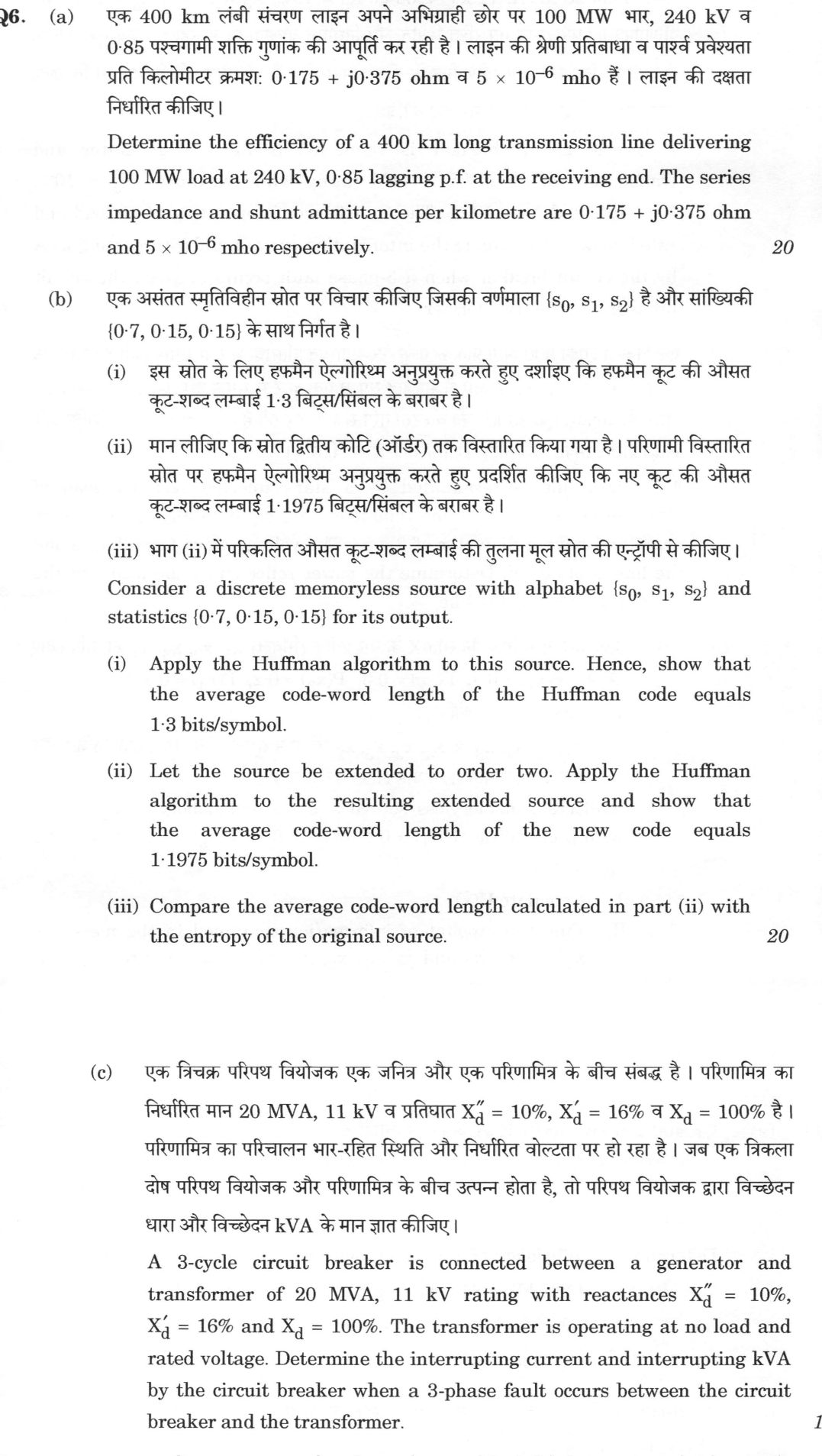
Determine the efficiency of a 400 km long transmission line delivering 100 MW load at 240 kV, 0·85 lagging p.f. at the receiving end. The series impedance and shunt admittance per kilometre are 0·175 + j0·375 ohm and 5 × 10⁻⁶ mho respectively. 20 marks
Consider a discrete memoryless source with alphabet {s₀, s₁, s₂} and statistics {0·7, 0·15, 0·15} for its output. Apply the Huffman algorithm to this source. Hence, show that the average code-word length of the Huffman code equals 1·3 bits/symbol.
Let the source be extended to order two. Apply the Huffman algorithm to the resulting extended source and show that the average code-word length of the new code equals 1·1975 bits/symbol.
Compare the average code-word length calculated in part (ii) with the entropy of the original source. 20 marks
A 3-cycle circuit breaker is connected between a generator and transformer of 20 MVA, 11 kV rating with reactances X_d'' = 10%, X_d' = 16% and X_d = 100%. The transformer is operating at no load and rated voltage. Determine the interrupting current and interrupting kVA by the circuit breaker when a 3-phase fault occurs between the circuit breaker and the transformer. 10 marks
हिंदी में प्रश्न पढ़ें
एक 400 km लंबी संचरण लाइन अपने अभिग्राही छोर पर 100 MW भार, 240 kV व 0·85 पश्चगामी शक्ति गुणांक की आपूर्ति कर रही है। लाइन की श्रेणी प्रतिबाधा व पार्श्व प्रवेश्यता प्रति किलोमीटर क्रमश: 0·175 + j0·375 ohm व 5 × 10⁻⁶ mho है। लाइन की दक्षता निर्धारित कीजिए। (20 अंक)
एक असंतत स्मृतिहीन स्रोत पर विचार कीजिए जिसकी वर्णमाला {s₀, s₁, s₂} है और सांख्यिकी {0·7, 0·15, 0·15} के साथ निर्गत है। इस स्रोत के लिए हफमैन ऐल्गोरिथ्म अनुप्रयुक्त करते हुए दर्शाइए कि हफमैन कूट की औसत कूट-शब्द लम्बाई 1·3 बिट्स/सिंबल के बराबर है।
मान लीजिए कि स्रोत द्वितीय कोटि (ऑर्डर) तक विस्तारित किया गया है। परिणामी विस्तारित स्रोत पर हफमैन ऐल्गोरिथ्म अनुप्रयुक्त करते हुए प्रदर्शित कीजिए कि नए कूट की औसत कूट-शब्द लम्बाई 1·1975 बिट्स/सिंबल के बराबर है।
भाग (ii) में परिकलित औसत कूट-शब्द लम्बाई की तुलना मूल स्रोत की एन्ट्रॉपी से कीजिए। (20 अंक)
एक त्रिचक्र परिपथ वियोजक एक जनित्र और एक परिणामित्र के बीच संबद्ध है। परिणामित्र का निर्धारित मान 20 MVA, 11 kV व प्रतिघात X_d'' = 10%, X_d' = 16% व X_d = 100% है। परिणामित्र का परिचालन भार-रहित स्थिति और निर्धारित वोल्टता पर हो रहा है। जब एक त्रिकला दोष परिपथ वियोजक और परिणामित्र के बीच उत्पन्न होता है, तो परिपथ वियोजक द्वारा विच्छेदन धारा और विच्छेदन kVA के मान ज्ञात कीजिए। (10 अंक)
Model answer
Drafted with AI by UPSC Answer Check against this question's marking rubric, to the expected length. UPSC does not publish answers for Mains — this is one way to score well, not an official key. How we build rubrics and answers.
(a) Efficiency of a 400 km long line (20 marks)
The line is longer than 250 km, so it is treated as a long line with distributed parameters. The shunt admittance is taken as purely capacitive, y = j5 × 10⁻⁶ S/km, and the calculation is per phase.
Line constants. z = 0.175 + j0.375 = 0.4138∠64.98° Ω/km and y = 5 × 10⁻⁶∠90° S/km.
- Characteristic impedance: Z_c = √(z/y) = √(82 760∠−25.02°) = 287.7∠−12.51° Ω = 280.9 − j62.3 Ω.
- Propagation constant: γ = √(zy) = √(2.069 × 10⁻⁶∠154.98°) = 1.4384 × 10⁻³∠77.49° = (0.3115 + j1.4043) × 10⁻³ per km.
- For l = 400 km: γl = 0.1246 + j0.5617 (α l = 0.1246 Np and β l = 0.5617 rad).
Hyperbolic functions.
- cosh γl = cosh 0.1246 cos 0.5617 + j sinh 0.1246 sin 0.5617 = 1.00777 × 0.8463 + j 0.12494 × 0.5326 = 0.8529 + j0.0665.
- sinh γl = sinh 0.1246 cos 0.5617 + j cosh 0.1246 sin 0.5617 = 0.1057 + j0.5367.
ABCD constants.
- A = D = cosh γl = 0.8529 + j0.0665 = 0.8555∠4.46°.
- B = Z_c sinh γl = (280.9 − j62.3)(0.1057 + j0.5367) = 63.14 + j144.17 = 157.4∠66.35° Ω.
- C = sinh γl/Z_c = −4.53 × 10⁻⁵ + j1.901 × 10⁻³ = 1.902 × 10⁻³∠91.36° S.
Check: AD − BC = 1.000 + j0.
Receiving end (per phase). V_R = 240/√3 = 138.56∠0° kV. I_R = 100 × 10⁶/(√3 × 240 × 10³ × 0.85) = 283.0 A, at −cos⁻¹0.85 = −31.79°, so I_R = 283.0∠−31.79° A.
Sending end.
- V_S = AV_R + BI_R. Here AV_R = 118.18 + j9.22 kV and BI_R = 157.4 × 283.0∠(66.35° − 31.79°) = 44.54∠34.56° kV = 36.71 + j25.26 kV, so V_S = 154.89 + j34.48 = 158.66 kV ∠12.56° per phase, that is, a line voltage of √3 × 158.66 = 274.8 kV.
- I_S = CV_R + AI_R = (−6.27 + j263.5) + (215.0 − j111.1) = 208.7 + j152.4 = 258.5 A ∠36.10°.
The angle between V_S and I_S is 12.56° − 36.10° = −23.55°, so the sending-end power factor is cos 23.55° = 0.917 lagging.
Sending-end power. P_S = 3V_SI_S cos φ_S = 3 × 158.66 × 10³ × 258.5 × 0.9167 = 112.8 MW.
Efficiency.
η = P_R/P_S = 100/112.8 = 0.887, that is, η ≈ 88.7%, with a line loss of about 12.8 MW.
(b) Huffman coding and source extension (20 marks)
The source has probabilities P(s₀) = 0.7, P(s₁) = 0.15 and P(s₂) = 0.15.
(b)(i) Huffman code of the source
Arrange the probabilities in descending order: 0.7, 0.15, 0.15. Combine the two smallest (0.15 + 0.15 = 0.30), and then combine 0.70 and 0.30. Assigning 0 to s₀ and 1 to the merged node, and then 0 and 1 to the two lower symbols, gives
- s₀ → 0 (length 1)
- s₁ → 10 (length 2)
- s₂ → 11 (length 2)
The average length is L = 0.7 × 1 + 0.15 × 2 + 0.15 × 2 = 1.3 bits/symbol.
(b)(ii) Second-order extension
The nine symbols of the extended source and their probabilities are as follows.
- s₀s₀: 0.7 × 0.7 = 0.49
- s₀s₁, s₁s₀, s₀s₂, s₂s₀: 0.7 × 0.15 = 0.105 each
- s₁s₁, s₁s₂, s₂s₁, s₂s₂: 0.15 × 0.15 = 0.0225 each
The Huffman procedure (always combining the two least probable entries) proceeds as follows.
- Combine two of the 0.0225 entries into 0.045, and the other two into 0.045.
- Combine the two 0.045 entries into 0.09.
- Combine 0.09 with one 0.105 into 0.195.
- Combine two of the remaining 0.105 entries into 0.21.
- Combine the last 0.105 with 0.195 into 0.30.
- Combine 0.21 and 0.30 into 0.51, and finally 0.49 and 0.51 into 1.
The resulting code words are:
- s₀s₀ (0.49) → 0
- s₀s₁ (0.105) → 100
- s₁s₀ (0.105) → 101
- s₀s₂ (0.105) → 110
- s₂s₀ (0.105) → 1110
- s₁s₁, s₁s₂, s₂s₁, s₂s₂ (0.0225 each) → 111100, 111101, 111110, 111111
The average length for pairs of symbols is
L₂ = 0.49 × 1 + 0.105(3 + 3 + 3 + 4) + 0.0225 × 4 × 6 = 0.49 + 1.365 + 0.54 = 2.395 bits per pair,
so the length per source symbol is L₂/2 = 1.1975 bits/symbol.
(b)(iii) Comparison with the entropy
The entropy of the original source is
H = −0.7 log₂0.7 − 2 × 0.15 log₂0.15 = 0.3602 + 0.8211 = 1.1813 bits/symbol.
The theorem for the n-th extension says H ≤ L_n/n < H + 1/n. Here 1.1813 ≤ 1.1975 < 1.6813, so the extended code is very close to the entropy limit. Its efficiency is η = H/(L₂/2) = 1.1813/1.1975 = 98.6%, against 1.1813/1.3 = 90.9% for the code of the original source. Extending the source therefore reduces the average length from 1.3 to 1.1975 bits/symbol, a saving of 0.1025 bits (about 7.9%), and higher orders of extension would approach H even more closely, at the cost of a larger code book and more delay.
(c) Interrupting current and kVA of a circuit breaker (10 marks)
Choice of reactance. The fault lies between the breaker and the transformer, so the fault current is supplied by the generator alone; the unloaded transformer supplies nothing. The breaker opens a few cycles after the fault, when the ac component has already decayed from its initial value. Standard practice is to find the initial symmetrical current with the sub-transient reactance X″_d = 10% and then to apply a multiplying factor. X′_d (about 16%) applies to later times, for time-delayed relay settings, and X_d (100%) gives the steady-state current, so neither is used for the interrupting duty.
Symmetrical short-circuit current. The rated current is I_base = 20 × 10⁶/(√3 × 11 × 10³) = 1049.7 A. The initial symmetrical current is
I″ = 1/X″_d = 1/0.10 = 10 pu = 10 × 1049.7 = 10 497 A.
Multiplying factor. The interrupting current is higher than the ac component alone. To allow for the decaying dc component, the initial symmetrical current is multiplied by a factor that depends on the breaker speed: 1.4 for a 2-cycle breaker, 1.2 for a 3-cycle breaker, 1.1 for a 5-cycle breaker and 1.0 for an 8-cycle breaker. For a 3-cycle breaker the factor is 1.2.
Interrupting current. I_int = 1.2 × 10 497 = 12 597 A ≈ 12.6 kA.
Interrupting kVA. kVA = √3 × 11 × 12.597 = 240 000 kVA = 240 MVA (equal to 1.2 × 10 × 20 MVA).
How this answer will be evaluated
Evaluation rubric
Each sub-part is marked on its own, against the marks and word limit printed on the paper.
- (a) Treat the 400 km line as a long line (z = 0.175 + j0.375 Ω/km, y = 5 × 10⁻⁶ S/km), find its ABCD constants, the sending-end voltage, current and power for 100 MW at 240 kV and 0.85 lagging, and the transmission efficiency. 20 marks
Must cover
- Z_c = √(z/y) ≈ 287.7∠−12.5° Ω and γl ≈ 0.1246 + j0.5617
- A = D ≈ 0.8555∠4.46°, B ≈ 157.4∠66.35° Ω, C ≈ 1.902 × 10⁻³∠91.36° S
- Per-phase V_R = 138.56 kV and I_R = 283 A at −31.79°, giving V_S ≈ 158.7 kV (274.8 kV line) and I_S ≈ 258.5 A
- P_S ≈ 112.8 MW at sending-end pf about 0.917, so η ≈ 88.7%
Loses marks
- Using the nominal-π or short-line model for 400 km.
- Mixing line and phase voltages in P = 3VI cos φ.
- Efficiency computed as sending over receiving power (above 1).
Earns more
- Use of hyperbolic functions of a complex argument with the distributed parameters, not the nominal-π approximation.
- Check AD − BC = 1 and consistent per-phase or line quantities.
Extra mark
- Stating the assumption that y is purely capacitive, and the line loss of about 12.8 MW
- (b) Source {0.7, 0.15, 0.15}: (i) Huffman code and L = 1.3 bits/symbol; (ii) Huffman on the second-order extension and L₂/2 = 1.1975 bits/symbol; (iii) compare with the entropy. 20 marks
Must cover
- Code 0, 10, 11 and L = 0.7 + 0.3 × 2 = 1.3 bits/symbol
- Extended probabilities 0.49, four of 0.105 and four of 0.0225, with the merging steps of the Huffman procedure
- Code lengths 1, 3, 3, 3, 4 and 6 (four times) giving L₂ = 2.395 and L₂/2 = 1.1975
- Entropy H ≈ 1.1813 bits/symbol; H ≤ L₂/2 < H + 1/2; efficiency about 98.6% against 90.9%
Loses marks
- Non-prefix or non-optimal code word lengths.
- Dividing by 2 omitted, giving L₂ = 2.395 bits/symbol.
- Entropy computed with natural logarithms or without the factor 2 × 0.15.
Earns more
- Correct assignment of code words that is prefix-free.
- Comparison stated as a saving per symbol (about 0.1025 bits).
Extra mark
- Statement of the general theorem H ≤ L_n/n < H + 1/n and the effect of higher-order extensions
- (c) Breaker between a 20 MVA, 11 kV generator (X″_d = 10%, X′_d = 16%, X_d = 100%) and an unloaded transformer: find the interrupting current and kVA for a 3-cycle breaker with a 3-phase fault at the breaker. 10 marks
Must cover
- Sub-transient reactance X″_d chosen, since the fault current comes only from the generator
- I_base = 1049.7 A and I″ = 1/0.10 = 10 pu = 10 497 A
- Multiplying factor 1.2 for a 3-cycle breaker
- Interrupting current ≈ 12.6 kA and interrupting kVA ≈ 240 MVA
Loses marks
- Using X_d or X′_d.
- Omitting the multiplying factor or using 1.0 for a 3-cycle breaker.
- Computing kVA with 20 MVA base directly instead of √3 × 11 × I.
Earns more
- Explanation why X′_d and X_d are not used for the interrupting duty.
- Consistent base kVA and voltage.
Extra mark
- Mention of the momentary (closing) current of about 1.6 I″ or of the other multiplying factors (1.4, 1.1, 1.0)
What "Calculate" is asking you to do
Apply the standard formula or schedule to data the question has already supplied — a table of readings, cost records, a balance sheet — and produce the number. The method is rarely in doubt; the marks sit in the named intermediate quantities, each of which has to appear as a labelled line.
Structure that answers it
Data as given → formula or standard treatment, named → substitution → each intermediate, labelled → result with units
Where marks are lost
Omitting an intermediate the marking scheme pays for separately, or rounding at an intermediate line so the final figure drifts. In commerce and accountancy, any figure in a statement that no numbered working note supports is treated as unearned.
Practice this exact question
Write your answer and it is marked point by point against the model answer above — what you covered, what you missed, what you got wrong.
Evaluate my answer →More from Electrical Engineering 2026 Paper II
- Q3 (a) (i) A system has a unit response as c(t) = 1 − e^(−0·5t). Evaluate its unit impulse a…
- Q4 (a) Design a PI controller so that a unity feedback system having open loop transfer func…
- Q5 (a) Write the state space equation for the following circuit. [Circuit diagram: voltage s…
- Q6 (a) Determine the efficiency of a 400 km long transmission line delivering 100 MW load at…
- Q7 (a) A 3-phase line is terminated by a star-connected resistive load of 800 ohm per phase.…
- Q8 (a) A hollow cylinder made of insulating material surrounded by a thin metal sheath has i…