Paper II — Q8
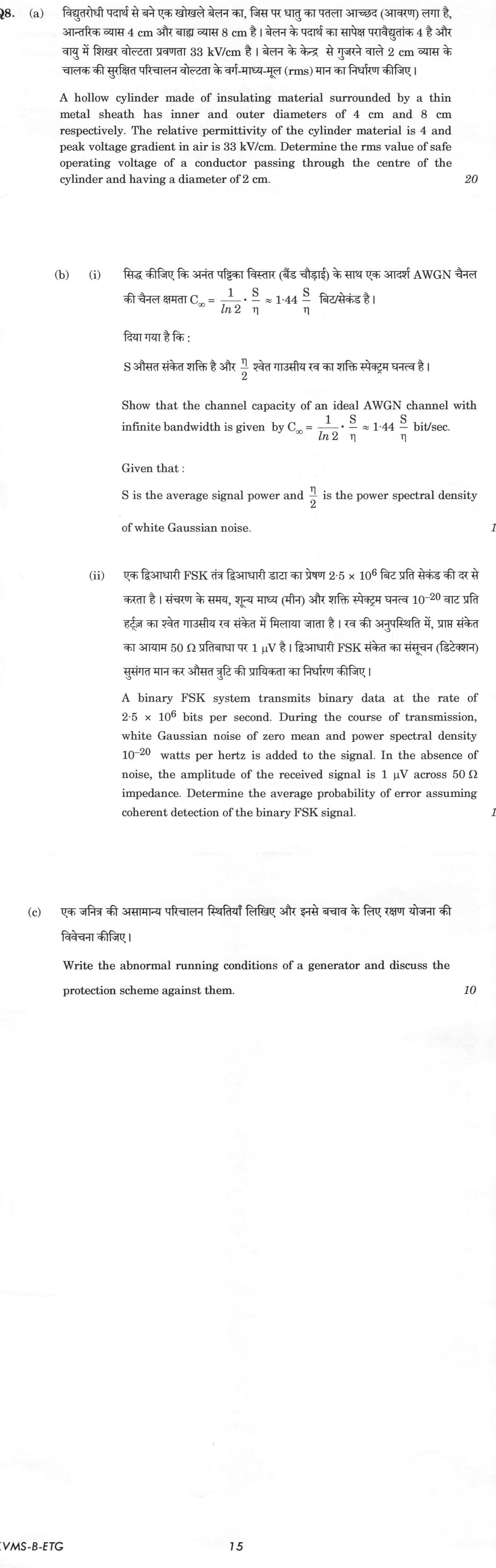
(a) A hollow cylinder made of insulating material surrounded by a thin metal sheath has inner and outer diameters of 4 cm and 8…
A hollow cylinder made of insulating material surrounded by a thin metal sheath has inner and outer diameters of 4 cm and 8 cm respectively. The relative permittivity of the cylinder material is 4 and peak voltage gradient in air is 33 kV/cm. Determine the rms value of safe operating voltage of a conductor passing through the centre of the cylinder and having a diameter of 2 cm. 20 marks
Show that the channel capacity of an ideal AWGN channel with infinite bandwidth is given by C∞ = 1/ln 2 · S/η ≈ 1.44 S/η bit/sec. Given that : S is the average signal power and η/2 is the power spectral density of white Gaussian noise. 10 marks
A binary FSK system transmits binary data at the rate of 2·5 × 10⁶ bits per second. During the course of transmission, white Gaussian noise of zero mean and power spectral density 10⁻²⁰ watts per hertz is added to the signal. In the absence of noise, the amplitude of the received signal is 1 μV across 50 Ω impedance. Determine the average probability of error assuming coherent detection of the binary FSK signal. 10 marks
Write the abnormal running conditions of a generator and discuss the protection scheme against them. 10 marks
हिंदी में प्रश्न पढ़ें
विद्युतरोधी पदार्थ से बने एक खोखले बेलन का, जिस पर धातु का पतला आच्छद (आवरण) लगा है, आंतरिक व्यास 4 cm और बाह्य व्यास 8 cm है। बेलन के पदार्थ का सापेक्ष परावैद्युतांक 4 है और वायु में शिखर वोल्टता प्रवणता 33 kV/cm है। बेलन के केन्द्र से गुजरने वाले 2 cm व्यास के चालक की सुरक्षित परिचालन वोल्टता का वर्ग-माध्य-मूल (rms) मान का निर्धारण कीजिए। (20 अंक)
सिद्ध कीजिए कि अनंत पट्टिका विस्तार (बैंड चौड़ाई) के साथ एक आदर्श AWGN चैनल की चैनल क्षमता C∞ = 1/ln 2 · S/η ≈ 1.44 S/η बिट/सेकंड है। दिया गया है कि : S औसत संकेत शक्ति है और η/2 श्वेत गाउसीय रव का शक्ति स्पेक्ट्रम घनत्व है। (10 अंक)
एक द्विआधारी FSK तंत्र द्विआधारी डाटा का प्रेषण 2·5 × 10⁶ बिट प्रति सेकंड की दर से करता है। संचरण के समय, शून्य माध्य (मीन) और शक्ति स्पेक्ट्रम घनत्व 10⁻²⁰ वाट प्रति हर्ट्ज़ का श्वेत गाउसीय रव संकेत में मिलाया जाता है। रव की अनुपस्थिति में, प्राप्त संकेत का आयाम 50 Ω प्रतिबाधा पर 1 μV है। द्विआधारी FSK संकेत का संसूचन (डिटेक्शन) सुसंगत मान कर औसत त्रुटि की प्रायिकता का निर्धारण कीजिए। (10 अंक)
एक जनित्र की असामान्य परिचालन स्थितियाँ लिखिए और इनसे बचाव के लिए रक्षण योजना की विवेचना कीजिए। (10 अंक)
Model answer
Drafted with AI by UPSC Answer Check against this question's marking rubric, to the expected length. UPSC does not publish answers for Mains — this is one way to score well, not an official key. How we build rubrics and answers.
(a) Safe operating voltage of a conductor in a composite dielectric (20 marks)
Geometry. The conductor has radius r₁ = 1 cm. It lies in air out to the inner surface of the insulating cylinder at r₂ = 2 cm (inner diameter 4 cm). The cylinder has ε_r = 4 and extends to r₃ = 4 cm (outer diameter 8 cm), where the thin earthed metal sheath lies. So there are two coaxial dielectric layers in series: air (1 to 2 cm) and the insulator (2 to 4 cm).
Field in each layer. For a charge λ per unit length on the conductor, Gauss's law gives
- in air: E(r) = λ/(2πε₀r), which is greatest at the conductor surface, r = r₁;
- in the insulator: E(r) = λ/(2πε₀ε_r r).
The maximum gradient in air is therefore g_max = λ/(2πε₀r₁), so that λ/(2πε₀) = g_max r₁.
Voltage. The peak voltage between the conductor and the sheath is the integral of the field:
V = ∫E dr = (λ/2πε₀)[ln(r₂/r₁) + (1/ε_r) ln(r₃/r₂)] = g_max r₁ [ln(r₂/r₁) + (1/ε_r) ln(r₃/r₂)].
Numbers. The permissible peak gradient in air is g_max = 33 kV/cm.
V_peak = 33 × 1 × [ln 2 + (1/4) ln 2] = 33 × [0.6931 + 0.1733] = 33 × 0.8664 = 28.59 kV.
RMS value. V_rms = V_peak/√2 = 28.59/1.4142 = 20.2 kV.
Check on the insulator. At r = 2 cm the gradient in air is 33 × 1/2 = 16.5 kV/cm, and just inside the insulator it is 16.5/4 = 4.1 kV/cm. The stress in the insulator is far below that at the conductor, so the limiting stress is at the surface of the conductor in air, as assumed. The safe rms operating voltage of the conductor is about 20.2 kV.
(b)(i) Capacity of an ideal AWGN channel of infinite bandwidth (10 marks)
The noise has a two-sided power spectral density η/2, so the noise power in a bandwidth B is N = (η/2)(2B) = ηB. The Shannon-Hartley capacity is
C = B log₂(1 + S/(ηB)) bits/s.
Put x = S/(ηB), so that B = S/(ηx). Then
C = (S/η)(1/x) log₂(1 + x) = (S/η)(1/ln 2)[ln(1 + x)/x].
As B → ∞, x → 0, and ln(1 + x) = x − x²/2 + x³/3 − … so ln(1 + x)/x → 1. Hence
C_∞ = lim(B→∞) C = (1/ln 2)(S/η) = 1.44 S/η bits/s, since 1/ln 2 = log₂e = 1.4427.
Interpretation. Capacity rises with B, but only up to this limit, because the noise power ηB grows in proportion to B. With S = E_bC, the limit gives E_b/η ≥ ln 2 = 0.693, that is −1.6 dB, the Shannon limit for error-free communication.
(b)(ii) Error probability of coherent binary FSK (10 marks)
Data. R_b = 2.5 × 10⁶ b/s, so T_b = 1/R_b = 0.4 μs. The noise has a two-sided power spectral density N₀/2 = 10⁻²⁰ W/Hz, so N₀ = 2 × 10⁻²⁰ W/Hz. This is the convention used in part (i).
Energy per bit. The received sinusoid has amplitude A = 1 μV across R = 50 Ω, so the power is A²/(2R) = (10⁻⁶)²/(2 × 50) = 10⁻¹⁴ W, and
E_b = (A²/2R)T_b = 10⁻¹⁴ × 0.4 × 10⁻⁶ = 4 × 10⁻²¹ J.
Error probability. For coherent detection of binary FSK (orthogonal signals),
P_e = Q(√(E_b/N₀)) = ½ erfc(√(E_b/2N₀)).
E_b/N₀ = 4 × 10⁻²¹/(2 × 10⁻²⁰) = 0.2, so
P_e = Q(√0.2) = Q(0.447) ≈ 0.327.
Comment. An error probability of about 0.33 means the link is almost unusable, because E_b/N₀ = 0.2 (−7 dB) is very low; an E_b/N₀ of about 13.5 dB is needed for P_e = 10⁻⁶. (If 10⁻²⁰ W/Hz were read as N₀ itself, E_b/N₀ = 0.4 and P_e = Q(0.632) = 0.264.)
(c) Abnormal running conditions of a generator and their protection (10 marks)
Abnormal running conditions are not internal short circuits. They are usually slow to develop, so the protection gives an alarm or trips after a time delay, and it is set to keep the generator within its thermal and mechanical limits.
- Overloading (thermal overload): heats the stator winding. It is guarded by thermal relays or temperature detectors (RTDs) in the slots, with an alarm and then a delayed trip.
- Unbalanced loading (negative-sequence current): the negative-sequence field rotates against the rotor at twice the synchronous speed and induces double-frequency currents that overheat the rotor surface. A negative-sequence relay with an inverse-time I₂²t = K characteristic gives the protection.
- Loss of excitation (field failure): the machine runs as an induction generator, drawing reactive power from the grid and overheating the rotor, and may lose synchronism. It is protected by an offset mho (impedance) relay, or an under-excitation or field-failure relay, which trips after a short delay.
- Loss of synchronism (pole slipping): causes large swings in current and torque. An out-of-step (impedance-swing) relay detects it and trips.
- Motoring (loss of prime mover): the generator takes power from the grid, which can overheat the turbine blades or damage the engine. A reverse-power (directional power) relay trips after a time delay.
- Overspeed: follows a sudden loss of load and endangers the rotor. The governor limits it, and a centrifugal overspeed trip (or overfrequency relay) shuts the prime mover down.
- Overvoltage and over-fluxing (high V/Hz): caused by loss of load or an AVR fault. An overvoltage relay and a volts-per-hertz relay protect the insulation and core.
- Stator or rotor cooling failure, bearing failure and vibration: temperature and vibration detectors give an alarm and trip.
- Rotor earth fault: the first earth fault does not cause damage, but a second one would short-circuit part of the winding, so a field earth-fault relay raises an alarm or trips.
How this answer will be evaluated
Evaluation rubric
Each sub-part is marked on its own, against the marks and word limit printed on the paper.
- (a) A conductor of diameter 2 cm lies at the centre of a hollow insulating cylinder (inner diameter 4 cm, outer diameter 8 cm, ε_r = 4) with an earthed thin metal sheath; find the rms safe operating voltage for a peak gradient in air of 33 kV/cm. 20 marks
Must cover
- Layers identified: air from r = 1 cm to 2 cm and insulator from 2 cm to 4 cm, with the maximum air gradient at the conductor surface
- g_max = λ/(2πε₀r₁) and V = g_max r₁[ln(r₂/r₁) + (1/ε_r)ln(r₃/r₂)]
- V_peak = 33 × [ln 2 + (1/4) ln 2] ≈ 28.6 kV
- V_rms = V_peak/√2 ≈ 20.2 kV
Loses marks
- Using diameters as radii.
- Dividing the air term by ε_r or using ε_r for the wrong layer.
- Reporting the peak value instead of the rms value.
Earns more
- Correct radii from diameters (1, 2 and 4 cm).
- Check that the stress in the insulator is lower than in the air.
Extra mark
- Gradient at the inner surface of the insulator: 16.5 kV/cm in air and about 4.1 kV/cm in the insulator
- (b)(i) Show that the capacity of an ideal AWGN channel with infinite bandwidth is C_∞ = (1/ln 2)(S/η) ≈ 1.44 S/η bits/s, with η/2 the noise power spectral density. 10 marks
Must cover
- Noise power N = ηB and C = B log₂(1 + S/(ηB))
- Substitution x = S/(ηB) giving C = (S/η)(1/ln 2) ln(1 + x)/x
- Limit x → 0, ln(1 + x)/x → 1, so C_∞ = S/(η ln 2) = 1.44 S/η
Loses marks
- Taking N = (η/2)B.
- Claiming that capacity grows without bound as B → ∞.
- Using the limit without the step from B to x.
Earns more
- Series expansion of ln(1 + x) or the standard limit.
- Correct use of the two-sided density η/2 to obtain N = ηB.
Extra mark
- Shannon limit E_b/η ≥ ln 2 = −1.6 dB, and the remark that capacity saturates as B grows
- (b)(ii) Coherent binary FSK at 2.5 Mb/s with a received amplitude of 1 μV across 50 Ω and noise PSD 10⁻²⁰ W/Hz: find the average error probability. 10 marks
Must cover
- T_b = 0.4 μs, signal power A²/(2R) = 10⁻¹⁴ W and E_b = 4 × 10⁻²¹ J
- Noise density convention stated: N₀/2 = 10⁻²⁰, so N₀ = 2 × 10⁻²⁰ W/Hz
- P_e = Q(√(E_b/N₀)) for coherent orthogonal FSK
- E_b/N₀ = 0.2 and P_e = Q(0.447) ≈ 0.327
Loses marks
- Using the coherent PSK formula Q(√(2E_b/N₀)).
- Using A²/R for the power.
- Reporting the bit error probability without evaluating Q.
Earns more
- Use of the sinusoid power A²/(2R) and not A²/R.
- Comment that the SNR is far too low, or the alternative reading N₀ = 10⁻²⁰ giving 0.264.
Extra mark
- Statement of the requirement E_b/N₀ ≈ 13.5 dB for P_e = 10⁻⁶
- (c) List the abnormal running conditions of a synchronous generator (not internal faults) and discuss the protection scheme against each. 10 marks
Must cover
- Overload, unbalanced (negative-sequence) loading, loss of excitation and loss of synchronism
- Motoring/reverse power, overspeed, overvoltage or over-fluxing, cooling or bearing failure, rotor earth fault
- A protection for each: thermal relay/RTD, I₂²t negative-sequence relay, offset mho or field-failure relay, out-of-step relay, reverse-power relay, governor and overspeed trip, overvoltage and V/Hz relay, temperature and vibration detectors, field earth-fault relay
- Correct consequence for each (rotor heating, induction-generator action, turbine damage, insulation stress) and alarm versus delayed trip
Loses marks
- Listing internal faults (stator differential, earth fault) as abnormal running conditions.
- Naming conditions without the protection scheme.
- Stating instantaneous trip for every condition.
Earns more
- Condition-to-protection pairing clearly made for each item.
- Distinction between abnormal conditions and internal faults, and the role of time delay.
Extra mark
- Mention of the inverse-time characteristic I₂²t = K
What "Calculate" is asking you to do
Apply the standard formula or schedule to data the question has already supplied — a table of readings, cost records, a balance sheet — and produce the number. The method is rarely in doubt; the marks sit in the named intermediate quantities, each of which has to appear as a labelled line.
Structure that answers it
Data as given → formula or standard treatment, named → substitution → each intermediate, labelled → result with units
Where marks are lost
Omitting an intermediate the marking scheme pays for separately, or rounding at an intermediate line so the final figure drifts. In commerce and accountancy, any figure in a statement that no numbered working note supports is treated as unearned.
Practice this exact question
Write your answer and it is marked point by point against the model answer above — what you covered, what you missed, what you got wrong.
Evaluate my answer →More from Electrical Engineering 2026 Paper II
- Q5 (a) Write the state space equation for the following circuit. [Circuit diagram: voltage s…
- Q6 (a) Determine the efficiency of a 400 km long transmission line delivering 100 MW load at…
- Q7 (a) A 3-phase line is terminated by a star-connected resistive load of 800 ohm per phase.…
- Q8 (a) A hollow cylinder made of insulating material surrounded by a thin metal sheath has i…