GS Paper I — Q15
How do the melting of the Arctic ice and glaciers of the Antarctic differently affect the weather patterns and human activities…
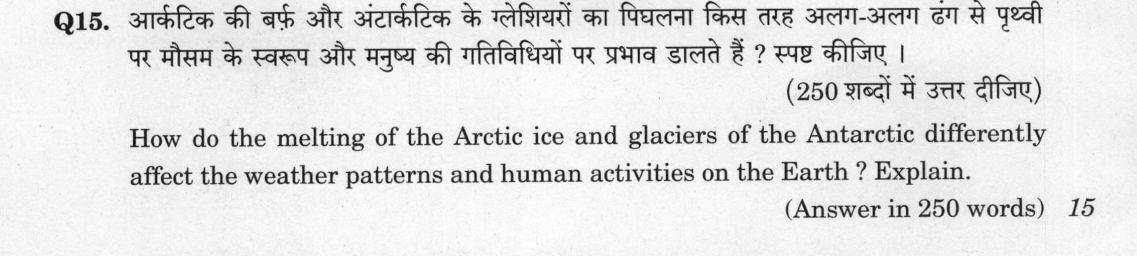
How do the melting of the Arctic ice and glaciers of the Antarctic differently affect the weather patterns and human activities on the Earth ? Explain. (Answer in 250 words) 15 marks
हिंदी में प्रश्न पढ़ें
आर्कटिक की बर्फ और अंटार्कटिक के ग्लेशियरों का पिघलना किस तरह अलग-अलग ढंग से पृथ्वी पर मौसम के स्वरूप और मनुष्य की गतिविधियों पर प्रभाव डालते हैं ? स्पष्ट कीजिए । (250 शब्दों में उत्तर दीजिए)
Model answer
Written by UPSC Answer Check against this question's marking rubric, to the 250-word length. UPSC does not publish answers for Mains — this is one way to score well, not an official key.
The Arctic and Antarctica melt differently because the Arctic is an ocean-ice system, while Antarctica is a land-ice system, producing distinct feedback loops, weather effects and human impacts.
Arctic: Sea-ice loss lowers albedo, accelerating Arctic amplification. This positive feedback makes the Arctic warm faster than the global mean. A warmer Arctic weakens and meanders the polar jet stream, allowing cold air to spill south and heat domes to persist, causing mid-latitude cold waves, heatwaves and erratic precipitation. These teleconnections can influence the Indian monsoon. Seasonally, a summer ice-free Arctic is projected within decades, opening the Northern Sea Route, encouraging resource extraction and affecting indigenous livelihoods; the 2021 Central Arctic Ocean moratorium, however, prevents unregulated commercial fishing in the high seas.
Antarctica: Glacier and ice-sheet melt, especially from unstable marine-terminating glaciers, threatens sea-level rise over multi-century ice-sheet dynamics. Freshwater input can weaken the AMOC and alter Southern Ocean overturning, while reduced sea-ice/ice-shelf extent weakens the Southern Ocean carbon sink. Meltwater input and regional warming shift pressure gradients, moving the Southern Hemisphere westerlies and storm tracks, modifying ITCZ and precipitation patterns, and altering extratropical cyclones and drought/rainfall anomalies. Direct human activity is limited, but global fisheries, research stations and tourism are affected by changing sea-ice, habitat and access. India’s deltaic and low-lying coasts face long-term vulnerability from Antarctic ice loss.
Thus, Arctic melting acts faster on weather and northern activities, while Antarctic ice loss is slower but larger for sea level and global circulation, making both polar regions critical to climate security.
What "Explain" is asking you to do
Make the working of something clear — what sets it off, what follows from what, and what it produces. Explain is the Commission's mechanism word: it dominates the technical papers and the “explain why” stems, where the marks sit in the causal chain and not in the label.
Structure that answers it
State what it is → the initiating condition → the chain of cause, step by step → an instance where it plays out → what the chain produces
Where marks are lost
Describing what something looks like instead of why it works that way. Naming the stages without linking them reads as description too.
How this answer will be evaluated
Approach
Framework: GS1 Geography: Physical-Human Linkage. explain: definition/context > points in order > small example > short close Full marks: Clearly distinguishes mechanisms (Jet Stream vs Ocean Currents) and specific human impacts (Trade vs Coastal Cities).
Key points expected
- Arctic: Disruption of polar jet stream causing extreme weather
- Arctic: Opening of Northern Sea Route affecting trade
- Antarctic: Disruption of thermohaline circulation (AMOC)
- Antarctic: Sea-level rise affecting coastal human settlements
Evaluation rubric
Each sub-part is marked on its own, against the marks and word limit printed on the paper.
- The answer Differentiate the specific impacts of Arctic vs Antarctic ice melt on weather and human activity. 15 marks · 250 words
explain— definition/context → points in order → small example → short close
Must cover
- Arctic: Disruption of polar jet stream causing extreme weather
- Arctic: Opening of Northern Sea Route affecting trade
- Antarctic: Disruption of thermohaline circulation (AMOC)
- Antarctic: Sea-level rise affecting coastal human settlements
Loses marks
- Treating Arctic and Antarctic impacts as identical
- Focusing only on global warming without specific regional effects
- Narrating chronology of ice loss without explaining mechanisms
Earns more
- Mention of 'Albedo effect' as a feedback mechanism
- Reference to 'Polar amplification' or 'Ice-albedo feedback'
- Specific mention of 'Thermohaline circulation' or 'AMOC'
- Linking Arctic melt to 'Wildfire' or 'Heatwave' events
Extra mark
- 30-second sketch map showing Jet Stream vs Ocean Currents
- One robust statistic on sea-level rise or ice loss rate
Practice this exact question
Write your answer and it is marked point by point against the model answer above — what you covered, what you missed, what you got wrong.
Evaluate my answer →More from General Studies 2021 GS Paper I
- Q12 Bring out the constructive programmes of Mahatma Gandhi during Non-Cooperation Movement a…
- Q13 "There arose a serious challenge to the Democratic State System between the two World War…
- Q14 Briefly mention the alignment of major mountain ranges of the world and explain their imp…
- Q15 How do the melting of the Arctic ice and glaciers of the Antarctic differently affect the…
- Q16 Discuss the multi-dimensional implications of uneven distribution of mineral oil in the w…
- Q17 What are the main socio-economic implications arising out of the development of IT indust…
- Q18 Discuss the main objectives of Population Education and point out the measures to achieve…