GS Paper I — Q5
Despite India being one of the countries of the Gondwanaland, its mining industry contributes much less to its Gross Domestic…
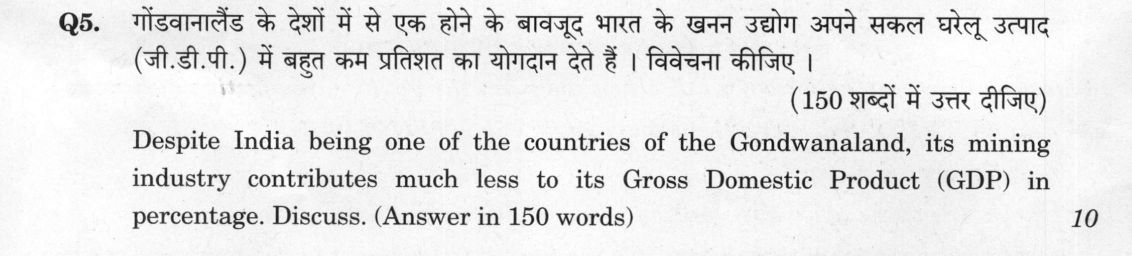
Despite India being one of the countries of the Gondwanaland, its mining industry contributes much less to its Gross Domestic Product (GDP) in percentage. Discuss. (Answer in 150 words) 10 marks
हिंदी में प्रश्न पढ़ें
गोंडवानालैंड के देशों में से एक होने के बावजूद भारत के खनन उद्योग अपने सकल घरेलू उत्पाद (जी.डी.पी.) में बहुत कम प्रतिशत का योगदान देते हैं । विवेचना कीजिए । (150 शब्दों में उत्तर दीजिए)
Model answer
Written by UPSC Answer Check against this question's marking rubric, to the 150-word length. UPSC does not publish answers for Mains — this is one way to score well, not an official key.
India’s Gondwanaland heritage gives it about 3–5% of world iron-ore reserves, 11% bauxite and major Jharia, Raniganj coalfields, yet mining adds only ~1.75% to GDP, versus about 10–14% in Australia and a larger share in Brazil. The gap is policy-driven: MMDR Act complexities, delayed environmental clearances, auction disruptions and federal structure and centre-state coordination weaken investment certainty. Structurally, public-sector dominance in mining (CIL; SAIL downstream in steel), low mechanisation, neglected underground mining and poor mineral exploration, with only ~10% of the obvious geological potential explored, limit output. Operationally, land acquisition hurdles, PESA/FRA tribal rights, transport infrastructure gaps and illegal mining issues (Shah Commission findings) raise costs. Sectorally, a manufacturing-led, services-dominant model and low value-addition, exporting raw ore rather than processed minerals, reduce mining’s GDP weight. The way forward is implementing the National Mineral Policy 2019, boosting NMET funding, deep-seated exploration, cluster-based mining and circular-economy processing to sustainably raise mining’s share.
What "Discuss" is asking you to do
Lay the issue out from more than one side — how it arose, what is claimed for it, what is held against it, and where it now stands. UPSC attaches discuss to broad topics with several live dimensions, so coverage of the dimensions earns more than the strength of your opinion.
Structure that answers it
Set the issue up → the case as it is made → the case against → the dimension both sides leave out → where the balance now lies
Where marks are lost
Listing facts with no thread between them, or arguing one side throughout and calling it a discussion.
How this answer will be evaluated
Approach
Framework: GS1 Geography/Economy. discuss: intro > 3-4 dimensions > example > balanced close Full marks: Clearly links geology to economic outcome with specific examples and policy context.
Key points expected
- Link Gondwanaland geology to mineral endowment (coal, iron, bauxite).
- Identify structural reasons for low GDP share (policy, infrastructure).
- Mention specific mineral-rich regions (e.g., Jharkhand, Odisha).
- Contrast resource availability with actual industrial output.
Evaluation rubric
Each sub-part is marked on its own, against the marks and word limit printed on the paper.
- The answer Explain the paradox of India's Gondwanaland status vs. low mining contribution to GDP. 10 marks · 150 words
discuss— intro → 3-4 dimensions → example → balanced close
Must cover
- Link Gondwanaland geology to mineral endowment (coal, iron, bauxite).
- Identify structural reasons for low GDP share (policy, infrastructure).
- Mention specific mineral-rich regions (e.g., Jharkhand, Odisha).
- Contrast resource availability with actual industrial output.
Loses marks
- Listing minerals without explaining the GDP paradox.
- Ignoring the Gondwanaland context entirely.
- Vague generalizations without specific examples.
Earns more
- Reference to specific mining policies or reforms.
- Mention of environmental constraints on mining.
- Comparison with other resource-rich nations.
- Discussion of value addition in mining.
Extra mark
- Specific statistic on mining's GDP contribution.
- Map sketch of major mineral belts.
Practice this exact question
Write your answer and it is marked point by point against the model answer above — what you covered, what you missed, what you got wrong.
Evaluate my answer →More from General Studies 2021 GS Paper I
- Q2 Trace the rise and growth of socio-religious reform movements with special reference to Y…
- Q3 Assess the main administrative issues and socio-cultural problems in the integration proc…
- Q4 Differentiate the causes of landslides in the Himalayan region and Western Ghats. (Answer…
- Q5 Despite India being one of the countries of the Gondwanaland, its mining industry contrib…
- Q6 What are the environmental implications of the reclamation of water bodies into urban lan…
- Q7 Mention the global occurrence of volcanic eruptions in 2021 and their impact on regional…
- Q8 Why is India considered as a subcontinent ? Elaborate your answer. (Answer in 150 words)…