GS Paper I — Q20
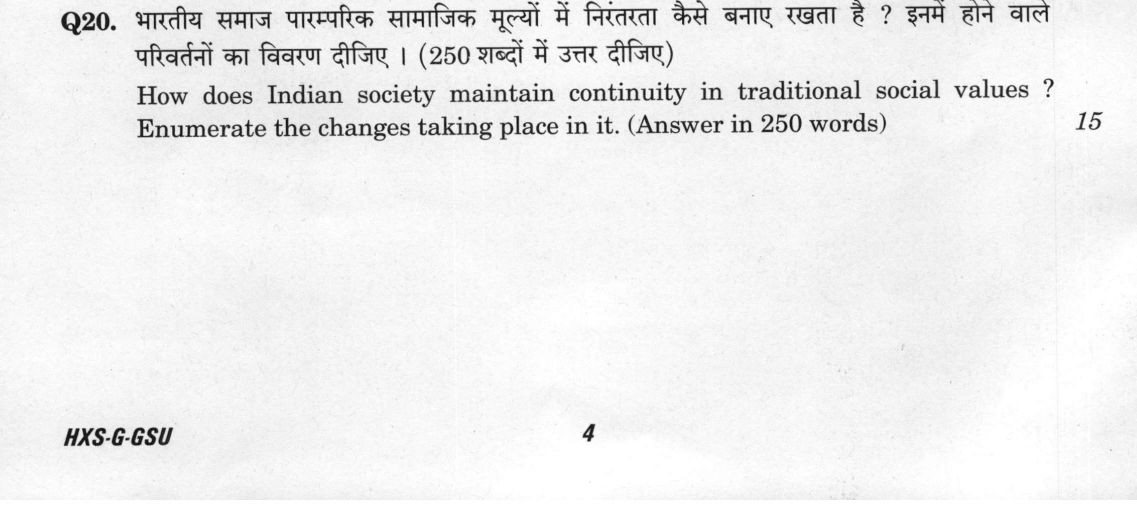
How does Indian society maintain continuity in traditional social values ? Enumerate the changes taking place in it. (Answer in…
How does Indian society maintain continuity in traditional social values ? Enumerate the changes taking place in it. (Answer in 250 words) 15 marks
हिंदी में प्रश्न पढ़ें
भारतीय समाज पारंपरिक सामाजिक मूल्यों में निरंतरता कैसे बनाए रखता है ? इनमें होने वाले परिवर्तनों का विवरण दीजिए । (250 शब्दों में उत्तर दीजिए)
Model answer
Written by UPSC Answer Check against this question's marking rubric, to the 250-word length. UPSC does not publish answers for Mains — this is one way to score well, not an official key.
Indian society functions as a dynamic continuum, harmonizing civilizational antiquity with modern imperatives through a process of selective adaptation.
Mechanisms Maintaining Continuity in Traditional Values
First, the socialization process within joint and extended family structures preserves collectivist ethics, filial piety, and respect for hierarchy. Second, religious rituals, community festivals, and oral folklore continually reinforce cultural solidarity. Third, institutional transmitters—such as temples, customary laws, village panchayats, and the *guru-shishya parampara*—reproduce traditional knowledge, Dharmashastric ethics, and artistic heritage across generations. Fourth, persistent endogamy and caste-based social networks help sustain traditional community affiliations and occupational patterns.
Enumeration of Changes Taking Place
Driven by constitutional values (Articles 14, 15, 21), post-1991 economic liberalization, mass education, digital connectivity, and women's empowerment movements, key transformations include:
- Family and Matrimony: Proliferation of nuclear households, live-in relationships, and a gradual rise in inter-caste and inter-faith unions.
- Gender Roles: Alteration of patriarchal structures through women's expanding workforce participation, property rights, and reproductive autonomy.
- Ritualistic Dilution: Declining orthodox ritual observance and weakening dietary taboos, especially among urban youth.
- Occupational Secularization: De-linking of traditional caste identities from economic livelihoods due to market expansion and affirmative action.
These changes exhibit marked regional variations, progressing more rapidly in urbanized, southern states with higher social indices than in orthodox northern rural hinterlands and insulated tribal belts.
Rather than undergoing outright Westernization, Indian society demonstrates adaptive resilience through selective modernization, wherein traditional forms evolve to accommodate contemporary needs—such as arranged marriages reforming into digitally mediated "assisted marriages."
What "Enumerate" is asking you to do
Produce the complete set of items asked for, countable and correctly named. The examiner marks against a checklist, so a missing item costs and an elaborated one gains nothing — where discussion is wanted the stem asks for it as a separate sub-part.
Structure that answers it
One line naming the basis on which the set is drawn → items numbered, each in a phrase or a single line → the discussion sub-part taken up separately, after the list is complete
Where marks are lost
Treating it as an essay. Six items named in six lines score better than three items explained at length.
How this answer will be evaluated
Approach
Framework: Society: continuity, data, intersectionality, then solution. explain: definition/context > points in order > small example > short close Full marks: Analyzes the 'how' of continuity and lists changes with clear reasoning.
Key points expected
- Mechanism of continuity (e.g., family, religion, caste)
- Enumeration of specific changes (e.g., urbanization, digital shift)
- Linkage between continuity and change (synthesis)
- Analytical tone avoiding mere chronology
Evaluation rubric
Each sub-part is marked on its own, against the marks and word limit printed on the paper.
- The answer Explain the mechanisms of continuity in traditional values and enumerate the changes occurring. · 250 words
explain— definition/context → points in order → small example → short close
Must cover
- Mechanism of continuity (e.g., family, religion, caste)
- Enumeration of specific changes (e.g., urbanization, digital shift)
- Linkage between continuity and change (synthesis)
- Analytical tone avoiding mere chronology
Loses marks
- Narrating history without analysis
- Emotive or biased language on social issues
- Listing changes without explaining the 'why'
Earns more
- Reference to specific social institutions
- Mention of modernizing factors (tech, law)
- Balanced view of tradition vs modernity
- Use of sociological concepts
Extra mark
- One robust statistic on social change
- Reference to a specific reform act or movement
Practice this exact question
Write your answer and it is marked point by point against the model answer above — what you covered, what you missed, what you got wrong.
Evaluate my answer →More from General Studies 2021 GS Paper I
- Q17 What are the main socio-economic implications arising out of the development of IT indust…
- Q18 Discuss the main objectives of Population Education and point out the measures to achieve…
- Q19 What is Cryptocurrency ? How does it affect global society ? Has it been affecting Indian…
- Q20 How does Indian society maintain continuity in traditional social values ? Enumerate the…