GS Paper IV — Q11
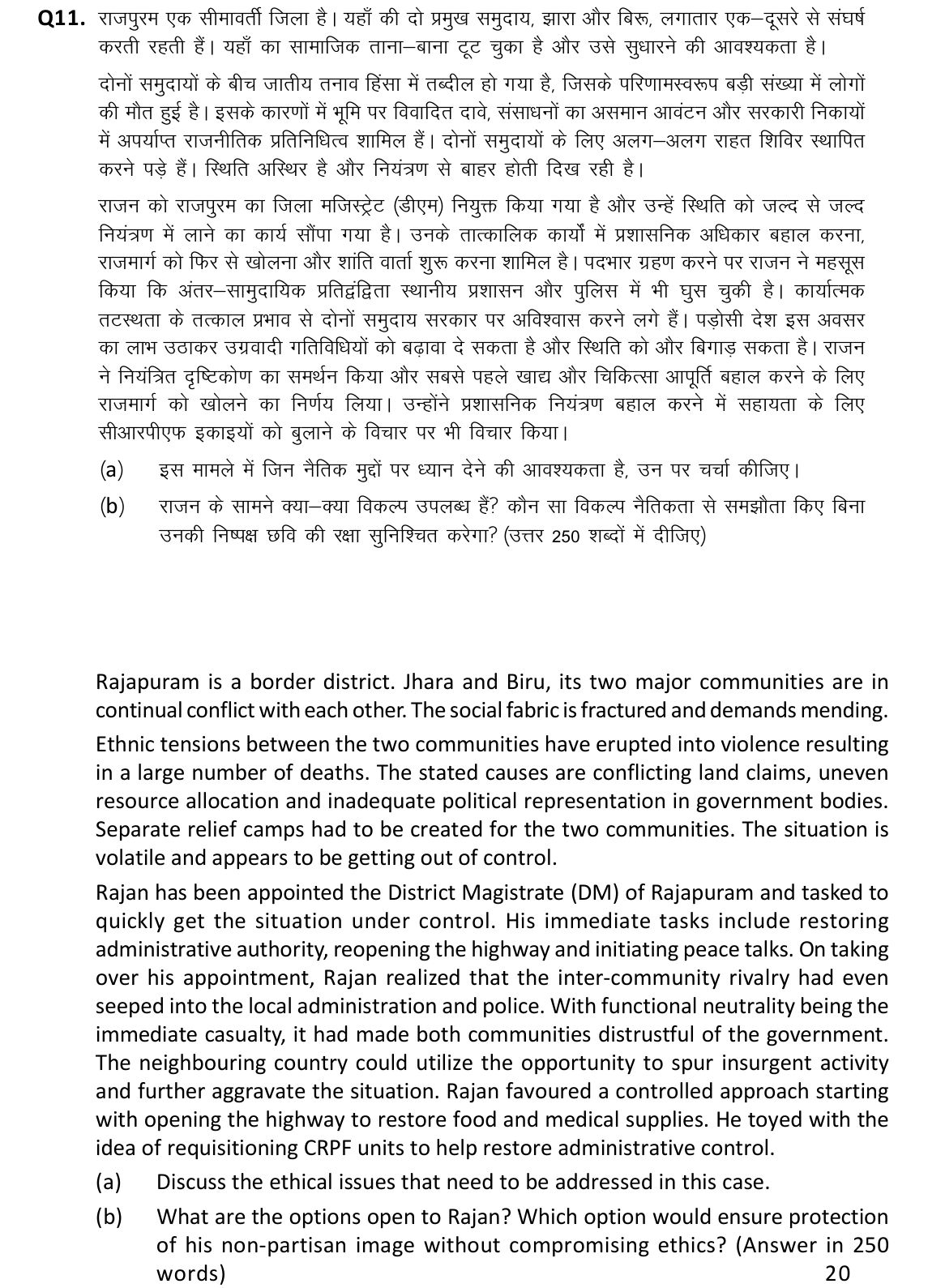
Rajapuram is a border district. Jhara and Biru, its two major communities, are in continual conflict with each other. The social…
Rajapuram is a border district. Jhara and Biru, its two major communities, are in continual conflict with each other. The social fabric is fractured and demands mending.
Ethnic tensions between the two communities have erupted into violence resulting in a large number of deaths. The stated causes are conflicting land claims, uneven resource allocation and inadequate political representation in government bodies. Separate relief camps had to be created for the two communities. The situation is volatile and appears to be getting out of control.
Rajan has been appointed the District Magistrate (DM) of Rajapuram and tasked to quickly get the situation under control. His immediate tasks include restoring administrative authority, reopening the highway and initiating peace talks. On taking over his appointment, Rajan realized that the inter-community rivalry had even seeped into the local administration and police. With functional neutrality being the immediate casualty, it had made both communities distrustful of the government. The neighbouring country could utilize the opportunity to spur insurgent activity and further aggravate the situation. Rajan favoured a controlled approach starting with opening the highway to restore food and medical supplies. He toyed with the idea of requisitioning CRPF units to help restore administrative control.
Discuss the ethical issues that need to be addressed in this case.
What are the options open to Rajan? Which option would ensure protection of his non-partisan image without compromising ethics? (Answer in 250 words) 20 marks
Model answer
Written by UPSC Answer Check against this question's marking rubric, to the 250-word length. UPSC does not publish answers for Mains — this is one way to score well, not an official key.
The governance crisis in Rajapuram presents a critical test of crisis management, where an administrative breakdown and ethnic polarization threaten internal cohesion as well as border security.
Ethical Issues Involved
The foremost ethical issue is the collapse of functional neutrality and institutional integrity within the local administration and police. Under the Nolan principles and the ethos of civil services, public servants must remain strictly non-partisan. When state functionaries allow ethnic loyalties to dictate duty, the state loses its moral authority and becomes an arena of conflict rather than an arbiter of justice.
A related issue is distributive justice versus administrative expediency. The conflict is rooted in structural inequalities involving land claims, resource distribution, and political under-representation. Merely imposing negative peace through coercive force, without addressing historical grievances and procedural fairness, constitutes an ethical failure of governance.
There is also an acute humanitarian imperative. The DM has a constitutional duty under Article 21 to protect life and ensure the non-discriminatory provision of essential commodities, medical aid, and security to both Jhara and Biru relief camps.
Finally, the situation involves balancing national security with local legitimacy. The vulnerability of a border district to hostile foreign exploitation demands swift stabilization. However, national security concerns cannot become a pretext for authoritarian overreach that alienates border populations and deepens communal fault lines.
Evaluation of Options Open to Rajan
Option 1: A purely security-driven approach using CRPF to forcibly clear the highway and enforce administrative control. While this swiftly restores state authority and secures the border, an over-reliance on coercive power risks being perceived as oppressive, hardening community resistance and damaging Rajan’s image as an empathetic administrator.
Option 2: A dialogue-first approach prioritizing immediate peace talks before enforcing physical control. While this demonstrates procedural fairness and community respect, initiating talks while supplies remain choked and local administration compromised risks projecting administrative weakness. It may also allow extremist elements to exploit the delay.
Option 3: A calibrated, sequenced approach that combines neutral security deployment, visible humanitarian equity, institutional sanitization, and structured dialogue.
The Recommended Course of Action
To preserve his non-partisan image without compromising ethics, Rajan must adopt the sequenced approach (Option 3).
First, he should requisition central forces like the CRPF strictly for neutral, operational tasks—namely, securing the vital highway and establishing area domination. Utilizing central forces bypasses the compromised local police apparatus, signaling objective resolve.
Second, the restored supply line must be visibly leveraged to deliver food and medical relief symmetrically to both Jhara and Biru camps, demonstrating humanitarian neutrality.
Third, Rajan must restore institutional credibility by temporarily reshuffling visibly partisan local officials away from sensitive operational posts, replacing them with officers of proven integrity.
Concurrently, he must institute an inclusive District Peace and Reconciliation Council with equal representation from Jhara and Biru elders, civil society, and women leaders. This council should address immediate de-escalation while creating institutional mechanisms to examine long-term land and resource disputes.
By combining firm, impartial law enforcement with equitable humanitarian relief and institutional reform, Rajan can protect the state’s neutrality, counter external threats, and restore the fractured social fabric of Rajapuram.
What "Discuss" is asking you to do
Lay the issue out from more than one side — how it arose, what is claimed for it, what is held against it, and where it now stands. UPSC attaches discuss to broad topics with several live dimensions, so coverage of the dimensions earns more than the strength of your opinion.
Structure that answers it
Set the issue up → the case as it is made → the case against → the dimension both sides leave out → where the balance now lies
Where marks are lost
Listing facts with no thread between them, or arguing one side throughout and calling it a discussion.
How this answer will be evaluated
Approach
Framework: GS4 Ethical Dilemma & Decision Making. (a) discuss: intro > 3-4 dimensions > example > balanced close | (b) suggest: the problem in one line > implementable measures > who acts > conclusion Full marks: Identifies all key ethical issues and proposes a nuanced, multi-step solution that balances security with neutrality.
Key points expected
- Conflict between duty to maintain law and order vs. neutrality
- Ethical dilemma of resource allocation and political representation
- Distrust of government due to compromised administrative neutrality
- National security risk from neighboring country's potential interference
- List at least 3 distinct options (e.g., CRPF, peace talks, administrative reform)
- Select the option that best ensures 'non-partisan image'
- Justify the choice without compromising ethics
- Address the 'controlled approach' mentioned in the case
Evaluation rubric
Each sub-part is marked on its own, against the marks and word limit printed on the paper.
- (a) Identify and analyze the ethical dilemmas in the Rajapuram conflict scenario.
discuss— intro → 3-4 dimensions → example → balanced close
Must cover
- Conflict between duty to maintain law and order vs. neutrality
- Ethical dilemma of resource allocation and political representation
- Distrust of government due to compromised administrative neutrality
- National security risk from neighboring country's potential interference
Loses marks
- Listing values without linking them to the specific case
- Ignoring the 'neighboring country' dimension
- Focusing only on the violence, not the root causes
Earns more
- Mention of 'functional neutrality' as a casualty
- Reference to the 'social fabric' being fractured
- Identification of 'insurgent activity' as a specific threat
- Discussion of the 'volatility' of the situation
Extra mark
- Reference to specific ethical frameworks (e.g., utilitarianism vs. deontology)
- Mention of specific constitutional provisions on equality
- (b) Propose options for Rajan and identify the one that protects his non-partisan image. · 250 words
suggest— the problem in one line → implementable measures → who acts → conclusion
Must cover
- List at least 3 distinct options (e.g., CRPF, peace talks, administrative reform)
- Select the option that best ensures 'non-partisan image'
- Justify the choice without compromising ethics
- Address the 'controlled approach' mentioned in the case
Loses marks
- Choosing a purely military solution without ethical justification
- Ignoring the 'non-partisan' constraint in the final choice
- Vague suggestions without a clear course of action
Earns more
- Mentioning 'reopening the highway' as a first step
- Discussing the pros/cons of 'requisitioning CRPF units'
- Proposing 'peace talks' as a long-term solution
- Suggesting 'administrative reform' to restore trust
Extra mark
- Reference to specific conflict resolution models (e.g., mediation)
- Mention of specific legal powers of a DM
Practice this exact question
Write your answer and it is marked point by point against the model answer above — what you covered, what you missed, what you got wrong.
Evaluate my answer →More from General Studies 2026 GS Paper IV
- Q8 Ravi is a senior police officer with vast experience in riot control and cyber-policing.…
- Q9 Seema is a senior bureaucrat with a reputation of honesty and professional efficiency. Sh…
- Q10 Vikas is a government officer with over a decade of service in public administration. He…
- Q11 Rajapuram is a border district. Jhara and Biru, its two major communities, are in continu…
- Q12 Ajit has been recently promoted as the Head of the Department of Weapon Sales (DWS) in th…