GS Paper IV — Q10
Vikas is a government officer with over a decade of service in public administration. He has recently moved as the District…
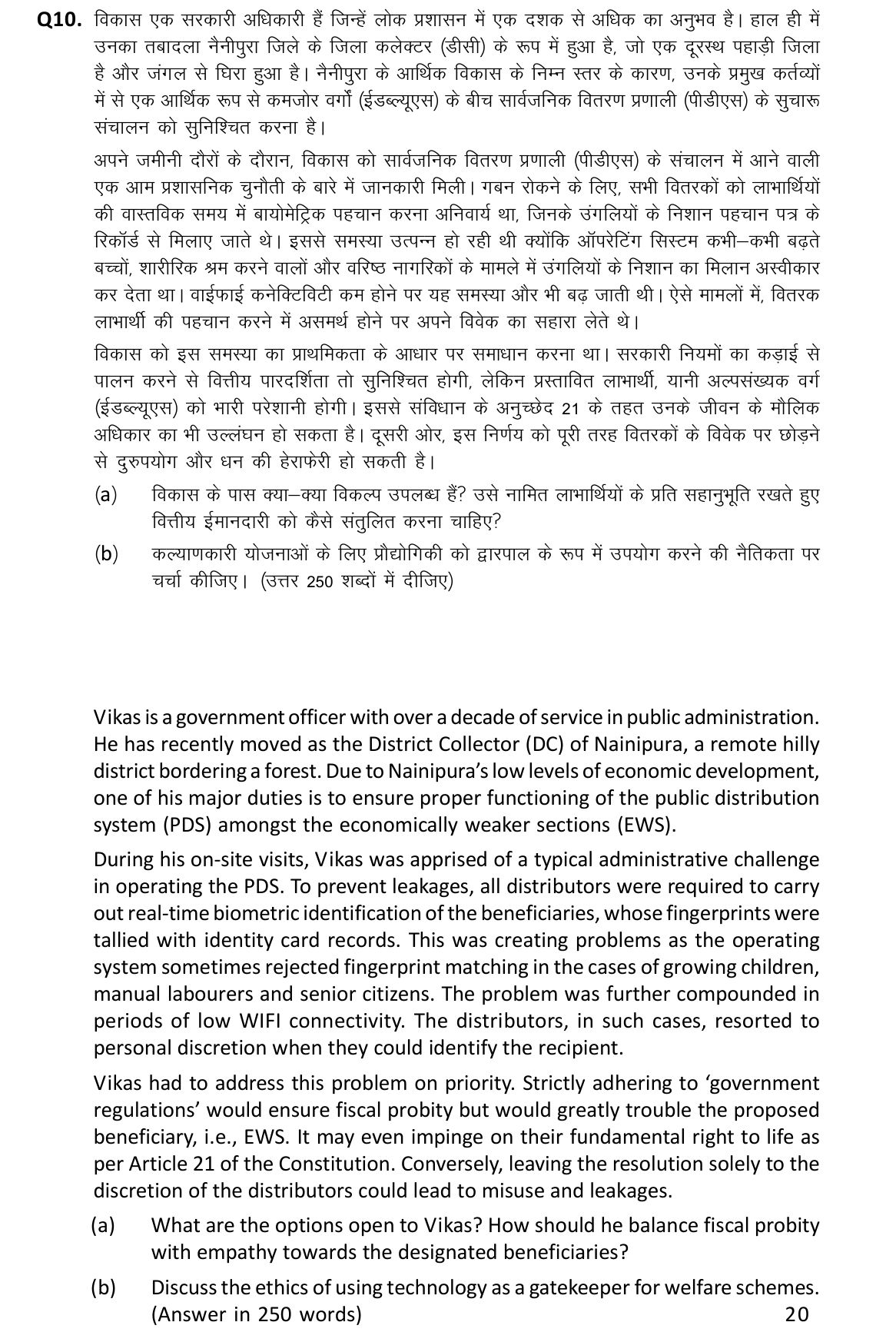
Vikas is a government officer with over a decade of service in public administration. He has recently moved as the District Collector (DC) of Nainipura, a remote hilly district bordering a forest. Due to Nainipura's low levels of economic development, one of his major duties is to ensure proper functioning of the public distribution system (PDS) amongst the economically weaker sections (EWS).
During his on-site visits, Vikas was apprised of a typical administrative challenge in operating the PDS. To prevent leakages, all distributors were required to carry out real-time biometric identification of the beneficiaries, whose fingerprints were tallied with identity card records. This was creating problems as the operating system sometimes rejected fingerprint matching in the cases of growing children, manual labourers and senior citizens. The problem was further compounded in periods of low WiFi connectivity. The distributors, in such cases, resorted to personal discretion when they could identify the recipient.
Vikas had to address this problem on priority. Strictly adhering to government regulations would ensure fiscal probity but would greatly trouble the proposed beneficiary, i.e., EWS. It may even impinge on their fundamental right to life as per Article 21 of the Constitution. Conversely, leaving the resolution solely to the discretion of the distributors could lead to misuse and leakages.
What are the options open to Vikas? How should he balance fiscal probity with empathy towards the designated beneficiaries?
Discuss the ethics of using technology as a gatekeeper for welfare schemes. (Answer in 250 words) 20 marks
Model answer
Written by UPSC Answer Check against this question's marking rubric, to the 250-word length. UPSC does not publish answers for Mains — this is one way to score well, not an official key.
The dilemma is not merely procedural: rigid biometric gatekeeping protects the PDS treasury but may deny food to genuine EWS, touching Article 21’s right to life and food security. Vikas should adopt a hybrid, audited fallback rather than absolute biometric-only or unchecked discretion. Where matching fails, distributors can use a documented manual-override protocol: OTP/alternate ID linked to Aadhaar or ration card, verification by a local committee (village panchayat, ASHA/ANM, school teacher), and periodic physical verification of children, labourers and elders. Every override must be logged, sampled and audited, with penalties for false claims. This balances fiscal probity—through traceability and deterrence—with empathy—by preventing wrongful exclusion in low-WiFi hilly areas.
Ethically, technology as a welfare gatekeeper is defensible when it reduces corruption, ghost beneficiaries and leakages, but it becomes problematic when system limitations produce exclusion errors: eligible persons are denied not because they are ineligible, but because fingerprints fail or connectivity falters. The poorest often lack digital literacy, stable identity documents, or recourse to contest errors, so an unappealable machine decision can erode the right to food. Human-centred design is therefore essential: biometrics should assist, not replace, human judgment, with transparent grievance redressal and offline fallbacks. The Aadhaar/PDS exclusion controversy and Supreme Court’s Puttaswamy-linked concerns show that technology-driven governance must remain subordinate to fundamental rights, proportionality and dignity. Thus, Vikas should treat biometric failure as a service failure, not beneficiary fault, and combine data integrity with constitutional compassion. This preserves fiscal probity without converting welfare into a digital exclusion machine.
What "Discuss" is asking you to do
Lay the issue out from more than one side — how it arose, what is claimed for it, what is held against it, and where it now stands. UPSC attaches discuss to broad topics with several live dimensions, so coverage of the dimensions earns more than the strength of your opinion.
Structure that answers it
Set the issue up → the case as it is made → the case against → the dimension both sides leave out → where the balance now lies
Where marks are lost
Listing facts with no thread between them, or arguing one side throughout and calling it a discussion.
How this answer will be evaluated
Approach
Framework: GS4 Ethical Dilemma & Governance. (a) suggest: the problem in one line > implementable measures > who acts > conclusion | (b) discuss: intro > 3-4 dimensions > example > balanced close Full marks: Balances probity with empathy; nuanced ethical analysis of tech gatekeeping.
Key points expected
- Immediate: Offline biometric mode or manual override with audit
- Short-term: Grievance redressal for failed biometric matches
- Long-term: Multi-modal authentication (face/iris) for EWS
- Balancing: Strict rules for audit vs. empathy for access
- Efficiency vs. Exclusion (digital divide) trade-off
- Privacy concerns of biometric data collection
- Algorithmic bias against manual labourers/elderly
- Accountability of tech failures vs. human error
Evaluation rubric
Each sub-part is marked on its own, against the marks and word limit printed on the paper.
- (a) Options for Vikas and balancing fiscal probity with empathy.
suggest— the problem in one line → implementable measures → who acts → conclusion
Must cover
- Immediate: Offline biometric mode or manual override with audit
- Short-term: Grievance redressal for failed biometric matches
- Long-term: Multi-modal authentication (face/iris) for EWS
- Balancing: Strict rules for audit vs. empathy for access
Loses marks
- Suggesting complete removal of biometric authentication
- Ignoring the 'leakage' risk of manual discretion
- Preaching values without administrative solutions
Earns more
- Mentioning 'Aadhaar' or 'JAM trinity' context
- Citing 'Right to Life' (Art 21) as a constraint
- Suggesting 'Social Audit' to check distributor discretion
- Proposing 'Offline mode' for low connectivity areas
Extra mark
- Reference to 'NITI Aayog' guidelines on biometric failure
- Mentioning 'Jan Dhan' linkage for financial inclusion
- (b) Ethics of technology as a gatekeeper for welfare schemes. · 250 words
discuss— intro → 3-4 dimensions → example → balanced close
Must cover
- Efficiency vs. Exclusion (digital divide) trade-off
- Privacy concerns of biometric data collection
- Algorithmic bias against manual labourers/elderly
- Accountability of tech failures vs. human error
Loses marks
- One-sided praise of technology without critique
- Ignoring the 'human element' in welfare delivery
- Exceeding the 250-word limit significantly
Earns more
- Mentioning 'Digital India' or 'Aadhaar' as examples
- Discussing 'Data Protection' or 'Right to Privacy'
- Citing 'Digital Literacy' gap in rural areas
- Balancing 'Fiscal Probit' with 'Social Justice'
Extra mark
- Reference to 'Justice K.S. Puttaswamy' judgment
- Mentioning 'UN SDGs' on reducing inequality
Practice this exact question
Write your answer and it is marked point by point against the model answer above — what you covered, what you missed, what you got wrong.
Evaluate my answer →More from General Studies 2026 GS Paper IV
- Q7 Lata, a mother of two children, was admitted to a hospital for acute abdominal pain. Her…
- Q8 Ravi is a senior police officer with vast experience in riot control and cyber-policing.…
- Q9 Seema is a senior bureaucrat with a reputation of honesty and professional efficiency. Sh…
- Q10 Vikas is a government officer with over a decade of service in public administration. He…
- Q11 Rajapuram is a border district. Jhara and Biru, its two major communities, are in continu…
- Q12 Ajit has been recently promoted as the Head of the Department of Weapon Sales (DWS) in th…