GS Paper IV — Q8
Ravi is a senior police officer with vast experience in riot control and cyber-policing. Since one year, he has been the…
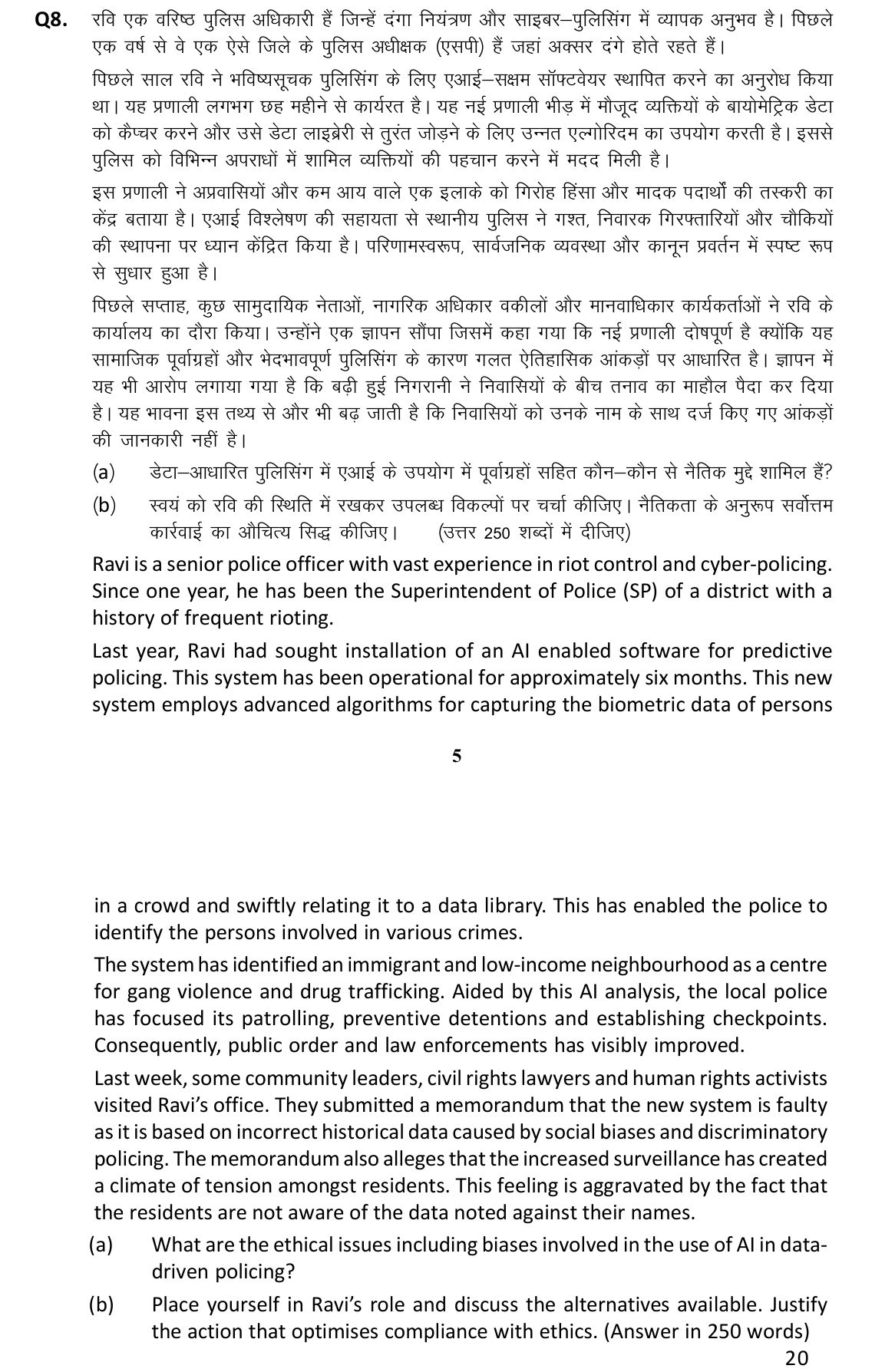
Ravi is a senior police officer with vast experience in riot control and cyber-policing. Since one year, he has been the Superintendent of Police (SP) of a district with a history of frequent rioting.
Last year, Ravi had sought installation of an AI enabled software for predictive policing. This system has been operational for approximately six months. This new system employs advanced algorithms for capturing the biometric data of persons in a crowd and swiftly relating it to a data library. This has enabled the police to identify the persons involved in various crimes.
The system has identified an immigrant and low-income neighbourhood as a centre for gang violence and drug trafficking. Aided by this AI analysis, the local police has focused its patrolling, preventive detentions and establishing checkposts. Consequently, public order and law enforcement has visibly improved.
Last week, some community leaders, civil rights lawyers and human rights activists visited Ravi's office. They submitted a memorandum that the new system is faulty as it is based on incorrect historical data caused by social biases and discriminatory policing. The memorandum also alleges that the increased surveillance has created a climate of tension amongst residents. This feeling is aggravated by the fact that the residents are not aware of the data noted against their names.
What are the ethical issues including biases involved in the use of AI in data-driven policing?
Place yourself in Ravi's role and discuss the alternatives available. Justify the action that optimises compliance with ethics. (Answer in 250 words) 20 marks
Model answer
Written by UPSC Answer Check against this question's marking rubric, to the 250-word length. UPSC does not publish answers for Mains — this is one way to score well, not an official key.
Ethical Issues and Biases in AI-Driven Policing
Algorithmic and Historical Bias: Predictive algorithms trained on legacy policing data entrench pre-existing societal prejudices ("garbage in, garbage out"), unfairly profiling immigrant and low-income populations.
Privacy and Due Process Violations: Indiscriminate crowd biometric harvesting without consent contravenes the right to informational privacy (K.S. Puttaswamy). The opacity of predictive models denies individuals procedural fairness and awareness of data stored against them.
Feedback Loops and Chilling Effect: Over-patrolling flagged pockets causes higher recording of minor infractions, creating a self-fulfilling loop that falsely validates the algorithm while breeding community alienation and chilling civil liberties.
Alternatives for Ravi and Ethical Justification
Option 1: Continue the system unchanged. Merits: Sustains current operational deterrence and public order. Demerits: Institutionalises discrimination and risks constitutional invalidity.
Option 2: Blanket suspension of the AI tool. Merits: Immediately safeguards civil liberties. Demerits: May create an enforcement vacuum in a riot-prone district.
Option 3: Calibrated continuation with robust safeguards (Recommended). Merits: Balances collective security with individual fundamental rights. Demerits: Incurs procedural delays and administrative costs.
Justification: Grounded in the Nolan Principles (Accountability, Openness, Objectivity) and the doctrine of proportionality, Ravi should adopt Option 3:
- Commission an independent algorithmic bias audit to cleanse skewed historical datasets.
- Enforce a "human-in-the-loop" doctrine where AI outputs serve only as secondary leads, barring automated preventive detentions.
- Establish a transparent community liaison mechanism enabling residents to access data logs, contest erroneous profiling, and rebuild institutional trust.
AI should serve as an auxiliary aid to empathetic human policing, ensuring technological efficiency does not eclipse constitutional morality.
What "Discuss" is asking you to do
Lay the issue out from more than one side — how it arose, what is claimed for it, what is held against it, and where it now stands. UPSC attaches discuss to broad topics with several live dimensions, so coverage of the dimensions earns more than the strength of your opinion.
Structure that answers it
Set the issue up → the case as it is made → the case against → the dimension both sides leave out → where the balance now lies
Where marks are lost
Listing facts with no thread between them, or arguing one side throughout and calling it a discussion.
How this answer will be evaluated
Approach
Framework: GS4 Ethical Dilemma & Case Study Framework. (a) highlight: name the salient points > one line of substance each > close | (b) justify: claim > 3-4 reasons > evidence > conclusion Full marks: Identifies specific algorithmic biases and proposes a balanced, actionable solution with clear justification.
Key points expected
- Algorithmic bias from discriminatory historical data
- Privacy violation via biometric surveillance
- Profilng of marginalized/immigrant communities
- Lack of transparency and informed consent
- Immediate audit of the AI system's data
- Engagement with community leaders for transparency
- Balancing public safety with civil liberties
- Justification of the chosen ethical path
Evaluation rubric
Each sub-part is marked on its own, against the marks and word limit printed on the paper.
- (a) Identify ethical issues and specific biases in AI-driven policing.
highlight— name the salient points → one line of substance each → close
Must cover
- Algorithmic bias from discriminatory historical data
- Privacy violation via biometric surveillance
- Profilng of marginalized/immigrant communities
- Lack of transparency and informed consent
Loses marks
- Generic listing of values without context
- Ignoring the specific 'immigrant' bias in the case
Earns more
- Erosion of public trust and social cohesion
- Violation of right to privacy (Article 21)
- Creation of a 'chilling effect' on civil liberties
Extra mark
- Reference to 'Black Box' nature of AI algorithms
- Mention of 'Data Protection' or 'Right to be Forgotten'
- (b) Discuss alternatives and justify the ethically optimal course of action. · 250 words
justify— claim → 3-4 reasons → evidence → conclusion
Must cover
- Immediate audit of the AI system's data
- Engagement with community leaders for transparency
- Balancing public safety with civil liberties
- Justification of the chosen ethical path
Loses marks
- Choosing to ignore the complaint entirely
- Preaching values without actionable steps
Earns more
- Suggesting human-in-the-loop verification
- Proposing a phased suspension or modification
- Establishing a grievance redressal mechanism
Extra mark
- Reference to 'Proportionality' principle in policing
- Mention of 'Community Policing' as an alternative
Practice this exact question
Write your answer and it is marked point by point against the model answer above — what you covered, what you missed, what you got wrong.
Evaluate my answer →More from General Studies 2026 GS Paper IV
- Q5 (a) Usually schools, working in remote areas, do not fully comply with government regulat…
- Q6 (a) On the request of his Personal Assistant (PA), the District Magistrate (DM) stops the…
- Q7 Lata, a mother of two children, was admitted to a hospital for acute abdominal pain. Her…
- Q8 Ravi is a senior police officer with vast experience in riot control and cyber-policing.…
- Q9 Seema is a senior bureaucrat with a reputation of honesty and professional efficiency. Sh…
- Q10 Vikas is a government officer with over a decade of service in public administration. He…
- Q11 Rajapuram is a border district. Jhara and Biru, its two major communities, are in continu…