GS Paper IV — Q6
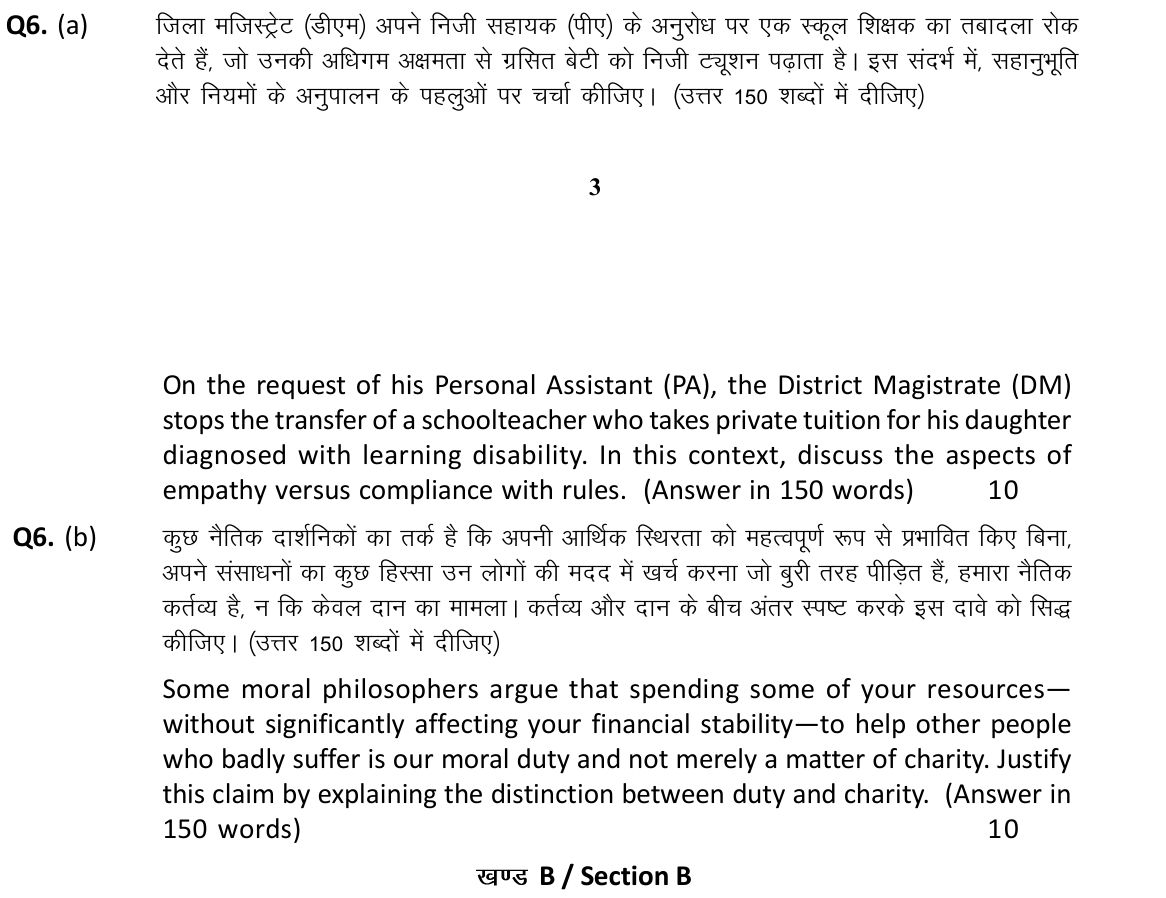
(a) On the request of his Personal Assistant (PA), the District Magistrate (DM) stops the transfer of a schoolteacher who takes…
On the request of his Personal Assistant (PA), the District Magistrate (DM) stops the transfer of a schoolteacher who takes private tuition for his daughter diagnosed with learning disability. In this context, discuss the aspects of empathy versus compliance with rules. (Answer in 150 words) 10 marks
Some moral philosophers argue that spending some of your resources — without significantly affecting your financial stability — to help other people who badly suffer is our moral duty and not merely a matter of charity. Justify this claim by explaining the distinction between duty and charity. (Answer in 150 words) 10 marks
Model answer
Written by UPSC Answer Check against this question's marking rubric, to the 150-word length. UPSC does not publish answers for Mains — this is one way to score well, not an official key.
(a) Empathy versus Compliance with Rules
The DM’s intervention highlights the ethical tension between compassionate administration for a special-needs child and rule-based impartiality. Halting a transfer solely on a Personal Assistant’s informal request risks favouritism, bureaucratic nepotism, and a breach of administrative integrity. Empathy must align with procedural fairness rather than proximity to authority. The DM should instead route such appeals through formal, documented transfer-exemption guidelines for medical dependencies, ensuring both compassionate consideration and transparent, rule-governed legitimacy.
(b) Duty versus Charity
Charity is traditionally viewed as supererogatory—praiseworthy but optional—whereas duty entails an enforceable moral obligation. Peter Singer’s utilitarian principle argues that if one can prevent severe suffering without sacrificing anything of comparable moral significance, doing so is an imperative duty, not discretionary charity. For example, contributing surplus income to famine relief is a basic moral requirement. Although libertarians object that this compromises absolute property rights, the fundamental right to survival outweighs marginal luxuries. Hence, aiding the destitute becomes a demand of basic justice.
What "Discuss" is asking you to do
Lay the issue out from more than one side — how it arose, what is claimed for it, what is held against it, and where it now stands. UPSC attaches discuss to broad topics with several live dimensions, so coverage of the dimensions earns more than the strength of your opinion.
Structure that answers it
Set the issue up → the case as it is made → the case against → the dimension both sides leave out → where the balance now lies
Where marks are lost
Listing facts with no thread between them, or arguing one side throughout and calling it a discussion.
How this answer will be evaluated
Approach
Framework: GS4 Ethical Dilemma & Moral Philosophy. (a) discuss: intro > 3-4 dimensions > example > balanced close | (b) justify: claim > 3-4 reasons > evidence > conclusion Full marks: Clear, balanced, and actionable; names the 'wall' and resolves it; includes a value-wise example.
Key points expected
- Identify the conflict: personal empathy vs. administrative duty
- Analyze the 'easy-but-wrong' option of ignoring the rule
- Discuss the impact on institutional trust and fairness
- Propose a course of action balancing both aspects
- Define the distinction between duty and charity
- Explain the 'moral duty' argument (e.g., utilitarianism)
- Justify the claim with 3-4 reasons
- Conclude with a balanced judgment
Evaluation rubric
Each sub-part is marked on its own, against the marks and word limit printed on the paper.
- (a) Balanced analysis of empathy vs. rule compliance in the DM's decision. 10 marks · 150 words
discuss— intro → 3-4 dimensions → example → balanced close
Must cover
- Identify the conflict: personal empathy vs. administrative duty
- Analyze the 'easy-but-wrong' option of ignoring the rule
- Discuss the impact on institutional trust and fairness
- Propose a course of action balancing both aspects
Loses marks
- Preaching instead of reasoning
- Ignoring the 'compliance with rules' aspect
- Failing to address the 'silent stakeholders' (other students)
Earns more
- Mention the 'higher right' of rule of law
- Reference the specific rule regarding private tuition
- Suggest a long-term solution for the teacher's daughter
- Highlight the role of the PA in the decision
Extra mark
- Cite a specific Supreme Court judgment on private tuition
- Reference the 'Right to Education' Act provisions
- (b) Justify the claim that helping the suffering is a duty, not charity. 10 marks · 150 words
justify— claim → 3-4 reasons → evidence → conclusion
Must cover
- Define the distinction between duty and charity
- Explain the 'moral duty' argument (e.g., utilitarianism)
- Justify the claim with 3-4 reasons
- Conclude with a balanced judgment
Loses marks
- Confusing duty with charity
- Failing to justify the claim
- Preaching instead of reasoning
Earns more
- Reference Peter Singer's 'drowning child' argument
- Mention the 'marginal utility' concept
- Discuss the 'social contract' perspective
- Highlight the 'moral obligation' of the privileged
Extra mark
- Cite a specific philosopher's work (e.g., Kant, Mill)
- Reference a specific ethical framework (e.g., Rawls' 'Veil of Ignorance')
Practice this exact question
Write your answer and it is marked point by point against the model answer above — what you covered, what you missed, what you got wrong.
Evaluate my answer →More from General Studies 2026 GS Paper IV
- Q3 (a) Dr. B. R. Ambedkar had cautioned that employing civil disobedience within a constitut…
- Q4 (a) Citing the serious adverse effects of long-term medication, a doctor convinces the fa…
- Q5 (a) Usually schools, working in remote areas, do not fully comply with government regulat…
- Q6 (a) On the request of his Personal Assistant (PA), the District Magistrate (DM) stops the…
- Q7 Lata, a mother of two children, was admitted to a hospital for acute abdominal pain. Her…
- Q8 Ravi is a senior police officer with vast experience in riot control and cyber-policing.…
- Q9 Seema is a senior bureaucrat with a reputation of honesty and professional efficiency. Sh…