GS Paper IV — Q4
(a) Citing the serious adverse effects of long-term medication, a doctor convinces the family of a female patient for surgery…
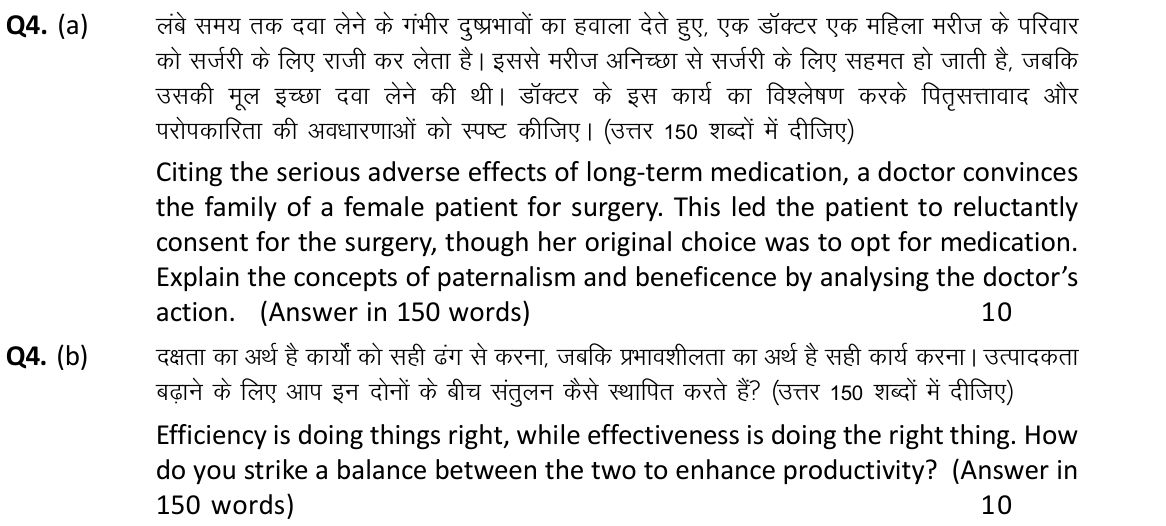
Citing the serious adverse effects of long-term medication, a doctor convinces the family of a female patient for surgery. This led the patient to reluctantly consent for the surgery, though her original choice was to opt for medication. Explain the concepts of paternalism and beneficence by analysing the doctor's action. (Answer in 150 words) 10 marks
Efficiency is doing things right, while effectiveness is doing the right thing. How do you strike a balance between the two to enhance productivity? (Answer in 150 words) 10 marks
Model answer
Written by UPSC Answer Check against this question's marking rubric, to the 150-word length. UPSC does not publish answers for Mains — this is one way to score well, not an official key.
(a) Paternalism is overriding a person’s expressed preference to promote their welfare; beneficence is acting in the patient’s best interest. The doctor’s action was paternalistic: he overrode her preference by invoking serious adverse effects to persuade the family; her “reluctant” consent was mediated by family pressure, not fully voluntary or informed. Thus, while beneficence may justify intervention, it conflicts with autonomy when the patient’s original choice for medication is displaced. Soft paternalism is defensible only with genuine informed consent, not family-mediated pressure overriding her stated will.
(b) Efficiency means doing things right—optimal resource use; effectiveness means doing the right thing—achieving validated goals (Drucker). Balance requires outcome-based KPIs tied to public objectives, periodic goal-relevance review, and process redesign to avoid the activity trap where efficient routines serve outdated ends. Efficiency alone risks doing the wrong thing well; effectiveness alone risks waste. Productivity rises when means align with validated ends.
What "Explain" is asking you to do
Make the working of something clear — what sets it off, what follows from what, and what it produces. Explain is the Commission's mechanism word: it dominates the technical papers and the “explain why” stems, where the marks sit in the causal chain and not in the label.
Structure that answers it
State what it is → the initiating condition → the chain of cause, step by step → an instance where it plays out → what the chain produces
Where marks are lost
Describing what something looks like instead of why it works that way. Naming the stages without linking them reads as description too.
How this answer will be evaluated
Approach
Framework: GS4 Ethical Dilemma & Management Principles. (a) explain: definition/context > points in order > small example > short close | (b) suggest: the problem in one line > implementable measures > who acts > conclusion Full marks: Precise definitions, clear application to the case, and actionable, well-structured measures.
Key points expected
- Define medical paternalism (doctor decides for patient)
- Define beneficence (acting in patient's best interest)
- Identify violation of patient autonomy in the scenario
- Analyze the conflict between doctor's intent and patient's choice
- Define efficiency (doing things right) and effectiveness (doing right things)
- Suggest a method to prioritize tasks (e.g., Eisenhower Matrix)
- Propose a feedback mechanism to check effectiveness
- Link the balance to enhanced productivity
Evaluation rubric
Each sub-part is marked on its own, against the marks and word limit printed on the paper.
- (a) Define paternalism and beneficence and apply them to the doctor's specific action. 10 marks · 150 words
explain— definition/context → points in order → small example → short close
Must cover
- Define medical paternalism (doctor decides for patient)
- Define beneficence (acting in patient's best interest)
- Identify violation of patient autonomy in the scenario
- Analyze the conflict between doctor's intent and patient's choice
Loses marks
- Defining terms without applying them to the case
- Ignoring the patient's original choice for medication
- Preaching general ethics without analyzing the specific action
Earns more
- Mention informed consent as a key ethical principle
- Reference the 'do no harm' principle
- Distinguish between 'soft' and 'hard' paternalism
- Mention the role of the family in the decision
Extra mark
- Cite the Indian Medical Council (Professional Conduct, Etiquette and Ethics) Regulations
- Reference the concept of 'substituted judgment'
- (b) Provide implementable measures to balance efficiency and effectiveness for productivity. 10 marks · 150 words
suggest— the problem in one line → implementable measures → who acts → conclusion
Must cover
- Define efficiency (doing things right) and effectiveness (doing right things)
- Suggest a method to prioritize tasks (e.g., Eisenhower Matrix)
- Propose a feedback mechanism to check effectiveness
- Link the balance to enhanced productivity
Loses marks
- Treating efficiency and effectiveness as mutually exclusive
- Providing only theoretical definitions without practical application
- Ignoring the 'productivity' aspect of the question
Earns more
- Mention the 'Pareto Principle' (80/20 rule)
- Suggest setting SMART goals
- Discuss the role of time management
- Mention the importance of strategic planning
Extra mark
- Cite a specific management framework like 'Balanced Scorecard'
- Reference a specific productivity tool or methodology
Practice this exact question
Write your answer and it is marked point by point against the model answer above — what you covered, what you missed, what you got wrong.
Evaluate my answer →More from General Studies 2026 GS Paper IV
- Q1 (a) Owing to paucity of time, a university professor generates a Ph.D. evaluation report…
- Q2 (a) An endangered tribe has developed a severe skeletal deformity. A university research…
- Q3 (a) Dr. B. R. Ambedkar had cautioned that employing civil disobedience within a constitut…
- Q4 (a) Citing the serious adverse effects of long-term medication, a doctor convinces the fa…
- Q5 (a) Usually schools, working in remote areas, do not fully comply with government regulat…
- Q6 (a) On the request of his Personal Assistant (PA), the District Magistrate (DM) stops the…
- Q7 Lata, a mother of two children, was admitted to a hospital for acute abdominal pain. Her…