GS Paper IV — Q1
(a) Owing to paucity of time, a university professor generates a Ph.D. evaluation report using Artificial Intelligence and…
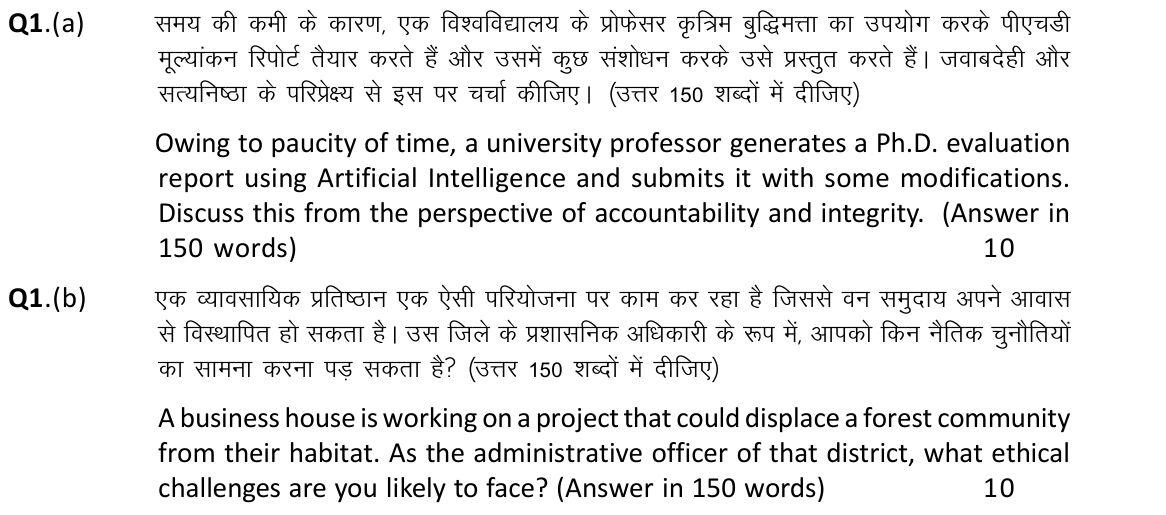
Owing to paucity of time, a university professor generates a Ph.D. evaluation report using Artificial Intelligence and submits it with some modifications. Discuss this from the perspective of accountability and integrity. (Answer in 150 words) 10 marks
A business house is working on a project that could displace a forest community from their habitat. As the administrative officer of that district, what ethical challenges are you likely to face? (Answer in 150 words) 10 marks
Model answer
Written by UPSC Answer Check against this question's marking rubric, to the 150-word length. UPSC does not publish answers for Mains — this is one way to score well, not an official key.
AI in Academic Evaluation Using AI as an assistive tool is permissible, but presenting unverified AI-generated text as one's own expert judgment constitutes an accountability failure, as the evaluator remains solely responsible for the evaluation's outcome. Regarding integrity, concealing AI usage amounts to academic dishonesty, compromising professional fidelity for convenience under time pressure and setting a poor precedent for students. Ethical academic governance necessitates transparent disclosure norms and mandatory human verification before final submission.
Ethical Challenges in Forest Displacement The primary ethical dilemma lies in balancing industrial growth against the constitutional right to habitat (Article 21) and Free, Prior, and Informed Consent under the Forest Rights Act, 2006. The District Magistrate faces challenges of distributive justice, resisting corporate-political pressures, and reconciling administrative impartiality with empathy as a public trustee. An ethical course of action demands conducting transparent Gram Sabha hearings, enforcing comprehensive Rehabilitation and Resettlement packages under the RFCTLARR Act, 2013, and formally escalating socio-environmental concerns through institutional channels rather than offering silent compliance.
What "Discuss" is asking you to do
Lay the issue out from more than one side — how it arose, what is claimed for it, what is held against it, and where it now stands. UPSC attaches discuss to broad topics with several live dimensions, so coverage of the dimensions earns more than the strength of your opinion.
Structure that answers it
Set the issue up → the case as it is made → the case against → the dimension both sides leave out → where the balance now lies
Where marks are lost
Listing facts with no thread between them, or arguing one side throughout and calling it a discussion.
How this answer will be evaluated
Approach
Framework: GS4 Ethical Dilemma & Accountability Framework. (a) discuss: intro > 3-4 dimensions > example > balanced close | (b) challenges: 3-4 challenges > solutions mapped to them > conclusion Full marks: Balanced reasoning with specific legal/ethical references and a clear course of action.
Key points expected
- Define accountability as answerability for professional judgment
- Define integrity as adherence to academic honesty
- Identify the 'easy-but-wrong' option of time-saving
- Conclude on the erosion of institutional trust
- Identify the conflict between development and rights
- Name the 'silent stakeholder' (forest community)
- Reference the legal duty (e.g., PESA Act)
- Propose a course of action (e.g., consultation)
Evaluation rubric
Each sub-part is marked on its own, against the marks and word limit printed on the paper.
- (a) Critique the use of AI for academic evaluation through the lenses of accountability and integrity. 10 marks · 150 words
discuss— intro → 3-4 dimensions → example → balanced close
Must cover
- Define accountability as answerability for professional judgment
- Define integrity as adherence to academic honesty
- Identify the 'easy-but-wrong' option of time-saving
- Conclude on the erosion of institutional trust
Loses marks
- Focusing on technical AI capabilities rather than ethics
- Preaching against AI without analyzing the professor's duty
- Ignoring the specific context of a Ph.D. evaluation
Earns more
- Mention the 'black box' nature of AI bias
- Reference the duty of the evaluator to the candidate
- Distinguish between tool-use and outsourcing judgment
- Mention the impact on the university's reputation
Extra mark
- Cite UGC regulations on academic misconduct
- Reference the concept of 'moral agency' in AI
- (b) Identify ethical dilemmas in balancing development with tribal rights and propose a course of action. 10 marks · 150 words
challenges— 3-4 challenges → solutions mapped to them → conclusion
Must cover
- Identify the conflict between development and rights
- Name the 'silent stakeholder' (forest community)
- Reference the legal duty (e.g., PESA Act)
- Propose a course of action (e.g., consultation)
Loses marks
- Taking a purely pro-development or anti-development stance
- Ignoring the administrative officer's specific role
- Failing to mention the legal framework for tribal protection
Earns more
- Mention the 'wall' of political pressure for investment
- Discuss the trade-off between economic growth and social justice
- Suggest a three-horizon approach to resolution
- Highlight the risk of social unrest
Extra mark
- Cite the 5th/6th Schedule of the Constitution
- Reference the concept of 'Free, Prior and Informed Consent' (FPIC)
Practice this exact question
Write your answer and it is marked point by point against the model answer above — what you covered, what you missed, what you got wrong.
Evaluate my answer →More from General Studies 2026 GS Paper IV
- Q1 (a) Owing to paucity of time, a university professor generates a Ph.D. evaluation report…
- Q2 (a) An endangered tribe has developed a severe skeletal deformity. A university research…
- Q3 (a) Dr. B. R. Ambedkar had cautioned that employing civil disobedience within a constitut…
- Q4 (a) Citing the serious adverse effects of long-term medication, a doctor convinces the fa…