GS Paper IV — Q3
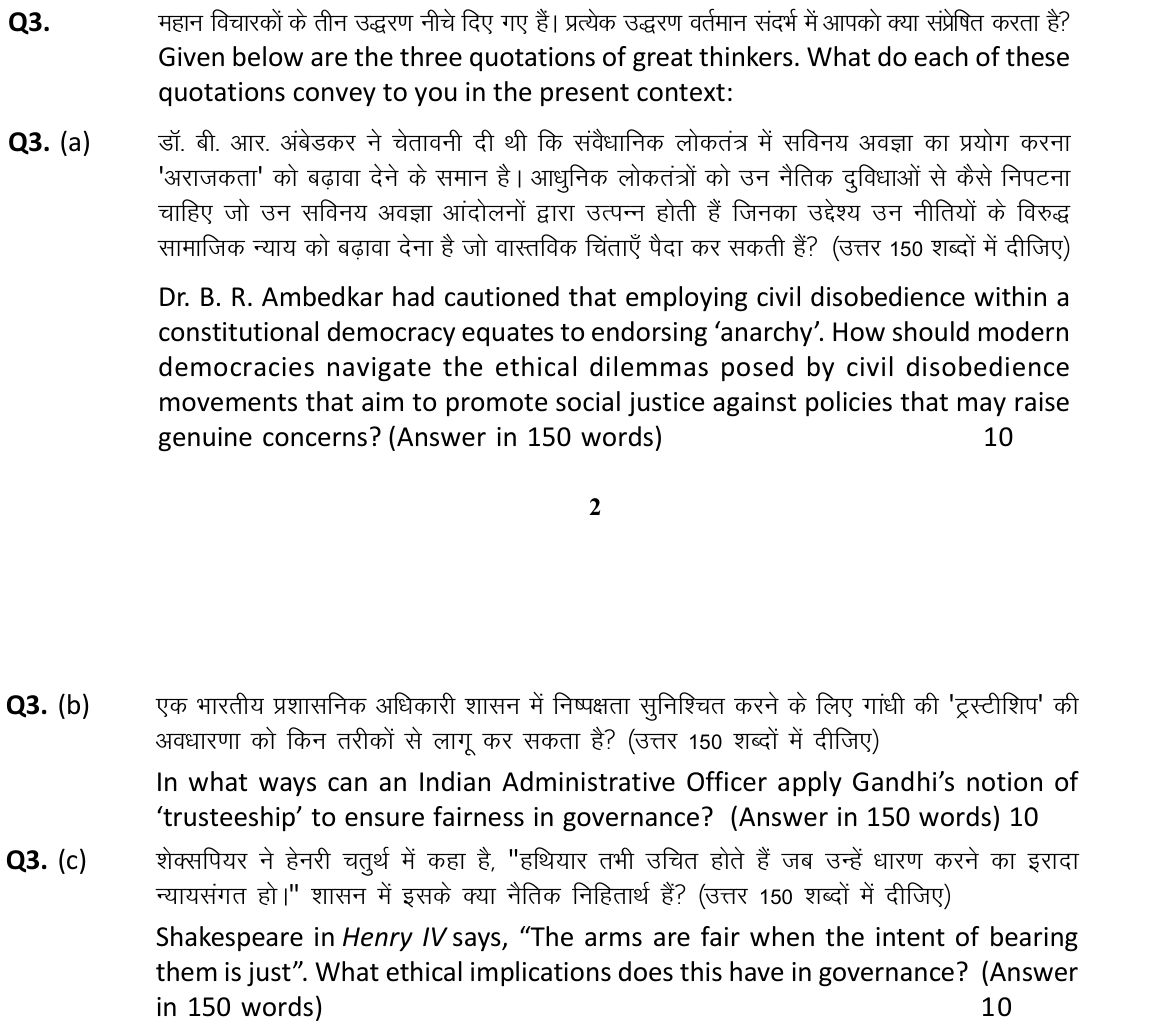
(a) Dr. B. R. Ambedkar had cautioned that employing civil disobedience within a constitutional democracy equates to endorsing…
Dr. B. R. Ambedkar had cautioned that employing civil disobedience within a constitutional democracy equates to endorsing 'anarchy'. How should modern democracies navigate the ethical dilemmas posed by civil disobedience movements that aim to promote social justice against policies that may raise genuine concerns? (Answer in 150 words) 10 marks
In what ways can an Indian Administrative Officer apply Gandhi's notion of 'trusteeship' to ensure fairness in governance? (Answer in 150 words) 10 marks
Shakespeare in Henry IV says, "The arms are fair when the intent of bearing them is just." What ethical implications does this have in governance? (Answer in 150 words) 10 marks
Model answer
Written by UPSC Answer Check against this question's marking rubric, to the 150-word length. UPSC does not publish answers for Mains — this is one way to score well, not an official key.
(a) Civil Disobedience and Constitutionalism In the 1949 Constituent Assembly debates, Dr. B.R. Ambedkar cautioned that methods like civil disobedience and Satyagraha, though justified under colonial rule, become the "grammar of anarchy" once constitutional avenues of redress exist. Modern democracies must navigate this by institutionalizing dissent—upholding peaceful protest under Article 19(1)(b), Public Interest Litigations, RTI, and parliamentary accountability—while safeguarding the rule of law. Ethical governance requires distinguishing legitimate, non-violent agitation from lawlessness, resolving public grievances (such as during the farm-law or anti-CAA agitations) through structured dialogue rather than administrative apathy.
(b) Gandhian Trusteeship in Administration Gandhi’s concept of trusteeship presents a moral alternative to both capitalism and class-conflict socialism, positing that holders of wealth and authority are not owners, but trustees bound to utilize resources for societal welfare. An Indian Administrative Officer applies this by functioning as a custodian of state authority, public funds, and common lands. In welfare delivery and procurement, this demands allocating resources transparently to uplift the most vulnerable (Antyodaya), eschewing personal discretion, bureaucratic rent-seeking, or partisan pressures.
(c) Just Intent and State Coercion Shakespeare’s dictum asserts that coercive power is ethically justifiable only when guided by righteous intent. In governance, the state’s monopoly on force (policing, statutory enforcement, and administrative sanctions) derives legitimacy solely from its pursuit of the public good and constitutional morality. Exercising state authority for partisan, retaliatory, or self-serving ends corrupts its ethical foundation. Thus, public administration must ensure that just intent is perpetually constrained by the principles of proportionality, procedural fairness, and institutional accountability.
What "Discuss" is asking you to do
Lay the issue out from more than one side — how it arose, what is claimed for it, what is held against it, and where it now stands. UPSC attaches discuss to broad topics with several live dimensions, so coverage of the dimensions earns more than the strength of your opinion.
Structure that answers it
Set the issue up → the case as it is made → the case against → the dimension both sides leave out → where the balance now lies
Where marks are lost
Listing facts with no thread between them, or arguing one side throughout and calling it a discussion.
How this answer will be evaluated
Approach
Framework: GS4 Ethical Dilemma & Governance Framework. (a) discuss: intro > 3-4 dimensions > example > balanced close | (b) explain: definition/context > points in order > small example > short close | (c) analyse: intro > causes > effects > stakeholders/linkages > way forward Full marks: Clear, balanced, actionable, with specific examples and legal/ethical grounding.
Key points expected
- Acknowledge Ambedkar's caution on anarchy
- Distinguish civil disobedience from law-breaking
- Balance social justice vs constitutional order
- Suggest institutional mechanisms for redressal
- Define trusteeship in administrative context
- Link to public trust and accountability
- Apply to resource allocation or decision-making
- Ensure fairness and non-discrimination
Evaluation rubric
Each sub-part is marked on its own, against the marks and word limit printed on the paper.
- (a) Navigate ethical dilemmas of civil disobedience in constitutional democracy. 10 marks · 150 words
discuss— intro → 3-4 dimensions → example → balanced close
Must cover
- Acknowledge Ambedkar's caution on anarchy
- Distinguish civil disobedience from law-breaking
- Balance social justice vs constitutional order
- Suggest institutional mechanisms for redressal
Loses marks
- Justifying anarchy or law-breaking
- Ignoring the constitutional framework
- Preaching without administrative reasoning
Earns more
- Reference to constitutional morality
- Mention of judicial review role
- Distinction between passive and active resistance
- Reference to modern examples (e.g., farmers' movement)
Extra mark
- Cite specific Article (e.g., Art 21 or 32)
- Reference to specific Supreme Court judgment
- (b) Apply Gandhi's 'trusteeship' to ensure fairness in governance. 10 marks · 150 words
explain— definition/context → points in order → small example → short close
Must cover
- Define trusteeship in administrative context
- Link to public trust and accountability
- Apply to resource allocation or decision-making
- Ensure fairness and non-discrimination
Loses marks
- Treating trusteeship as mere charity
- Ignoring the administrative role
- Vague moralizing without practical application
Earns more
- Mention of 'Sarvodaya' or 'Seva' concept
- Link to anti-corruption and transparency
- Reference to public interest over personal gain
- Mention of stakeholder consultation
Extra mark
- Cite specific IAS code of conduct provision
- Reference to RTI or CVC guidelines
- (c) Analyse ethical implications of 'just intent' in governance. 10 marks · 150 words
analyse— intro → causes → effects → stakeholders/linkages → way forward
Must cover
- Interpret Shakespeare's quote in governance context
- Link intent to legitimacy of action
- Discuss power and its ethical use
- Balance means and ends
Loses marks
- Ignoring the 'intent' aspect
- Focusing only on 'arms' (power) without ethics
- Preaching without governance context
Earns more
- Reference to 'Rule of Law' vs 'Rule by Law'
- Mention of public interest test
- Link to accountability and transparency
- Reference to ethical leadership
Extra mark
- Cite specific case of misuse of power
- Reference to specific ethical code (e.g., UNDP)
Practice this exact question
Write your answer and it is marked point by point against the model answer above — what you covered, what you missed, what you got wrong.
Evaluate my answer →More from General Studies 2026 GS Paper IV
- Q1 (a) Owing to paucity of time, a university professor generates a Ph.D. evaluation report…
- Q2 (a) An endangered tribe has developed a severe skeletal deformity. A university research…
- Q3 (a) Dr. B. R. Ambedkar had cautioned that employing civil disobedience within a constitut…
- Q4 (a) Citing the serious adverse effects of long-term medication, a doctor convinces the fa…
- Q5 (a) Usually schools, working in remote areas, do not fully comply with government regulat…
- Q6 (a) On the request of his Personal Assistant (PA), the District Magistrate (DM) stops the…