GS Paper IV — Q2
(a) An endangered tribe has developed a severe skeletal deformity. A university research has identified a mineral supplement as a…
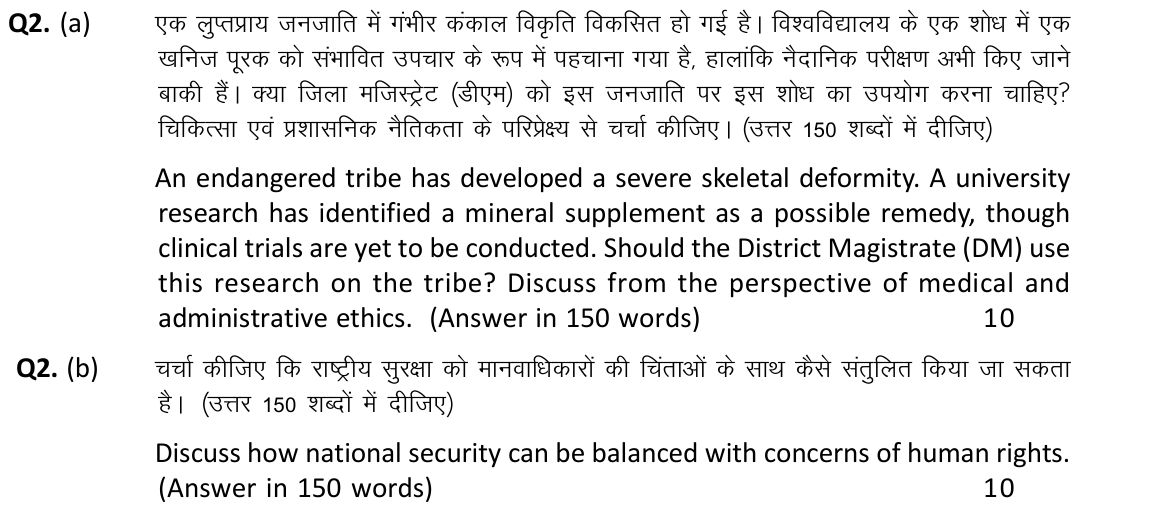
An endangered tribe has developed a severe skeletal deformity. A university research has identified a mineral supplement as a possible remedy, though clinical trials are yet to be conducted. Should the District Magistrate (DM) use this research on the tribe? Discuss from the perspective of medical and administrative ethics. (Answer in 150 words) 10 marks
Discuss how national security can be balanced with concerns of human rights. (Answer in 150 words) 10 marks
Model answer
Written by UPSC Answer Check against this question's marking rubric, to the 150-word length. UPSC does not publish answers for Mains — this is one way to score well, not an official key.
(a) Administering an untested supplement to an endangered tribe violates core medical ethics of non-maleficence (do no harm) and genuine informed consent, raising serious concerns of medical paternalism and exploiting vulnerable groups as de facto trial subjects. Administratively, the District Magistrate’s duty of due diligence prohibits unilateral rollouts of unvalidated research. Beneficence cannot bypass institutional safeguards. Therefore, the DM must not authorize direct distribution, but should instead coordinate with the Indian Council of Medical Research (ICMR) and institutional ethics committees to facilitate a strictly regulated, scientifically monitored clinical trial with community-level informed consent.
(b) National security and human rights are interdependent goods rather than a binary zero-sum trade-off. Overreaching state power under statutes like AFSPA or UAPA risks using security as a pretext for rights violations, eroding democratic trust and state legitimacy. To harmonize them, state actions must satisfy the K.S. Puttaswamy proportionality standard: measures must be lawful, necessary, least restrictive, time-bound through sunset clauses, and subject to robust judicial oversight to preserve constitutional freedoms.
What "Discuss" is asking you to do
Lay the issue out from more than one side — how it arose, what is claimed for it, what is held against it, and where it now stands. UPSC attaches discuss to broad topics with several live dimensions, so coverage of the dimensions earns more than the strength of your opinion.
Structure that answers it
Set the issue up → the case as it is made → the case against → the dimension both sides leave out → where the balance now lies
Where marks are lost
Listing facts with no thread between them, or arguing one side throughout and calling it a discussion.
How this answer will be evaluated
Approach
Framework: GS4 Ethical Dilemma & Administrative Ethics. (a) discuss: intro > 3-4 dimensions > example > balanced close | (b) discuss: intro > 3-4 dimensions > example > balanced close Full marks: Nuanced application of ethical frameworks to specific dilemmas with actionable solutions.
Key points expected
- Identify conflict: urgency of cure vs. lack of clinical trials
- Apply medical ethics: informed consent, non-maleficence, autonomy
- Apply administrative ethics: duty of care, fiduciary responsibility
- Propose course of action: immediate/short-term/long-term
- Define the tension: state power vs. individual liberty
- Identify specific conflicts (e.g., surveillance vs. privacy, detention vs. due process)
- Propose mechanisms for balance (judicial oversight, independent commissions)
- Conclude with a balanced judgment on the priority of rights
Evaluation rubric
Each sub-part is marked on its own, against the marks and word limit printed on the paper.
- (a) Evaluate DM's decision to use untested research on a tribe via medical and administrative ethics. 10 marks · 150 words
discuss— intro → 3-4 dimensions → example → balanced close
Must cover
- Identify conflict: urgency of cure vs. lack of clinical trials
- Apply medical ethics: informed consent, non-maleficence, autonomy
- Apply administrative ethics: duty of care, fiduciary responsibility
- Propose course of action: immediate/short-term/long-term
Loses marks
- Preaching values without applying to the specific dilemma
- Ignoring the 'administrative' perspective (focusing only on medical)
- Failing to address the 'untested' nature of the remedy
Earns more
- Mention 'easy-but-wrong' option: immediate administration
- Reference specific ethical codes (e.g., NMC, Helsinki Declaration)
- Acknowledge silent stakeholders: university researchers, tribal elders
Extra mark
- Cite specific case law or precedent on tribal rights
- Mention specific administrative mechanism for ethical review
- (b) Analyze the balance between national security imperatives and human rights concerns. 10 marks · 150 words
discuss— intro → 3-4 dimensions → example → balanced close
Must cover
- Define the tension: state power vs. individual liberty
- Identify specific conflicts (e.g., surveillance vs. privacy, detention vs. due process)
- Propose mechanisms for balance (judicial oversight, independent commissions)
- Conclude with a balanced judgment on the priority of rights
Loses marks
- Taking an extreme stance (absolute security OR absolute rights)
- Vague generalities without specific examples of conflict
- Ignoring the role of institutions in maintaining balance
Earns more
- Reference specific laws (e.g., UAPA, NSA, PMLA) and their impact
- Mention the role of the Judiciary in balancing these interests
- Discuss the concept of 'proportionality' in security measures
Extra mark
- Cite a specific Supreme Court judgment on this balance
- Reference international human rights standards (e.g., ICCPR)
Practice this exact question
Write your answer and it is marked point by point against the model answer above — what you covered, what you missed, what you got wrong.
Evaluate my answer →More from General Studies 2026 GS Paper IV
- Q1 (a) Owing to paucity of time, a university professor generates a Ph.D. evaluation report…
- Q2 (a) An endangered tribe has developed a severe skeletal deformity. A university research…
- Q3 (a) Dr. B. R. Ambedkar had cautioned that employing civil disobedience within a constitut…
- Q4 (a) Citing the serious adverse effects of long-term medication, a doctor convinces the fa…
- Q5 (a) Usually schools, working in remote areas, do not fully comply with government regulat…