GS Paper IV — Q5
(a) Usually schools, working in remote areas, do not fully comply with government regulations. However, if the rules are enforced…
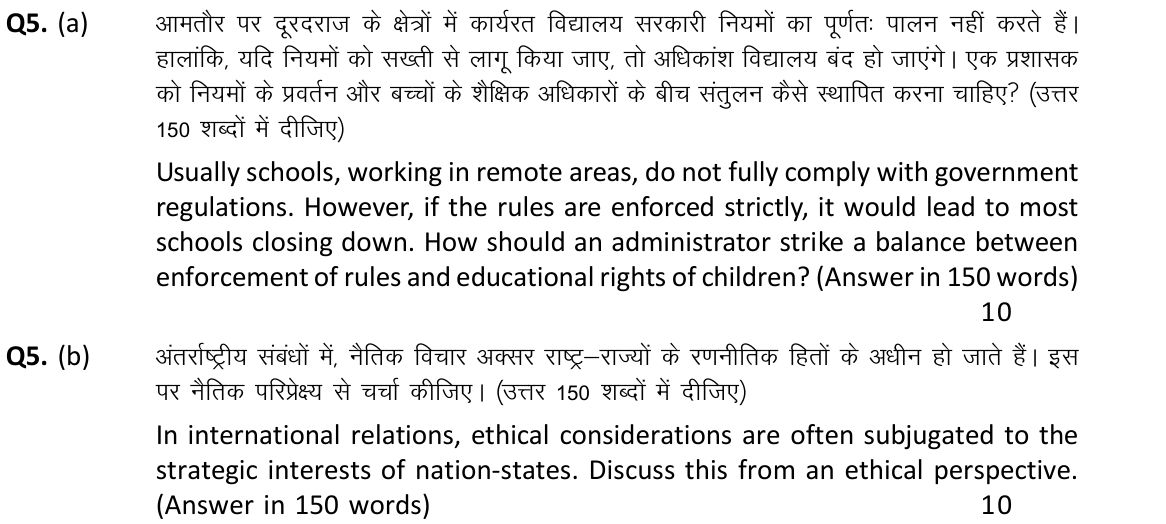
Usually schools, working in remote areas, do not fully comply with government regulations. However, if the rules are enforced strictly, it would lead to most schools closing down. How should an administrator strike a balance between enforcement of rules and educational rights of children? (Answer in 150 words) 10 marks
In international relations, ethical considerations are often subjugated to the strategic interests of nation-states. Discuss this from an ethical perspective. (Answer in 150 words) 10 marks
Model answer
Written by UPSC Answer Check against this question's marking rubric, to the 150-word length. UPSC does not publish answers for Mains — this is one way to score well, not an official key.
(a) Balancing Rule Enforcement and Educational Rights
The administrator faces a dilemma between enforcing regulatory norms under the Right to Education (RTE) Act, 2009 and safeguarding the child's fundamental right to education under Article 21A in remote, underserved regions. Immediate closure of non-compliant institutions leads to educational exclusion, defeating the welfare objective.
An administrator must adopt a graduated approach rooted in administrative empathy: Granting provisional recognition with phased compliance timelines, paired with targeted state capacity-building support, infrastructure subsidies, and teacher training. While non-negotiable child safety standards must be strictly enforced, procedural and infrastructural deficits should be bridged progressively to ensure schooling remains uninterrupted.
(b) Ethics versus Strategic Interests in International Relations
The ethical dimension of international relations is defined by the tension between Kantian ethical universalism—which demands fidelity to universal human rights and international law—and Morgenthau’s political realism, where national survival and strategic interest constitute the primary organizing principles.
Realpolitik often subjugates ethics, visible in selective human-rights criticisms directed at geopolitical rivals while ignoring abuses by strategic allies, or continuing arms sales to rights-violating regimes to secure energy or defense partnerships.
A viable synthesis lies in "ethical realism" or enlightened self-interest. True national interest is not antithetical to ethics; sustaining a credible, rules-based global order enhances a state's soft power, trust, and long-term security.
What "Discuss" is asking you to do
Lay the issue out from more than one side — how it arose, what is claimed for it, what is held against it, and where it now stands. UPSC attaches discuss to broad topics with several live dimensions, so coverage of the dimensions earns more than the strength of your opinion.
Structure that answers it
Set the issue up → the case as it is made → the case against → the dimension both sides leave out → where the balance now lies
Where marks are lost
Listing facts with no thread between them, or arguing one side throughout and calling it a discussion.
How this answer will be evaluated
Approach
Framework: GS4 Ethical Dilemma & International Relations. (a) suggest: the problem in one line > implementable measures > who acts > conclusion | (b) discuss: intro > 3-4 dimensions > example > balanced close Full marks: Actionable 3-horizon plan (a) / Nuanced IR theory application (b)
Key points expected
- Identify conflict: strict rules vs. child's right to education
- Immediate action: audit to distinguish safety vs. bureaucratic issues
- Short-term: phased compliance with capacity building for staff
- Long-term: policy review for remote-specific regulatory flexibility
- Define tension: State interest (Realism) vs. Universal Ethics
- Example: Humanitarian intervention vs. Non-interference
- Argument: Ethics as a tool for long-term stability
- Balanced close: Ethics as a constraint on power
Evaluation rubric
Each sub-part is marked on its own, against the marks and word limit printed on the paper.
- (a) Balanced administrative strategy for remote school compliance 10 marks · 150 words
suggest— the problem in one line → implementable measures → who acts → conclusion
Must cover
- Identify conflict: strict rules vs. child's right to education
- Immediate action: audit to distinguish safety vs. bureaucratic issues
- Short-term: phased compliance with capacity building for staff
- Long-term: policy review for remote-specific regulatory flexibility
Loses marks
- Preaching values without administrative action
- Suggesting immediate closure of non-compliant schools
- Ignoring the 'remote area' context in solutions
Earns more
- Mention of 'Right to Education' (RTE) Act as a higher right
- Reference to 'Ease of Doing Business' for schools
- Stakeholder analysis: teachers, parents, and local administration
Extra mark
- Citing specific RTE Act sections on infrastructure
- Reference to 'Gramin Shiksha' initiatives
- (b) Ethical critique of Realpolitik in international relations 10 marks · 150 words
discuss— intro → 3-4 dimensions → example → balanced close
Must cover
- Define tension: State interest (Realism) vs. Universal Ethics
- Example: Humanitarian intervention vs. Non-interference
- Argument: Ethics as a tool for long-term stability
- Balanced close: Ethics as a constraint on power
Loses marks
- Purely descriptive history without ethical analysis
- Ignoring the 'strategic interest' side of the argument
- Vague moralizing without political context
Earns more
- Reference to 'Just War Theory' or 'Human Security'
- Mention of UN Charter principles vs. Security Council vetoes
- Distinction between 'Moral' and 'Pragmatic' statecraft
Extra mark
- Citing a specific case like Syria or Ukraine
- Reference to Kant's 'Perpetual Peace'
Practice this exact question
Write your answer and it is marked point by point against the model answer above — what you covered, what you missed, what you got wrong.
Evaluate my answer →More from General Studies 2026 GS Paper IV
- Q2 (a) An endangered tribe has developed a severe skeletal deformity. A university research…
- Q3 (a) Dr. B. R. Ambedkar had cautioned that employing civil disobedience within a constitut…
- Q4 (a) Citing the serious adverse effects of long-term medication, a doctor convinces the fa…
- Q5 (a) Usually schools, working in remote areas, do not fully comply with government regulat…
- Q6 (a) On the request of his Personal Assistant (PA), the District Magistrate (DM) stops the…
- Q7 Lata, a mother of two children, was admitted to a hospital for acute abdominal pain. Her…
- Q8 Ravi is a senior police officer with vast experience in riot control and cyber-policing.…