GS Paper IV — Q7
Lata, a mother of two children, was admitted to a hospital for acute abdominal pain. Her sister-in-law, Sujatha, accompanied her…
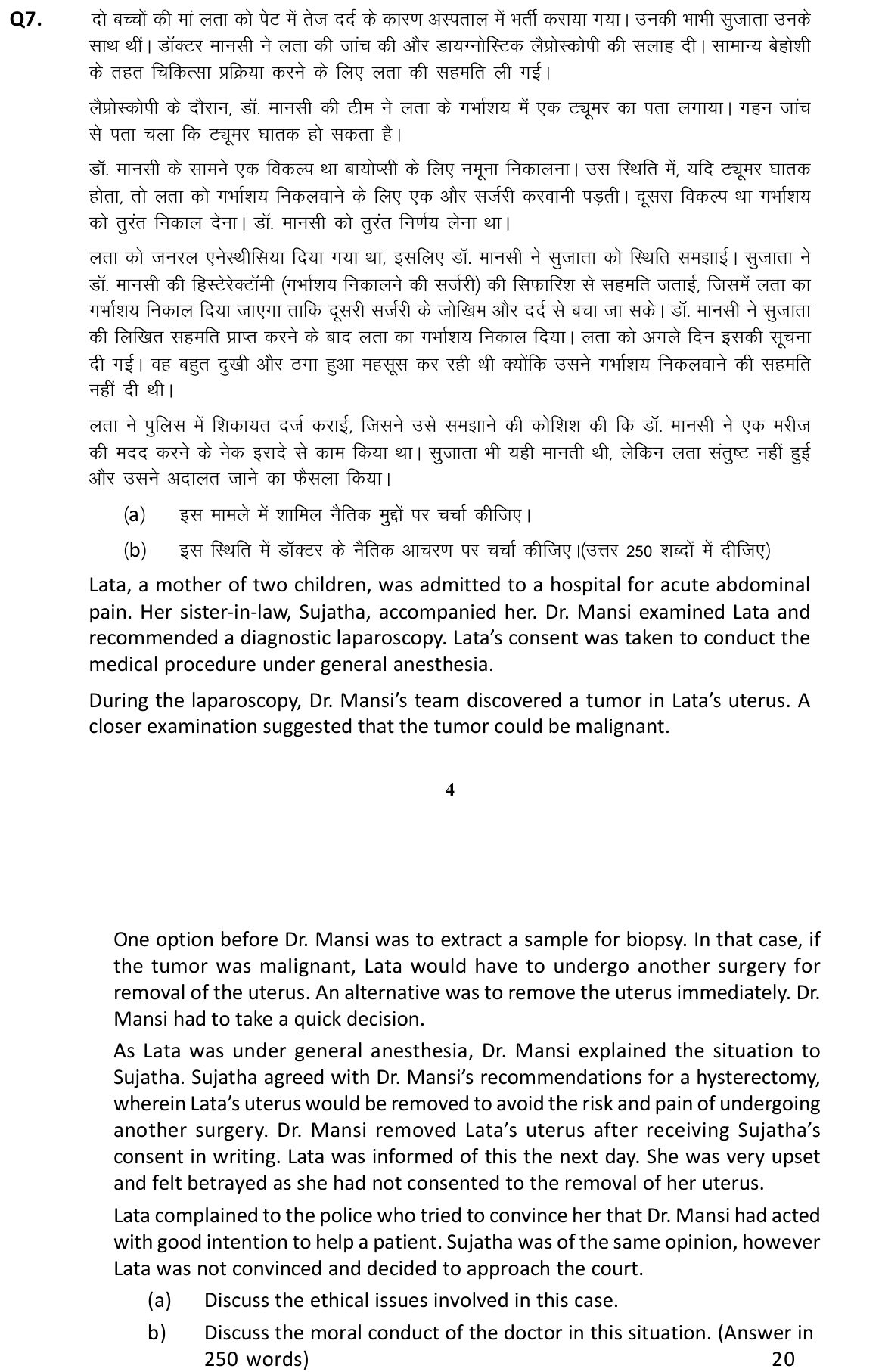
Lata, a mother of two children, was admitted to a hospital for acute abdominal pain. Her sister-in-law, Sujatha, accompanied her. Dr. Mansi examined Lata and recommended a diagnostic laparoscopy. Lata's consent was taken to conduct the medical procedure under general anesthesia.
During the laparoscopy, Dr. Mansi's team discovered a tumor in Lata's uterus. A closer examination suggested that the tumor could be malignant. One option before Dr. Mansi was to extract a sample for biopsy. In that case, if the tumor was malignant, Lata would have to undergo another surgery for removal of the uterus. An alternative was to remove the uterus immediately. Dr. Mansi had to take a quick decision.
As Lata was under general anesthesia, Dr. Mansi explained the situation to Sujatha. Sujatha agreed with Dr. Mansi's recommendation for a hysterectomy, wherein Lata's uterus would be removed to avoid the risk and pain of undergoing another surgery. Dr. Mansi removed Lata's uterus after receiving Sujatha's consent in writing. Lata was informed of this the next day. She was very upset and felt betrayed as she had not consented to the removal of her uterus.
Lata complained to the police who tried to convince her that Dr. Mansi had acted with good intention to help a patient. Sujatha was of the same opinion, however Lata was not convinced and decided to approach the court.
Discuss the ethical issues involved in this case.
Discuss the moral conduct of the doctor in this situation. (Answer in 250 words) 20 marks
Model answer
Written by UPSC Answer Check against this question's marking rubric, to the 250-word length. UPSC does not publish answers for Mains — this is one way to score well, not an official key.
Ethical Issues Involved
The central ethical issue is the violation of patient autonomy and bodily self-determination. Lata provided informed consent solely for a diagnostic laparoscopy, not an irreversible hysterectomy.
Second, there is the issue of invalid surrogate consent. A sister-in-law is not a legally authorized surrogate decision-maker for a conscious adult temporarily under anesthesia, especially for a major, life-altering procedure.
Third, the case exposes the tension between beneficence and medical paternalism. Dr. Mansi prioritized perceived medical benefit—sparing a second surgery—over the patient's fundamental right to choose her treatment course.
Finally, the case reflects procedural failures, notably the absence of clear emergency-exception protocols and prior contingent directives, leading to a profound breach of trust and legal vulnerability (as established in Samira Kohli v. Dr. Prabha Manchanda).
Moral Conduct of the Doctor
Dr. Mansi’s underlying intent was benevolent, aiming to minimize surgical trauma and financial cost. However, her moral conduct remains deeply flawed.
Ethically, medical emergency exceptions apply strictly to imminent threats to life. Because the tumor was only suspected to be malignant, a less invasive and ethically sound alternative existed: extracting a biopsy sample and planning a definitive procedure post-recovery. By failing to choose this proportional alternative, Dr. Mansi committed an error of proportionality and paternalistic overreach, substituting her own judgment and an unauthorized proxy’s assent for the patient’s will.
Verdict: While not malicious, Dr. Mansi’s conduct falls short of the required standard of informed consent and constitutes a serious ethical lapse. She was morally obligated to limit the procedure to a biopsy and seek Lata’s explicit consent post-recovery.
What "Discuss" is asking you to do
Lay the issue out from more than one side — how it arose, what is claimed for it, what is held against it, and where it now stands. UPSC attaches discuss to broad topics with several live dimensions, so coverage of the dimensions earns more than the strength of your opinion.
Structure that answers it
Set the issue up → the case as it is made → the case against → the dimension both sides leave out → where the balance now lies
Where marks are lost
Listing facts with no thread between them, or arguing one side throughout and calling it a discussion.
How this answer will be evaluated
Approach
Framework: GS4 Ethical Dilemma Analysis (Crux, Stakeholders, Duties, Options, Course of Action). (a) discuss: intro > 3-4 dimensions > example > balanced close | (b) discuss: intro > 3-4 dimensions > example > balanced close Full marks: Identifies the autonomy-beneficence conflict, critiques the surrogate consent, and provides a structured course of action.
Key points expected
- Conflict between patient autonomy and beneficence
- Validity of surrogate consent (Sujatha) vs. patient's right
- Duty of disclosure and informed consent
- Ethical dilemma of 'quick decision' under uncertainty
- Assessment of Dr. Mansi's intent vs. outcome
- Critique of the decision to remove uterus without biopsy
- Course of action: immediate (apology), short-term (compensation), long-term (protocol)
- Balanced judgment on 'good intention' vs. 'violation of rights'
Evaluation rubric
Each sub-part is marked on its own, against the marks and word limit printed on the paper.
- (a) Identify and analyze the core ethical conflicts regarding consent and medical decision-making.
discuss— intro → 3-4 dimensions → example → balanced close
Must cover
- Conflict between patient autonomy and beneficence
- Validity of surrogate consent (Sujatha) vs. patient's right
- Duty of disclosure and informed consent
- Ethical dilemma of 'quick decision' under uncertainty
Loses marks
- Listing values without applying them to the specific facts
- Ignoring the legal/ethical status of the sister-in-law
Earns more
- Mention of 'principle of double effect' or 'emergency exception'
- Distinction between diagnostic and therapeutic consent
- Reference to 'fiduciary duty' of the doctor
Extra mark
- Citing specific medical ethics codes (e.g., WMA Declaration of Helsinki)
- (b) Evaluate the doctor's moral conduct and propose a course of action. · 250 words
discuss— intro → 3-4 dimensions → example → balanced close
Must cover
- Assessment of Dr. Mansi's intent vs. outcome
- Critique of the decision to remove uterus without biopsy
- Course of action: immediate (apology), short-term (compensation), long-term (protocol)
- Balanced judgment on 'good intention' vs. 'violation of rights'
Loses marks
- Preaching moral values instead of analyzing the specific conduct
- Failing to address the 'course of action' aspect
Earns more
- Suggesting a 'second opinion' or 'ethics committee' consultation
- Mentioning the 'duty to mitigate harm' post-incident
Extra mark
- Reference to specific medical negligence case laws (e.g., Indian context)
Practice this exact question
Write your answer and it is marked point by point against the model answer above — what you covered, what you missed, what you got wrong.
Evaluate my answer →More from General Studies 2026 GS Paper IV
- Q4 (a) Citing the serious adverse effects of long-term medication, a doctor convinces the fa…
- Q5 (a) Usually schools, working in remote areas, do not fully comply with government regulat…
- Q6 (a) On the request of his Personal Assistant (PA), the District Magistrate (DM) stops the…
- Q7 Lata, a mother of two children, was admitted to a hospital for acute abdominal pain. Her…
- Q8 Ravi is a senior police officer with vast experience in riot control and cyber-policing.…
- Q9 Seema is a senior bureaucrat with a reputation of honesty and professional efficiency. Sh…
- Q10 Vikas is a government officer with over a decade of service in public administration. He…