GS Paper IV — Q9
Seema is a senior bureaucrat with a reputation of honesty and professional efficiency. She has recently been posted as the…
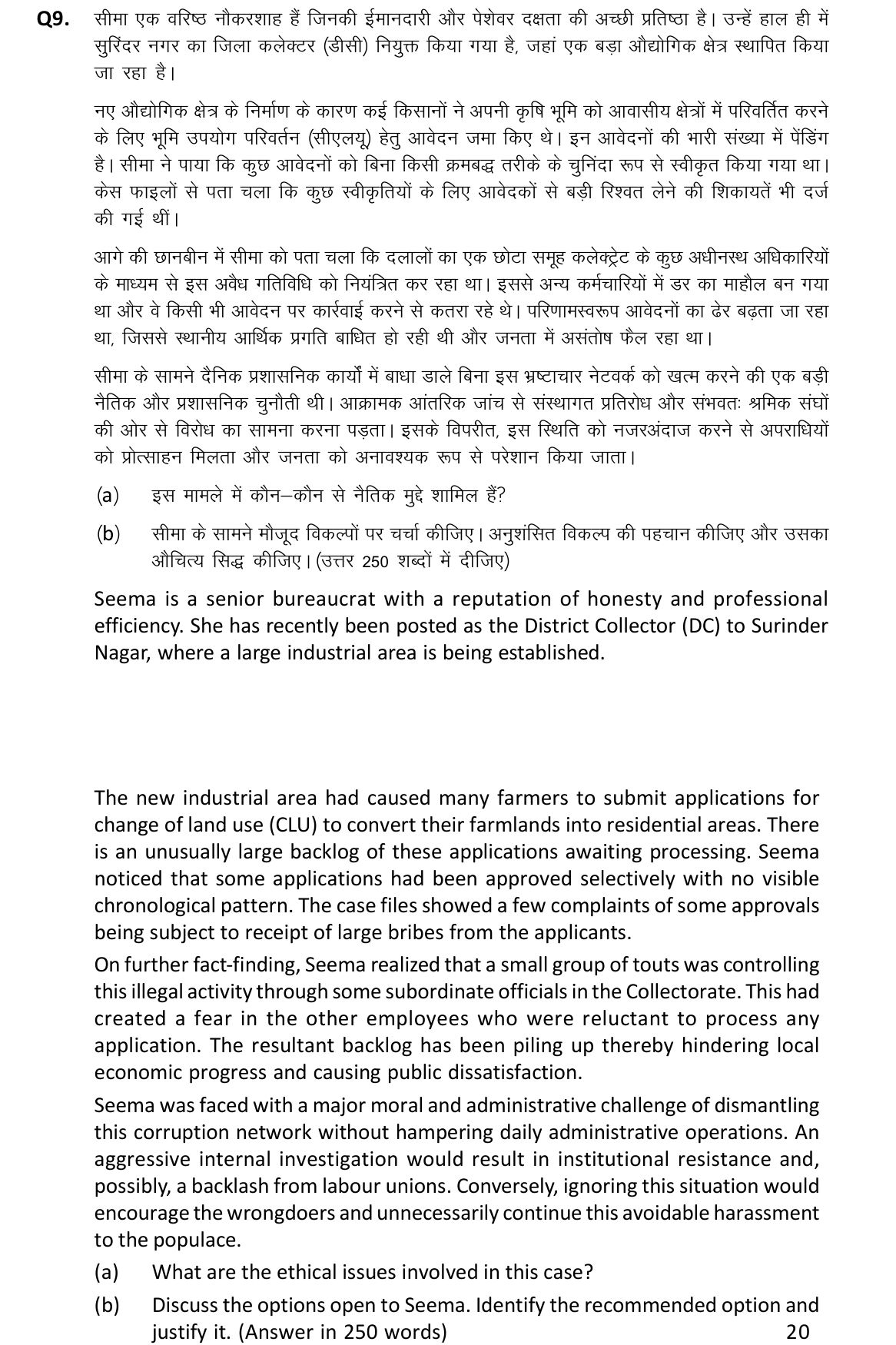
Seema is a senior bureaucrat with a reputation of honesty and professional efficiency. She has recently been posted as the District Collector (DC) to Surinder Nagar, where a large industrial area is being established.
The new industrial area had caused many farmers to submit applications for change of land use (CLU) to convert their farmland into residential areas. There is such a glut of these applications that disposal of most of them is delayed. Seema noticed that some of these applications had been approved while disregarding the chronological order. In this case's file, Seema found a few complaints alleging that hefty bribes had been taken from some applicants in exchange for approval.
On further fact-finding, Seema realized that a small group of touts was controlling this illegal activity through some subordinate officials in the Collectorate. This had created a fear in the other employees who were reluctant to process any application. The resultant backlog has been piling up thereby hindering local economic progress and causing public dissatisfaction.
Seema was faced with a major moral and administrative challenge of dismantling this corruption network without hampering daily administrative operations. An aggressive internal investigation would result in institutional resistance and, possibly, a backlash from labour unions. Conversely, ignoring this situation would encourage the wrongdoers and unnecessarily continue this avoidable harassment to the populace.
What are the ethical issues involved in this case?
Discuss the options open to Seema. Identify the recommended option and justify it. (Answer in 250 words) 20 marks
Model answer
Written by UPSC Answer Check against this question's marking rubric, to the 250-word length. UPSC does not publish answers for Mains — this is one way to score well, not an official key.
Ethical Issues Involved
Corruption and Procedural Injustice: Bribery and arbitrary queue-jumping violate procedural fairness, equality before the law, and the Nolan principle of integrity, leading to an acute breach of public trust.
Systemic Capture and Institutional Paralysis: The collusive nexus of touts and subordinate officials creates a chilling effect on honest staff. The resultant fear and backlog hinder regional economic progress and infringe upon citizens’ legitimate rights.
Administrative Dilemma: Seema faces a conflict between her duty to enforce strict anti-corruption accountability and the need to maintain workplace morale, avoid union backlash, and ensure uninterrupted public service delivery.
Options Available to Seema
Option 1: Sudden aggressive crackdown and mass suspensions. While it demonstrates immediate zero-tolerance, it risks severe union agitation, institutional instability, and procedural errors due to unverified evidence.
Option 2: Focus solely on clearing the backlog through digitisation, ignoring past misconduct. This maintains administrative continuity and reduces future discretion, but fosters moral hazard by letting corrupt actors escape accountability.
Option 3: Discreet, evidence-based targeted action paired with systemic digital reforms. A confidential internal audit isolates corrupt officials and touts for departmental action and FIRs, while simultaneously rolling out an automated, First-In-First-Out (FIFO) digital clearance dashboard. This prevents administrative disruption while steadily gathering evidence.
Recommended Option and Justification
Seema should adopt Option 3. Grounded in the Second ARC’s emphasis on preventive vigilance and disintermediation, this approach replaces administrative discretion with end-to-end transparency. By surgically penalising wrongdoers and structurally eliminating touts, Seema upholds administrative efficiency, protects honest employees, and restores institutional integrity without paralysing district governance.
What "Discuss" is asking you to do
Lay the issue out from more than one side — how it arose, what is claimed for it, what is held against it, and where it now stands. UPSC attaches discuss to broad topics with several live dimensions, so coverage of the dimensions earns more than the strength of your opinion.
Structure that answers it
Set the issue up → the case as it is made → the case against → the dimension both sides leave out → where the balance now lies
Where marks are lost
Listing facts with no thread between them, or arguing one side throughout and calling it a discussion.
How this answer will be evaluated
Approach
Framework: GS4 Case Study Framework (Crux, Stakeholders, Dilemmas, Options, Course of Action). (a) highlight: name the salient points > one line of substance each > close | (b) discuss: intro > 3-4 dimensions > example > balanced close Full marks: Identifies nuanced ethical conflicts and proposes a balanced, multi-step administrative solution that addresses both corruption and public service continuity.
Key points expected
- Conflict between duty to public and fear of institutional resistance
- Corruption (bribes) vs. administrative efficiency
- Silence vs. duty to report wrongdoing
- Impact on public trust and economic progress
- Identify at least 3 distinct options (e.g., aggressive investigation, gradual reform, ignoring)
- Justify the recommended option with specific reasoning
- Address the 'backlash from labour unions' constraint
- Propose a course of action (immediate/short-term/long-term)
Evaluation rubric
Each sub-part is marked on its own, against the marks and word limit printed on the paper.
- (a) Identify the specific ethical dilemmas and conflicts of interest in the case.
highlight— name the salient points → one line of substance each → close
Must cover
- Conflict between duty to public and fear of institutional resistance
- Corruption (bribes) vs. administrative efficiency
- Silence vs. duty to report wrongdoing
- Impact on public trust and economic progress
Loses marks
- Listing generic values without linking to the case
- Ignoring the 'fear' aspect of the subordinate officials
Earns more
- Mention of 'moral hazard' or 'ethical leadership'
- Reference to 'public interest' vs 'self-interest'
Extra mark
- Citing specific ethical values (e.g., integrity, accountability)
- (b) Evaluate options for dismantling the network and justify the recommended course of action. · 250 words
discuss— intro → 3-4 dimensions → example → balanced close
Must cover
- Identify at least 3 distinct options (e.g., aggressive investigation, gradual reform, ignoring)
- Justify the recommended option with specific reasoning
- Address the 'backlash from labour unions' constraint
- Propose a course of action (immediate/short-term/long-term)
Loses marks
- Choosing to 'ignore' the situation as the primary option
- Failing to address the 'fear' of other employees
- Preaching instead of providing a practical administrative solution
Earns more
- Mentioning 'whistleblower protection' or 'CVC guidelines'
- Balancing 'administrative operations' with 'anti-corruption measures'
Extra mark
- Reference to 'Right to Information Act' for transparency
- Mentioning 'e-governance' to reduce human interface
Practice this exact question
Write your answer and it is marked point by point against the model answer above — what you covered, what you missed, what you got wrong.
Evaluate my answer →More from General Studies 2026 GS Paper IV
- Q6 (a) On the request of his Personal Assistant (PA), the District Magistrate (DM) stops the…
- Q7 Lata, a mother of two children, was admitted to a hospital for acute abdominal pain. Her…
- Q8 Ravi is a senior police officer with vast experience in riot control and cyber-policing.…
- Q9 Seema is a senior bureaucrat with a reputation of honesty and professional efficiency. Sh…
- Q10 Vikas is a government officer with over a decade of service in public administration. He…
- Q11 Rajapuram is a border district. Jhara and Biru, its two major communities, are in continu…
- Q12 Ajit has been recently promoted as the Head of the Department of Weapon Sales (DWS) in th…