Paper I — Q1
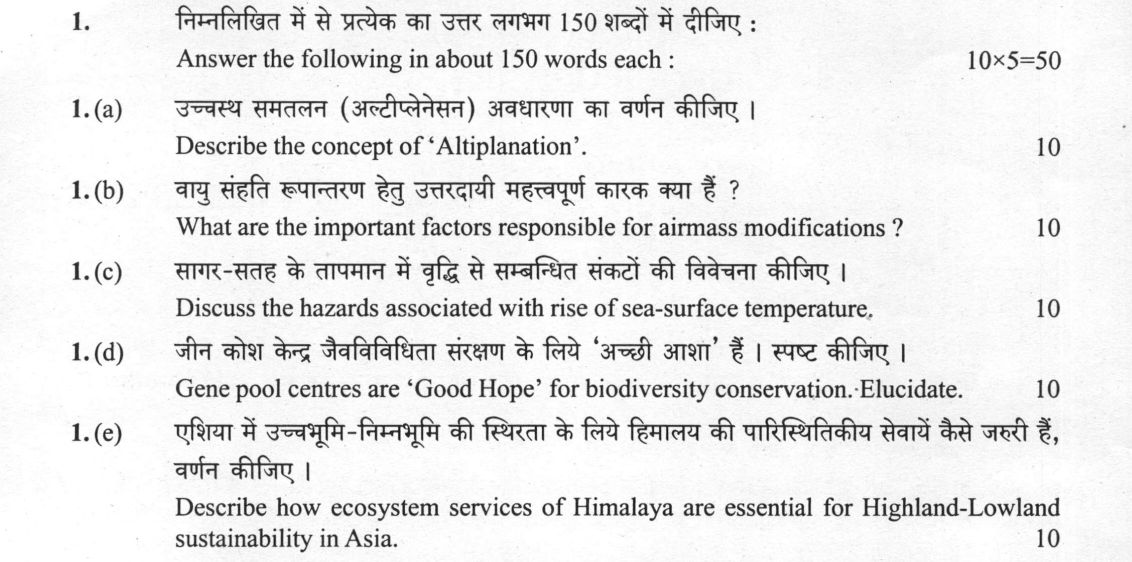
Answer the following in about 150 words each: (a) Describe the concept of 'Altiplanation'. (10 marks) (b) What are the important…
Answer the following in about 150 words each: Describe the concept of 'Altiplanation'. 10 marks
What are the important factors responsible for airmass modifications? 10 marks
Discuss the hazards associated with rise of sea-surface temperature. 10 marks
Gene pool centres are 'Good Hope' for biodiversity conservation. Elucidate. 10 marks
Describe how ecosystem services of Himalaya are essential for Highland-Lowland sustainability in Asia. 10 marks
हिंदी में प्रश्न पढ़ें
निम्नलिखित में से प्रत्येक का उत्तर लगभग 150 शब्दों में दीजिए : उच्चस्थ समतलन (अल्टीप्लेनेशन) अवधारणा का वर्णन कीजिए । (10 अंक)
वायु संहति रूपान्तरण हेतु उत्तरदायी महत्वपूर्ण कारक क्या हैं ? (10 अंक)
सागर-सतह के तापमान में वृद्धि से सम्बन्धित संकटों की विवेचना कीजिए । (10 अंक)
जीन कोश केन्द्र जैवविविधता संरक्षण के लिए 'अच्छी आशा' हैं । स्पष्ट कीजिए । (10 अंक)
एशिया में उच्चभूमि-निम्नभूमि की स्थिरता के लिये हिमालय की पारिस्थितिकीय सेवाएं कैसे जरूरी हैं, वर्णन कीजिए । (10 अंक)
Model answer
Written by UPSC Answer Check against this question's marking rubric, to the 150-word length. UPSC does not publish answers for Mains — this is one way to score well, not an official key.
(a) Describe the concept of 'Altiplanation'
Altiplanation refers to a complex periglacial geomorphic process that produces flat, step-like terraces or structural benches, known as altiplanation or goletz terraces, on mountaintops and upper valley slopes. The process is driven by the interaction of freeze-thaw weathering (gelifraction), nivation, and mass wasting.
During the warmer periods of the periglacial cycle, snow patches accumulated in hillside hollows induce intense nivation along the backwall. Gelifraction shatters the bedrock, causing the steep backwall scarp to retreat headward. Concurrently, the frost-shattered debris is evacuated downslope across the terrace floor (tread) through solifluction, gelifluction, and meltwater slopewash. Repeated seasonal cycles lead to the lateral expansion of planar treads backed by frost-riven scarps. Over time, coalescing terraces reshape high-altitude relief into stepped landscapes. These landforms are characteristically developed in permafrost and periglacial environments such as the Rocky Mountains, the Tien Shan, and parts of eastern Siberia.
(b) What are the important factors responsible for airmass modifications?
Airmass modification occurs when an airmass migrates from its source region and undergoes thermodynamic and dynamic transformations due to new underlying boundary conditions. The primary factors include:
Surface properties dictate the exchange of heat and moisture. A cold, dry continental polar (cP) airmass passing over a warm ocean undergoes rapid sensible heating and moisture influx, transforming into an unstable maritime polar (mP) airmass. Trajectory and path length determine the magnitude of modification; prolonged transit over contrasting surfaces enhances the depth of the modified layer. Topography and surface roughness induce frictional convergence, mechanical turbulence, and forced orographic uplift, disrupting stability. Vertical mixing and thermodynamic stability govern whether heating from below triggers deep convection or cooling from below creates a low-level temperature inversion. Lastly, residence time and seasonality control the flux of incoming solar radiation, establishing the rate and vertical extent of transformation.
(c) Discuss the hazards associated with rise of sea-surface temperature
The rise in Sea Surface Temperature (SST) under global warming disrupts ocean-atmosphere coupling, precipitating several severe marine and terrestrial hazards.
Elevated SSTs above the critical 26.5°C threshold enhance latent heat transfer, leading to the rapid intensification of tropical cyclones, as witnessed in the rising frequency of extremely severe cyclonic storms over the Arabian Sea and Bay of Bengal. Marine heatwaves trigger widespread coral bleaching by disrupting the symbiotic relationship between corals and zooxanthellae, threatening biodiversity in regions like Lakshadweep and the Gulf of Mannar. Furthermore, thermal expansion of ocean water, coupled with polar ice melt, accelerates global sea-level rise, increasing coastal erosion and inundation in vulnerable deltas such as the Sundarbans. Elevated temperatures also cause ocean deoxygenation and stratification, disrupting primary productivity, shifting pelagic fish distributions, and destabilizing traditional marine fisheries.
(d) Gene pool centres are 'Good Hope' for biodiversity conservation. Elucidate
Gene pool centres, conceptualized by Nikolai Vavilov as geographic centres of origin and diversity of cultivated plants, represent critical reservoirs of genetic variations necessary for ecological resilience and food security.
These centres harbor extensive populations of Crop Wild Relatives (CWR) and primitive landraces that possess evolutionary adaptations to abiotic stresses such as drought, salinity, and temperature extremes, as well as biotic resistance to emerging pests. In India, megadiversity zones spanning the Western Ghats, Eastern Himalaya, and the Indo-Burma region act as primary and secondary gene centres for staple crops, including rice (Oryza sativa), millets, and pulses. Conserving these centres facilitates in-situ conservation, allowing natural selection and continuous evolution of germplasm against climate change. They also supply irreplaceable genetic materials to ex-situ repositories, like the National Bureau of Plant Genetic Resources (NBPGR), providing the foundational biological capital needed for future crop breeding and ecosystem restoration.
(e) Describe how ecosystem services of Himalaya are essential for Highland-Lowland sustainability in Asia
The Himalayan mountain system provides critical provisioning, regulating, and supporting ecosystem services that sustain downstream highland-lowland socio-ecological systems across Asia.
As the "Water Tower of Asia," the Himalayan glaciers and snowfields regulate the perennial flow of major transboundary river systems—including the Indus, Ganga, and Brahmaputra—which sustain agricultural productivity, industrial demand, and domestic water supplies for over a billion people in the Indo-Gangetic plains. Climatologically, the range acts as an orographic barrier that intercepts the Southwest Monsoon, ensuring widespread precipitation across South Asia, while blocking freezing Central Asian katabatic winds during winter. The dense Himalayan forests regulate the hydrological cycle by facilitating groundwater recharge and mitigating downstream flood peaks. Furthermore, the mountain range drives vital sediment fluxes, replenishing fertile alluvial soils across the downstream plains, while its rich biodiversity corridors preserve ecological stability across connected river basins.
What "Describe" is asking you to do
Give a full, ordered account of the thing named — its parts, stages or mechanism — in the sequence in which it actually exists or occurs. Most describe questions come from the science optionals, where the marks sit in correct technical detail and, where the stem says so, a labelled diagram.
Structure that answers it
One-line identification of the subject → the parts or stages in their real order, each with its defining detail → labelled diagram where the subject is structural → closing line on function or significance
Where marks are lost
Loose general prose where the examiner is ticking named parts, correct terminology and their sequence; and in the General Studies papers, turning to evaluation before the description is finished.
How this answer will be evaluated
Approach
Framework: Concept > Mechanism > Diagram > Regional Example > Application. (a) describe: define > structure or process in order > labelled diagram > significance | (b) explain: definition/context > points in order > small example > short close | (c) discuss: intro > 3-4 dimensions > example > balanced close | (d) explain: definition/context > points in order > small example > short close | (e) describe: define > structure or process in order > labelled diagram > significance Full marks: Clear mechanism, labelled diagram, specific regional example, and strong causal link to human impact.
Key points expected
- Definition of Altiplanation (inversion)
- Mechanism: Cold air drainage to valley floor
- Labelled diagram of inversion profile
- Regional example (e.g., Himalayan valleys)
- Surface temperature (heating/cooling)
- Surface moisture (evaporation/precipitation)
- Mechanical mixing (turbulence)
- Diagram showing modification process
Evaluation rubric
Each sub-part is marked on its own, against the marks and word limit printed on the paper.
- (a) Define Altiplanation and explain the mechanism of temperature inversion. 10 marks · 150 words
describe— define → structure or process in order → labelled diagram → significance
Must cover
- Definition of Altiplanation (inversion)
- Mechanism: Cold air drainage to valley floor
- Labelled diagram of inversion profile
- Regional example (e.g., Himalayan valleys)
Loses marks
- Describing general temperature lapse rate only
- No diagram or sketch provided
Earns more
- Mention of radiation vs advection
- Impact on local weather/climate
Extra mark
- Specific temperature lapse rate data
- Reference to specific valley (e.g., Kashmir)
- (b) List and explain factors causing airmass modification. 10 marks · 150 words
explain— definition/context → points in order → small example → short close
Must cover
- Surface temperature (heating/cooling)
- Surface moisture (evaporation/precipitation)
- Mechanical mixing (turbulence)
- Diagram showing modification process
Loses marks
- Listing factors without explaining mechanism
- Confusing airmass with air mass
Earns more
- Mention of radiation effects
- Link to frontal systems
Extra mark
- Specific example of airmass type change
- Reference to specific region (e.g., Indian monsoon)
- (c) Analyze hazards linked to rising sea-surface temperature. 10 marks · 150 words
discuss— intro → 3-4 dimensions → example → balanced close
Must cover
- Increased cyclone intensity/frequency
- Sea-level rise (thermal expansion)
- Coral bleaching/ecosystem damage
- Impact on fisheries/agriculture
Loses marks
- General climate change talk without SST focus
- No link between temperature and specific hazard
Earns more
- Mention of El Niño/La Niña
- Specific regional impact (e.g., Indian coast)
Extra mark
- Recent disaster example (e.g., Cyclone Fani)
- Specific temperature rise data (e.g., 1.5°C)
- (d) Explain why gene pool centres are vital for conservation. 10 marks · 150 words
explain— definition/context → points in order → small example → short close
Must cover
- Definition of gene pool centre
- Role in preserving genetic diversity
- Seed banks/cryopreservation examples
- Link to food security/adaptation
Loses marks
- Confusing gene pool with species diversity
- No mention of conservation mechanisms
Earns more
- Mention of specific centres (e.g., Svalbard)
- Reference to IUCN/UNEP
Extra mark
- Specific species example (e.g., rice varieties)
- Reference to specific legislation (e.g., Nagoya Protocol)
- (e) Explain Himalayan ecosystem services for highland-lowland sustainability. 10 marks · 150 words
describe— define → structure or process in order → labelled diagram → significance
Must cover
- Water regulation (glaciers/rivers)
- Soil stability/erosion control
- Biodiversity/carbon sequestration
- Link to lowland agriculture (e.g., Ganges basin)
Loses marks
- General description of Himalayas without service focus
- No link to lowland sustainability
Earns more
- Mention of specific rivers (e.g., Indus, Ganges)
- Reference to climate regulation
Extra mark
- Specific data on water flow
- Reference to specific lowland region (e.g., Bengal Delta)
Practice this exact question
Write your answer and it is marked point by point against the model answer above — what you covered, what you missed, what you got wrong.
Evaluate my answer →More from Geography 2021 Paper I
- Q1 Answer the following in about 150 words each: (a) Describe the concept of 'Altiplanation'…
- Q2 (a) The concept of Plate tectonics has been derived from the isostasy and continental dri…
- Q3 (a) Examine major influencing factors for varied patterns of precipitations on the contin…
- Q4 (a) With suitable examples, elaborate human ecological adaptations. Explain its impacts o…