Paper I — Q6
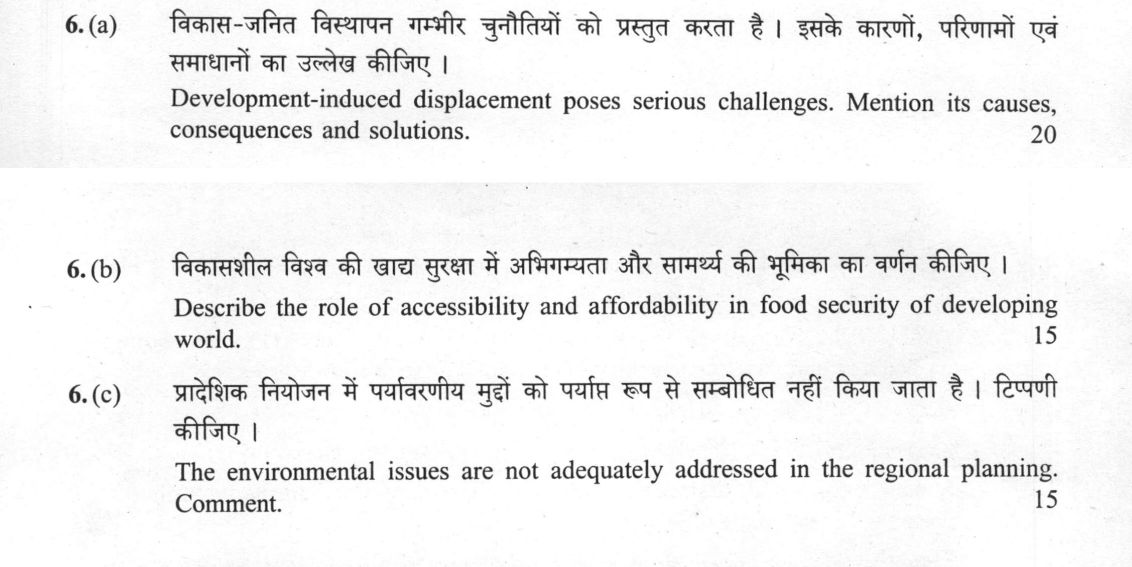
(a) Development-induced displacement poses serious challenges. Mention its causes, consequences and solutions. (20 marks) (b)…
Development-induced displacement poses serious challenges. Mention its causes, consequences and solutions. 20 marks
Describe the role of accessibility and affordability in food security of developing world. 15 marks
The environmental issues are not adequately addressed in the regional planning. Comment. 15 marks
हिंदी में प्रश्न पढ़ें
विकास-जनित विस्थापन गम्भीर चुनौतियों को प्रस्तुत करता है। इसके कारणों, परिणामों एवं समाधानों का उल्लेख कीजिए। (20 अंक)
विकासशील विश्व की खाद्य सुरक्षा में अभिगम्यता और सामर्थ्य की भूमिका का वर्णन कीजिए । (15 अंक)
प्रादेशिक नियोजन में पर्यावरणीय मुद्दों को पर्याप्त रूप से सम्बोधित नहीं किया जाता है । टिप्पणी कीजिए । (15 अंक)
Model answer
Written by UPSC Answer Check against this question's marking rubric, to the expected length. UPSC does not publish answers for Mains — this is one way to score well, not an official key.
Development-induced displacement, food insecurity, and environmental degradation reflect structural imbalances where economic growth overrides spatial equity, human entitlements, and ecological carrying capacities.
Development-Induced Displacement: Causes, Consequences, and Solutions
Development-induced displacement is driven by large-scale land acquisitions for multi-purpose hydro-projects (e.g., Narmada Valley), open-cast mining in mineral-rich indigenous belts, Special Economic Zones (SEZs), transport corridors, and urban renewal programs.
Its consequences align with Michael Cernea’s Impoverishment Risks and Reconstruction (IRR) model:
- Economic dispossession through landlessness, joblessness, and the loss of Common Property Resources (CPRs), which directly undermines household nutrition.
- Socio-cultural fragmentation, psychological trauma, and erosion of traditional knowledge systems.
- Disproportionate gendered vulnerabilities, as women lose informal safety nets, water-fuelwood access, and economic agency.
- Creation of "development refugees" who drift into marginal urban informal sectors.
Solutions require a shift from mere monetary compensation to comprehensive rehabilitation:
- Enforcing Free, Prior, and Informed Consent (FPIC) through frameworks like PESA 1996 and the Forest Rights Act 2006.
- Rigorous implementation of the Right to Fair Compensation and Transparency in Land Acquisition, Rehabilitation and Resettlement (RFCTLARR) Act, 2013, prioritizing "land-for-land" compensation.
- Pre-displacement social impact assessments and long-term livelihood restoration via institutional capacity building and benefit-sharing mechanisms.
Role of Accessibility and Affordability in Food Security
Food security in the developing world relies heavily on Amartya Sen’s Entitlement Approach, which posits that starvation is a function of collapsed access and exchange entitlements rather than gross output deficits.
Accessibility encompasses the physical and geographic reach of food systems. It requires resilient rural-urban transport corridors, cold-storage logistics, and decentralized market nodes. In the developing world, infrastructural deficits create severe spatial frictions: monsoon isolations cut off riverine tracts, while rapid, unplanned urbanization spawns urban "food deserts" where low-income settlements lack physical access to fresh produce. Digital delivery networks and modernized agricultural supply chains are emerging to bridge this last-mile gap.
Affordability represents the economic capacity to purchase adequate food without compromising other basic needs. It is dictated by real wage rates, purchasing power parity, and household vulnerability to volatile commodity markets. Developing nations address structural affordability gaps through safety nets such as the Targeted Public Distribution System (TPDS), Minimum Support Prices (MSP), and targeted direct benefit transfers, protecting vulnerable populations from food-price shocks.
Environmental Blind Spots in Regional Planning
Regional planning has persistently treated the environment as an externality, prioritizing aggregate GDP expansion, urban agglomeration economies, and sectoral growth over ecological boundaries. This stems from short-term political horizons, weak enforcement of post-clearance Environmental Impact Assessments (EIA), fragmented inter-state coordination across contiguous river basins, and a general disregard for spatial carrying capacities.
Consequently, development corridors often aggravate environmental degradation, causing topsoil loss, groundwater depletion, and urban heat islands. To rectify this, regional planning must transition toward John Friedmann’s territorial planning paradigm. Planning authorities must operationalize:
- Carrying-capacity-based regional master plans that integrate climate-adaptive land-use zoning.
- The "ridge-to-reef" watershed management approach to secure ecological continuums across administrative boundaries.
- Ecosystem Services Valuation (ESV) to factor natural capital degradation directly into cost-benefit regional accounting.
The challenges of displacement, food insecurity, and ecological distress are deeply interconnected. True regional sustainability requires moving beyond growth-pole orthodoxies to establish integrated spatial frameworks that protect local entitlements, respect ecological thresholds, and advance inclusive regional resilience.
What "Mention" is asking you to do
Put specific factual content on record — the names, features, targets or instances the stem asks for. Mention is usually the subordinate half of a larger question, so it must be done fully but quickly, leaving room for the part that carries the main directive.
Structure that answers it
The items named directly, without preamble → one qualifying detail against each → straight on to the part of the stem the marks actually sit in
Where marks are lost
Gesturing at the category instead of naming the particulars, or expanding it until the analytical half of the question is squeezed.
How this answer will be evaluated
Approach
(a) challenges: 3-4 challenges > solutions mapped to them > conclusion | (b) describe: define > structure or process in order > labelled diagram > significance | (c) comment: context > arguments both sides > judgment > close Full marks: Comprehensive causal chains, precise examples, clear diagrams, and balanced judgments.
Key points expected
- Causes: dams, mining, industrialization, infrastructure
- Consequences: loss of livelihood, social fragmentation
- Solutions: Rehabilitation and Resettlement (R&R) policy
- Diagram: Flowchart of displacement process
- Define food security (availability, access, utilization)
- Accessibility: transport, storage, market linkages
- Affordability: income levels, price volatility
- Diagram: Food security framework or supply chain
Evaluation rubric
Each sub-part is marked on its own, against the marks and word limit printed on the paper.
- (a) Causal chain of displacement: causes, consequences, and mapped solutions. 20 marks
challenges— 3-4 challenges → solutions mapped to them → conclusion
Must cover
- Causes: dams, mining, industrialization, infrastructure
- Consequences: loss of livelihood, social fragmentation
- Solutions: Rehabilitation and Resettlement (R&R) policy
- Diagram: Flowchart of displacement process
Loses marks
- Listing causes without linking to consequences
- Solutions not mapped to specific challenges
- No diagram or visual aid
Earns more
- Reference to specific Indian projects (e.g., Narmada)
- Mention of 'Right to Fair Compensation' Act
- Distinction between voluntary and involuntary displacement
Extra mark
- Data on specific displacement figures (e.g., Narmada)
- Sketch map of a major displacement site
- (b) Role of accessibility and affordability in food security. 15 marks
describe— define → structure or process in order → labelled diagram → significance
Must cover
- Define food security (availability, access, utilization)
- Accessibility: transport, storage, market linkages
- Affordability: income levels, price volatility
- Diagram: Food security framework or supply chain
Loses marks
- Confusing availability with access
- Ignoring the 'developing world' context
- No diagram or visual aid
Earns more
- Mention of Public Distribution System (PDS)
- Reference to 'food miles' or logistics costs
- Link to poverty and inequality
Extra mark
- Specific example of a food desert or surplus region
- Data on food inflation or subsidy costs
- (c) Critique of environmental issues in regional planning. 15 marks
comment— context → arguments both sides → judgment → close
Must cover
- Context: Regional planning objectives vs. environmental goals
- Arguments for: economic growth, rapid development
- Arguments against: ecological degradation, resource depletion
- Judgment: Need for integrated environmental planning
Loses marks
- One-sided argument without balance
- No clear judgment or conclusion
- Vague generalities without specific examples
Earns more
- Mention of Environmental Impact Assessment (EIA)
- Reference to 'Sustainable Development' goals
- Example of a failed or successful regional plan
Extra mark
- Specific case study (e.g., Ganga Action Plan)
- Reference to a specific policy or act
Practice this exact question
Write your answer and it is marked point by point against the model answer above — what you covered, what you missed, what you got wrong.
Evaluate my answer →More from Geography 2021 Paper I
- Q3 (a) Examine major influencing factors for varied patterns of precipitations on the contin…
- Q4 (a) With suitable examples, elaborate human ecological adaptations. Explain its impacts o…
- Q5 Answer the following in about 150 words each: (a) The interrelationships between social a…
- Q6 (a) Development-induced displacement poses serious challenges. Mention its causes, conseq…
- Q7 (a) Suggest criteria, indicators and techniques for delimitation of formal regions. (20 m…
- Q8 (a) Why is radicalism seen as a major paradigm shift in geography? Explain its causes, ap…