Paper I — Q3
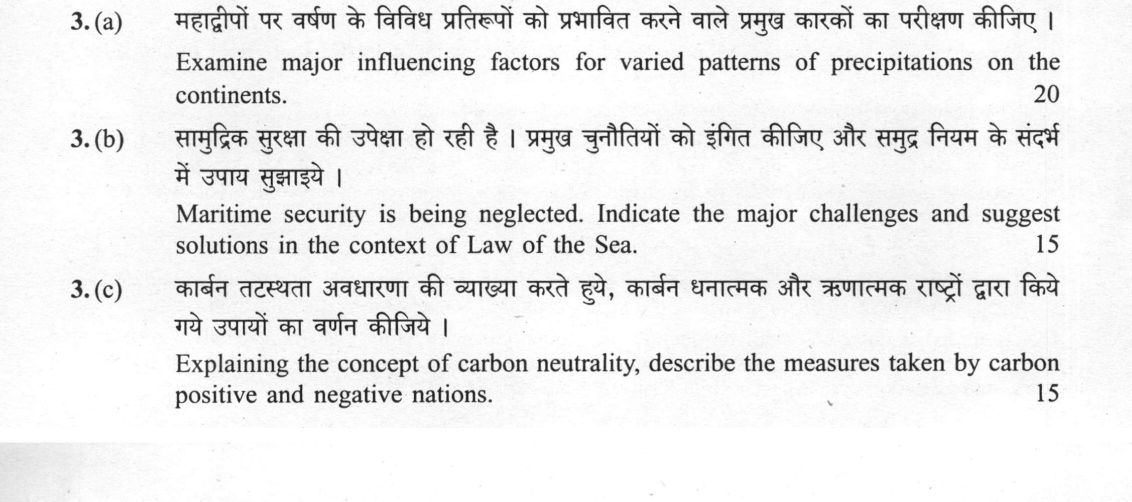
(a) Examine major influencing factors for varied patterns of precipitations on the continents. (20 marks) (b) Maritime security…
Examine major influencing factors for varied patterns of precipitations on the continents. 20 marks
Maritime security is being neglected. Indicate the major challenges and suggest solutions in the context of Law of the Sea. 15 marks
Explaining the concept of carbon neutrality, describe the measures taken by carbon positive and negative nations. 15 marks
हिंदी में प्रश्न पढ़ें
महाद्वीपों पर वर्षण के विविध प्रतिरूपों को प्रभावित करने वाले प्रमुख कारकों का परीक्षण कीजिए । (20 अंक)
सामुद्रिक सुरक्षा की उपेक्षा हो रही है । प्रमुख चुनौतियों को इंगित कीजिए और समुद्र नियम के सन्दर्भ में उपाय सुझाइये । (15 अंक)
कार्बन तटस्थता अवधारणा की व्याख्या करते हुये, कार्बन धनात्मक और ऋणात्मक राष्ट्रों द्वारा किये गये उपायों का वर्णन कीजिये । (15 अंक)
Model answer
Written by UPSC Answer Check against this question's marking rubric, to the expected length. UPSC does not publish answers for Mains — this is one way to score well, not an official key.
Continental precipitation Precipitation over continents is uneven because atmospheric circulation, surface energy balance, moisture availability and topography interact differently at each latitude. The principal controls are pressure belts, wind systems, ocean currents, relief, continentality and the seasonal migration of the ITCZ. Equatorial regions receive high convectional rain because warm, moist air rises in the low-pressure ITCZ; tropical deserts lie under subtropical highs and dry trade winds; temperate zones get frontal rain from westerlies and mid-latitude cyclones; polar regions are cold, stable and dry. Warm currents such as the Gulf Stream and Kuroshio add moisture to windward coasts, while cold currents such as the Humboldt and Canary create stable, arid margins. Orographic uplift forces rain on windward slopes and rain shadows on leeward sides; continentality reduces rainfall inland. In India, the Western Ghats and Himalayas produce heavy orographic rain, while the Thar is dry due to rain shadow and subtropical high.
Specific continental contrasts show these mechanisms. South America combines Amazonian convection, fed by equatorial moisture and uplift, with the Atacama’s aridity caused by the subtropical high, cold Humboldt Current and Andean rain shadow. Africa displays latitudinal zonation: equatorial rainforest, Sahelian and Saharan dry belts, and Mediterranean coasts. Asia’s monsoon reverses seasonal winds, bringing summer rain to India and East Asia; the ITCZ’s northward shift drives the Indian monsoon. Europe’s Mediterranean coasts are wet in winter and dry in summer under westerly and subtropical controls.
Maritime security Maritime security is neglected because states focus on land borders, while ocean threats are diffuse. Major challenges include piracy in the Gulf of Aden and Malacca Strait, illegal fishing, maritime terrorism, EEZ violations, seabed mining disputes, and climate change impacts on sea lanes of communication, including ice-free Arctic routes and coastal flooding. UNCLOS provides the legal framework. Coastal-state jurisdiction under Article 56 allows environmental and resource regulation in the EEZ; hot pursuit under Article 111 permits enforcement against offenders. The ISPS Code strengthens port and ship security. Regional cooperation through IORA and BIMSTEC, India’s SAGAR doctrine, India’s Navy, Coast Guard, joint patrols, information sharing, port state control and capacity building can address non-state threats. Disputes over seabed mining should be governed by the International Seabed Authority and precautionary environmental standards.
Carbon neutrality Carbon neutrality means net-zero CO₂ emissions, where anthropogenic sources are balanced by sinks or removals. It differs from climate neutrality, which includes all greenhouse gases. Nations with a positive carbon balance—net absorbers, usually called carbon-negative—include Bhutan and Suriname; their measures rely on forest carbon sinks, renewable-energy dominance, constitutional environmental provisions, Bhutan’s right to a clean environment and Suriname’s forest cover, and low industrial emissions. Carbon-positive nations, i.e. net emitters such as China, the USA and the EU, must reduce sources. The EU uses the Emissions Trading System; India is developing a carbon credit trading scheme; the USA has no nationwide carbon price, though states such as California operate cap-and-trade. Major emitters also use Paris Agreement NDCs, CCS technology, renewable subsidies, efficiency standards and India’s Panchamrit targets of 500 GW non-fossil capacity, 50 per cent renewable energy, 1 billion tonnes emission reduction and 50 per cent carbon intensity reduction by 2030. Carbon-negative countries can also support global sinks through REDD+ and blue carbon, while carbon-positive countries need demand-side decarbonisation.
The verdict is that precipitation patterns, maritime risks and carbon balances are linked by the same planetary systems: atmospheric circulation shapes rain and sea-lane climate, oceans connect trade and security, and carbon policy determines future climate stress. A coherent response requires scientific monitoring, UNCLOS-based governance and binding climate mitigation. Thus, geography, law and climate policy must be integrated.
What "Examine" is asking you to do
Test the proposition the question puts to you and return a finding on how far it holds. Examine stems carry a claim, or ask whether something has happened, and expect evidence weighed both ways before the extent is stated — often with remedial measures attached.
Structure that answers it
Restate the claim as the question frames it → evidence that supports it → evidence that undercuts it → the conditions under which it holds → verdict on how far it stands
Where marks are lost
Stopping at description. An examination has to reach a finding, and “examine with justification” means the extent must be stated, not implied.
How this answer will be evaluated
Approach
Framework: Concept > Mechanism > Diagram > Regional Example > Application. (a) examine: intro > how/why with reasoning > evidence > conclusion | (b) challenges: 3-4 challenges > solutions mapped to them > conclusion | (c) describe: define > structure or process in order > labelled diagram > significance Full marks: Clear causal chains, labelled diagrams, specific regional/statutory examples, balanced conclusions.
Key points expected
- Mechanism of ITCZ and seasonal monsoon shifts
- Role of pressure belts and prevailing winds
- Influence of topography (rain shadow effect)
- Impact of ocean currents and land-sea contrast
- 3-4 specific security challenges (e.g., piracy, ASW)
- Solutions mapped to specific challenges
- Context of UNCLOS (Law of the Sea)
- Balanced conclusion on security governance
Evaluation rubric
Each sub-part is marked on its own, against the marks and word limit printed on the paper.
- (a) Causal analysis of factors controlling continental precipitation patterns. 20 marks
examine— intro → how/why with reasoning → evidence → conclusion
Must cover
- Mechanism of ITCZ and seasonal monsoon shifts
- Role of pressure belts and prevailing winds
- Influence of topography (rain shadow effect)
- Impact of ocean currents and land-sea contrast
Loses marks
- Description without mechanism
- Answers with no diagram
- Generic listing without causal chain
Earns more
- Labelled sketch map of global precipitation
- Specific regional examples (e.g., Atacama, Amazon)
- Linking physical cause to human consequence
Extra mark
- Recent data on precipitation anomalies
- Specific climatic classification (Köppen)
- (b) Major maritime security challenges and Law of the Sea solutions. 15 marks
challenges— 3-4 challenges → solutions mapped to them → conclusion
Must cover
- 3-4 specific security challenges (e.g., piracy, ASW)
- Solutions mapped to specific challenges
- Context of UNCLOS (Law of the Sea)
- Balanced conclusion on security governance
Loses marks
- Vague security threats without specifics
- Solutions not linked to Law of the Sea
- Ignoring the 'neglected' aspect of the prompt
Earns more
- Reference to specific maritime zones (EEZ, HFS)
- Mention of international cooperation mechanisms
- Specific regional examples (e.g., South China Sea)
Extra mark
- Reference to specific UNCLOS articles
- Recent maritime incident or treaty
- (c) Concept of carbon neutrality and measures by positive/negative nations. 15 marks
describe— define → structure or process in order → labelled diagram → significance
Must cover
- Precise definition of carbon neutrality
- Measures by carbon positive nations (emitters)
- Measures by carbon negative nations (sinks)
- Significance of the balance for climate goals
Loses marks
- Confusing carbon neutral with carbon positive/negative
- Measures not clearly attributed to nation type
- Lack of definition or conceptual clarity
Earns more
- Labelled diagram of carbon cycle/balance
- Specific policy examples (e.g., carbon tax, reforestation)
- Distinction between positive and negative clearly drawn
Extra mark
- Reference to Paris Agreement targets
- Specific country examples (e.g., Bhutan, USA)
Practice this exact question
Write your answer and it is marked point by point against the model answer above — what you covered, what you missed, what you got wrong.
Evaluate my answer →More from Geography 2021 Paper I
- Q1 Answer the following in about 150 words each: (a) Describe the concept of 'Altiplanation'…
- Q2 (a) The concept of Plate tectonics has been derived from the isostasy and continental dri…
- Q3 (a) Examine major influencing factors for varied patterns of precipitations on the contin…
- Q4 (a) With suitable examples, elaborate human ecological adaptations. Explain its impacts o…
- Q5 Answer the following in about 150 words each: (a) The interrelationships between social a…
- Q6 (a) Development-induced displacement poses serious challenges. Mention its causes, conseq…