Paper I — Q2
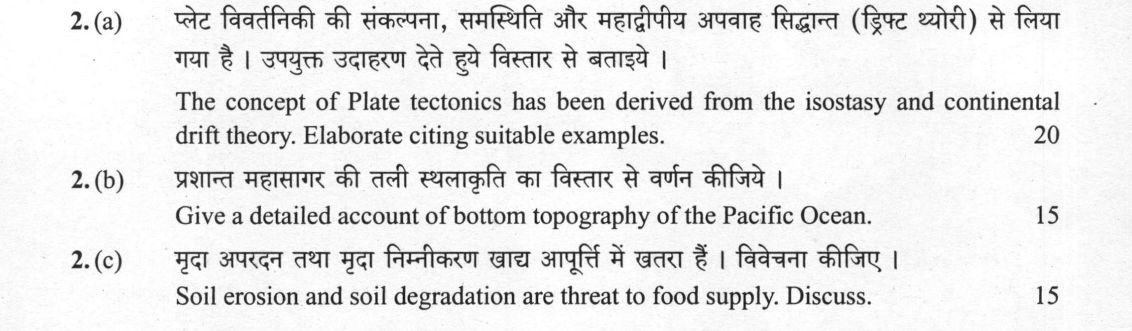
(a) The concept of Plate tectonics has been derived from the isostasy and continental drift theory. Elaborate citing suitable…
The concept of Plate tectonics has been derived from the isostasy and continental drift theory. Elaborate citing suitable examples. 20 marks
Give a detailed account of bottom topography of the Pacific Ocean. 15 marks
Soil erosion and soil degradation are threat to food supply. Discuss. 15 marks
हिंदी में प्रश्न पढ़ें
प्लेट विवर्तनिकी की संकल्पना, समस्थिति और महाद्वीपीय अपवाह सिद्धान्त (ड्रिफ्ट थ्योरी) से लिया गया है । उपयुक्त उदाहरण देते हुये विस्तार से बताइये । (20 अंक)
प्रशान्त महासागर की तली स्थलाकृति का विस्तार से वर्णन कीजिये । (15 अंक)
मृदा अपरदन तथा मृदा निम्नीकरण खाद्य आपूर्ति में खतरा हैं । विवेचना कीजिए । (15 अंक)
Model answer
Written by UPSC Answer Check against this question's marking rubric, to the expected length. UPSC does not publish answers for Mains — this is one way to score well, not an official key.
The theory of Plate Tectonics represents the grand unifying synthesis in geomorphology, seamlessly integrating the vertical equilibrium of Isostasy with the horizontal dynamics of Continental Drift.
Synthesis of Isostasy and Continental Drift into Plate Tectonics
Alfred Wegener’s Continental Drift hypothesis established empirical evidence for horizontal continental displacement, citing the morphological jig-saw fit of Atlantic coastlines, identical fossil distributions such as Glossopteris and Mesosaurus, continuous structural rock belts, and Permo-Carboniferous glacial tillites. However, it lacked a viable geodynamic mechanism. Simultaneously, the concept of Isostasy—formalized by George Airy’s variable crustal roots and Archdeacon Pratt’s variable crustal densities—demonstrated that the rigid lithosphere maintains buoyant hydrostatic equilibrium while floating on the denser, semi-fluid asthenosphere.
Plate tectonics integrated these principles through Harry Hess’s sea-floor spreading and subduction zone dynamics, driven by mantle convection currents. Isostatic buoyancy explains why low-density continental crust resists subduction, whereas aged, cold, and dense oceanic lithosphere founders into trenches. This cyclical opening and closure of ocean basins is articulated in the Wilson Cycle. For instance, the East African Rift illustrates nascent divergence where mantle upwelling thins the crust, while the Mid-Atlantic Ridge exemplifies active ocean-floor accretion. In contrast, the collision of the Indian and Eurasian plates creates the Himalayas, where double-thickness continental crust undergoes intense isostatic uplift, a process continuously measured and verified by modern space-borne GPS geodesy.
Bottom Topography of the Pacific Ocean
The Pacific Ocean basin features an asymmetrical bottom topography dominated by active subduction margins and extensive volcanism along the Pacific Ring of Fire.
Deep-sea trenches form its most prominent peripheral features, including the Kuril, Japan, and Peru-Chile trenches, culminating in the Challenger Deep within the Mariana Trench, the planet's deepest point at approximately 11,034 meters. The dominant ocean-ridge system is the broad, fast-spreading East Pacific Rise, which lacks the steep central rift valleys typical of the Atlantic. Vast abyssal plains, situated at depths between 3,000 and 6,000 meters, are punctuated by flat-topped guyots, isolated volcanic seamounts, and the prominent linear Hawaiian-Emperor Seamount chain generated by intraplate hotspot volcanism. Furthermore, the ocean floor is extensively segmented by transverse fracture zones, such as the Mendocino, Clarion, and Clipperton fracture systems.
Soil Erosion and Degradation: Threats to Food Security
While soil erosion refers specifically to the mechanical detachment and transportation of topsoil by wind and water, soil degradation represents a broader qualitative decline involving physical compaction, biological loss, and chemical deterioration such as acidification and salinization.
Both processes directly undermine global food security. The loss of the organic-rich A-horizon reduces cation exchange capacity, depletes macro- and micro-nutrients, and destroys soil structure, which impairs root penetration and drastically diminishes soil water-holding capacity. Consequently, agricultural yields decline despite intensive input usage.
In India, this vulnerability is evident across distinct agro-ecological zones: the extensive Chambal ravines illustrate severe gully erosion that has rendered thousands of hectares uncultivable; excessive canal irrigation without adequate drainage in the black soil tracts of Maharashtra has induced severe secondary salinization and alkalinization; and intensive monocropping has accelerated nutrient exhaustion and leaching in the lateritic soils of Kerala.
To safeguard the agricultural base against these threats, governance must institutionalize comprehensive watershed management, organic soil regeneration, and regenerative agricultural practices under the National Mission for Sustainable Agriculture, aligning resource conservation with long-term food stability.
What "Elaborate" is asking you to do
Give the full detailed account the question has compressed into a line — every dimension of it, with specifics. Elaborate rewards completeness and detail rather than clarification or argument: the examiner is checking whether you can fill out a topic without being told what its parts are.
Structure that answers it
State the proposition → first dimension in detail → second dimension in detail → the part the statement leaves implicit → the consolidated picture
Where marks are lost
Repeating the statement at greater length instead of adding substance. Elaborate also punishes narrowness: omitting a whole dimension costs more here than anywhere else in this family.
How this answer will be evaluated
Approach
Framework: Concept or mechanism > Diagram > Regional example > Application. (a) explain: definition/context > points in order > small example > short close | (b) describe: define > structure or process in order > labelled diagram > significance | (c) discuss: intro > 3-4 dimensions > example > balanced close Full marks: Clear causal chains, precise examples, labelled diagrams, balanced conclusions
Key points expected
- Define isostasy and continental drift
- Explain how these theories led to plate tectonics
- Cite suitable examples (e.g., Himalayas, Atlantic)
- Show causal link between theories
- Describe major topographic features
- Mention trenches, ridges, plains
- Locate features geographically
- Explain formation processes
Evaluation rubric
Each sub-part is marked on its own, against the marks and word limit printed on the paper.
- (a) Derive plate tectonics from isostasy and continental drift with examples. 20 marks
explain— definition/context → points in order → small example → short close
Must cover
- Define isostasy and continental drift
- Explain how these theories led to plate tectonics
- Cite suitable examples (e.g., Himalayas, Atlantic)
- Show causal link between theories
Loses marks
- No causal chain between theories
- Missing examples
- No diagram or sketch
Earns more
- Mention Wegener's evidence
- Reference seafloor spreading
- Discuss mantle convection
- Mention specific plate boundaries
Extra mark
- Labelled diagram of plate boundaries
- Reference specific geological features
- (b) Detailed account of Pacific Ocean bottom topography. 15 marks
describe— define → structure or process in order → labelled diagram → significance
Must cover
- Describe major topographic features
- Mention trenches, ridges, plains
- Locate features geographically
- Explain formation processes
Loses marks
- No geographical location
- Missing formation processes
- No diagram or map
Earns more
- Name specific trenches (Mariana, Tonga)
- Mention mid-ocean ridges
- Reference seamounts and abyssal plains
- Discuss tectonic setting
Extra mark
- Labelled map of Pacific floor
- Mention specific depth measurements
- (c) Discuss soil erosion and degradation as food supply threats. 15 marks
discuss— intro → 3-4 dimensions → example → balanced close
Must cover
- Define soil erosion and degradation
- Explain impact on food supply
- Provide 3-4 dimensions of threat
- Give balanced conclusion
Loses marks
- No link to food supply
- Missing dimensions
- No conclusion or balance
Earns more
- Mention specific regions affected
- Reference agricultural impacts
- Discuss economic consequences
- Suggest mitigation measures
Extra mark
- Recent data on soil loss
- Reference specific Indian regions
Practice this exact question
Write your answer and it is marked point by point against the model answer above — what you covered, what you missed, what you got wrong.
Evaluate my answer →More from Geography 2021 Paper I
- Q1 Answer the following in about 150 words each: (a) Describe the concept of 'Altiplanation'…
- Q2 (a) The concept of Plate tectonics has been derived from the isostasy and continental dri…
- Q3 (a) Examine major influencing factors for varied patterns of precipitations on the contin…
- Q4 (a) With suitable examples, elaborate human ecological adaptations. Explain its impacts o…
- Q5 Answer the following in about 150 words each: (a) The interrelationships between social a…