Paper I — Q7
(a) Suggest criteria, indicators and techniques for delimitation of formal regions. (20 marks) (b) Boundaries are important in…
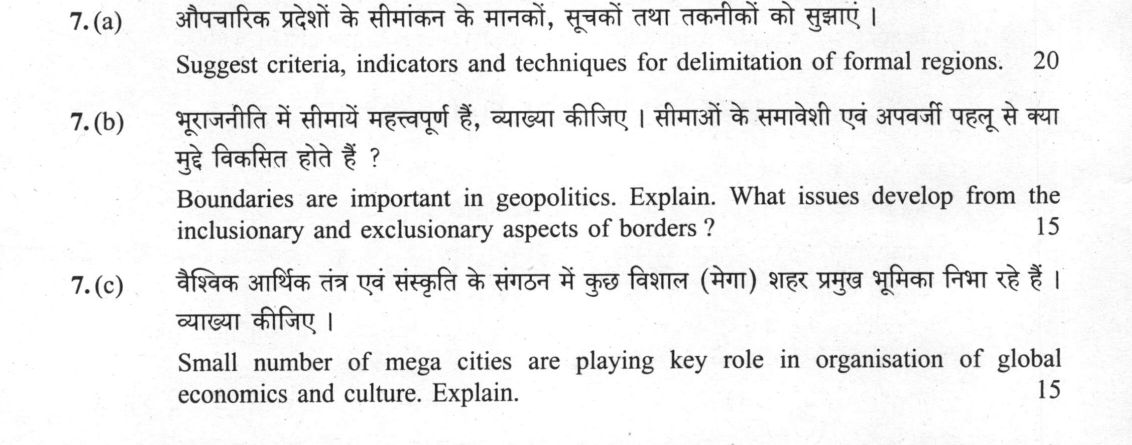
Suggest criteria, indicators and techniques for delimitation of formal regions. 20 marks
Boundaries are important in geopolitics. Explain. What issues develop from the inclusionary and exclusionary aspects of borders? 15 marks
Small number of mega cities are playing key role in organisation of global economics and culture. Explain. 15 marks
हिंदी में प्रश्न पढ़ें
औपचारिक प्रदेशों के सीमांकन के मानकों, सूचकों तथा तकनीकों को सुझाइए । (20 अंक)
भूराजनीति में सीमाएं महत्त्वपूर्ण हैं, व्याख्या कीजिए । सीमाओं के समावेशी एवं अपवर्जी पहलू से क्या मुद्दे विकसित होते हैं ? (15 अंक)
वैश्विक आर्थिक तंत्र एवं संस्कृति के संगठन में कुछ विशाल (मेगा) शहर प्रमुख भूमिका निभा रहे हैं । व्याख्या कीजिए । (15 अंक)
Model answer
Written by UPSC Answer Check against this question's marking rubric, to the expected length. UPSC does not publish answers for Mains — this is one way to score well, not an official key.
Regions are analytical devices for reading spatial unevenness, but their delimitation is also a political-economic act. For formal regions, the task is to identify contiguous areas that share measurable uniformity, not merely areas linked by flows.
Delimiting formal regions. The first criterion should be the purpose of the region: physical, economic, social-cultural or administrative. Formal regions require homogeneity in one or more attributes, a clear threshold, an appropriate scale, and administrative feasibility. Nodality and programmatic criteria—flows, market areas, or administrative mandates—should be used only as secondary checks; they define functional or program regions, not formal homogeneity. Indicators may be physical (climate, soil, physiography, vegetation), economic (crop pattern, industrial output, employment, income, trade) or social-cultural (language, religion, caste, literacy, migration). Techniques should begin with selecting comparable units, such as districts or tehsils, standardising indicators, and using factor analysis or PCA to reduce multicollinearity. Cluster analysis, such as hierarchical or k-means, can then group units by similarity. GIS overlay, spatial autocorrelation and threshold mapping should test contiguity, boundary stability and data gaps. A feasible procedure is: define the question, collect district-level data, test indicator reliability, choose clusters, overlay with administrative boundaries, and validate with local knowledge. For formal regions, the boundary should be where the indicator value changes sharply, not where interaction decays. This avoids arbitrary political boundaries unless they coincide with natural homogeneity. India’s Planning Commission’s 15 agro-climatic zones illustrate this logic. Gravity models and break-point rules are better reserved for functional regions; using them for formal regions would confuse homogeneity with interaction.
Boundaries and geopolitics. Boundaries matter because they are power containers, territorial traps and geopolitical constructs. They define sovereignty, jurisdiction, resource rights and identity, and they can trap populations, enclaves or economic opportunities within fixed lines. They also shape strategic depth, alliance politics and control of chokepoints. Inclusionary aspects decide who is counted as a citizen, who can access land, water, welfare and labour markets, and which identities are recognised. In India, linguistic reorganisation, citizenship registration in border states, and river-basin management show how inclusion shapes political stability. Inclusion can also be positive through border trade, cross-border water sharing and cultural recognition. Exclusionary aspects produce refugee crises, border conflicts and economic marginalisation. The India-Pakistan LoC and India-China LAC show how frozen or disputed boundaries can become sites of military tension; refugee movements of Rohingyas, Afghans and Sri Lankans show exclusionary pressure; restricted-area rules and weak border trade can marginalise frontier communities. Exclusion can create internal borders, visa regimes and economic enclaves.
Mega-cities and global hierarchy. A small number of mega-cities organise global economics and culture because they host command and control functions: finance, law, headquarters, R&D, media and advanced producer services. Friedmann’s world-city hypothesis and Sassen’s analysis show that global cities are not merely large; they are nodes in a hierarchical network, with a few dominant cities and many regional satellites. GaWC rankings, based on advanced business-service connectivity, identify such nodes. These cities also spread global cultural forms—brands, media, fashion, food and language—producing a degree of global cultural homogenization, though local hybridization remains. In India, Mumbai and Delhi occupy significant positions in the global urban hierarchy: Mumbai through finance, port, film and services, Delhi through political-administrative and service functions. Their networks link smaller Indian cities to global flows.
Thus, formal regional delimitation, boundary politics and world-city hierarchies are interconnected. Regions provide the units for planning and governance; borders regulate inclusion and exclusion; mega-cities concentrate command functions. A feasible way forward is to use objective indicators and GIS/statistical methods for formal regions, pair boundary governance with inclusive resource and citizenship policies, and integrate Indian mega-cities into global networks while reducing regional imbalances.
What "Suggest" is asking you to do
Propose measures that attach to the causes the question has just had you identify. Each should name who acts, on what, and why it would work; a measure with no actor behind it is a wish rather than a suggestion.
Structure that answers it
The problem in one line → measure 1 with the cause it addresses → measure 2 → measure 3 → how it would be implemented and what it requires
Where marks are lost
Prescriptions that would fit any question on any subject — awareness campaigns, capacity building, better coordination. The examiner checks whether each measure is traceable to a cause the answer itself named.
How this answer will be evaluated
Approach
Framework: Concept or mechanism > Diagram > Regional example > Application. (a) suggest: the problem in one line > implementable measures > who acts > conclusion | (b) explain: definition/context > points in order > small example > short close | (c) explain: definition/context > points in order > small example > short close Full marks: Precise definitions, clear distinction between concepts, specific examples, and logical flow.
Key points expected
- Define formal region (uniformity/homogeneity)
- List criteria (physical, cultural, economic)
- Identify specific indicators (e.g., rainfall, language)
- Explain delimitation techniques (isogons, choropleth)
- Define geopolitical significance of boundaries
- Explain inclusionary aspects (access, resources)
- Explain exclusionary aspects (barriers, sovereignty)
- Identify issues arising from these aspects
Evaluation rubric
Each sub-part is marked on its own, against the marks and word limit printed on the paper.
- (a) Criteria, indicators, and techniques for delimiting formal regions. 20 marks
suggest— the problem in one line → implementable measures → who acts → conclusion
Must cover
- Define formal region (uniformity/homogeneity)
- List criteria (physical, cultural, economic)
- Identify specific indicators (e.g., rainfall, language)
- Explain delimitation techniques (isogons, choropleth)
Loses marks
- Confusing formal with functional regions
- Listing criteria without explaining delimitation
- No mention of specific indicators
Earns more
- Mention of isogons/isopleths
- Distinction between formal and functional regions
- Example of a specific formal region (e.g., wheat belt)
- Discussion of data sources (census, remote sensing)
Extra mark
- Sketch map showing isogons
- Reference to specific statistical methods
- (b) Importance of boundaries in geopolitics and issues from inclusionary/exclusionary aspects. 15 marks
explain— definition/context → points in order → small example → short close
Must cover
- Define geopolitical significance of boundaries
- Explain inclusionary aspects (access, resources)
- Explain exclusionary aspects (barriers, sovereignty)
- Identify issues arising from these aspects
Loses marks
- Ignoring the inclusionary/exclusionary distinction
- Generalizing without geopolitical context
- No specific examples of issues
Earns more
- Mention of specific geopolitical theories (e.g., Heartland)
- Example of a boundary dispute
- Discussion of soft vs hard borders
- Link to national security
Extra mark
- Map of a disputed boundary
- Reference to a specific treaty or conflict
- (c) Role of mega cities in organizing global economics and culture. 15 marks
explain— definition/context → points in order → small example → short close
Must cover
- Define mega city/global city
- Explain economic role (finance, trade, HQs)
- Explain cultural role (media, diversity, soft power)
- Link to global networks (flows of capital/info)
Loses marks
- Focusing only on population size
- Ignoring the 'global' aspect (local focus)
- No link to economic/cultural organization
Earns more
- Mention of specific global cities (e.g., NY, London, Tokyo)
- Reference to GaWC or similar rankings
- Discussion of 'global city' theory (Friedmann/Sassen)
- Example of cultural export from a mega city
Extra mark
- Diagram of global city network
- Specific statistic on economic output
Practice this exact question
Write your answer and it is marked point by point against the model answer above — what you covered, what you missed, what you got wrong.
Evaluate my answer →More from Geography 2021 Paper I
- Q4 (a) With suitable examples, elaborate human ecological adaptations. Explain its impacts o…
- Q5 Answer the following in about 150 words each: (a) The interrelationships between social a…
- Q6 (a) Development-induced displacement poses serious challenges. Mention its causes, conseq…
- Q7 (a) Suggest criteria, indicators and techniques for delimitation of formal regions. (20 m…
- Q8 (a) Why is radicalism seen as a major paradigm shift in geography? Explain its causes, ap…