Paper I — Q4
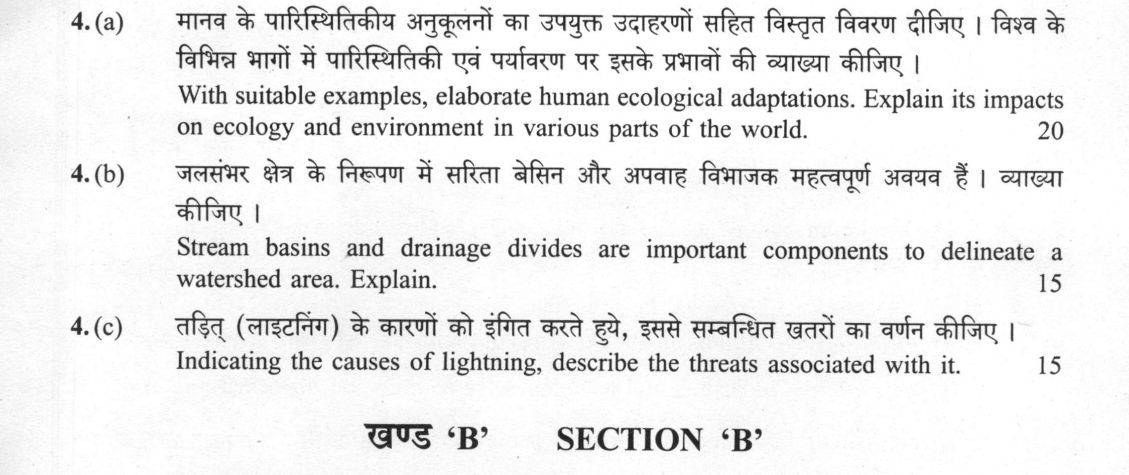
(a) With suitable examples, elaborate human ecological adaptations. Explain its impacts on ecology and environment in various…
With suitable examples, elaborate human ecological adaptations. Explain its impacts on ecology and environment in various parts of the world. 20 marks
Stream basins and drainage divides are important components to delineate a watershed area. Explain. 15 marks
Indicating the causes of lightning, describe the threats associated with it. 15 marks
हिंदी में प्रश्न पढ़ें
मानव के पारिस्थितिकीय अनुकूलनों का उपयुक्त उदाहरणों सहित विस्तृत विवरण दीजिए। विश्व के विभिन्न भागों में पारिस्थितिकी एवं पर्यावरण पर इसके प्रभावों की व्याख्या कीजिए। (20 अंक)
जलसंभर क्षेत्र के निरूपण में सरिता बेसिन और अपवाह विभाजक महत्वपूर्ण अवयव हैं। व्याख्या कीजिए। (15 अंक)
तड़ित (लाइटनिंग) के कारणों को इंगित करते हुए, इससे सम्बन्धित खतरों का वर्णन कीजिए। (15 अंक)
Model answer
Written by UPSC Answer Check against this question's marking rubric, to the expected length. UPSC does not publish answers for Mains — this is one way to score well, not an official key.
Human ecological adaptation represents the physiological, genetic, and socio-cultural adjustments through which human societies survive distinct biophysical environments. Genetic and physiological adaptations are evident in high-altitude populations, such as Tibetans possessing the EPAS1 gene mutation and Andeans with elevated hemoglobin concentrations to mitigate hypobaric hypoxia. Cultural and technological adaptations emerge across extreme biomes: the Inuit utilize insulated snow shelters and blubber diets in the Arctic; the Bedouin of Arabia and Raika pastoralists of the Thar Desert rely on nomadism, light woolen attire, and rainwater cisterns (tankas); while Ladakhi communities in cold-arid trans-Himalayas employ sun-facing mud architecture and meltwater diversion channels (zings). In rugged and tropical terrains, adaptation manifests in contour terracing and shifting cultivation (jhum).
These adaptations deeply transform local environments. Sustainable adaptations, such as traditional water harvesting (Ahar-Pyne in Bihar, Kuhls in Himachal Pradesh), preserve ecological equilibrium. However, intensifying human pressures distort these adaptations, converting shifting cultivation into shortened, unsustainable fallow cycles that drive primary deforestation, soil erosion, and biodiversity loss in the tropics, while mechanized over-irrigation in arid zones induces widespread soil salinization.
Stream Basins and Drainage Divides in Watershed Delineation
A stream basin is the spatial land unit drained by a main river and its tributary network toward a single pour point, while a drainage divide is the elevated topographic ridge line that separates the precipitation runoff directed into adjacent basins. Delineating a watershed requires mapping these structural components: identifying the outlet point, tracing ridge lines orthogonal to topographic contour intervals, or utilizing automated flow-direction and flow-accumulation algorithms from Digital Elevation Models (DEMs).
Applying morphometric frameworks, such as Horton and Strahler’s stream ordering systems, enables the classification of stream networks from headwater rills (first-order) to mature trunk channels. Watershed delineation forms the bedrock of integrated ecological planning using a ridge-to-valley approach. In India, decentralized models like the Pani Panchayat in Maharashtra and ridge-treatment initiatives across the Western Ghats utilize basin boundaries to optimize soil moisture conservation, regulate peak discharges, and arrest sediment yield.
Causes of Lightning and Associated Threats
Lightning is an electrostatic discharge resulting from charge separation within deep cumulonimbus clouds. Strong convective updrafts force collisions between rising supercooled water droplets and descending graupel or ice crystals. The lighter ice crystals gain positive charges and accumulate in the cloud's upper reaches, while heavier graupel particles become negatively charged near the cloud base. When the electric potential gradient exceeds the dielectric breakdown threshold of air, a stepped leader initiates electrical discharge. This occurs as Intra-Cloud (IC), Cloud-to-Cloud (CC), or Cloud-to-Ground (CG) lightning.
The threats are extensive, categorized into direct physical strikes, side flashes, touch voltages, and ground currents (step potential). CG strikes ignite catastrophic forest fires, damage power grids and telecommunication towers, and threaten civil aviation. India experiences substantial socio-economic vulnerability, recording over 2,000 fatalities annually, with acute casualty clusters in Bihar, Odisha, and lightning-prone pre-monsoon belts of Kerala.
Synthesis
Human ecological adaptations are fundamentally shaped by both hydrological morphology and atmospheric hazards. Systematic watershed delineation enables planned ecological adaptations through decentralized resource governance, while institutional mitigation against atmospheric extremes—using spatial vulnerability mapping and Doppler radar-based alerts like the Damini application—remains vital to safeguarding human settlements within dynamic tropical watersheds.
What "Elaborate" is asking you to do
Give the full detailed account the question has compressed into a line — every dimension of it, with specifics. Elaborate rewards completeness and detail rather than clarification or argument: the examiner is checking whether you can fill out a topic without being told what its parts are.
Structure that answers it
State the proposition → first dimension in detail → second dimension in detail → the part the statement leaves implicit → the consolidated picture
Where marks are lost
Repeating the statement at greater length instead of adding substance. Elaborate also punishes narrowness: omitting a whole dimension costs more here than anywhere else in this family.
How this answer will be evaluated
Approach
Framework: Concept > Diagram > Regional Example > Application. (a) explain: definition/context > points in order > small example > short close | (b) explain: definition/context > points in order > small example > short close | (c) describe: define > structure or process in order > labelled diagram > significance Full marks: Precise mechanism, labelled diagrams, specific regional examples, and clear causal links.
Key points expected
- Define human ecological adaptation
- Explain physiological/cultural adaptation mechanisms
- Provide specific regional examples (e.g., Andes, Arctic)
- Analyze impacts on local ecology/environment
- Define stream basin and drainage divide
- Explain role of divides in delineation
- Describe the relationship between the two
- Include a labelled diagram of a watershed
Evaluation rubric
Each sub-part is marked on its own, against the marks and word limit printed on the paper.
- (a) Detailed analysis of human ecological adaptations with global examples and environmental impacts. 20 marks
explain— definition/context → points in order → small example → short close
Must cover
- Define human ecological adaptation
- Explain physiological/cultural adaptation mechanisms
- Provide specific regional examples (e.g., Andes, Arctic)
- Analyze impacts on local ecology/environment
Loses marks
- Description without mechanism
- No regional examples provided
- Ignoring environmental impact aspect
Earns more
- Labelled sketch of a specific adaptation
- Link physical cause to human consequence
- Mention specific indigenous practices
- Discuss climate change implications
Extra mark
- Recent disaster or census data
- Specific scientific term (e.g., acclimatization)
- (b) Explanation of how stream basins and drainage divides define watershed boundaries. 15 marks
explain— definition/context → points in order → small example → short close
Must cover
- Define stream basin and drainage divide
- Explain role of divides in delineation
- Describe the relationship between the two
- Include a labelled diagram of a watershed
Loses marks
- No diagram provided
- Confusing watershed with catchment
- Vague description of boundaries
Earns more
- Mention topographic map usage
- Explain the hydrological cycle link
- Differentiate between sub-basins and main basin
Extra mark
- Specific example of a major watershed (e.g., Ganga)
- Mention GIS/remote sensing in delineation
- (c) Description of lightning causes and associated threats. 15 marks
describe— define → structure or process in order → labelled diagram → significance
Must cover
- Explain the physical cause (charge separation)
- Describe the discharge mechanism
- List specific threats (fire, injury, infrastructure)
- Mention the role of cumulonimbus clouds
Loses marks
- No explanation of the cause
- Listing threats without context
- Ignoring the 'causes' part of the prompt
Earns more
- Diagram of charge separation in cloud
- Mention specific safety measures
- Differentiate between cloud-to-ground and intra-cloud
Extra mark
- Specific statistic on lightning deaths
- Mention specific technology (lightning rods)
Practice this exact question
Write your answer and it is marked point by point against the model answer above — what you covered, what you missed, what you got wrong.
Evaluate my answer →More from Geography 2021 Paper I
- Q1 Answer the following in about 150 words each: (a) Describe the concept of 'Altiplanation'…
- Q2 (a) The concept of Plate tectonics has been derived from the isostasy and continental dri…
- Q3 (a) Examine major influencing factors for varied patterns of precipitations on the contin…
- Q4 (a) With suitable examples, elaborate human ecological adaptations. Explain its impacts o…
- Q5 Answer the following in about 150 words each: (a) The interrelationships between social a…
- Q6 (a) Development-induced displacement poses serious challenges. Mention its causes, conseq…
- Q7 (a) Suggest criteria, indicators and techniques for delimitation of formal regions. (20 m…