Paper I — Q8
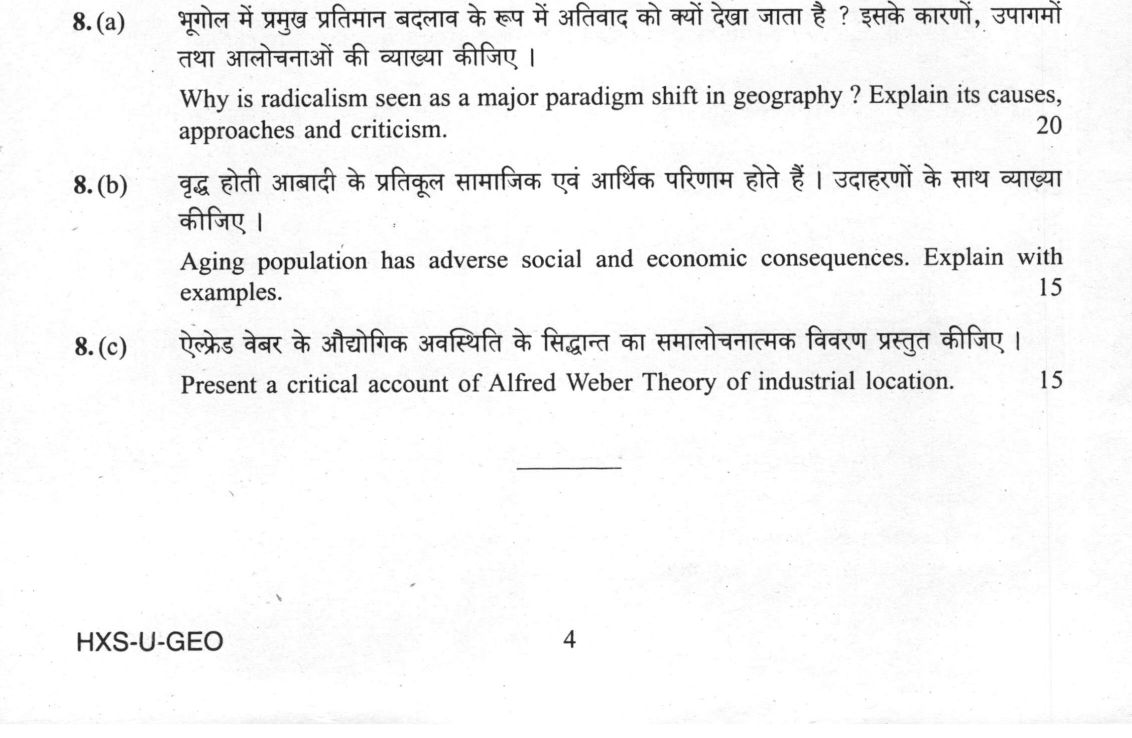
(a) Why is radicalism seen as a major paradigm shift in geography? Explain its causes, approaches and criticism. (20 marks) (b)…
Why is radicalism seen as a major paradigm shift in geography? Explain its causes, approaches and criticism. 20 marks
Aging population has adverse social and economic consequences. Explain with examples. 15 marks
Present a critical account of Alfred Weber Theory of industrial location. 15 marks
हिंदी में प्रश्न पढ़ें
भूगोल में प्रमुख प्रतिमान बदलाव के रूप में अतिवाद को क्यों देखा जाता है ? इसके कारणों, उपागमों तथा आलोचनाओं की व्याख्या कीजिए । (20 अंक)
वृद्ध होती आबादी के प्रतिकूल सामाजिक एवं आर्थिक परिणाम होते हैं । उदाहरणों के साथ व्याख्या कीजिए । (15 अंक)
ऐल्फ्रेड वेबर के औद्योगिक अवस्थिति के सिद्धांत का समालोचनात्मक विवरण प्रस्तुत कीजिए । (15 अंक)
Model answer
Written by UPSC Answer Check against this question's marking rubric, to the expected length. UPSC does not publish answers for Mains — this is one way to score well, not an official key.
Radicalism as a Paradigm Shift in Geography
Radical geography marked a profound epistemological break during the late 1960s and 1970s, transitioning the discipline from the quantitative, value-free spatial science of positivism to a normative framework rooted in Marxist political economy. While positivism treated space as an isotropic, geometric container governed by abstract universal laws, radicalism established that spatial structures are socially produced and actively reproduce the inequalities of capitalist production.
The shift was caused by acute socio-political crises—including the anti-Vietnam War movement, civil rights struggles, and urban racial conflicts in the West. Quantitative models failed to explain or resolve escalating urban poverty, ghettoization, and regional disparities, creating an intellectual crisis of relevance.
Radical geography advanced through multiple approaches. David Harvey applied Marxist political economy in Social Justice and the City, demonstrating how capital accumulation relies on a "spatial fix" that creates uneven geographical development. William Bunge pioneered "geographical expeditions," taking research directly to oppressed inner-city communities in Detroit to use spatial mapping for community advocacy. Radicalism also integrated anarchist geography, reviving Kropotkin and Reclus to promote decentralized spatial organization, and socialist-feminist geography, which exposed the spatial entrapping of women through patriarchal divisions of urban space.
However, radicalism faced criticism for economic determinism, as early Marxist models reduced complex cultural, ecological, and individual human agencies purely to class dynamics. Positivists and behavioralists also criticized its explicit political commitment, arguing it sacrificed scientific objectivity for ideological polemic.
Social and Economic Consequences of Aging Population
The demographic transition toward low fertility and extended life expectancy shifts age-sex pyramids toward an aging structure, creating structural socio-economic vulnerabilities.
Socially, rising old-age dependency ratios weaken traditional joint family safety nets, disproportionately transferring care burdens to women. Elderly isolation and psychological morbidity increase alongside intergenerational friction over resource allocation. Spatially, this triggers settlement reconfiguration: in Kerala, large-scale youth out-migration has left elderly-dominated "empty-nest" villages, altering rural community structures and service delivery.
Economically, a shrinking working-age cohort reduces labor supply, inflates wage bills, and dampens aggregate household savings, constraining domestic capital formation. Public finances face dual pressure as tax bases contract while sovereign expenditure on pensions and geriatric healthcare escalates. In response, advanced aging societies like Japan and Germany are restructuring labor policies and fostering a "silver economy" via robotics and eldercare infrastructure. In India, where demographic aging coexists with high informality, targeted interventions like the National Programme for Health Care of the Elderly (NPHCE) seek to establish decentralized geriatric infrastructure to mitigate care deficits.
Critical Account of Alfred Weber’s Theory of Industrial Location
Alfred Weber’s (1909) Least Cost Theory formulated industrial location as an optimization problem, identifying the point of minimum aggregate cost driven by three sequential factors: transport costs (calculated using the material index and locational weight in a locational triangle), labor cost differentials (deviating location via isodapanes), and agglomeration economies.
Critically, the theory rests on highly rigid, unrealistic assumptions: an isotropic surface, fixed uniform demand at a single consumption point, perfect competition, and ubiquitous labor availability at constant wages. It overlooks demand-side spatial variations (Loschian market areas), revenue maximization, and behavioral non-rationality of entrepreneurs. Furthermore, modern post-Fordist industrial systems rely on flexible specialization, just-in-time logistics, footloose components, and digital supply chains, rendering Weber's primary focus on transport costs of bulk raw materials insufficient.
Nonetheless, Weberian logic remains relevant for primary, weight-losing industries, such as the iron and steel agglomerations of India's Chota Nagpur Plateau. However, contemporary industrial location is overwhelmingly governed by global value chains (GVCs), coastal proximity for trade, and policy-driven agglomerations such as Special Economic Zones and National Industrial Corridors.
Integrating critical spatial political economy, demographic transitions, and evolving industrial geographies provides the necessary analytical framework to guide balanced regional planning and sustainable spatial development.
What "Explain" is asking you to do
Make the working of something clear — what sets it off, what follows from what, and what it produces. Explain is the Commission's mechanism word: it dominates the technical papers and the “explain why” stems, where the marks sit in the causal chain and not in the label.
Structure that answers it
State what it is → the initiating condition → the chain of cause, step by step → an instance where it plays out → what the chain produces
Where marks are lost
Describing what something looks like instead of why it works that way. Naming the stages without linking them reads as description too.
How this answer will be evaluated
Approach
Framework: UPSC Geography Paper 1 Rubric. (a) explain: definition/context > points in order > small example > short close | (b) explain: definition/context > points in order > small example > short close | (c) critique: the claim > its strengths > its weaknesses > your judgment Full marks: Comprehensive, well-structured, with diagrams and specific examples; critical analysis is sharp.
Key points expected
- Define radicalism as a paradigm shift in geography
- Explain causes (e.g., critique of positivism, Marxist influence)
- Detail approaches (e.g., political economy, social justice)
- Provide specific criticisms of the radical approach
- Define aging population and its demographic context
- Explain adverse social consequences (e.g., healthcare burden, pension strain)
- Explain adverse economic consequences (e.g., labor shortage, GDP impact)
- Provide specific examples (e.g., Japan, Germany, or India)
Evaluation rubric
Each sub-part is marked on its own, against the marks and word limit printed on the paper.
- (a) Define radicalism as a paradigm shift and detail its causes, approaches, and criticisms. 20 marks
explain— definition/context → points in order → small example → short close
Must cover
- Define radicalism as a paradigm shift in geography
- Explain causes (e.g., critique of positivism, Marxist influence)
- Detail approaches (e.g., political economy, social justice)
- Provide specific criticisms of the radical approach
Loses marks
- Confusing radicalism with general political radicalism
- Failing to link causes to specific geographical theories
- Lack of critical analysis in the criticism section
Earns more
- Mention key thinkers (e.g., David Harvey, Doreen Massey)
- Contrast with positivist or humanist paradigms
- Use a diagram illustrating the paradigm shift
Extra mark
- Reference specific radical geography journals or publications
- Cite a specific radical geographical study or case study
- (b) Explain the adverse social and economic consequences of an aging population with examples. 15 marks
explain— definition/context → points in order → small example → short close
Must cover
- Define aging population and its demographic context
- Explain adverse social consequences (e.g., healthcare burden, pension strain)
- Explain adverse economic consequences (e.g., labor shortage, GDP impact)
- Provide specific examples (e.g., Japan, Germany, or India)
Loses marks
- Generalizing without specific examples
- Failing to distinguish social from economic consequences
- Ignoring the 'adverse' aspect and discussing benefits
Earns more
- Use a diagram showing demographic transition or dependency ratio
- Link physical aging to specific economic mechanisms
- Mention specific policies or interventions
Extra mark
- Cite recent census data or specific statistics on aging
- Reference a specific government policy addressing aging
- (c) Present a critical account of Alfred Weber's Theory of industrial location. 15 marks
critique— the claim → its strengths → its weaknesses → your judgment
Must cover
- State the core claim of Weber's theory (e.g., least cost principle)
- Explain the strengths of the theory (e.g., logical framework)
- Detail the weaknesses/limitations (e.g., static nature, ignores agglomeration)
- Provide a final judgment on its applicability
Loses marks
- Describing the theory without critical analysis
- Failing to address the 'critical' aspect of the command word
- Ignoring the specific context of industrial location
Earns more
- Use a diagram of the locational triangle or isodapanes
- Mention specific factors Weber considered (e.g., weight, transport)
- Contrast with later theories (e.g., Losch, Christaller)
Extra mark
- Reference specific industrial examples where the theory applies/fails
- Mention specific critiques by later geographers
Practice this exact question
Write your answer and it is marked point by point against the model answer above — what you covered, what you missed, what you got wrong.
Evaluate my answer →More from Geography 2021 Paper I
- Q5 Answer the following in about 150 words each: (a) The interrelationships between social a…
- Q6 (a) Development-induced displacement poses serious challenges. Mention its causes, conseq…
- Q7 (a) Suggest criteria, indicators and techniques for delimitation of formal regions. (20 m…
- Q8 (a) Why is radicalism seen as a major paradigm shift in geography? Explain its causes, ap…