Paper II — Q1
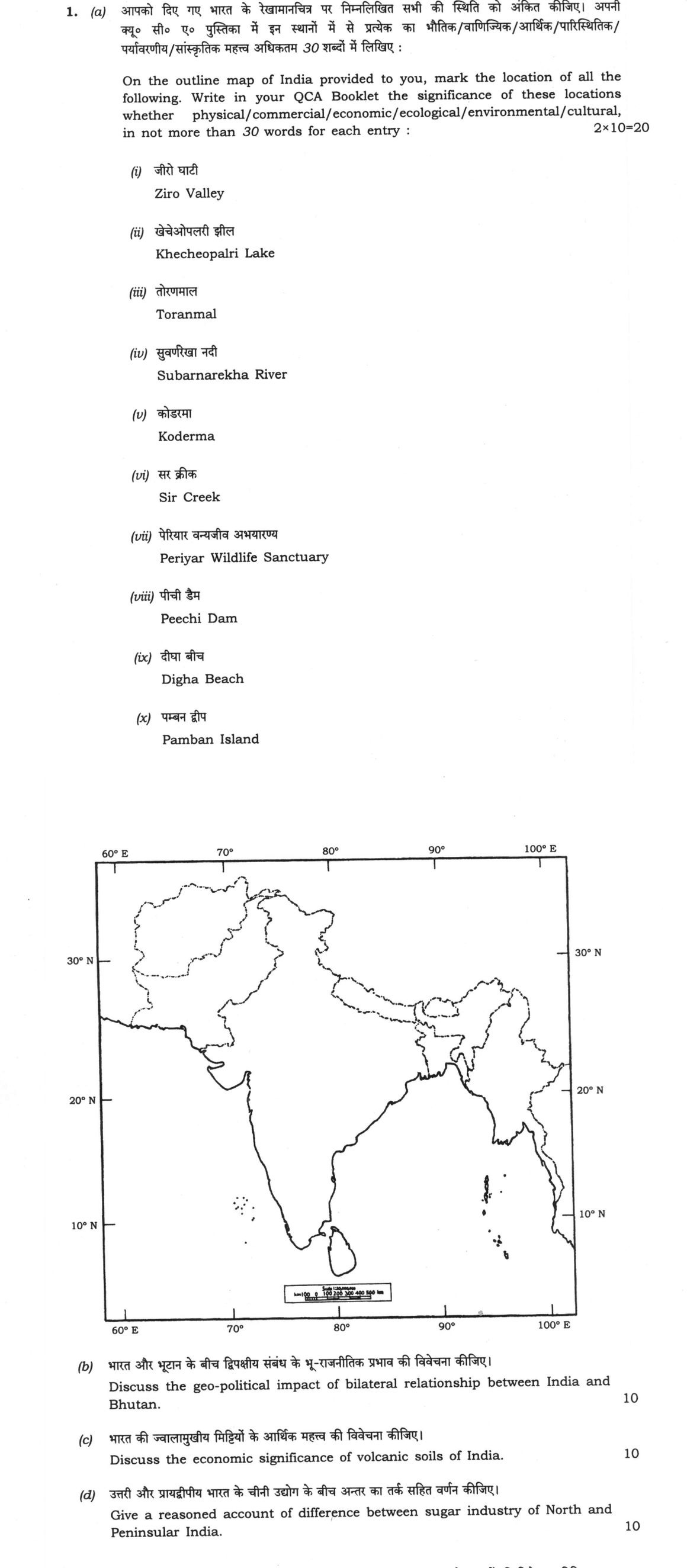
(a) On the outline map of India provided to you, mark the location of all the following. Write in your QCA Booklet the…
On the outline map of India provided to you, mark the location of all the following. Write in your QCA Booklet the significance of these locations whether physical/commercial/economic/ecological/environmental/cultural, in not more than 30 words for each entry: 2×10=20 Ziro Valley
Khecheopalri Lake
Toranmal
Subarnarekha River
Koderma
Sir Creek
Periyar Wildlife Sanctuary
Peechi Dam
Digha Beach
Pamban Island
Discuss the geo-political impact of bilateral relationship between India and Bhutan. 10 marks
Discuss the economic significance of volcanic soils of India. 10 marks
Give a reasoned account of difference between sugar industry of North and Peninsular India. 10 marks
हिंदी में प्रश्न पढ़ें
आपको दिए गए भारत के रेखामानचित्र पर निम्नलिखित सभी की स्थिति को अंकित कीजिए। अपनी क्यू० सी० ए० पुस्तिका में इन स्थानों में से प्रत्येक का भौतिक/वाणिज्यिक/आर्थिक/पारिस्थितिक/पर्यावरणीय/सांस्कृतिक महत्व अधिकतम 30 शब्दों में लिखिए : 2×10=20 ज़ीरो घाटी
खेचेओपलरी झील
तोरणमाल
सुवर्णरेखा नदी
कोडरमा
सर क्रीक
पेरियार वन्यजीव अभयारण्य
पीची डैम
दीघा बीच
पम्बन द्वीप
भारत और भूटान के बीच द्विपक्षीय संबंध के भू-राजनीतिक प्रभाव की विवेचना कीजिए। 10
भारत की ज्वालामुखीय मिट्टियों के आर्थिक महत्व की विवेचना कीजिए। 10
उत्तरी और प्रायद्वीपीय भारत के चीनी उद्योग के बीच अंतर का तर्क सहित वर्णन कीजिए। 10
The figure this question refers to, in words
The question paper is a scan and the diagram did not survive as text. This is the figure as read from the original page — every component, value and label — so the question can be worked from the text below.
(a) An outline map of India and adjacent areas enclosed in a rectangular border with coordinate ticks. Longitudes marked at top and bottom are 60° E, 70° E, 80° E, 90° E, and 100° E. Latitudes marked on the left and right borders are 10° N, 20° N, and 30° N. A graphical scale bar at the bottom center indicates 'Scale 1:15,000,000' with division markers at km 100, 0, 100, 200, 300, 400, 500 km. The map displays the external boundary of India, the outline of Sri Lanka, the Lakshadweep Islands, and the Andaman and Nicobar Islands, with an unlabelled blank interior intended for marking locations.
Model answer
Written by UPSC Answer Check against this question's marking rubric, to the expected length. UPSC does not publish answers for Mains — this is one way to score well, not an official key.
(a) Map Entries and Significance
(i) Ziro Valley: Located in Lower Subansiri district, Arunachal Pradesh. Famous for the UNESCO-shortlisted Apatani cultural landscape featuring sustainable wet-rice-cum-fish agro-ecosystems and the nationally acclaimed annual Ziro Music Festival.
(ii) Khecheopalri Lake: Sacred wish-fulfilling lake in West Sikkim. An integral constituent of the Buddhist-Hindu Demazong sacred landscape, preserving critical wetland biodiversity in the Eastern Himalayas.
(iii) Toranmal: High-altitude hill resort in Nandurbar district, Maharashtra, on the Satpura Range bordering Gujarat. It serves as a vital tribal cultural hub, hosting Gorakhnath shrine and Yashwant Lake.
(iv) Subarnarekha River: Inter-state rainfed river traversing Jharkhand, West Bengal, and Odisha. Historically known for alluvial gold deposits, it supports major heavy mineral-industrial clusters, though subject to riparian sharing contentions.
(v) Koderma: Situated on the northern fringe of Jharkhand’s Chota Nagpur Plateau. Globally renowned as the "Mica Capital of India", it historically anchor-supplied world electronics markets with high-grade ruby mica sheets.
(vi) Sir Creek: A 96-km tidal estuary in the Rann of Kutch separating Gujarat from Sindh, Pakistan. It holds intense geopolitical salience over maritime boundary delimitation, exclusive economic zone rights, and rich fisheries.
(vii) Periyar Wildlife Sanctuary: Protected area in Kerala's Western Ghats surrounding the artificial Periyar Lake. An established Project Tiger and Elephant Reserve, it anchors eco-tourism and southern montane biodiversity conservation.
(viii) Peechi Dam: Catchment reservoir constructed across the Manali River in Thrissur, Kerala. Serving as Kerala’s earliest post-independence multipurpose irrigation project, it supplies regional drinking water and feeds an adjoining wildlife sanctuary.
(ix) Digha Beach: Low-gradient, hard-packed sea resort in Purba Medinipur, West Bengal, along the Bay of Bengal. It forms the fulcrum of eastern coastal tourism, flanked by Casuarina afforestation belts.
(x) Pamban Island: Barrier island in Tamil Nadu housing Rameswaram, linked to the mainland via the historic rail and road Pamban Bridge. It commands strategic maritime position adjacent to the Sethusamudram Shipping Canal route.
(b) Geopolitical Impact of India-Bhutan Bilateral Relationship
The bilateral relationship between India and Bhutan represents a model of asymmetric yet mutually reinforcing geopolitical synergy anchored by the 1949 Treaty of Friendship, updated in 2007. Bhutan functions as a critical strategic buffer against China, safeguarding India’s narrow Siliguri Corridor (Chicken’s Neck). The 2017 Doklam standoff underscored Bhutan’s centrality under India’s security umbrella, halting unilateral shifts along contested tri-junctions.
Economically, bilateral cooperation is defined by hydropower diplomacy. Mutually developed projects such as Chukha, Kurichhu, Tala, and Mangdechhu generate clean baseload electricity for India while providing nearly 70 percent of Bhutan’s domestic revenues and export value. Beyond resource exchange, the relationship incorporates cultural diplomacy rooted in shared Mahayana Buddhist heritage and veneration of Guru Rinpoche. Furthermore, Bhutan’s unique carbon-negative developmental paradigm (Gross National Happiness) offers India a dependable environmental partner for sub-regional climate resilience via BBIN initiatives. To sustain this buffer in the face of ongoing Sino-Bhutanese border negotiations, India must balance infrastructural integration with Bhutan's sovereign economic diversification.
(c) Economic Significance of Volcanic Soils of India
India's volcanic soils, predominantly the black soils (Regur or Vertisols) derived from the weathering of the Cretaceous Deccan Trap flood basalt province, underpin the agrarian economy of central and peninsular India.
- Agricultural Specialization: High concentrations of montmorillonite clay impart distinct moisture-retention and "self-ploughing" properties (deep cracking during dry seasons). This makes the soil exceptionally suited for drought-resilient rainfed cash crops, driving India's "Black Cotton Belt" across Maharashtra, Gujarat, Madhya Pradesh, and northern Karnataka. It concurrently supports vast acreage of sugarcane, soybean, and jowar.
- Horticultural Capitalization: Controlled irrigation on these fertile, calcium- and magnesium-rich soils has fostered thriving export horticulture, particularly Nashik’s viticulture, Solapur’s pomegranates, and Nagpur’s citrus varieties.
- Structural Challenges: The dense, impermeable subsoil layer and underlying hard-rock basalt aquifers present severe groundwater recharge bottlenecks. This triggers seasonal waterlogging during the monsoons and rapid moisture depletion in dry summers, mandating investments in drip irrigation, watershed micro-management, and gypsum-based soil conditioning to sustain long-term economic returns.
(d) Comparative Analysis of Sugar Industry: North vs. Peninsular India
The spatial distribution of India’s sugar industry exhibits pronounced structural and geographical divergence between the traditional Northern belt (Uttar Pradesh, Bihar, Haryana, Punjab) and the Peninsular belt (Maharashtra, Karnataka, Tamil Nadu, Andhra Pradesh).
`` Factor North India (Subtropical) Peninsular India (Tropical) --------------------------------------------------------------------------------------------------------- Climatic Regime Subtropical: extremes of summer/winter Tropical maritime: frost-free, humid Crushing Season Short (100–120 days: Nov–Feb) Long (150–180 days: Oct–May) Sucrose Recovery Lower (9.5% – 10.5%) Higher (11% – 12.5%+) Operational Structure Cooperative/State mills; older plants Modern, high-capacity cooperative & private Inter-use Competition High diversion to Gur and Khandsari Low diversion; high factory delivery Value-Addition Limited; seasonal molasses accumulation Integrated co-gen, ethanol, and bagasse paper ``
North India's subtropical climate induces early cane drying and frost risks, truncating the crushing duration. Conversely, the Peninsular maritime climate moderates transpiration, prolongs cane vegetative growth, and optimizes sucrose accumulation.
Peninsular mills leverage higher operating efficiencies, superior capital recovery, forward integration (distilleries, bio-power), and coastal proximity for bulk exports. To address these structural imbalances, Northern mills require modernisation through high-yielding varieties (e.g., Co-0238), expanded crushing capacities, and dedicated ethanol-blending infrastructure.
What "Discuss" is asking you to do
Lay the issue out from more than one side — how it arose, what is claimed for it, what is held against it, and where it now stands. UPSC attaches discuss to broad topics with several live dimensions, so coverage of the dimensions earns more than the strength of your opinion.
Structure that answers it
Set the issue up → the case as it is made → the case against → the dimension both sides leave out → where the balance now lies
Where marks are lost
Listing facts with no thread between them, or arguing one side throughout and calling it a discussion.
How this answer will be evaluated
Approach
Framework: null. (a) discuss: Map marking > Significance statement | (b) discuss: intro > 3-4 dimensions > example > balanced close | (c) discuss: intro > 3-4 dimensions > example > balanced close | (d) explain: definition/context > points in order > small example > short close Full marks: Precise map marking; deep geopolitical/soil analysis; clear comparative reasoning.
Key points expected
- Ziro: Apatani culture
- Khecheopalri: Shiva legend
- Toranmal: Bauxite
- Subarnarekha: Floods
- Koderma: Coal
- Sir Creek: Dispute
- Periyar: Elephant
- Peechi: Irrigation
- Digha: Tourism
- Pamban: Bridge
- Bhutan: Hydro/Buffer
- Volcanic: Fertility/Coffee
- Sugar: Sorga vs Coorg
Evaluation rubric
Each sub-part is marked on its own, against the marks and word limit printed on the paper.
- (a) Mark 10 locations on map; write significance for each in QCA. 20 marks · 30 words
discuss— Map marking → Significance statement
Must cover
- Correct map location for all 10 places
- Significance categorized (physical/commercial/etc.)
- Specific to each location (not generic)
Loses marks
- Wrong map location
- Generic significance for multiple places
Earns more
- Ziro: Apatani culture/tea
- Khecheopalri: Shiva temple/legend
- Toranmal: Bauxite mining
- Subarnarekha: Floods/irrigation
Extra mark
- Koderma: Coal capital
- Pamban: Bridge/strategic
- (b) Analyze geopolitical impact of India-Bhutan bilateral relations. 10 marks · 30 words
discuss— intro → 3-4 dimensions → example → balanced close
Must cover
- Hydro-diplomacy (power exports)
- Strategic depth against China
- Border security (Sikkim/NE)
- Cultural/religious ties
Loses marks
- Ignoring China factor
- Treating as purely economic
Earns more
- 1949 Treaty of Peace
- Bhutan as buffer state
- Recent border demarcation
Extra mark
- Specific power purchase agreement
- Bhutan's 'High Value Low Volume' policy
- (c) Evaluate economic significance of volcanic soils in India. 10 marks · 30 words
discuss— intro → 3-4 dimensions → example → balanced close
Must cover
- Fertility (potash/phosphorus rich)
- Agricultural yield (coffee/tea)
- Regional distribution (Deccan/NE)
- Soil conservation value
Loses marks
- Confusing with black soil generally
- No specific crop examples
Earns more
- Deccan Traps origin
- Specific crops (coffee in Karnataka)
- Comparison with alluvial soils
Extra mark
- Specific mineral content data
- Erosion challenges in hilly areas
- (d) Reasoned account of differences in sugar industry (North vs Peninsular). 10 marks · 30 words
explain— definition/context → points in order → small example → short close
Must cover
- Cane variety (Sorga vs Coorg)
- Crushing season (winter vs summer)
- Yield per acre (North higher)
- By-products (bagasse utilization)
Loses marks
- Listing without reasoning
- Ignoring cane variety impact
Earns more
- State examples (UP vs Karnataka)
- Factory efficiency differences
- Transport/logistics factors
Extra mark
- Specific yield figures (t/acre)
- Molasses production difference
Practice this exact question
Write your answer and it is marked point by point against the model answer above — what you covered, what you missed, what you got wrong.
Evaluate my answer →More from Geography 2021 Paper II
- Q1 (a) On the outline map of India provided to you, mark the location of all the following.…
- Q2 (a) Landslide is a major problem in Himalayan region. Discuss its causes and mitigation m…
- Q3 (a) Discuss the importance of solar energy in future economic development of India. 20 (b…
- Q4 (a) Discuss the reserves, distribution and production of all varieties of coal in India.…