Paper II — Q4
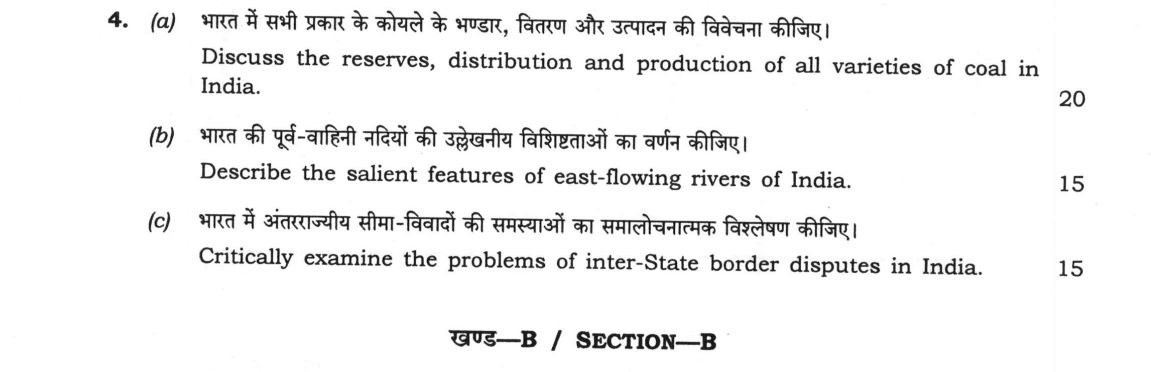
(a) Discuss the reserves, distribution and production of all varieties of coal in India. 20 (b) Describe the salient features of…
Discuss the reserves, distribution and production of all varieties of coal in India. 20 marks
Describe the salient features of east-flowing rivers of India. 15 marks
Critically examine the problems of inter-State border disputes in India. 15 marks
हिंदी में प्रश्न पढ़ें
भारत में सभी प्रकार के कोयले के भंडार, वितरण और उत्पादन की विवेचना कीजिए। 20
भारत की पूर्व-वाहिनी नदियों की उल्लेखनीय विशिष्टताओं का वर्णन कीजिए। 15
भारत में अंतरराज्यीय सीमा-विवादों की समस्याओं का समालोचनात्मक विश्लेषण कीजिए। 15
Model answer
Written by UPSC Answer Check against this question's marking rubric, to the expected length. UPSC does not publish answers for Mains — this is one way to score well, not an official key.
India’s coal geography is shaped by two major geological systems: the Gondwana basins of peninsular India and the Tertiary deposits of the northeast. Coal reserves, distribution and production. Anthracite is the highest-rank coal but its Indian reserves and production are negligible, with minor occurrences in Jammu and Kashmir. Bituminous and sub-bituminous coals form the bulk of hard-coal reserves, estimated at over 300 billion tonnes, concentrated in Gondwana basins of Jharkhand, Odisha, Chhattisgarh, West Bengal, Madhya Pradesh, Telangana and Maharashtra. Lignite, the lowest-rank coal, has substantial reserves, about 45.8 billion tonnes, roughly 11-13% of combined coal and lignite reserves, and is found in Tamil Nadu, Gujarat, Rajasthan, Karnataka, Maharashtra, West Bengal and the northeast. Tertiary coal, mostly sub-bituminous and lignite, occurs in Meghalaya, Assam, Nagaland, Manipur and Arunachal Pradesh; it is geographically significant but quantitatively small. Gondwana coal therefore supplies the overwhelming bulk of hard-coal production, while Tertiary and lignite output remain regionally important. Production follows the same pattern but with state-level shifts. Chhattisgarh, Odisha and Jharkhand lead hard-coal production, while Madhya Pradesh and Telangana/Maharashtra are also important; West Bengal remains relevant, especially for coking coal, but is not among the top five producers. Total coal and lignite production now exceeds 1,000 million tonnes, with Coal India Ltd accounting for about 80% of domestic output; captive mining by power, steel and cement units has increased private participation. Variety-wise, bituminous and sub-bituminous hard coal dominates output; lignite supplies only about 4-5% of total coal and lignite production, mostly for nearby thermal plants; tertiary coal is minor. Coking coal production is limited and quality-variable, so India remains import-dependent for metallurgical coal.
East-flowing rivers. The Godavari, Krishna, Mahanadi, Cauvery and Pennar rise mainly in the Western Ghats or Deccan and flow eastward to the Bay of Bengal. Their salient features include smaller drainage basins than the larger Himalayan river systems, strong monsoon dependence, seasonal flow with high flood peaks and low dry-season discharge, and the development of broad deltas, especially Godavari, Krishna, Mahanadi and Cauvery; Pennar has a smaller deltaic signature. Their basins are less glaciated and therefore less perennial, though upper reaches support reservoirs and hydel projects. These deltas are agriculturally vital for rice, sugarcane, cotton and horticulture. Compared with west-flowing rivers such as the Narmada, Tapi and Sabarmati, east-flowing rivers generally have larger catchments, longer courses, more alluvial plains, higher sediment loads in lower reaches, and greater hydroelectric potential in their upper reaches. West-flowing rivers are often shorter, rift-valley or steep-gradient, and less deltaic.
Inter-State border disputes. India’s border disputes often combine linguistic identity, colonial demarcation and resource or strategic interests. Resource-based causes include control over water, forests, minerals and border trade. The Belgaum/Kalaburagi dispute between Karnataka and Maharashtra centred on Kannada-speaking areas; Supreme Court intervention in 1976 largely settled the boundary, yet local grievances persist. The Kasaragod issue between Kerala and Karnataka reflects similar linguistic and administrative tensions. The Kutch-Sindh boundary, though international, shows how colonial lines and resource/strategic concerns can harden disputes. Northeastern boundary issues, including India-Myanmar and India-Bangladesh segments and internal state boundaries, involve tribal mobility, forest rights, water and land. Institutional mechanisms include the Inter-State Council under Article 263, Zonal Councils, and Supreme Court adjudication. The Inter-State Council is consultative and lacks binding force; Zonal Councils provide dialogue but depend on political will; Supreme Court decisions are authoritative but can be slow and may not resolve underlying socio-economic claims. A durable way forward requires transparent demarcation, data-based resource sharing, respect for linguistic and tribal identities, and stronger federal negotiation, so that border questions do not undermine development or national integration.
What "Discuss" is asking you to do
Lay the issue out from more than one side — how it arose, what is claimed for it, what is held against it, and where it now stands. UPSC attaches discuss to broad topics with several live dimensions, so coverage of the dimensions earns more than the strength of your opinion.
Structure that answers it
Set the issue up → the case as it is made → the case against → the dimension both sides leave out → where the balance now lies
Where marks are lost
Listing facts with no thread between them, or arguing one side throughout and calling it a discussion.
How this answer will be evaluated
Approach
Framework: Concept or mechanism > Diagram > Regional example > Application. (a) discuss: intro > 3-4 dimensions > example > balanced close | (b) describe: define > structure or process in order > labelled diagram > significance | (c) examine: intro > how/why with reasoning > evidence > conclusion Full marks: Precise data, specific examples, and clear causal links.
Key points expected
- Classify coal into lignite, sub-bituminous, bituminous, and anthracite.
- Provide specific reserve figures for major coalfields.
- Map distribution across Jharia, Raniganj, and Nagaland.
- Link production data to specific industrial regions.
- Identify major east-flowing rivers like Godavari and Krishna.
- Explain the origin from the Western Ghats.
- Describe the deltaic formation and alluvial plains.
- Note the drainage pattern and basin characteristics.
Evaluation rubric
Each sub-part is marked on its own, against the marks and word limit printed on the paper.
- (a) Reserves, distribution, and production of all coal varieties in India. 20 marks
discuss— intro → 3-4 dimensions → example → balanced close
Must cover
- Classify coal into lignite, sub-bituminous, bituminous, and anthracite.
- Provide specific reserve figures for major coalfields.
- Map distribution across Jharia, Raniganj, and Nagaland.
- Link production data to specific industrial regions.
Loses marks
- Listing varieties without specific reserve data.
- General description without regional distribution.
- Ignoring the distinction between coal types.
Earns more
- Mention specific coalfield names like Jharia or Raniganj.
- Include recent production statistics or trends.
- Discuss the role of Coal India Limited.
- Note the geographical spread of lignite deposits.
Extra mark
- Labelled sketch map of major coalfields.
- Reference to specific geological formations.
- (b) Salient features of east-flowing rivers of India. 15 marks
describe— define → structure or process in order → labelled diagram → significance
Must cover
- Identify major east-flowing rivers like Godavari and Krishna.
- Explain the origin from the Western Ghats.
- Describe the deltaic formation and alluvial plains.
- Note the drainage pattern and basin characteristics.
Loses marks
- Confusing east-flowing with west-flowing rivers.
- Failing to mention the Western Ghats origin.
- Lack of specific river names or locations.
Earns more
- Mention specific tributaries of major rivers.
- Discuss the impact on coastal geography.
- Note the seasonal variation in flow.
- Reference specific delta regions like Godavari Delta.
Extra mark
- Labelled diagram of an east-flowing river basin.
- Mention specific hydrological data or discharge rates.
- (c) Problems of inter-State border disputes in India. 15 marks
examine— intro → how/why with reasoning → evidence → conclusion
Must cover
- Identify specific border disputes like Siliguri Corridor.
- Explain the causes: historical, geographical, or political.
- Discuss the impact on regional development and security.
- Mention the role of the Inter-State Council.
Loses marks
- General discussion without specific examples.
- Ignoring the legal or constitutional framework.
- Failing to link disputes to broader political issues.
Earns more
- Reference specific cases like Kashmir or Punjab.
- Discuss the legal framework for dispute resolution.
- Note the role of the Supreme Court in disputes.
- Mention the impact on local populations.
Extra mark
- Reference to specific Supreme Court judgments.
- Mention specific constitutional articles on inter-state issues.
Practice this exact question
Write your answer and it is marked point by point against the model answer above — what you covered, what you missed, what you got wrong.
Evaluate my answer →More from Geography 2021 Paper II
- Q1 (a) On the outline map of India provided to you, mark the location of all the following.…
- Q2 (a) Landslide is a major problem in Himalayan region. Discuss its causes and mitigation m…
- Q3 (a) Discuss the importance of solar energy in future economic development of India. 20 (b…
- Q4 (a) Discuss the reserves, distribution and production of all varieties of coal in India.…
- Q5 Answer the following questions in about 150 words each: 10×5=50 (a) Discuss the salient f…
- Q6 (a) Explain the impact of tropical cyclones and western disturbances on the climate of In…
- Q7 (a) Critically examine how Panchayati Raj system is catalyst in decentralized planning in…