Paper II — Q8
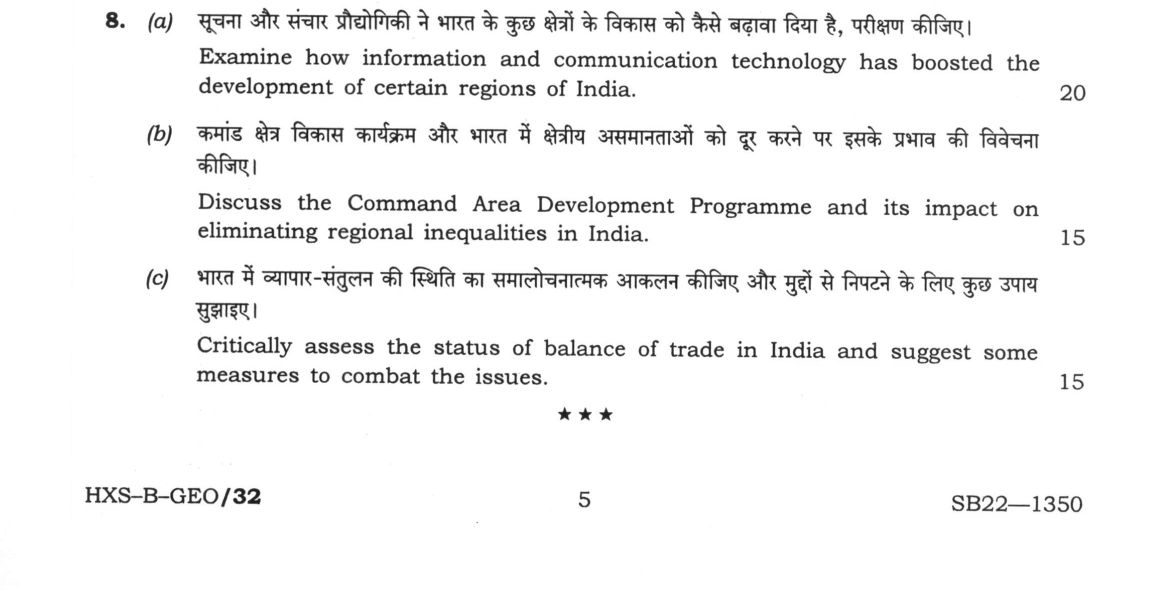
(a) Examine how information and communication technology has boosted the development of certain regions of India. 20 (b) Discuss…
Examine how information and communication technology has boosted the development of certain regions of India. 20 marks
Discuss the Command Area Development Programme and its impact on eliminating regional inequalities in India. 15 marks
Critically assess the status of balance of trade in India and suggest some measures to combat the issues. 15 marks
हिंदी में प्रश्न पढ़ें
सूचना और संचार प्रौद्योगिकी ने भारत के कुछ क्षेत्रों के विकास को कैसे बढ़ावा दिया है, परीक्षण कीजिए। 20
कमांड क्षेत्र विकास कार्यक्रम और भारत में क्षेत्रीय असमानताओं को दूर करने पर इसके प्रभाव की विवेचना कीजिए। 15
भारत में व्यापार-संतुलन की स्थिति का समालोचनात्मक आकलन कीजिए और मुद्दों से निपटने के लिए कुछ उपाय सुझाइए। 15
Model answer
Written by UPSC Answer Check against this question's marking rubric, to the expected length. UPSC does not publish answers for Mains — this is one way to score well, not an official key.
Regional development trajectories in India reflect a dynamic interplay of technological adoption, natural resource management, and external trade integration.
ICT-Led Regional Development and Spatial Divergence
Information and Communication Technology (ICT) has fundamentally reshaped India’s economic geography by reducing spatial friction. Growth initially manifested as dense agglomerations in primary techno-poles like Bengaluru, Hyderabad, and Pune, supported by Software Technology Parks of India (STPI) and Special Economic Zones (SEZs). This concentration generated large-scale white-collar employment and disproportionately elevated the service sector contribution to Gross State Domestic Product (GSDP) in southern and western states.
Subsequently, investments under the Digital India mission facilitated the emergence of Tier-2 and Tier-3 hubs like Kochi, Indore, and Bhubaneswar. Notably, Kerala’s Technopark model demonstrated decentralized ICT expansion, enabling reverse migration of skilled labor into non-metropolitan tracts. However, an examination of this growth reveals an entrenched digital divide. ICT benefits remain largely confined to metropolitan and select urban corridors, while rural and peripheral regions suffer from connectivity gaps and poor digital infrastructure, exacerbating inter-regional socio-economic disparities.
CADP and Regional Inequalities
The Command Area Development Programme (CADP), launched in 1974-75 and later restructured under the Pradhan Mantri Krishi Sinchayee Yojana (PMKSY-CADWM), was institutionalized through Command Area Development Authorities (CADAs) to optimize water use efficiency and enhance agricultural productivity by bridging the gap between potential created and utilized. By integrating on-farm development works with participatory irrigation and watershed management, it sought equitable land-water governance.
In practice, CADP’s impact on regional equity has been uneven. It reinforced the prosperity of the Green Revolution core in Punjab, Haryana, and Western Uttar Pradesh, while eastern and peninsular rainfed regions derived limited gains due to institutional inertia and institutional fragmentation, thereby widening regional agricultural divides. Within command areas, tail-end farmers face severe water deprivation compared to head-reach cultivators. Furthermore, intensive canal irrigation without adequate drainage has caused ecological degradation, notably widespread waterlogging and soil salinization in the Indira Gandhi Canal (IGNP) command in Rajasthan.
Balance of Trade: Status and Strategic Measures
Since the 1991 economic reforms, India’s external sector has been characterized by a persistent merchandise trade deficit, sustained largely by an expanding services trade surplus (primarily software and ITES) and secondary income transfers. The trade composition remains asymmetrical: imports are heavily dominated by crude petroleum, electronic components, gold, and gems and jewellery, whereas merchandise exports are concentrated in refined petroleum products, pharmaceuticals, engineering goods, and textiles.
Structurally, this deficit is driven by the high import intensity of domestic manufacturing, scale disadvantages and technological obsolescence in the MSME sector, and elevated logistics costs. To correct this imbalance, policy must emphasize:
Targeted import substitution and domestic value addition via the Production Linked Incentive (PLI) schemes in critical sectors like semiconductors, solar photovoltaics, and active pharmaceutical ingredients.
Upgrading export infrastructure and multi-modal logistics networks through PM Gati Shakti to reduce high transaction costs.
Negotiating modern, balanced bilateral Free Trade Agreements (FTAs) to secure diversified market access for labor-intensive exports, alongside targeted technological support to enhance MSME competitiveness.
Conclusion
Balanced regional development requires resolving these spatial and structural imbalances. Bridging the rural-urban digital divide, adopting participatory tail-to-head water management in irrigation commands, and strengthening export-oriented manufacturing are vital to fostering equitable growth across India's geographical landscape.
What "Examine" is asking you to do
Test the proposition the question puts to you and return a finding on how far it holds. Examine stems carry a claim, or ask whether something has happened, and expect evidence weighed both ways before the extent is stated — often with remedial measures attached.
Structure that answers it
Restate the claim as the question frames it → evidence that supports it → evidence that undercuts it → the conditions under which it holds → verdict on how far it stands
Where marks are lost
Stopping at description. An examination has to reach a finding, and “examine with justification” means the extent must be stated, not implied.
How this answer will be evaluated
Approach
Framework: Concept or mechanism > Diagram > Regional example > Application. (a) examine: intro > how/why with reasoning > evidence > conclusion | (b) discuss: intro > 3-4 dimensions > example > balanced close | (c) critically evaluate: positives > negatives/limits > conditions/safeguards > conclusion Full marks: Comprehensive, well-structured answers with specific examples, diagrams, and critical analysis.
Key points expected
- Identify specific regions (e.g., IT corridors, e-governance hubs)
- Explain the mechanism of ICT-driven development
- Provide evidence of regional transformation
- Link technology to socio-economic outcomes
- Define Command Area Development Programme
- Explain its objectives and implementation
- Assess impact on regional inequalities
- Provide balanced evaluation
Evaluation rubric
Each sub-part is marked on its own, against the marks and word limit printed on the paper.
- (a) Examine how ICT has boosted development in specific Indian regions. 20 marks
examine— intro → how/why with reasoning → evidence → conclusion
Must cover
- Identify specific regions (e.g., IT corridors, e-governance hubs)
- Explain the mechanism of ICT-driven development
- Provide evidence of regional transformation
- Link technology to socio-economic outcomes
Loses marks
- Generic discussion without regional focus
- No mechanism explained
- Lack of specific examples
Earns more
- Mention specific technologies (e.g., 4G/5G, e-governance)
- Reference specific initiatives (e.g., Digital India)
- Include regional examples (e.g., Bangalore, Pune)
- Discuss both positive and negative impacts
Extra mark
- Include a diagram showing ICT infrastructure
- Cite specific statistics on regional development
- (b) Discuss Command Area Development Programme and its impact on regional inequalities. 15 marks
discuss— intro → 3-4 dimensions → example → balanced close
Must cover
- Define Command Area Development Programme
- Explain its objectives and implementation
- Assess impact on regional inequalities
- Provide balanced evaluation
Loses marks
- No definition of the programme
- Lack of regional focus
- No balanced evaluation
Earns more
- Mention specific regions benefited
- Reference specific crops or irrigation projects
- Discuss both successes and limitations
- Link to broader agricultural development
Extra mark
- Include a map showing command areas
- Cite specific data on regional disparities
- (c) Critically assess India's balance of trade and suggest measures to combat issues. 15 marks
critically evaluate— positives → negatives/limits → conditions/safeguards → conclusion
Must cover
- Define balance of trade
- Assess current status with evidence
- Identify key issues/challenges
- Suggest specific measures
Loses marks
- No critical assessment
- Lack of specific measures
- No evidence or data
Earns more
- Reference specific trade data
- Mention specific sectors (e.g., IT, agriculture)
- Discuss both imports and exports
- Link to broader economic policy
Extra mark
- Include a graph showing trade trends
- Cite specific policy recommendations
Practice this exact question
Write your answer and it is marked point by point against the model answer above — what you covered, what you missed, what you got wrong.
Evaluate my answer →More from Geography 2021 Paper II
- Q5 Answer the following questions in about 150 words each: 10×5=50 (a) Discuss the salient f…
- Q6 (a) Explain the impact of tropical cyclones and western disturbances on the climate of In…
- Q7 (a) Critically examine how Panchayati Raj system is catalyst in decentralized planning in…
- Q8 (a) Examine how information and communication technology has boosted the development of c…