Paper II — Q7
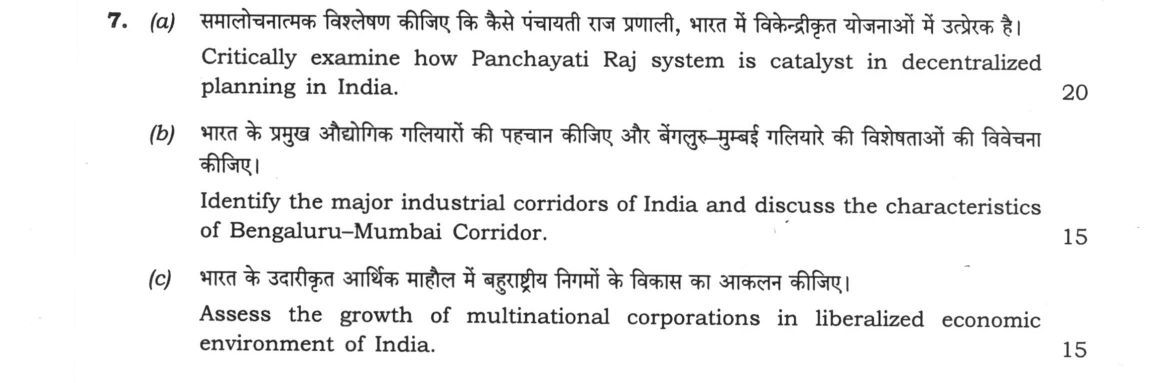
(a) Critically examine how Panchayati Raj system is catalyst in decentralized planning in India. 20 (b) Identify the major…
Critically examine how Panchayati Raj system is catalyst in decentralized planning in India. 20 marks
Identify the major industrial corridors of India and discuss the characteristics of Bengaluru-Mumbai Corridor. 15 marks
Assess the growth of multinational corporations in liberalized economic environment of India. 15 marks
हिंदी में प्रश्न पढ़ें
समालोचनात्मक विश्लेषण कीजिए कि कैसे पंचायती राज प्रणाली, भारत में विकेन्द्रीकृत योजनाओं में उत्प्रेरक है। 20
भारत के प्रमुख औद्योगिक गलियारों की पहचान कीजिए और बेंगलुरु-मुंबई गलियारे की विशेषताओं की विवेचना कीजिए। 15
भारत के उदारीकृत आर्थिक माहौल में बहुराष्ट्रीय निगमों के विकास का आकलन कीजिए। 15
Model answer
Written by UPSC Answer Check against this question's marking rubric, to the expected length. UPSC does not publish answers for Mains — this is one way to score well, not an official key.
Panchayati Raj and decentralized planning The Panchayati Raj system became a constitutional catalyst for decentralized planning after the 73rd Amendment (1992), which made Gram Sabha, panchayats and District Planning Committees integral to local planning. Article 243G assigns panchayats functions in the Eleventh Schedule, while Article 243ZD creates District Planning Committees to consolidate plans of panchayats and municipalities. PESA (1996) extends self-governance to Scheduled Areas, allowing Gram Sabhas to plan and control local resources. In Scheduled Areas, this gives Gram Sabhas a stronger role over natural resources and local plans, though implementation is often constrained by state bureaucracy. In practice, PRIs have enabled bottom-up identification of water, roads, sanitation and livelihood needs, and DPCs have attempted to aggregate village plans into district plans. Yet the catalyst effect is uneven. Vertical fiscal imbalance leaves PRIs dependent on state grants and transfers, while horizontal imbalance means resource-rich and weak states produce different planning capacities. Many panchayats lack technical staff for project formulation, monitoring and MIS, and political interference often distorts priorities toward visible works or patronage. Thus PRIs are a necessary institutional base for decentralized planning, but not an automatic catalyst unless fiscal devolution, technical support and accountability are strengthened.
Industrial corridors and BMEC India’s industrial corridor strategy, under NICDP, now covers 11 corridors; the major ones include the Delhi-Mumbai Industrial Corridor, Chennai-Bangalore Industrial Corridor, Bengaluru-Mumbai Economic Corridor, Amritsar-Kolkata Industrial Corridor and Vizag-Chennai Industrial Corridor. BMEC is the western knowledge-economy spine linking Mumbai, the terminal financial and port metropolis, with Bengaluru, the IT and biotech hub, while Pune functions as an intermediate knowledge and engineering node. Its characteristic is not merely manufacturing but a dense IT/ITES and biotech economy, integrated with startup ecosystems, research parks and service clusters. Mumbai provides finance, ports and global connectivity; Bengaluru supplies software, biotech and venture capital; Pune adds engineering, education and manufacturing. Connectivity is strengthened by NH-48, airports, logistics nodes and proposed high-speed rail, making it a corridor of high-value services, innovation and urban agglomeration rather than a single industrial belt. Its impact, however, depends on land, power, water, skilled labour and the ability to connect industrial nodes with hinterland markets.
MNCs after liberalisation Post-1991 liberalisation transformed MNC growth through FDI inflows, which rose from a few hundred million dollars in the early 1990s to over $80 billion in 2022-23. Sectorally, MNC presence shifted from traditional manufacturing to services, especially IT/ITES, financial services, telecom and professional services, while retaining manufacturing in auto, pharma and electronics. Spatially, MNCs cluster in metropolitan corridors with skilled labour, connectivity and markets: NCR in northern India, and the western and southern corridors around Mumbai-Pune-Bengaluru and Chennai. This concentration has generated jobs and technology transfer, but it has also widened regional disparities, with eastern and northeastern states receiving comparatively limited MNC investment. Policy responses such as SEZs and Make in India aim to broaden the spatial base, improve manufacturing linkages and reduce dependence on a few metros. MNC growth is also uneven within metros, with headquarters and R&D concentrated in global cities and lower-value operations in peripheral industrial estates.
Conclusion Taken together, PRIs, industrial corridors and MNCs show that India’s spatial development is institutionally decentralized but economically concentrated. Panchayati Raj can catalyze planning only with fiscal and technical empowerment; corridors can generate growth only if they connect hinterlands; and MNC growth must be steered toward balanced regional participation. The verdict is that these mechanisms are promising but conditional: inclusive development requires stronger local institutions, corridor-based linkages and deliberate regional policy. Without such balance, corridors and MNCs may deepen existing regional inequalities.
What "Critically examine" is asking you to do
Test the proposition the question puts to you and return a finding on how far it holds. Examine stems carry a claim, or ask whether something has happened, and expect evidence weighed both ways before the extent is stated — often with remedial measures attached. “Critically” is not a section added at the end: name the yardstick you are judging by — the evidence, the stated objective, a constitutional principle, a rival explanation — and let a verdict close each part of the body. Where the question quotes a claim, that verdict must land on the claim itself, accepted, qualified or rejected, and not on the theme in general.
Structure that answers it
Restate the claim as the question frames it → evidence that supports it → evidence that undercuts it → the conditions under which it holds → verdict on how far it stands
Where marks are lost
Merits in one paragraph, demerits in the next, and a conclusion calling for a balanced and holistic approach. That is a survey with the judgement left out and it holds the answer in the middle band. The opposite error is reading “critically” as permission to attack — and with the odd pairings, critically describe or critically explain, the exposition still carries most of the marks, the judgement being a layer on it rather than a substitute for it.
How this answer will be evaluated
Approach
Framework: Concept or mechanism > Diagram > Regional example > Application. (a) examine: intro > how/why with reasoning > evidence > conclusion | (b) discuss: intro > 3-4 dimensions > example > balanced close | (c) evaluate: criteria > evidence > balanced judgment Full marks: Comprehensive, well-structured, with diagrams and specific examples.
Key points expected
- Define Panchayati Raj and decentralized planning
- Explain the 73rd/74th Amendment mechanism
- Link local planning to national development
- Provide evidence of success or failure
- Identify major industrial corridors of India
- Locate Bengaluru-Mumbai Corridor
- Discuss its specific characteristics
- Link physical geography to industrial growth
Evaluation rubric
Each sub-part is marked on its own, against the marks and word limit printed on the paper.
- (a) Critical analysis of Panchayati Raj as a catalyst for decentralized planning. 20 marks
examine— intro → how/why with reasoning → evidence → conclusion
Must cover
- Define Panchayati Raj and decentralized planning
- Explain the 73rd/74th Amendment mechanism
- Link local planning to national development
- Provide evidence of success or failure
Loses marks
- Description without critical analysis
- Ignoring the 'catalyst' aspect
- No mention of constitutional basis
Earns more
- Mention 11th/12th Five Year Plan
- Reference NITI Aayog's role
- Discuss Gram Sabha's role
- Mention specific state examples
Extra mark
- Labelled sketch of Panchayati Raj hierarchy
- Cite specific budget allocation data
- (b) Identification of major industrial corridors and characteristics of Bengaluru-Mumbai Corridor. 15 marks
discuss— intro → 3-4 dimensions → example → balanced close
Must cover
- Identify major industrial corridors of India
- Locate Bengaluru-Mumbai Corridor
- Discuss its specific characteristics
- Link physical geography to industrial growth
Loses marks
- Failing to identify other corridors
- Vague description of characteristics
- No map or spatial reference
Earns more
- Mention other corridors (e.g., Delhi-Mumbai)
- Reference specific industries in the corridor
- Discuss infrastructure development
- Mention IT/Pharma hubs
Extra mark
- Labelled map of industrial corridors
- Cite specific industrial park names
- (c) Assessment of MNC growth in India's liberalized economic environment. 15 marks
evaluate— criteria → evidence → balanced judgment
Must cover
- Define liberalized economic environment
- Explain the growth of MNCs
- Link liberalization policies to MNC growth
- Provide evidence of economic impact
Loses marks
- Ignoring the 'liberalized' context
- No link between policy and growth
- Vague assessment without evidence
Earns more
- Mention 1991 LPG reforms
- Reference specific sectors (IT, Auto)
- Discuss FDI inflows
- Mention specific MNC examples
Extra mark
- Graph of FDI inflows over time
- Cite specific policy changes
Practice this exact question
Write your answer and it is marked point by point against the model answer above — what you covered, what you missed, what you got wrong.
Evaluate my answer →More from Geography 2021 Paper II
- Q4 (a) Discuss the reserves, distribution and production of all varieties of coal in India.…
- Q5 Answer the following questions in about 150 words each: 10×5=50 (a) Discuss the salient f…
- Q6 (a) Explain the impact of tropical cyclones and western disturbances on the climate of In…
- Q7 (a) Critically examine how Panchayati Raj system is catalyst in decentralized planning in…
- Q8 (a) Examine how information and communication technology has boosted the development of c…