Paper II — Q5
Answer the following questions in about 150 words each: 10×5=50 (a) Discuss the salient features of Project Tiger in India. (b)…
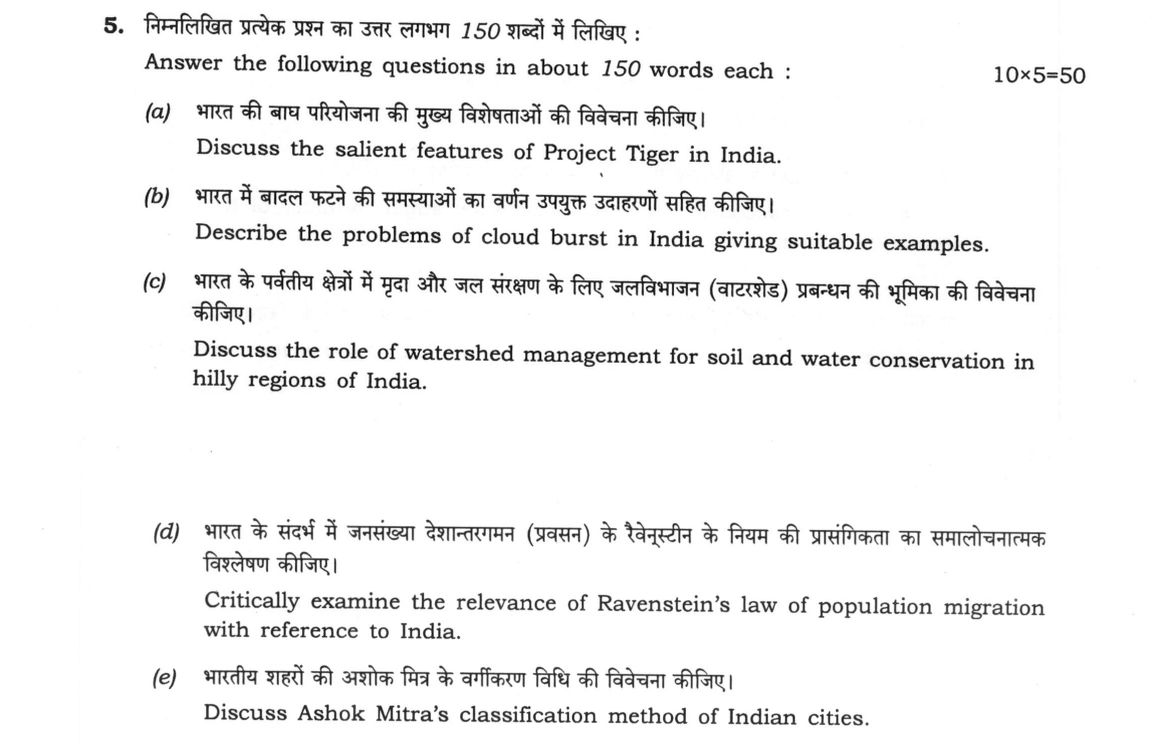
Answer the following questions in about 150 words each: 10×5=50
Discuss the salient features of Project Tiger in India.
Describe the problems of cloud burst in India giving suitable examples.
Discuss the role of watershed management for soil and water conservation in hilly regions of India.
Critically examine the relevance of Ravenstein's law of population migration with reference to India.
Discuss Ashok Mitra's classification method of Indian cities.
हिंदी में प्रश्न पढ़ें
निम्नलिखित प्रत्येक प्रश्न का उत्तर लगभग 150 शब्दों में लिखिए : 10×5=50
भारत की बाघ परियोजना की मुख्य विशेषताओं की विवेचना कीजिए।
भारत में बादल फटने की समस्याओं का वर्णन उपयुक्त उदाहरणों सहित कीजिए।
भारत के पर्वतीय क्षेत्रों में मृदा और जल संरक्षण के लिए जलविभाजन (वाटरशेड) प्रबंधन की भूमिका की विवेचना कीजिए।
भारत के संदर्भ में जनसंख्या देशांतरण (प्रवसन) के रेवेनस्टीन के नियम की प्रासंगिकता का समालोचनात्मक विश्लेषण कीजिए।
भारतीय शहरों की अशोक मित्र के वर्गीकरण विधि की विवेचना कीजिए।
Model answer
Written by UPSC Answer Check against this question's marking rubric, to the 150-word length. UPSC does not publish answers for Mains — this is one way to score well, not an official key.
(a) Project Tiger Project Tiger, launched in 1973 after the Wildlife Protection Act, is India’s flagship in-situ tiger conservation programme. Its salient feature is the core–buffer strategy: core areas are strictly protected for tigers, while buffer zones accommodate human activity under regulation, reducing encroachment and poaching. Initially nine reserves, it now covers more than 54 tiger reserves, including Corbett and Sundarbans. The National Tiger Conservation Authority, established in 2006, upgraded it from a project to a statutory body, strengthening planning, funding and monitoring. Community participation is institutionalised through Eco Development Committees, which channel benefits to villages around reserves. Successes are visible in population recovery, with Sathyamangalam and Manas showing strong rebound. Yet challenges remain: corridor fragmentation, habitat loss, human–wildlife conflict and the need for landscape-level governance. Thus Project Tiger has been effective in species recovery but must now secure connectivity and coexistence.
(b) Cloud Burst A cloud burst is an extreme, short-duration rainfall event, often triggered by orographic lifting when moist air is forced upward over the Himalayas or Western Ghats. In India, it is most hazardous in narrow valleys, steep slopes and fast-draining catchments, where rainfall exceeds the land’s absorption capacity. The 2013 Kedarnath disaster, where cloudburst-like rainfall triggered flash floods and landslides, killed thousands and destroyed roads, bridges and pilgrimage infrastructure. Leh in 2010 showed urban vulnerability, with sudden inundation damaging buildings and transport. Mumbai in 2005, though partly urban drainage failure, illustrated how intense rainfall overwhelms cities. Such events damage hydropower projects, silt reservoirs, disrupt rail and road networks, and endanger downstream communities. Early warning remains limited because cloudbursts develop rapidly, local gauges are sparse, and forecast lead time is short. Hence the problem is not only meteorological but also one of land-use and infrastructure planning.
(c) Watershed Management Watershed management in hilly regions treats the catchment as an integrated unit, combining soil, water and vegetation conservation. In the Himalayas, spring-shed development protects recharge zones, while contour bunding, terracing, check dams and afforestation slow runoff, reduce erosion and recharge groundwater. Such measures also reduce siltation of reservoirs and protect downstream agriculture. The Sukhomajri watershed in Himachal Pradesh showed how community participation, check dams and afforestation can raise water availability. Alwar district in Rajasthan showed that participatory watershed planning can restore degraded land and improve livelihoods. These techniques are integrated with MGNREGA, which provides wage employment for check dams, farm ponds and bunds, while supporting climate adaptation by reducing flood and drought risks. Its key advantage is addressing the source of erosion rather than only downstream damage. Its limitation is scale, requiring sustained institutional support and maintenance. Thus it is a practical, ecologically sound strategy for soil and water conservation.
(d) Ravenstein’s Law Ravenstein’s law, derived from 19th-century European migration, emphasises counter-streams, short-distance movement, distance decay and step-migration. In India, these ideas retain partial relevance. Distance decay is visible in the dominance of intra-state and neighbouring-state movement; step-migration is common as people move from villages to towns, then to district centres or cities; counter-streams appear as return and reverse flows from cities to villages. Rural–urban migration and male-dominated labour streams, such as Bihar–Punjab and Kerala–Gulf, support the classical emphasis on economic, short-to-medium distance movement. Yet Indian migration deviates significantly. The feminisation of migration is evident: Census 2011 records a high female share of internal migrants, while marriage explains about 50% of all internal migrants and about 66% of female migrants. Circular migration, marriage migration, and long-distance IT-sector moves to Bangalore, Hyderabad and Pune also challenge the model. Thus Ravenstein’s law is a useful heuristic for distance and staged movement, but it is incomplete for India’s gendered, circular and skill-driven migration.
(e) Ashok Mitra Ashok Mitra’s classification of Indian cities, based on the 1961 Census, is a functional hierarchy based on employment structure, rather than a size-based scheme. It is distinct from Census size classes I–VI. It distinguishes four functional types: highly specialized, specialized, diversified and non-specialized cities. Highly specialized cities are dominated by one function; specialized cities have a dominant function with secondary activities; diversified cities have balanced employment; non-specialized cities are small towns with limited range. This approach explains urban primacy and regional roles: Mumbai, Delhi and Kolkata function as major national nodes, while smaller cities serve local markets. It helps urban policy and regional planning by identifying economic bases, not merely population size. However, functional data change rapidly with industrialisation, services and IT growth, and a 1961 snapshot may understate later transformations. Thus Mitra’s classification remains conceptually important for Indian urban hierarchy, but must be updated with current employment data.
What "Critically examine" is asking you to do
Test the proposition the question puts to you and return a finding on how far it holds. Examine stems carry a claim, or ask whether something has happened, and expect evidence weighed both ways before the extent is stated — often with remedial measures attached. “Critically” is not a section added at the end: name the yardstick you are judging by — the evidence, the stated objective, a constitutional principle, a rival explanation — and let a verdict close each part of the body. Where the question quotes a claim, that verdict must land on the claim itself, accepted, qualified or rejected, and not on the theme in general.
Structure that answers it
Restate the claim as the question frames it → evidence that supports it → evidence that undercuts it → the conditions under which it holds → verdict on how far it stands
Where marks are lost
Merits in one paragraph, demerits in the next, and a conclusion calling for a balanced and holistic approach. That is a survey with the judgement left out and it holds the answer in the middle band. The opposite error is reading “critically” as permission to attack — and with the odd pairings, critically describe or critically explain, the exposition still carries most of the marks, the judgement being a layer on it rather than a substitute for it.
How this answer will be evaluated
Approach
Framework: Concept or mechanism > Diagram > Regional example > Application. (a) discuss: intro > 3-4 dimensions > example > balanced close | (b) describe: define > structure or process in order > labelled diagram > significance | (c) discuss: intro > 3-4 dimensions > example > balanced close | (d) examine: intro > how/why with reasoning > evidence > conclusion | (e) discuss: intro > 3-4 dimensions > example > balanced close Full marks: Precise, well-structured, with diagrams and specific examples
Key points expected
- Mention 1973 launch and Wildlife Protection Act
- Explain in-situ conservation and habitat protection
- Note 50% forest cover requirement for reserves
- Mention community involvement and anti-poaching measures
- Define cloud burst (intense rainfall in short time)
- Explain the mechanism (updrafts, orographic lift)
- Provide specific Indian examples (e.g., Uttarakhand, Mumbai)
- Mention the consequences (flooding, landslides)
Evaluation rubric
Each sub-part is marked on its own, against the marks and word limit printed on the paper.
- (a) Intro > 3-4 dimensions > example > balanced close · 150 words
discuss— intro → 3-4 dimensions → example → balanced close
Must cover
- Mention 1973 launch and Wildlife Protection Act
- Explain in-situ conservation and habitat protection
- Note 50% forest cover requirement for reserves
- Mention community involvement and anti-poaching measures
Loses marks
- General conservation talk without specific Project Tiger features
- Ignoring the legal framework (WPA 1972)
Earns more
- Reference to Project Tiger Stripes (PTS) monitoring
- Mention of specific tiger reserves (e.g., Corbett, Ranthambore)
- Discussion of human-wildlife conflict mitigation
Extra mark
- Labelled map of a specific tiger reserve
- Recent tiger census data (e.g., 2022 count)
- (b) Define > structure or process in order > labelled diagram > significance · 150 words
describe— define → structure or process in order → labelled diagram → significance
Must cover
- Define cloud burst (intense rainfall in short time)
- Explain the mechanism (updrafts, orographic lift)
- Provide specific Indian examples (e.g., Uttarakhand, Mumbai)
- Mention the consequences (flooding, landslides)
Loses marks
- Confusing cloud burst with general monsoon rainfall
- Lack of specific Indian examples
Earns more
- Reference to specific meteorological conditions
- Mention of climate change as a contributing factor
- Discussion of early warning systems
Extra mark
- Diagram showing the cloud burst mechanism
- Specific rainfall data from a recent event
- (c) Intro > 3-4 dimensions > example > balanced close · 150 words
discuss— intro → 3-4 dimensions → example → balanced close
Must cover
- Define watershed management
- Explain soil conservation techniques (terracing, check dams)
- Explain water conservation techniques (percolation tanks, rainwater harvesting)
- Mention the role in hilly regions (erosion control, groundwater recharge)
Loses marks
- General discussion of water conservation without specific watershed techniques
- Ignoring the specific context of hilly regions
Earns more
- Reference to specific Indian programs (e.g., Drought Prone Area Programme)
- Mention of community participation
- Discussion of economic benefits
Extra mark
- Diagram of a watershed management structure
- Specific example of a successful watershed project
- (d) Intro > how/why with reasoning > evidence > conclusion · 150 words
examine— intro → how/why with reasoning → evidence → conclusion
Must cover
- State Ravenstein's laws (e.g., most migrants move short distances)
- Apply laws to Indian migration patterns (rural-urban, inter-state)
- Provide evidence from Indian census data
- Critically evaluate the relevance (limitations in modern context)
Loses marks
- Stating laws without application to India
- Lack of critical evaluation (just describing the laws)
Earns more
- Mention of specific Indian migration corridors
- Discussion of economic factors driving migration
- Reference to recent migration studies
Extra mark
- Graph showing migration distances in India
- Specific census data on migration
- (e) Intro > 3-4 dimensions > example > balanced close · 150 words
discuss— intro → 3-4 dimensions → example → balanced close
Must cover
- Mention Ashok Mitra's classification method
- Explain the criteria used (e.g., population, economic activity)
- Describe the categories (e.g., metropolises, large cities)
- Mention the significance of the classification
Loses marks
- General discussion of city classification without specific reference to Mitra
- Lack of detail on the criteria used
Earns more
- Reference to specific cities in each category
- Discussion of the limitations of the method
- Comparison with other classification methods
Extra mark
- Table showing Mitra's classification categories
- Specific examples of cities in each category
Practice this exact question
Write your answer and it is marked point by point against the model answer above — what you covered, what you missed, what you got wrong.
Evaluate my answer →More from Geography 2021 Paper II
- Q2 (a) Landslide is a major problem in Himalayan region. Discuss its causes and mitigation m…
- Q3 (a) Discuss the importance of solar energy in future economic development of India. 20 (b…
- Q4 (a) Discuss the reserves, distribution and production of all varieties of coal in India.…
- Q5 Answer the following questions in about 150 words each: 10×5=50 (a) Discuss the salient f…
- Q6 (a) Explain the impact of tropical cyclones and western disturbances on the climate of In…
- Q7 (a) Critically examine how Panchayati Raj system is catalyst in decentralized planning in…
- Q8 (a) Examine how information and communication technology has boosted the development of c…