Paper II — Q6
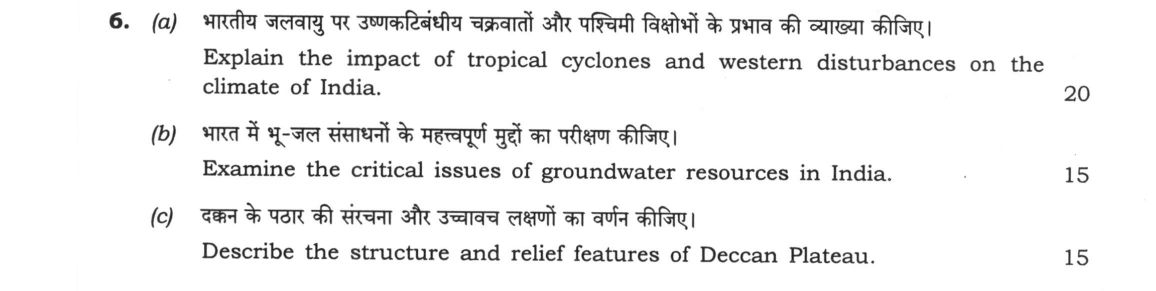
(a) Explain the impact of tropical cyclones and western disturbances on the climate of India. 20 (b) Examine the critical issues…
Explain the impact of tropical cyclones and western disturbances on the climate of India. 20 marks
Examine the critical issues of groundwater resources in India. 15 marks
Describe the structure and relief features of Deccan Plateau. 15 marks
हिंदी में प्रश्न पढ़ें
भारतीय जलवायु पर उष्णकटिबंधीय चक्रवातों और पश्चिमी विच्छोभों के प्रभाव की व्याख्या कीजिए। 20
भारत में भू-जल संसाधनों के महत्त्वपूर्ण मुद्दों का परीक्षण कीजिए। 15
दक्कन के पठार की संरचना और उच्चावच लक्षणों का वर्णन कीजिए। 15
Model answer
Written by UPSC Answer Check against this question's marking rubric, to the expected length. UPSC does not publish answers for Mains — this is one way to score well, not an official key.
India’s climate, water balance and physiography are linked by circulation systems that redistribute heat and moisture, by aquifers that store that moisture, and by the Deccan’s structure that channels runoff.
Tropical cyclones are warm-core systems generated over warm tropical seas, where latent heat release from evaporation lowers central pressure and deepens circulation. In India, most originate in the Bay of Bengal during pre-monsoon and post-monsoon months, while Arabian Sea cyclones are less frequent. On landfall, they dump intense coastal rainfall, produce storm surges and wind damage, especially in Odisha, Andhra Pradesh and Tamil Nadu. Their climatic role is not merely destructive: they release stored oceanic heat, redistribute moisture into the interior, alter short-term temperature and humidity, and can influence the timing of monsoon withdrawal by changing low-level moisture flow. Their timing also matters: pre-monsoon systems can add moisture before Kharif sowing, while post-monsoon systems can delay Rabi field operations. The Bay of Bengal’s shallow, warm waters make its cyclones particularly frequent and damaging.
Western disturbances are mid-latitude troughs in the westerlies, often of Mediterranean origin, which enter northwest India in December–February. Unlike the summer monsoon, which is a convective, ocean-to-land moisture transport, they carry moisture into a cold, dry winter atmosphere. Over Punjab, Haryana and Delhi they cause unseasonal rain and hailstorms. This affects Rabi crops: light rain may benefit wheat, but excessive rain, hail or cold damage can reduce yields. They also moderate winter temperatures and add to the non-monsoon rainfall budget of the north.
Groundwater issues are critical because India’s irrigation and domestic supply rely heavily on wells. Over-extraction in Punjab, Haryana and Rajasthan has created dark zones where water tables fall rapidly, pumping costs rise, and aquifers become vulnerable to salinisation. Contamination is widespread: arsenic is common in parts of the Gangetic plains, while fluoride is more typical of granitic and gneissic terrains, though it can occur locally in Deccan basalts. Access is inequitable: large farmers with borewells and power can extract more, while marginal farmers and rural households face scarcity and poor quality. Policy responses include Atal Bhujal Yojana, which promotes community-led demand management, and NAQUIM, the national aquifer mapping programme, which maps aquifers to guide management. State rainwater harvesting mandates exist, but implementation is uneven, recharge data are patchy, and overuse continues where water is cheap.
Deccan Plateau is a broad basaltic tableland formed mainly by the Deccan Traps, whose major eruptions occurred around 66 Ma in the late Cretaceous to early Paleocene. Repeated lava flows, cooled in thick sheets, were later dissected by rivers and weathered, producing step-like topography through differential erosion. The Western Ghats form a steep escarpment along the west, with horst-graben structural control, while the Eastern Ghats are more discontinuous and denudational. Internally, the plateau can be divided into the Maharashtra, Karnataka and Telangana plateaus. Drainage is dominated by the Godavari, Krishna and Kaveri, which cut through the basalt and carry sediment eastward. The black cotton soil, or regur, developed from weathered basalt, is thick and fertile, supporting cotton, pulses and oilseeds, but its swelling nature makes water management essential.
Together, cyclones and western disturbances show how external circulation systems shape India’s rainfall and crop risk; groundwater stress shows how uneven storage and access undermine that supply; and the Deccan’s structure shows how geology controls runoff, soil and agriculture. Sustainable development therefore requires monsoon-aware planning, aquifer conservation, and land-use suited to plateau geomorphology.
What "Explain" is asking you to do
Make the working of something clear — what sets it off, what follows from what, and what it produces. Explain is the Commission's mechanism word: it dominates the technical papers and the “explain why” stems, where the marks sit in the causal chain and not in the label.
Structure that answers it
State what it is → the initiating condition → the chain of cause, step by step → an instance where it plays out → what the chain produces
Where marks are lost
Describing what something looks like instead of why it works that way. Naming the stages without linking them reads as description too.
How this answer will be evaluated
Approach
Framework: Concept or mechanism > Diagram > Regional example > Application. (a) explain: definition/context > points in order > small example > short close | (b) examine: intro > how/why with reasoning > evidence > conclusion | (c) describe: define > structure or process in order > labelled diagram > significance Full marks: Comprehensive mechanism, precise regional examples, labelled diagrams, and recent data.
Key points expected
- Define tropical cyclones and western disturbances
- Explain formation mechanism of both
- Detail impact on rainfall and temperature
- Identify specific regions affected
- Identify over-exploitation issues
- Explain quality degradation (arsenic/fluoride)
- Link to agricultural practices
- Mention regional disparities
Evaluation rubric
Each sub-part is marked on its own, against the marks and word limit printed on the paper.
- (a) Mechanism and climatic impact of tropical cyclones and western disturbances. 20 marks
explain— definition/context → points in order → small example → short close
Must cover
- Define tropical cyclones and western disturbances
- Explain formation mechanism of both
- Detail impact on rainfall and temperature
- Identify specific regions affected
Loses marks
- Description without mechanism
- Confusing cyclones with western disturbances
- No regional specificity
Earns more
- Mention specific months of occurrence
- Link to monsoon onset/retreat
- Reference specific cyclone names
- Mention impact on agriculture
Extra mark
- Labelled sketch map of cyclone tracks
- Recent disaster data (e.g., Cyclone Fani)
- (b) Critical issues of groundwater resources in India. 15 marks
examine— intro → how/why with reasoning → evidence → conclusion
Must cover
- Identify over-exploitation issues
- Explain quality degradation (arsenic/fluoride)
- Link to agricultural practices
- Mention regional disparities
Loses marks
- Generic description without critical analysis
- Ignoring quality issues
- No regional examples
Earns more
- Reference CGWB data
- Mention specific states (e.g., Punjab, Rajasthan)
- Discuss legal frameworks (Jal Shakti)
- Link to climate change
Extra mark
- Recent census or CGWB report data
- Specific case study of a state
- (c) Structure and relief features of Deccan Plateau. 15 marks
describe— define → structure or process in order → labelled diagram → significance
Must cover
- Define Deccan Plateau structure
- Describe relief features (escarpments, valleys)
- Mention geological composition
- Identify major rivers
Loses marks
- Description without structure
- Ignoring relief features
- No geographical specificity
Earns more
- Reference specific geological formations
- Mention specific rivers (Godavari, Krishna)
- Describe the Western and Eastern Ghats
- Mention specific landforms (Dongars)
Extra mark
- Labelled sketch map of Deccan Plateau
- Specific geological age (Cretaceous)
Practice this exact question
Write your answer and it is marked point by point against the model answer above — what you covered, what you missed, what you got wrong.
Evaluate my answer →More from Geography 2021 Paper II
- Q3 (a) Discuss the importance of solar energy in future economic development of India. 20 (b…
- Q4 (a) Discuss the reserves, distribution and production of all varieties of coal in India.…
- Q5 Answer the following questions in about 150 words each: 10×5=50 (a) Discuss the salient f…
- Q6 (a) Explain the impact of tropical cyclones and western disturbances on the climate of In…
- Q7 (a) Critically examine how Panchayati Raj system is catalyst in decentralized planning in…
- Q8 (a) Examine how information and communication technology has boosted the development of c…