Paper II — Q2
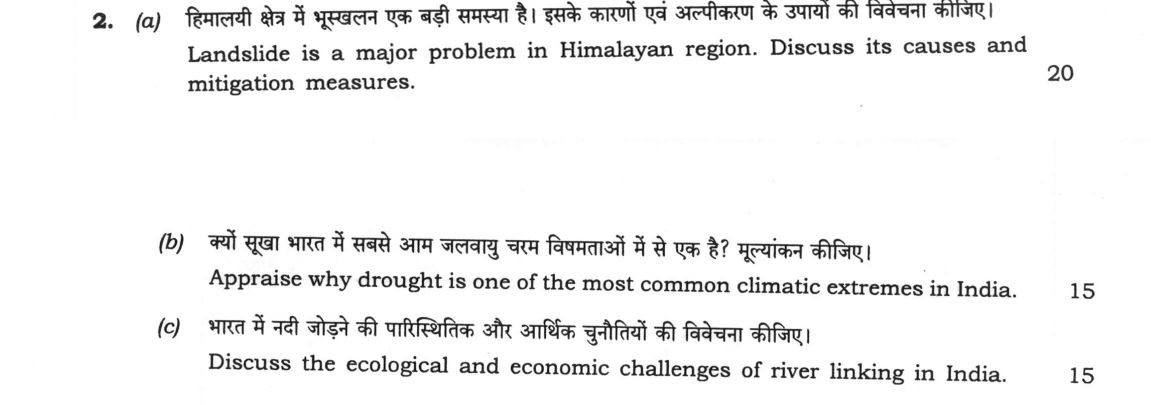
(a) Landslide is a major problem in Himalayan region. Discuss its causes and mitigation measures. 20 (b) Appraise why drought is…
Landslide is a major problem in Himalayan region. Discuss its causes and mitigation measures. 20 marks
Appraise why drought is one of the most common climatic extremes in India. 15 marks
Discuss the ecological and economic challenges of river linking in India. 15 marks
हिंदी में प्रश्न पढ़ें
हिमालयी क्षेत्र में भूस्खलन एक बड़ी समस्या है। इसके कारणों एवं अल्पीकरण के उपायों की विवेचना कीजिए। 20
क्यों सूखा भारत में सबसे आम जलवायु चरम विषमताओं में से एक है? मूल्यांकन कीजिए। 15
भारत में नदी जोड़ने की पारिस्थितिक और आर्थिक चुनौतियों की विवेचना कीजिए। 15
Model answer
Written by UPSC Answer Check against this question's marking rubric, to the expected length. UPSC does not publish answers for Mains — this is one way to score well, not an official key.
India’s complex physiographic and hydro-climatic architecture exposes distinct geomorphic zones to differentiated disasters, ranging from mass wasting in the young fold mountains of the north to pervasive water stress across peninsular drylands.
Landslides in the Himalayan Region: Causes and Mitigation
The Himalayan arc is inherently prone to mass movements due to ongoing Indo-Eurasian tectonic convergence, high seismicity, fragile lithology of thrust zones (such as the Main Central Thrust), and extreme slope gradients with high relief energy. Intense monsoon downpours and glacial melt rapidly elevate pore-water pressure along shear planes, triggering slope failures.
These natural vulnerabilities are magnified by anthropogenic pressures. Unscientific road-widening, unmitigated blasting, slope toe-cutting for infrastructure, unregulated tourism, and deforestation remove stabilizing vegetative cover and disrupt the natural angle of repose.
Mitigation necessitates an integrated framework aligned with National Disaster Management Authority (NDMA) guidelines, balancing structural and non-structural interventions:
- Structural Measures: Slope stabilization using rock bolting, hydro-seeding, retaining walls, and wire-mesh geo-textiles. Dewatering through surface and sub-surface drainage network correction is critical to prevent pore-pressure buildup.
- Non-Structural Measures: Bio-engineering via deep-root species (such as vetiver grass), Landslide Hazard Zonation (LHZ) to regulate slope-loading, radar- and rain-gauge-coupled Early Warning Systems (EWS), and strict enforcement of Himalayan hill-building bylaws.
Drought as a Climatic Extreme in India
Drought is India’s most frequent climatic extreme due to an acute dependence on the South-West Monsoon, which delivers over 75% of annual precipitation within four months. This system is subject to spatial-temporal unpredictability and atmospheric anomalies, particularly the El Niño-Southern Oscillation (ENSO) and negative Indian Ocean Dipole phases. Regions in Northwest India and the Peninsular rain-shadow (Rayalaseema, Marathwada) face chronic vulnerability, with the rainfall coefficient of variation exceeding 30 to 40%.
This meteorological exposure translates rapidly into hydrological and agricultural distress because nearly 50% of India’s net sown area remains rainfed and devoid of assured irrigation. Decades of water-intensive cropping (like paddy and sugarcane) have led to severe groundwater overdraft, exhausting unconfined aquifers. The socio-economic vulnerability of small and marginal farmers amplifies drought impacts into rural livelihood shocks. Mitigating this risk requires bridging structural deficits through decentralized water harvesting under MGNREGA, promoting climate-resilient micro-irrigation, and scaling solarized agricultural pumping through PM-KUSUM to optimize groundwater extraction.
Ecological and Economic Challenges of River Linking
The National River Linking Project (NRLP) seeks to correct spatial water imbalances by inter-basin transfers, but it faces profound ecological and economic trade-offs:
Ecological Challenges: Inter-basin diversions disrupt natural fluvial regimes, reduce downstream freshwater discharge, and impede sediment transport, accelerating deltaic degradation and coastal erosion in the Godavari, Krishna, and Mahanadi mouths. Reservoir inundation leads to severe forest fragmentation and biodiversity loss. For instance, the Ken-Betwa Link Project (KBLP) submerges substantial core habitat within the Panna Tiger Reserve. Inter-basin water transfers also alter water chemistry, temperature, and estuarine salinity, threatening endemic aquatic fauna.
Economic Challenges: Mega-diversions require massive capital investments that risk cost overruns and locked fiscal resources. Projects carry heavy Resettlement and Rehabilitation (R&R) costs alongside socio-environmental compensations. Riparian conflicts over surplus-versus-deficit basin classifications exacerbate inter-state federal disputes under Article 262. Furthermore, the massive recurring energy costs required for lift hydraulics challenge long-term benefit-cost viability when compared to decentralized watershed conservation.
A forward-looking policy must balance macro-engineering with localized ecological realities. Enhancing disaster resilience requires shifting from reactive structural fixes toward integrated river basin management (IWRM), nature-based slope stabilization, and decentralized micro-watershed development to ensure long-term ecological and water security.
What "Discuss" is asking you to do
Lay the issue out from more than one side — how it arose, what is claimed for it, what is held against it, and where it now stands. UPSC attaches discuss to broad topics with several live dimensions, so coverage of the dimensions earns more than the strength of your opinion.
Structure that answers it
Set the issue up → the case as it is made → the case against → the dimension both sides leave out → where the balance now lies
Where marks are lost
Listing facts with no thread between them, or arguing one side throughout and calling it a discussion.
How this answer will be evaluated
Approach
Framework: Concept or mechanism > Diagram > Regional example > Application. (a) discuss: intro > 3-4 dimensions > example > balanced close | (b) evaluate: criteria > evidence > balanced judgment | (c) challenges: 3-4 challenges > solutions mapped to them > conclusion Full marks: Precise mechanism, specific Indian examples, and clear diagrams.
Key points expected
- Geological causes: tectonic activity, young fold mountains, loose debris
- Climatic causes: monsoon intensity, glacial melt, freeze-thaw cycles
- Anthropogenic causes: road cutting, deforestation, blasting
- Mitigation: bio-engineering, retaining walls, slope stabilization, planning
- Monsoon variability: failure of SW monsoon or delayed onset
- Spatial distribution: uneven rainfall across regions
- Temporal distribution: inter-annual and intra-seasonal fluctuations
- Regional susceptibility: arid zones (Rajasthan) vs. monsoon-dependent zones
Evaluation rubric
Each sub-part is marked on its own, against the marks and word limit printed on the paper.
- (a) Causal chain of Himalayan landslides and specific mitigation measures. 20 marks
discuss— intro → 3-4 dimensions → example → balanced close
Must cover
- Geological causes: tectonic activity, young fold mountains, loose debris
- Climatic causes: monsoon intensity, glacial melt, freeze-thaw cycles
- Anthropogenic causes: road cutting, deforestation, blasting
- Mitigation: bio-engineering, retaining walls, slope stabilization, planning
Loses marks
- Generic 'natural causes' without Himalayan specifics
- Mitigation measures that are purely administrative, not technical
Earns more
- Specific examples: Uttarakhand 2013, Chamoli 2021, or Sikkim
- Distinction between rockfall, debris flow, and mudslide
- Role of GSI or NDRF in monitoring
Extra mark
- Labelled sketch of a typical Himalayan slope failure
- Reference to specific mitigation projects (e.g., in NH-1)
- (b) Evaluation of why drought is a recurring climatic extreme in India. 15 marks
evaluate— criteria → evidence → balanced judgment
Must cover
- Monsoon variability: failure of SW monsoon or delayed onset
- Spatial distribution: uneven rainfall across regions
- Temporal distribution: inter-annual and intra-seasonal fluctuations
- Regional susceptibility: arid zones (Rajasthan) vs. monsoon-dependent zones
Loses marks
- Confusing drought with famine (economic vs climatic)
- Ignoring the role of the monsoon mechanism
Earns more
- Mention of El Niño / La Niña influence
- Distinction between meteorological and agricultural drought
- Reference to IMD drought monitoring
Extra mark
- Map showing drought-prone zones in India
- Specific data on rainfall deficit in a recent year
- (c) Ecological and economic obstacles to the National River Linking Project. 15 marks
challenges— 3-4 challenges → solutions mapped to them → conclusion
Must cover
- Ecological: disruption of riverine ecosystems, loss of biodiversity
- Ecological: impact on wetlands and groundwater recharge
- Economic: massive cost of canals and pumping stations
- Economic: displacement of populations and land acquisition issues
Loses marks
- Treating it as a purely engineering problem
- Ignoring the downstream impact on deltaic regions
Earns more
- Specific examples: Peninsular vs Himalayan component
- Mention of environmental clearance delays
- Reference to specific rivers (e.g., Godavari, Krishna)
Extra mark
- Diagram of the proposed river linking network
- Reference to specific environmental impact assessment reports
Practice this exact question
Write your answer and it is marked point by point against the model answer above — what you covered, what you missed, what you got wrong.
Evaluate my answer →More from Geography 2021 Paper II
- Q1 (a) On the outline map of India provided to you, mark the location of all the following.…
- Q2 (a) Landslide is a major problem in Himalayan region. Discuss its causes and mitigation m…
- Q3 (a) Discuss the importance of solar energy in future economic development of India. 20 (b…
- Q4 (a) Discuss the reserves, distribution and production of all varieties of coal in India.…
- Q5 Answer the following questions in about 150 words each: 10×5=50 (a) Discuss the salient f…