Paper II — Q3
(a) Discuss the importance of solar energy in future economic development of India. 20 (b) Critically examine the importance of…
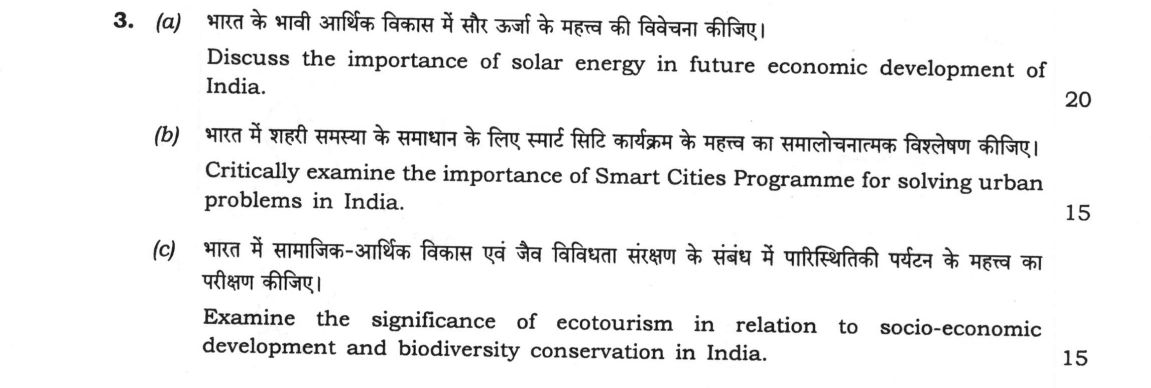
Discuss the importance of solar energy in future economic development of India. 20 marks
Critically examine the importance of Smart Cities Programme for solving urban problems in India. 15 marks
Examine the significance of ecotourism in relation to socio-economic development and biodiversity conservation in India. 15 marks
हिंदी में प्रश्न पढ़ें
भारत के भावी आर्थिक विकास में सौर ऊर्जा के महत्व की विवेचना कीजिए। 20
भारत में शहरी समस्या के समाधान के लिए स्मार्ट सिटी कार्यक्रम के महत्व का समालोचनात्मक विश्लेषण कीजिए। 15
भारत में सामाजिक-आर्थिक विकास एवं जैव विविधता संरक्षण के संबंध में पारिस्थितिकी पर्यटन के महत्व का परीक्षण कीजिए। 15
Model answer
Written by UPSC Answer Check against this question's marking rubric, to the expected length. UPSC does not publish answers for Mains — this is one way to score well, not an official key.
India’s transition toward sustainable regional development hinges on a synergistic triad: clean energy transitions, resilient urban spaces, and ecological conservation. Solar power, the Smart Cities Mission, and ecotourism collectively drive economic decarbonization, spatial equity, and ecological resilience.
Solar Energy and Future Economic Development
Solar energy constitutes the cornerstone of India’s decarbonization pathway and long-term energy security, vital for achieving the 500 GW non-fossil capacity target and expanding the National Solar Mission. The plummeting Levelised Cost of Electricity (LCOE) and the deployment of solar-wind hybrid systems bolster industrial competitiveness by providing affordable, low-emission power. Beyond macro-energy stability, solar energy acts as a powerful economic multiplier. Under the Production Linked Incentive (PLI) scheme for high-efficiency solar PV modules, domestic manufacturing and MSME supply chains have expanded, generating localized green jobs. In the external sector, scaling solar capacity directly displaces thermal power demand, reducing the foreign exchange burden of fossil fuel imports. At the agrarian scale, solar energy transforms rural livelihoods; initiatives like the PM-KUSUM scheme allow farmers to replace diesel irrigation with solar pumps and generate supplemental income by feeding surplus power from decentralized grids back to the utility, fostering rural electrification and income stability.
Smart Cities Mission and Urban Problem-Solving
The Smart Cities Mission (SCM) provides modern, technology-driven solutions to chronic urban challenges. SCM has improved urban administration through Integrated Command and Control Centres (ICCCs), optimized public transit systems such as the Ahmedabad BRTS and multi-modal mobility hubs, and improved municipal service delivery via automated SCADA water management.
However, a critical examination shows that SCM struggles to solve deep-seated structural urban problems. The Area Based Development (ABD) approach has concentrated substantial financial resources into small, already affluent pockets, effectively creating enclaves of privilege while bypassing contiguous informal settlements and peri-urban fringes. Institutional reliance on Special Purpose Vehicles (SPVs) has frequently sidelined elected Urban Local Bodies, straining municipal capacity and creating funding bottlenecks. Crucially, digital-first interventions fail to structurally eliminate core urban challenges such as socio-economic inequality, urban unemployment, and acute climate vulnerabilities, including urban heat islands and waterlogging.
Ecotourism, Socio-Economic Development, and Conservation
Ecotourism offers a non-extractive development paradigm that reconciles economic growth with environmental sustainability in ecologically fragile regions. Socio-economically, it fosters community-based tourism, generating alternative livelihoods in eco-guiding, hospitality, and handicraft production for forest-dependent communities. This decentralized economic activity spurs basic infrastructure development, including road access and sanitation, in historically marginalized, remote geographies.
From a biodiversity conservation standpoint, ecotourism generates self-sustaining revenues that fund protected area management and habitat restoration. By conferring tangible financial value on living ecosystems, it aligns community interests with conservation, mitigating anthropogenic pressures like illegal grazing, logging, and poaching. The successful involvement of local tribal groups in the Periyar Tiger Reserve and participatory ecotourism frameworks in the Great Himalayan National Park demonstrate how local communities transform into active conservation stewards when economic incentives are institutionalized.
Way Forward
To harness these sectors sustainably, India must integrate solar-powered municipal infrastructure within smart city frameworks while expanding smart mobility to connect peripheral ecotourism circuits. Aligning decentralized renewable energy, inclusive urban spatial planning, and community-led conservation provides a balanced roadmap to advance the targets of SDG 7 (Affordable and Clean Energy), SDG 11 (Sustainable Cities), and SDG 15 (Life on Land).
What "Discuss" is asking you to do
Lay the issue out from more than one side — how it arose, what is claimed for it, what is held against it, and where it now stands. UPSC attaches discuss to broad topics with several live dimensions, so coverage of the dimensions earns more than the strength of your opinion.
Structure that answers it
Set the issue up → the case as it is made → the case against → the dimension both sides leave out → where the balance now lies
Where marks are lost
Listing facts with no thread between them, or arguing one side throughout and calling it a discussion.
How this answer will be evaluated
Approach
Framework: Concept > Diagram > Regional Example > Application. (a) discuss: intro > 3-4 dimensions > example > balanced close | (b) critically evaluate: positives > negatives/limits > conditions/safeguards > conclusion | (c) examine: intro > how/why with reasoning > evidence > conclusion Full marks: Precise mechanism, labelled diagram, specific Indian examples, balanced critical analysis
Key points expected
- Energy security and import substitution
- Rural electrification and agricultural productivity
- Job creation in manufacturing and installation
- Reduction of carbon footprint
- Sustainable urban development (SUD) focus
- Citizen-centric approach and governance
- Limitations: top-down planning or funding
- Impact on specific urban problems (water, waste)
Evaluation rubric
Each sub-part is marked on its own, against the marks and word limit printed on the paper.
- (a) Intro > 3-4 dimensions > example > balanced close 20 marks
discuss— intro → 3-4 dimensions → example → balanced close
Must cover
- Energy security and import substitution
- Rural electrification and agricultural productivity
- Job creation in manufacturing and installation
- Reduction of carbon footprint
Loses marks
- Generic description without economic link
- Ignoring the 'future' aspect of development
- No diagram or map
Earns more
- Mention of National Solar Mission (JNNLM)
- Reference to specific states (Rajasthan, Gujarat)
- Link to industrial competitiveness
- Mention of net-zero targets
Extra mark
- Labelled sketch map of solar parks
- Recent capacity addition data
- (b) Positives > negatives/limits > conditions/safeguards > conclusion 15 marks
critically evaluate— positives → negatives/limits → conditions/safeguards → conclusion
Must cover
- Sustainable urban development (SUD) focus
- Citizen-centric approach and governance
- Limitations: top-down planning or funding
- Impact on specific urban problems (water, waste)
Loses marks
- Only listing features without critical analysis
- Ignoring the 'urban problems' aspect
- No mention of limitations or challenges
Earns more
- Mention of specific cities (Pune, Bhopal)
- Reference to Smart City Mission guidelines
- Discussion on digital infrastructure
- Comparison with traditional planning
Extra mark
- Diagram of smart city components
- Specific statistic on fund utilization
- (c) Intro > how/why with reasoning > evidence > conclusion 15 marks
examine— intro → how/why with reasoning → evidence → conclusion
Must cover
- Link to socio-economic development (jobs, income)
- Link to biodiversity conservation (protection)
- Community participation and local benefits
- Sustainable tourism model
Loses marks
- Confusing ecotourism with mass tourism
- Ignoring the biodiversity conservation aspect
- No specific Indian examples
Earns more
- Mention of specific ecotourism sites (Kerala, Andaman)
- Reference to wildlife sanctuaries
- Discussion on carrying capacity
- Mention of specific species or ecosystems
Extra mark
- Map of ecotourism hotspots
- Specific data on tourist numbers
Practice this exact question
Write your answer and it is marked point by point against the model answer above — what you covered, what you missed, what you got wrong.
Evaluate my answer →More from Geography 2021 Paper II
- Q1 (a) On the outline map of India provided to you, mark the location of all the following.…
- Q2 (a) Landslide is a major problem in Himalayan region. Discuss its causes and mitigation m…
- Q3 (a) Discuss the importance of solar energy in future economic development of India. 20 (b…
- Q4 (a) Discuss the reserves, distribution and production of all varieties of coal in India.…
- Q5 Answer the following questions in about 150 words each: 10×5=50 (a) Discuss the salient f…
- Q6 (a) Explain the impact of tropical cyclones and western disturbances on the climate of In…