Paper I — Q1
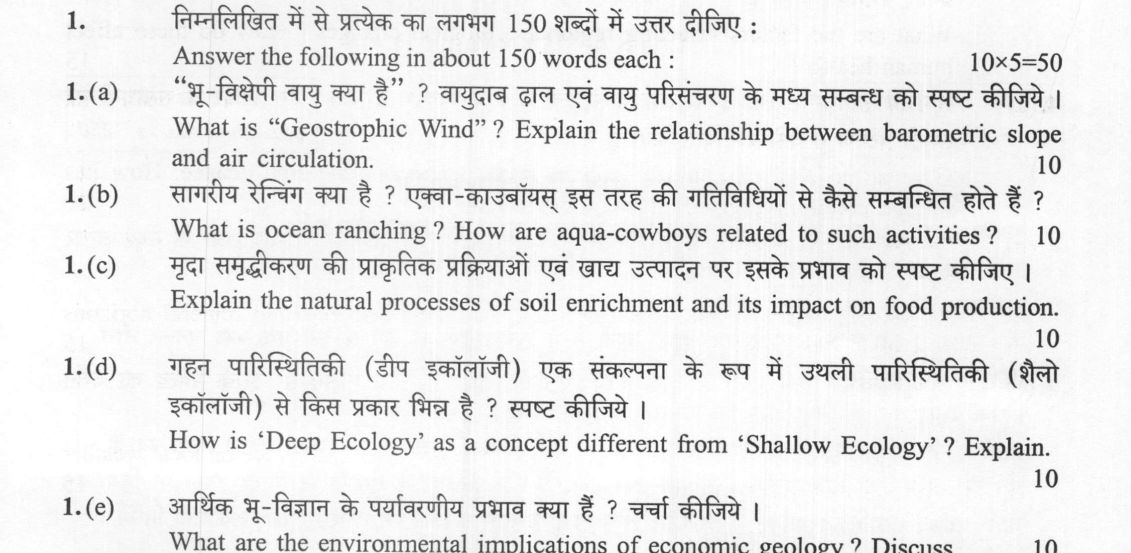
Answer the following in about 150 words each: (a) What is "Geostrophic Wind"? Explain the relationship between barometric slope…
Answer the following in about 150 words each: What is "Geostrophic Wind"? Explain the relationship between barometric slope and air circulation. 10 marks
What is ocean ranching? How are aqua-cowboys related to such activities? 10 marks
Explain the natural processes of soil enrichment and its impact on food production. 10 marks
How is 'Deep Ecology' as a concept different from 'Shallow Ecology'? Explain. 10 marks
What are the environmental implications of economic geology? Discuss. 10 marks
हिंदी में प्रश्न पढ़ें
निम्नलिखित में से प्रत्येक का लगभग 150 शब्दों में उत्तर दीजिए : "भू-विषुवती वायु क्या है" ? वायुदाब ढाल एवं वायु परिसंचरण के मध्य सम्बन्ध को स्पष्ट कीजिये । (10 अंक)
सागरीय रैन्चिंग क्या है ? एक्वा-काउबॉयस इस तरह की गतिविधियों से कैसे सम्बन्धित होते हैं ? (10 अंक)
मृदा समृद्धीकरण की प्राकृतिक प्रक्रियाओं एवं खाद्य उत्पादन पर इसके प्रभाव को स्पष्ट कीजिए । (10 अंक)
गहन पारिस्थितिकी (डीप इकोलॉजी) एक संकल्पना के रूप में उथली पारिस्थितिकी (शैलो इकोलॉजी) से किस प्रकार भिन्न है ? स्पष्ट कीजिये । (10 अंक)
आर्थिक भू-विज्ञान के पर्यावरणीय प्रभाव क्या हैं ? चर्चा कीजिये । (10 अंक)
Model answer
Written by UPSC Answer Check against this question's marking rubric, to the 150-word length. UPSC does not publish answers for Mains — this is one way to score well, not an official key.
(a) Geostrophic Wind and Barometric Slope
A geostrophic wind is a theoretical, upper-tropospheric wind that flows parallel to straight isobars, resulting from an exact equilibrium between the horizontal Pressure Gradient Force (PGF) and the Coriolis force in the absence of surface friction.
The barometric slope represents the steepness of atmospheric pressure change over a horizontal distance, visually depicted by isobaric spacing. When the barometric slope is steep (closely spaced isobars), the pressure gradient force intensifies, accelerating air parcels rapidly from high-pressure zones toward low-pressure troughs.
As air velocity increases, the Coriolis force—which is directly proportional to wind speed—deflects the moving air progressively (to the right in the Northern Hemisphere and to the left in the Southern Hemisphere). When the wind speed reaches a critical threshold where the deflecting Coriolis force matches the pressure gradient force in magnitude but acts in the exact opposite direction, the net acceleration becomes zero. Consequently, the circulation ceases to cross isobars and flows parallel to them, forming stable upper-level circulations such as mid-latitude westerlies and jet streams.
(b) Ocean Ranching and Aqua-Cowboys
Ocean ranching is an open-water aquaculture practice wherein commercially valuable juvenile marine species (such as salmon, trout, or prawns) are artificially hatched and reared in controlled environments, released into the open sea to grow by foraging on natural marine food webs, and subsequently harvested upon their return to natal waters or specific feeding grounds.
The term "aqua-cowboys" refers to marine entrepreneurs and commercial operators who manage, track, and harvest these free-ranging marine stocks across pelagic zones, often extending into international waters beyond Exclusive Economic Zones (EEZs). Analogous to terrestrial cowboys herding cattle on open rangelands, aqua-cowboys utilize satellite telemetry, acoustic homing signals, and thermal tracking to monitor fish schools without asserting private territorial ownership over the ocean expanse.
In India, selective sea-ranching of green tiger shrimp by the Central Marine Fisheries Research Institute (CMFRI) in the Palk Bay exemplifies how this practice enhances wild capture fisheries and livelihoods while avoiding the high coastal pollution and feed costs associated with conventional, confined cage aquaculture.
(c) Natural Processes of Soil Enrichment and Food Production
Soil enrichment is driven by pedogenic processes: primary mineral weathering, biological nitrogen fixation, organic matter humification, and alluvial sedimentation.
Weathering breaks down parent rock to liberate essential cations (Ca²⁺, Mg²⁺, K⁺). Nitrogen-fixing bacteria, such as symbiotic Rhizobium in leguminous root nodules and free-living Azotobacter, convert atmospheric N₂ into plant-available nitrates. Concurrently, detritivores and soil microbes decompose plant litter into recalcitrant humus, enhancing cation-exchange capacity, moisture retention, and soil aeration. Furthermore, periodic river flooding deposits fresh mineral-rich silt (khadar) across riparian plains.
These mechanisms sustain primary agricultural productivity by replenishing depleted macronutrients and micronutrients without structural soil degradation. In the Indo-Gangetic and Brahmaputra floodplains, natural alluvial rejuvenation maintains baseline fertility, enabling continuous multi-cropping systems (such as the rice-wheat rotation) that underpin regional food security and agricultural resilience.
(d) Deep Ecology versus Shallow Ecology
Shallow ecology and deep ecology represent two contrasting environmental paradigms, originally differentiated by Norwegian philosopher Arne Næss in 1973.
Shallow ecology is an anthropocentric, utilitarian approach to conservation. It views nature as a resource reservoir for human benefit, prioritizing technological fixes, pollution abatement, and resource efficiency primarily to protect human health, economic growth, and modern living standards. It manages environmental crises within existing capitalist and industrial consumption models without altering human-nature hierarchies.
Deep ecology is an ecocentric, non-anthropocentric philosophy that accords intrinsic value to all living beings, regardless of their instrumental utility to human needs. It argues that human interference with the non-human world is excessive and worsening. Consequently, deep ecology advocates for fundamental structural overhauls, including voluntary human population reduction, biospheric egalitarianism, the preservation of wilderness, and an ideological shift from pursuing material affluence to adopting voluntary simplicity ("living lightly on Earth").
(e) Environmental Implications of Economic Geology
Economic geology focuses on exploring and extracting commercially viable minerals, ores, fossil fuels, and aggregates. While it provides the raw material foundation for industrialization, its operations impose severe environmental externalities across the lithosphere, hydrosphere, and atmosphere.
Open-cast and underground mining cause extensive land degradation, topsoil loss, and deforestation, disrupting local geomorphic stability and biodiversity. Acid Mine Drainage (AMD)—caused when exposed sulfide minerals like pyrite oxidize upon contact with water and air—generates highly acidic runoff that leaches toxic heavy metals into nearby drainage basins. In India, this is evident in the acid pollution across the Damodar River basin from coal mining and chromium contamination in Odisha’s Sukinda valley. Furthermore, mineral smelting discharges hazardous sulfur dioxide (SO₂) and particulate emissions.
Mitigating these ecological footprints requires integrating economic geology with comprehensive Environmental Impact Assessments (EIA), zero-discharge tailing management, and progressive post-mining landscape restoration under frameworks such as the Star Rating System for sustainable mining.
What "Explain" is asking you to do
Make the working of something clear — what sets it off, what follows from what, and what it produces. Explain is the Commission's mechanism word: it dominates the technical papers and the “explain why” stems, where the marks sit in the causal chain and not in the label.
Structure that answers it
State what it is → the initiating condition → the chain of cause, step by step → an instance where it plays out → what the chain produces
Where marks are lost
Describing what something looks like instead of why it works that way. Naming the stages without linking them reads as description too.
How this answer will be evaluated
Approach
Framework: Concept > Mechanism > Diagram > Example. (a) explain: definition/context > points in order > small example > short close | (b) explain: definition/context > points in order > small example > short close | (c) explain: definition/context > points in order > small example > short close | (d) compare: paired headings or table > key differences > significance > conclusion | (e) discuss: intro > 3-4 dimensions > example > balanced close Full marks: Clear definitions, accurate mechanisms, relevant diagrams, specific examples, and strong linkages.
Key points expected
- Define geostrophic wind (pressure gradient = Coriolis force)
- Explain barometric slope (pressure gradient force)
- Describe relationship between slope and wind speed
- Include diagram of isobars and wind direction
- Define ocean ranching (aquaculture in open sea)
- Explain aqua-cowboys (fish farmers/herders)
- Describe activities (seeding, protecting, harvesting)
- Link to sustainable food production
Evaluation rubric
Each sub-part is marked on its own, against the marks and word limit printed on the paper.
- (a) Define geostrophic wind and link barometric slope to air circulation. 10 marks · 150 words
explain— definition/context → points in order → small example → short close
Must cover
- Define geostrophic wind (pressure gradient = Coriolis force)
- Explain barometric slope (pressure gradient force)
- Describe relationship between slope and wind speed
- Include diagram of isobars and wind direction
Loses marks
- Confusing geostrophic with gradient wind
- No diagram or mechanism explanation
Earns more
- Mention Coriolis effect direction (N/S hemisphere)
- Reference to isobars and pressure systems
Extra mark
- Labelled sketch of geostrophic balance
- Mention of specific pressure systems (e.g., ITCZ)
- (b) Define ocean ranching and explain the role of aqua-cowboys. 10 marks · 150 words
explain— definition/context → points in order → small example → short close
Must cover
- Define ocean ranching (aquaculture in open sea)
- Explain aqua-cowboys (fish farmers/herders)
- Describe activities (seeding, protecting, harvesting)
- Link to sustainable food production
Loses marks
- Confusing with terrestrial ranching
- No link to aqua-cowboys
Earns more
- Mention specific species (e.g., salmon, tuna)
- Reference to coastal regions (e.g., Norway, Japan)
Extra mark
- Diagram of ocean ranching setup
- Mention of specific aqua-cowboy techniques
- (c) Explain natural soil enrichment processes and their impact on food production. 10 marks · 150 words
explain— definition/context → points in order → small example → short close
Must cover
- Define soil enrichment (nutrient addition)
- List natural processes (weathering, organic matter, leaching)
- Explain impact on soil fertility
- Link to food production (crop yield)
Loses marks
- Confusing with artificial fertilization
- No link to food production
Earns more
- Mention specific nutrients (N, P, K)
- Reference to soil types (e.g., alluvial, black soil)
Extra mark
- Diagram of soil profile and enrichment
- Mention of specific crops (e.g., rice, wheat)
- (d) Differentiate Deep Ecology from Shallow Ecology. 10 marks · 150 words
compare— paired headings or table → key differences → significance → conclusion
Must cover
- Define Deep Ecology (intrinsic value of nature)
- Define Shallow Ecology (anthropocentric)
- Compare key differences (goals, methods, scope)
- Mention Arne Naess (Deep Ecology founder)
Loses marks
- Confusing with other ecological concepts
- No clear differentiation
Earns more
- Reference to specific principles (e.g., biocentric equality)
- Mention of environmental movements
Extra mark
- Table comparing Deep and Shallow Ecology
- Mention of specific environmental issues
- (e) Discuss environmental implications of economic geology. 10 marks · 150 words
discuss— intro → 3-4 dimensions → example → balanced close
Must cover
- Define economic geology (study of mineral resources)
- Explain environmental impacts (mining, pollution)
- Discuss resource depletion and sustainability
- Link to economic development
Loses marks
- Confusing with general geology
- No link to environmental implications
Earns more
- Mention specific minerals (e.g., coal, iron ore)
- Reference to mining regions (e.g., Jharia, Bellary)
Extra mark
- Diagram of mining impact
- Mention of specific environmental disasters
Practice this exact question
Write your answer and it is marked point by point against the model answer above — what you covered, what you missed, what you got wrong.
Evaluate my answer →More from Geography 2023 Paper I
- Q1 Answer the following in about 150 words each: (a) What is "Geostrophic Wind"? Explain the…
- Q2 (a) "Evidences from palaeomagnetism and sea floor spreading have validated that continent…
- Q3 (a) What are the causes of origin of local winds? Discuss their significance on prevailin…
- Q4 (a) Give an account of marine resources and their economic significance. How has marine p…